

Kaiser Permanente Faces Historic Strike Amid HMO Model Under Scrutiny
Over the past few months, Kaiser Permanente, one of the largest healthcare providers in the United States, has experienced the most significant operational turmoil in its history.
On October 14, a major strike that had been brewing for months and lasted for three days came to a temporary end. As part of the resolution, Kaiser Permanente and the coalition of unions reached a tentative agreement, committing to more aggressively address staff shortages while increasing employee wages and benefits. Specifically, Kaiser Permanente announced that it would raise the minimum hourly wage for employees in California to $25 by 2026, and to $23 per hour in other states. This represents a significant increase over the company’s initial offer of a 12%–14% pay raise. Additionally, Kaiser Permanente proposed a minimum bonus and potential bonuses of up to $3,750, and put forward recommendations on employee benefits including healthcare coverage, retirement income plans, tuition assistance, training programs, and education trust funds.
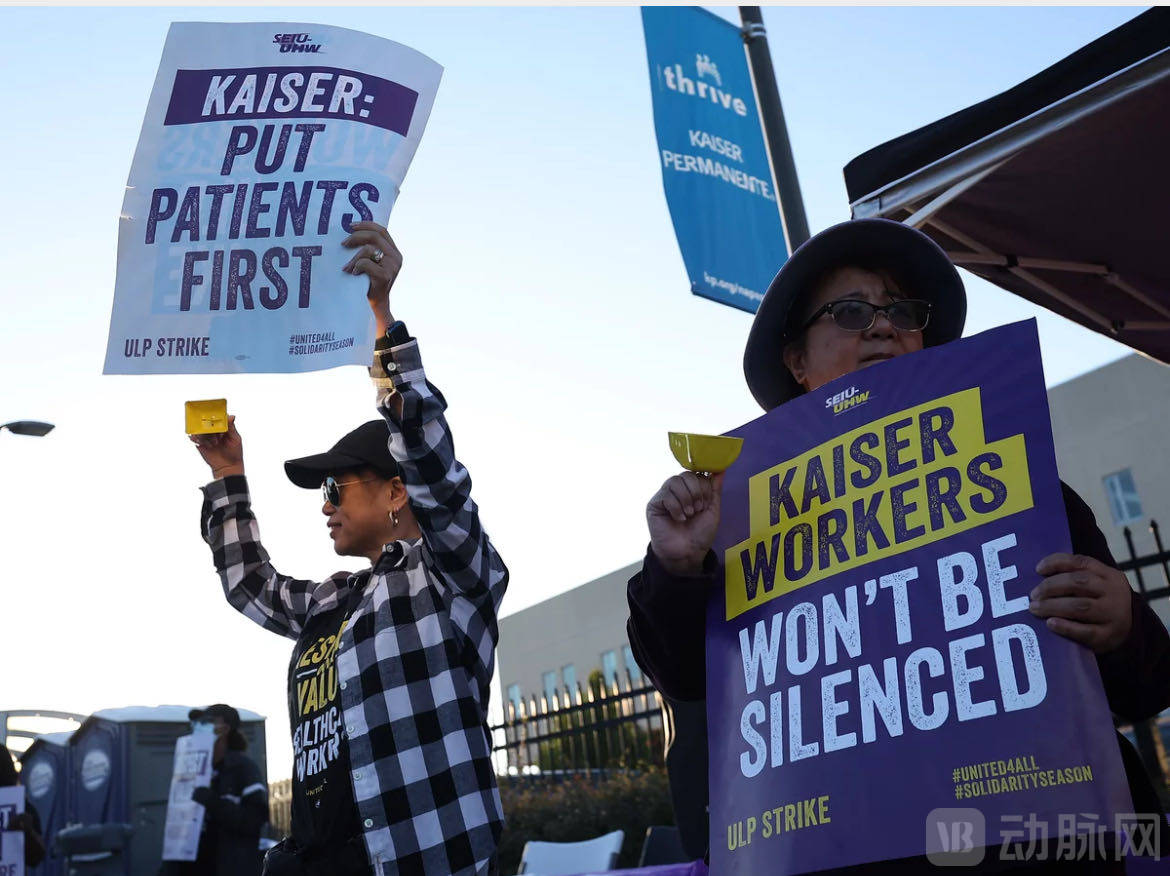
October 2023, Kaiser Permanente employees on strike. Image source: NPR
Of course, this agreement is still subject to approval by a collective vote of Kaiser Permanente employees. If the majority of employees do not endorse these adjustments, they will go on strike again in mid-November.
This is the largest healthcare labor dispute in modern U.S. history. Nearly 80,000 employees of Kaiser Permanente participated in the strike, with nurses, laboratory technicians, pharmacists, and therapists from hospitals and clinics across California, Colorado, and Washington, D.C., walking off the job to protest on the streets. “Kaiser Permanente has grown alongside me over the years; I cannot imagine my life without this organization,” said a pharmacist who has worked at Kaiser for more than two decades, expressing that the increasing workload since the onset of the COVID-19 pandemic had left her physically and emotionally exhausted. Employees are demanding that Kaiser Permanente promptly increase staffing levels and raise the minimum hourly wage to $25.
The persistent labor shortage, left unaddressed, served as the trigger for the recent large-scale strike by Kaiser Permanente employees. However, for a capital-intensive healthcare organization like Kaiser Permanente, the labor gap did not emerge overnight, and resolving it will require far more than a mere signed agreement.
Kaiser Permanente’s operational system is vast, comprising three interdependent yet independently operated entities: the Kaiser Foundation Health Plan (KFHP), Kaiser Foundation Hospitals (KFH), and The Permanente Medical Groups. The hallmark of this business model lies in its integration of healthcare financing and medical service delivery, offering comprehensive health coverage products to the external market. Users can select from various types of health coverage plans, thereby gaining access to Kaiser Permanente’s service ecosystem, which provides end-to-end care throughout the coverage period—from disease prevention and diagnosis to treatment and medication management. Under this prepaid system, Kaiser Permanente functions simultaneously as a health insurer, a healthcare provider, and a physician group, resulting in highly complex business processes and an intricately intertwined professional team structure.
Currently, Kaiser Permanente is one of the largest healthcare groups in the United States, operating in eight states—Washington, Oregon, California, Hawaii, Colorado, Georgia, Virginia, and Maryland—as well as the District of Columbia, serving nearly 13 million patients nationwide.
Of course, Kaiser Permanente’s position in the global healthcare services sector is not defined solely by its business scale. As a pioneer of managed care worldwide, it serves as a model for numerous healthcare providers, and any changes to its operations attract significant attention. Today, this trailblazer also finds itself mired in difficulties.
In the 1930s, Kaiser Permanente originated from a small hospital in the California desert. Its founder, Henry Kaiser, collaborated with local construction firms to establish an insurance association named “Industrial Indemnity,” under which Dr. Sidney Garfield provided medical services to 5,000 construction workers building the Colorado River Aqueduct. The Industrial Indemnity Insurance Association prepaid physicians either 17.5% of premiums or a fixed fee of $1.50 per worker per month. Workers received medical care for work-related injuries directly, while non-occupational medical services were available for an additional fee.
In its early years, Kaiser Permanente experienced rapid growth. Around the 1940s, the Kaiser Permanente model expanded beyond California and was implemented in more regions across the United States. At that time, most Americans faced financial constraints and could not afford high medical costs; Kaiser Permanente provided them with a cost-effective solution. During World War II, Kaiser Permanente’s health plans covered workers at Kaiser shipyards in California and Washington State, offering timely medical coverage to many low-income individuals. After the war, Kaiser Permanente accelerated its expansion, opening its services to the general public in multiple states—including California, Oregon, and Washington—and allowing other employers to purchase services through group prepaid arrangements.
However, Kaiser Permanente’s rapid expansion was short-lived. By adopting an asset-heavy model involving the construction of its own hospitals or entering into contracts with them, Kaiser Permanente requires a substantial member base to support its operations, resulting in high marginal costs for expansion. In fact, although Kaiser Permanente has extended its operational footprint to eight U.S. states, more than 70% of its business remains concentrated in California under this exclusive, asset-heavy operating model.
The dispute in early October was actually foreshadowed as early as April. A coalition of 12 unions has been negotiating with Kaiser Permanente, seeking to address key issues such as pay raises and job protection in the new contract.
According to Lucas, Executive Director of the coalition of unions leading the strike, Kaiser Permanente experienced a mass exodus of healthcare workers during the nationwide surge of the COVID-19 pandemic, resulting in severe staffing shortages. After the pandemic subsided, a backlog of patients who had delayed care flooded the system, causing a sharp increase in demand for routine services and overwhelming Kaiser’s staff. Data show that in April 2023, approximately 11% of unionized positions across the entire Kaiser Permanente system were vacant. Current employees have had to extend their working hours to maintain basic medical services, with some working up to 60 hours per week. “There is no doubt that new hires are needed to fill these vacancies,” Lucas pointed out.
This severe labor shortage has not only undermined employee benefits but also deteriorated the quality of care that Kaiser Permanente provides to its patients.
An optometrist at the Kaiser Permanente Medical Center in Capitol Heights, Maryland, told the media that even before the COVID-19 pandemic, the number of optometrists had been steadily declining, with patient appointment wait times in her department already reaching five to ten business days. Currently, patients must wait at least two months. The optometrist pointed out that within her Kaiser Permanente service area, the number of optometrists has dropped from around 70 to fewer than 50, with colleagues continuing to resign. “Patient experience has been significantly affected,” she emphasized. “Therefore, our goal in striking is to change this situation.”
“Staffing shortages at Kaiser Permanente began to come into sharp focus before the COVID-19 pandemic,” Lucas pointed out, “but the company’s management chose to ignore them.” Exacerbated by the pandemic, Kaiser Permanente’s workforce gap has become a thorny issue.
Kaiser Permanente is well aware of the severity of the labor shortage and has been actively working to address it. On one hand, Kaiser Permanente has proactively expanded its recruitment efforts. The organization had previously planned to hire 10,000 employees in 2023, a target that was nearly achieved before the major strike erupted in October. However, as Lucas, the aforementioned union leader, pointed out, thousands of veteran staff members resigned during the new hiring period, leaving Kaiser Permanente’s labor gap unimproved. On the other hand, Kaiser Permanente is streamlining its recruitment processes to enable new hires to quickly assume their roles and attend to patients. “Over the next four years, we will welcome 25,000 new healthcare workers,” stated Kaiser Permanente’s Human Resources Department.
According to striking Kaiser Permanente employees, the reason for the workforce’s financial shortfall is not only the heavy workload but also low wages. “We work day and night, yet by the weekend, we can’t even afford basic daily expenses,” striking workers told U.S. media.
During months of negotiations, the Coalition of Kaiser Permanente Unions demanded a 25% wage increase for all employees, along with enhanced benefits such as greater investment in training for current staff and improved health insurance coverage for retirees. However, prior to reaching an agreement to end the strike, Kaiser Permanente was willing to accept a wage increase of only 12% to 14% and refused to provide new labor protections for outsourced workers.
In practice, the operational mechanism of Kaiser Permanente inherently grants healthcare professionals limited decision-making authority, with their prescribing privileges and compensation subject to certain restrictions. In Kaiser’s integrated care model, maintaining financial alignment among the three parties—the insurance arm, the hospital arm, and the physicians—is crucial. Under an annual budget framework, the insurance arm and physicians share the risk of medical cost overruns. For healthcare institutions and physicians, the intrinsic incentive to control medical expenditures is aligned with that of the insurance arm.
In this collaborative model, physicians’ income is capped; they receive no financial incentives for increased medical expenditures, nor do they benefit from cost savings. Consequently, the optimal interest for physicians lies in ensuring that medical services are delivered based on the most appropriate clinical diagnoses. Therefore, it is not without merit that Kaiser Permanente has repeatedly stated publicly that its compensation and employee benefits are superior to those offered by other healthcare employers.
It is precisely because the autonomy of medical institutions and physicians is constrained that the quality of care provided by the Kaiser Permanente system has remained controversial. For instance, to reduce healthcare costs, Kaiser Permanente encourages its physicians to prescribe non-branded (generic) drugs rather than brand-name drugs, through clinical guidelines developed by physicians and pharmacists. Consequently, the medical services offered by Kaiser Permanente are inadequate for patients seeking a higher level of care.
In this sense, Kaiser Permanente finds it difficult to prioritize employee benefits over controlling healthcare costs. Disputes over wages are likely to persist for the long term.
Thus, the difficulties in asset-heavy expansion, coupled with the inherent constraints that hinder the full realization of its medical attributes, have dethroned the Kaiser Permanente model. Nevertheless, as a defining hallmark of U.S. healthcare services, does Kaiser Permanente still offer valuable lessons? Currently, its high-quality solutions in key areas—such as proactive health management, ambulatory surgical center services, and digital process management—remain worthy of emulation by industry peers.
First, Kaiser Permanente emphasizes proactive health management. In practice, beyond cost containment through restrictions on the authority of healthcare institutions and physicians, Kaiser’s managed care model has also significantly curbed the growth of medical expenses. As previously mentioned, Kaiser Permanente offers health coverage products and establishes its own healthcare service network—either through self-built facilities or partnerships—to provide medical services to its members. Within this integrated, closed-loop healthcare system, annual medical costs are fixed. Kaiser Permanente reduces medical expenditures by implementing various preventive health management strategies for its members and by providing follow-up care and intensive management for those with existing conditions.
For example, in a health coverage plan, Kaiser Permanente provides specialized postoperative medical care for patients with cardiovascular disease. Between 2006 and 2010, the 90-day readmission rate among its members decreased by 30%, effectively reducing mortality and emergency department visit rates. Data show that Kaiser Permanente’s average cost level is 17% lower than that of comparable medical services provided by U.S. hospitals.
Second, Kaiser Permanente extensively adopts ambulatory care models to reduce patients’ emergency and inpatient costs. In the United States, expenses from emergency visits and hospitalizations account for a significant proportion of total healthcare spending. Kaiser Permanente has strengthened its outpatient capabilities, increased the volume of day-case surgeries, and shortened lengths of stay. By optimizing primary care outpatient services and triage capabilities, it reduces demand for emergency care, thereby lowering healthcare costs.
In China, the uneven distribution of medical resources means that a limited number of top-tier hospitals bear the brunt of diagnosing and treating most critically ill patients nationwide, leading to perennial bed shortages at these large institutions. VCBeat has observed that in Grade A tertiary hospitals in some first-tier cities, day care units modeled after Kaiser Permanente have become standard. In these day care units, patients can receive treatments such as chemotherapy and ablation, which previously required short hospital stays, thereby significantly reducing waiting times.
Finally, there is the management of diagnosis and treatment processes based on digitalization. Kaiser Permanente’s healthcare system is highly electronic, reducing medical costs by minimizing redundant medical examinations and decreasing members’ in-person visits to hospitals. Previously, Kaiser Permanente invested $4 billion in building the KP HealthConnect medical information management system, which digitized clinical workflows and enabled health management for members through client-side applications. As the largest electronic medical record (EMR) system in the United States, it has fully digitized the medical records of 8.6 million Kaiser members, providing healthcare teams with tools to deliver medical services and manage member health. In China, while hospital processes such as appointment registration, triage guidance, and payment have largely been informatized, effective patient data management has yet to be established, and optimization of diagnosis and treatment processes based on digitalization still requires improvement.
Years ago, innovators in healthcare services made numerous attempts to replicate Kaiser Permanente’s closed-loop model in China, with few successes. Today, Kaiser Permanente itself is facing operational challenges, further demonstrating that this healthcare model is not infallible. The key to innovation in healthcare services lies in thoroughly understanding unmet needs within specific contexts and integrating proven, effective elements into one’s own clinical workflows.