

ElevateBio Cuts 13% Workforce Despite $401M Series D Funding, Files for IPO

ElevateBio
Cell and Gene Therapy New Drug Developer
On October 26, biomedical media outlet Fierce Biotech reported that cell and gene therapy company ElevateBio will lay off 13% of its workforce.
ElevateBio, founded in 2017, is a technology-driven company dedicated to providing resource support for cell and gene therapies. This May, ElevateBio completed a Series D financing round of up to $401 million, led by Matrix Capital Management. Notable co-investors included the multinational corporation Novo Nordisk, as well as top-tier investment firms such as SoftBank Vision Fund and MPM Capital.This financing round has directly become the largest funding deal to date in 2023, bringing profound implications to the CGT sector.
However, even after securing substantial financing, ElevateBio still embarked on layoffs. Why?
Platform-Based Companies Attracting Significant Investor Attention
ElevateBio is not a biotechnology company in the traditional sense; it operates more as a platform company. Rather than solely developing and building proprietary production pipelines, it continuously incubates new companies within this niche sector. This model integrates specialized teams, resources, and capital, collaborating with scientific founders, medical centers, and entrepreneurs to continually launch new ventures.
Specifically, ElevateBio provides scientific founders with end-to-end capabilities spanning from basic research to clinical application by integrating and establishing a comprehensive cell and gene therapy technology platform, expert teams, and infrastructure. These services include R&D and manufacturing teams, manufacturing facilities, and expertise in drug development and commercialization.
Under this model, ElevateBio’s newly established subsidiaries can share these specialized technology platforms as well as its expert teams in R&D, clinical development, and manufacturing. This approach accelerates the flow and sharing of resources to some extent, while also addressing the shortage of specialized talent in the cell and gene therapy sector.
The foundation of this business model is ElevateBio’s technology platform. ElevateBio’s ecosystem integrates multiple R&D technology platforms: Life Edit, a novel full-spectrum gene editing platform; a proprietary induced pluripotent stem cell (iPSC) platform; RNA, cell, protein, and vector engineering platforms; and BaseCamp®, its end-to-end cGMP manufacturing and process development operation for gene medicines.
Among these technology platforms, BaseCamp® is the core of ElevateBio.This is ElevateBio’s technology platform focused on R&D, process development, and cGMP manufacturing. It provides cell and gene therapy expertise to ElevateBio’s portfolio companies and select strategic partners, including cGMP, analytical and quality control laboratories, protein engineering, virology, and immunology laboratories. Through its dedicated viral vector and cell therapy platforms, ElevateBio offers the tools, expertise, and resources needed to advance cell and gene therapies from concept to commercialization.
Leveraging these leading platforms and capabilities, ElevateBio is also building a highly innovative pipeline of cell, gene, and regenerative medicines.
It is precisely due to its innovative technology platform and highly concentrated industrial resources that ElevateBio has garnered significant attention in the capital markets, completing multiple rounds of substantial financing:
In 2019, completed a $150 million Series A financing round;
In 2020, it completed a $170 million Series B financing round;
In 2021, it completed a USD 525 million Series C financing round;
In 2023, completed a $401 million Series D financing round.
With ample funding support, ElevateBio acquired Life Edit Therapeutics in 2021 to enhance its technological capabilities in novel RGN and base editing. This acquisition brought multiple partnerships to ElevateBio.In May 2023, Novo Nordisk entered into a strategic collaboration with Life Edit Therapeutics, an ElevateBio company, with potential deal values reaching up to $2 billion., to develop gene-editing therapies targeting a set of therapeutic targets for rare diseases and metabolic cardiovascular diseases. The collaboration agreement covers the development of seven projects, with Novo Nordisk paying Life Edit an undisclosed upfront payment.
In addition to its collaboration with Novo Nordisk, ElevateBio has also partnered with Moderna and collaborated with the California Institute for Regenerative Medicine to establish a company focused on allogeneic immune cell therapies based on iPSCs.
Why Layoffs?
Following the completion of its Series D financing, David Hallal, CEO of ElevateBio, stated, “We have raised approximately $1.25 billion over the past five and a half years while retaining the majority of our cash reserves, positioning the company on a highly favorable growth trajectory.” Coupled with collaborations with Moderna and Novo Nordisk, ElevateBio’s future development is poised for even greater momentum.
However, the capital winter is also a good time for Biotech to make business adjustments.
A spokesperson for ElevateBio stated that, to further scale operations in the company’s strongest growth areas, ElevateBio intends to focus on process development and manufacturing for genomic medicines using its BaseCamp® platform, as well as the development of its Life Edit gene editing platform.
This means that some of the company's preclinical work is being cut.
“Therefore, ElevateBio has made the difficult decision to implement modest reductions in several preclinical-stage therapeutic programs that are still years away from clinical trials, which will result in a 13% reduction in the company’s workforce,” the spokesperson said.
It remains unclear how many employees will be laid off. However, LinkedIn indicates that ElevateBio has approximately 500 employees.
An ElevateBio spokesperson stated that 2023 was a transformative year for the company, which currently has 20 industry partners with whom it collaborates on gene editing, cGMP manufacturing, and RNA engineering. “Our financial performance is strong, with robust growth in both customers and revenue. We will allocate significant resources to continue scaling our core business to meet growing industry demand.”
25 CGT Companies Have Already Laid Off Staff
According to Fierce Biotech’s statistics, among the 120 biotech companies that announced layoffs this year, 25 were CGT firms, accounting for more than 20%, including pioneers in the CGT field.
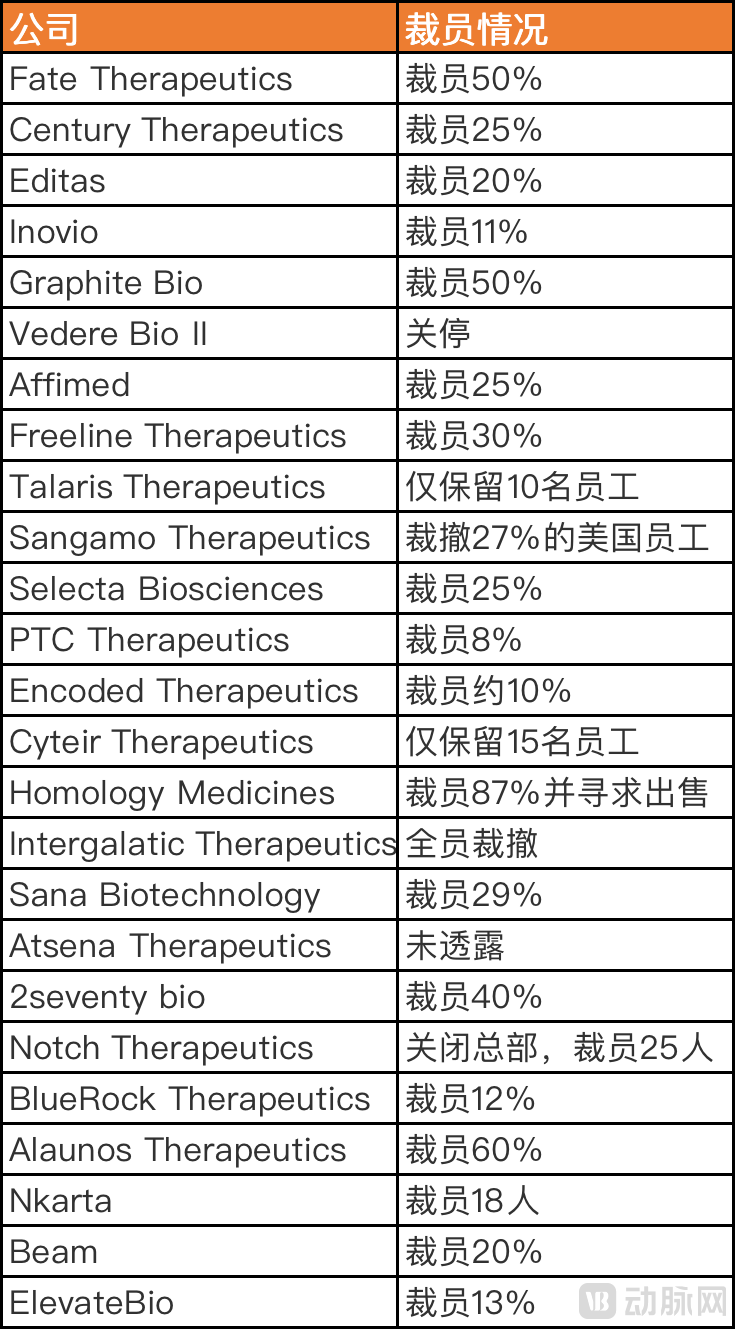
CGT Companies That Underwent Layoffs and Restructuring Abroad in 2023, Compiled from Fierce Biotech
For example, Sangamo, which long monopolized the ZFN technology route, implemented extreme protection of its technology platform and patents for many years, failing to advance any pipeline to late-stage development. Major pharmaceutical companies that had previously collaborated with Sangamo have also withdrawn one after another.
Of course, not all layoffs and downsizing have negative impacts. For example, Nkarta, a star company in CAR-NK cell therapy that recently laid off employees, announced its focus on applying off-the-shelf cell therapies to autoimmune diseases. It also announced that the FDA had approved its Investigational New Drug (IND) application for NKX019, a CAR-NK cell therapy, for the treatment of lupus nephritis, marking the first expansion of this therapy into this indication. Following this announcement, the company’s stock price surged by 112%.
Following its layoffs, ElevateBio will have a clearer business scope and more defined revenue targets, which may have a more positive impact on the company’s future development.
Nevertheless, platform companies have their limitations. After all, the biopharmaceutical sector is driven by evidence; robust clinical data serve as the currency of value for biotechnology, and such data stem from high-quality products.
Most of a company’s value derives from first-in-class or best-in-class products. The combined value of hundreds of R&D-stage projects pales in comparison to that of a single approved blockbuster drug. Therefore, a valuable platform is one capable of identifying a small number of high-value products rather than a large volume of mediocre ones.
Cell and gene therapy (CGT) is one of the sectors with the highest concentration of platform-based companies. However, it is evident that a significant number of foreign CGT companies are refocusing their pipelines, streamlining their workforce, and reducing operational costs.
In recent years, the expansion of cell and gene therapy (CGT) into the field of autoimmune diseases reflects emerging technologies’ efforts to precisely target and broaden their market reach. The global market for autoimmune disease treatments is projected to grow from $120.6 billion in 2020 to $146.1 billion in 2025, representing a compound annual growth rate (CAGR) of 3.9%. Many currently marketed drugs suffer from limitations such as lack of disease specificity, low patient response rates, and significant side effects, leaving substantial unmet clinical needs. In contrast, CGT offers multifaceted advantages and demonstrates favorable efficacy in treating autoimmune conditions. Notably, CAR-T therapy can not only selectively eliminate aberrant autologous B cells but also holds the promise of achieving immune reconstitution.
In addition to systemic lupus erythematosus, the disease with the strongest association, multiple companies are also attempting to tackle indications such as scleroderma, myositis, nephropathy, and neuromyelitis optica spectrum disorders.
An investor once told VCBeat, “The logic that a technology platform alone can attract investment no longer holds; this year, there have been virtually no pure-platform projects. Investors are not ignoring platforms, but rather, the value of a platform must be validated through its products.”
Successful product validation encompasses both the short-term ability to secure substantial financial investment from large pharmaceutical companies for adoption and use, and the long-term demonstration of superior clinical performance by the drug molecule leading to regulatory approval and market launch.
Yet enduring companies still require a platform as their foundation. This may seem paradoxical, but history shows that the way to resolve this paradox is to follow the approach Bob Swanson took when founding Genentech: focus on products and build a platform that supports those products, rather than focusing on the platform for its own sake.
A CGT entrepreneur in Boston remarked, “CGT remains a widely watched hotspot, but platform companies are heavily influenced by the broader environment. With both manufacturing and application segments trending downward, it increasingly tests whether platform companies can support proof-of-concept efforts in manufacturing and applications, or generate revenue at an early stage. It seems that investors now have higher expectations for platform companies. These expectations have always existed; however, in the current environment, ‘future hopes’ have turned into ‘present-day requirements.’”