

Jiangxi Medex Technology Co., Ltd. Files IPO Prospectus Highlighting Proprietary WCE Technology and Breakthrough in Domestic Contact Laser Systems
In 1986, SLT Corporation of the United States successfully developed and launched the world’s first contact laser system, Contact Laser. Leveraging its patent rights to WCE (Wavelength Conversion Effect) technology, it became a global leader in the field of laser medicine.
In 2002, SLT was acquired by PhotoMedx, a U.S. company listed on the NASDAQ stock exchange.
In 2016, in response to the national call to “strengthen innovation capabilities in high-end medical devices, accelerate the transformation and upgrading of the medical device industry, and enhance the international competitiveness of medical diagnostic and therapeutic equipment and medical materials with independent intellectual property rights,” entrepreneur Mr. Huang Renzhu, with highly forward-looking vision, fully acquired the contact semiconductor laser business segment of PhotoMedex, a former NASDAQ-listed company in the United States, and established Jiangxi Medex Technology Co., Ltd. (hereinafter referred to as “Medex Technology”).
Medex Technology, leveraging its globally exclusive patented WCE technology, is committed to becoming a premier provider of precise contact surgical treatment solutions both in China and internationally. The company has established R&D centers in the United States, Shanghai, Shenzhen, and Jiangxi.
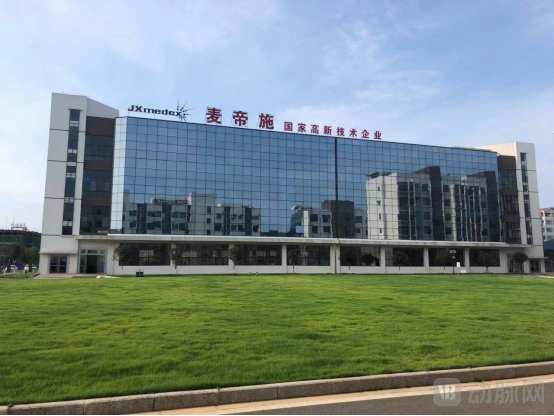
In 2021, LaserPro 980, the third-generation contact semiconductor laser therapeutic device independently developed by Medex Technology, was registered and launched on the market. This milestone filled the gap in China for medical contact lasers, overcame numerous limitations of traditional energy-based devices in clinical surgery—such as low cutting precision, significant thermal collateral damage, and limited functionality—and officially initiated the localization process for the series of contact semiconductor laser systems. Furthermore,LaserPro 980 has also obtained a Class III medical device registration certificate, a rare achievement in China that covers nine major clinical departments.It has truly achieved the progression from technology introduction to implementation, and ultimately to innovation.
The company has established a comprehensive product portfolio centered on laser main units, featuring over 200 combinations of “fiber + handpiece” consumables, capable of meeting the requirements for cutting, vaporization, coagulation, and hemostasis of human tissues across various anatomical sites and tissue types.
The team holds 4 international invention patents, 6 domestic invention patents, 20 utility model patents, and 3 software copyrights. It has obtained two Class II medical device registration certificates, two Class III medical device registration certificates, and FDA certification. Additionally, it has been awarded the Jiangxi Provincial Science and Technology Progress Award, recognized as a “Specialized, Refined, Differential, and Innovative” enterprise and a “Jiangxi Premium Product,” included in the “Jiangxi Province Catalogue for the Promotion and Application of Major Technical Equipment (First Set) (2019 Edition),” and listed among the “VB-Find Award: Top 100 Most Innovative Medical Device Products (Solutions).”
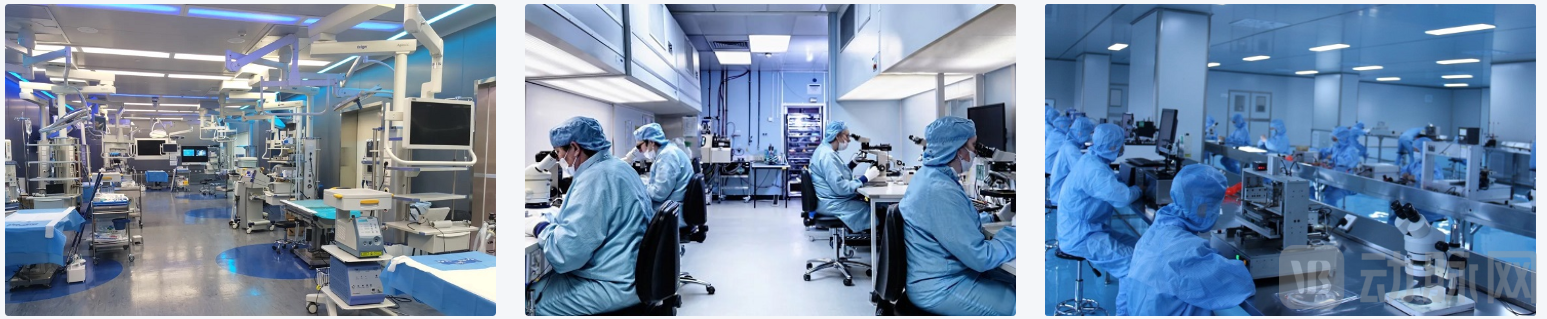
Jiangxi Medex Technology Co., Ltd. Corporate Environment
Laser scalpels are categorized into non-contact and contact types. The former operates by directing a laser beam onto tissue from a certain distance away from the human body. Due to the lack of direct contact with the tissue, it is difficult to precisely control the irradiation site, angle, distance, and duration, resulting in lower operational precision and difficulty in managing the depth of energy penetration. Meanwhile, the beam may reflect onto non-target areas, posing risks of accidental irradiation and injury. During laser application, reflection and refraction occur, and significant smoke is generated, obscuring the surgical field. Furthermore, with a single-wavelength laser, it is often challenging to achieve both effective cutting and vaporization simultaneously while maintaining optimal performance.Efficacycoagulation hemostasis.
The latter overcomes the aforementioned drawbacks and, owing to its high precision, rapid efficiency, low risk of infection, effective hemostasis, and clear surgical field, is favored by surgeons. It has been widely used in various complex intracranial tumor surgeries, spinal cord tumor surgeries, endoscopic interventional procedures, minimally invasive endoscopic surgeries, and solid tumor resections.
Compared with non-contact laser scalpels, contact laser scalpels achieve a cutting precision of up to 0.2 mm. Furthermore, the range of thermal damage to surrounding tissues is less than 0.5 mm, effectively protecting adjacent blood vessels and critical neural structures. The fine tip of the laser scalpel allows for precise manipulation of deeply situated pathological tissues within confined surgical spaces.
During operation, the contact laser scalpel relies on thermal energy, thereby avoiding traction on surrounding tissues. Its tip is made of non-metallic sapphire material, ensuring that no electrical current passes through the patient’s body during use. This prevents stimulation or damage to adjacent blood vessels and nerves, does not interfere with electrophysiological monitoring, and enables efficient performance in both dry and wet environments.
Studies have shown that contact laser scalpels can reduce the metastasis of malignant tumors. This is because the laser applies gentle, pressure-free energy to the tumor tissue during the procedure, avoiding the displacement of tumor cells into nearby blood and lymphatic vessels. Furthermore, the laser seals these vessels, thereby preventing tumor cell migration and dissemination.[1]
WCE (Wavelength Conversion Effect) is a globally exclusive patent held by Medex Technology. This technology enables real-time, controllable output of laser power, creating a gradual temperature decrease from the tip to the body of the instrument, thereby forming a thermal expansion slope (i.e., a temperature gradient zone). Energy is concentrated at the tip of the laser scalpel for cutting and vaporization, while 35% of the energy is released laterally to form a low-temperature zone of approximately 60°, facilitating coagulation and hemostasis. This allows for simultaneous cutting and hemostasis during surgical procedures without the need to change instruments.
Leveraging the underlying support of WCE technology, Medex Technology has launched a contact-type surgical semiconductor laser system.
What Is a “Contact Semiconductor”? Let’s Start by Examining “Contact” and “Semiconductor” Separately.
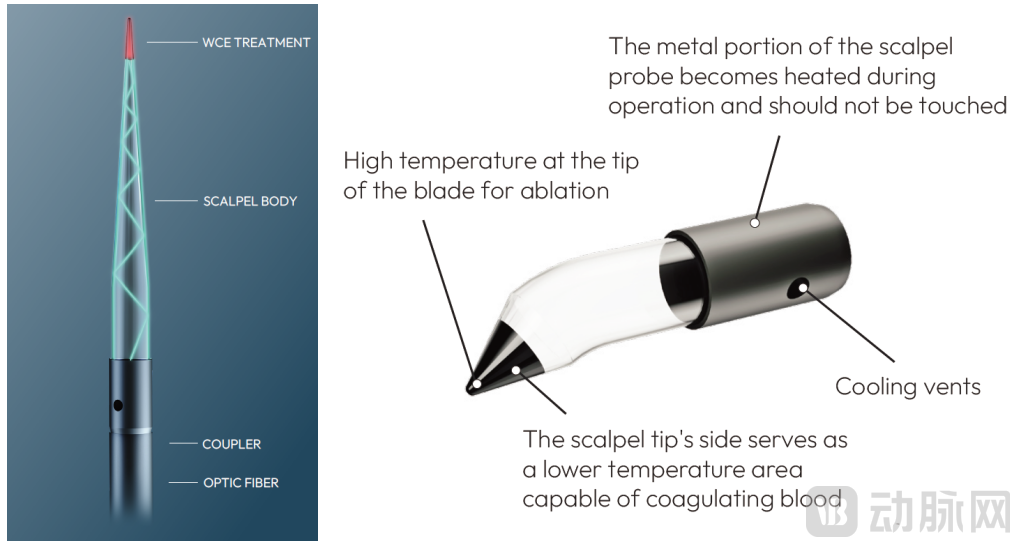
First is the “contact” mode. When traditional non-contact lasers act on human tissue, they rely on light propagation, with the wavelength being particularly critical for the water and hemoglobin absorption coefficients of the tissue. In contrast, Medex’s contact laser conducts light to the tip via a sapphire probe, converting light energy into thermal energy, and then uses the probe tip in direct contact with the tissue to achieve cutting, hemostasis, ablation, and other effects. The application of contact lasers is not directly related to laser wavelength; different wavelengths exhibit the same efficiency in converting light to thermal energy.
For the operating surgeon, contact laser systems offer significant tactile feedback compared to non-contact systems, facilitating more precise surgical maneuvers. Furthermore, as the energy is focused through the handpiece tip, these systems provide a precise treatment zone with minimal thermal damage and high laser energy utilization efficiency. They also eliminate risks such as laser reflection, thereby ensuring enhanced safety.
Furthermore, there is the “semiconductor.” Semiconductor lasers are lasers that use semiconductor materials as the working medium. Compared with other types of lasers such as solid-state, liquid, and gas lasers, they offer the best energy conversion efficiency. Moreover, semiconductor lasers have a long operational lifespan, capable of continuous operation for hundreds of thousands of hours, with higher stability.
“The development of contact-type semiconductor lasers is a comprehensive and systematic engineering endeavor; from the main unit to the fiber-optic handpiece, every step presents a formidable challenge,” Mr. Huang Renzhu told VCBeat. The first step in R&D is to identify a high-quality light source suitable for surgical applications. Furthermore, the semiconductor laser’s main unit must not only offer high power stability but also be adjustable and long-lasting, capable of both continuous and pulsed output, while seamlessly integrating with the fiber-optic and handpiece systems. Achieving an effective integration between the fiber optics and the handpiece poses another significant challenge; for instance, an independent cooling system must be installed between the handpiece and the fiber optics.
Building on semiconductor contact laser scalpel technology, Medex utilizes its proprietary WCE patent to treat sapphire tips and optimize tip design, thereby enhancing vaporization, coagulation, and hemostasis while reducing tissue adhesion. Through close collaboration with clinical experts, the company has developed multi-angle treatment heads suitable for more complex surgical procedures. Tailoring solutions to meet the specific needs of clinical customers is the core pursuit of Medex Technology, enabling diverse surgical outcomes including cutting, ablation, coagulation, and hemostasis.
“Our laser scalpel features a variety of tip angles and shapes. The round tip is suitable for bulk resection, vaporization, and hemostasis, while the pointed tip is designed for precise cutting and capsular dissection. We offer both rigid-handled fiber optics for open surgery and integrated flexible fiber optics specifically for endoscopic procedures,” Mr. Huang Renzhu told VCBeat.
Its product registration coversNeurosurgery, Respiratory Medicine, Gastroenterology, Urology, Otorhinolaryngology (ENT), Gynecology, Orthopedics, General Surgery, Medical AestheticsWidely applied across nine major departments, it is user-friendly and easy to master, offering a short learning curve for physicians. It has demonstrated unique advantages in microsurgery, endoscopic minimally invasive surgery, and solid tumor ablation, earning the reputation of being “the paintbrush in the doctor’s hand.”
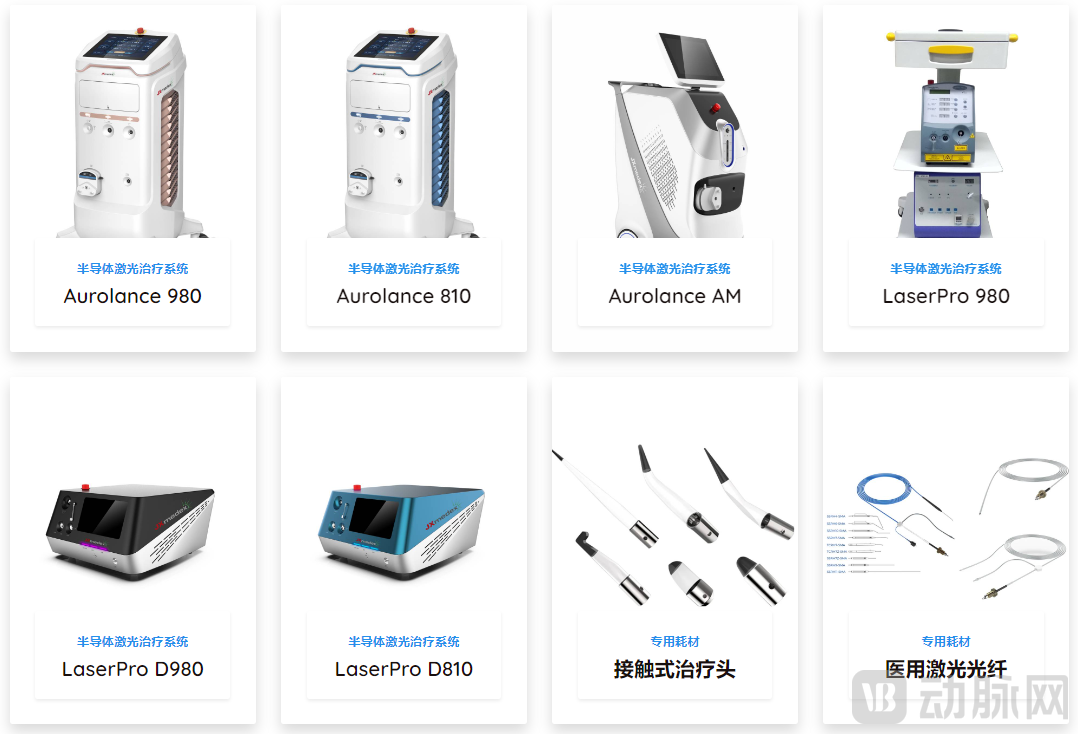
Medex Technology Product Overview, Images from the Official Corporate Website
Professor Zhang Junting, acclaimed as “Asia’s No. 1 Surgeon,” once evaluated Medex Technology’s contact laser scalpel as follows: “For lesions that are relatively hard and calcified in skull base surgery, the contact laser scalpel offers significant technical advantages... It can efficiently cut hard and tough tumors, perform precise maneuvers in narrow spaces, and simultaneously seal tiny blood vessels, making it irreplaceable by meningeal scissors.”
Leveraging the advantages of "precision, safety, and efficiency," Medex Technology's surgical semiconductor laser system has already beenBeijing Tiantan Hospital, Chinese PLA General Hospital (301 Hospital), China-Japan Friendship Hospital, Tsinghua Changgung Hospital, Shanghai Changhai Hospital, Shanghai Pulmonary Hospital, Shanghai East Hospital, Nanfang Hospital of Southern Medical University, The First Affiliated Hospital of Sun Yat-sen University, The First Affiliated Hospital of Guangzhou Medical University, West China HospitalHas been clinically applied at multiple top-tier tertiary hospitals in China.
Meanwhile, the company is grounded in the international arena, with a dual-drive strategy for both domestic and overseas markets. Its related products received U.S. FDA clearance in 2022, andJohns Hopkins Hospital, Children’s National Hospital, and other well-known U.S. medical institutions.
Building a comprehensive surgical solution around contact laser systems is not only the original aspiration of Medex Technology but also the guiding beacon for its forward progress. Adhering to the philosophy of “producing one generation, developing one generation, and pre-researching one generation,” the company’s R&D team is currently engaged in intensive and orderly development efforts.Radiofrequency and UV light series products for medical aesthetics, surgical power systems, intelligent navigation systems, and integrated surgical systemsand other products. The company expects to obtain four Class III medical device certifications by the end of the year and will gradually launch multiple innovative products over the next 2–3 years.
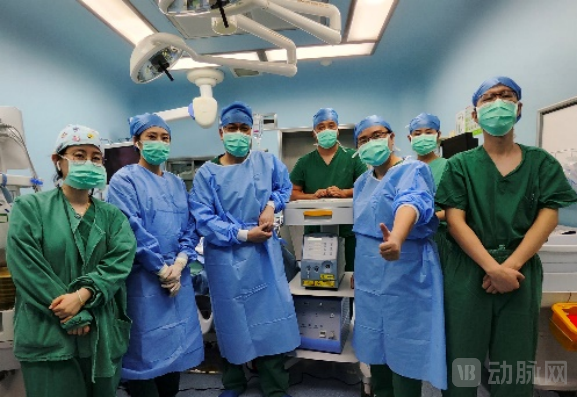
Looking back at the company’s development journey, it is evident that Medex Technology’s acquisition of WCE technology and its product line was not merely a simple transfer of technology. Rather, it exemplifies the principle of “making foreign technologies serve China,” involving the localization, adaptation, and innovation of advanced international technologies. Mr. Huang Renzhu stated that in the future, Medex will introduce more advanced, reliable, and user-friendly solutions to improve the conditions for both patients and operators, reduce healthcare costs, and position itself as a pioneer in the global field of laser medicine and an advocate for “sculpting-style” precision surgery.
References:
1. China Medical Engineering “Application of Contact Laser Scalpel in Neurosurgery”
2. Chinese PLA Medical Journal: “Application of Contact Laser Scalpel in Microsurgical Resection of Brainstem Tumors”
3. “The First Orange Hometown Science and Technology Innovation Star of Xinfeng County | Medex R&D Team: Deeply Cultivating the High-End Medical Device Industry Track”