

BioGeometry Secures Hundreds of Millions in Financing, Leading the Next Golden Track of Bio AI with Its "Microscopic World Model"

BioGeometry
Large Molecule Drug Developer

Index Capital
Financial Services Institution

CAS Investment
Professional investment management institutions

Fortune Capital
Venture Capital Institution

Gaorong Ventures
Venture Capital Institution

LINKX CAPITAL
Early-Stage Investment Firm in Frontier Technologies
Recently, BioGeometry, a leading domestic AI for Science (AI4S) company, announced the completion of its latest strategic financing round in the hundreds of millions of RMB. This round was co-led by Shanghai Biomedical Innovation Transformation Fund, CAS Investment, Fortune Capital, and LinkX Capital, with participation from Gaorong Ventures and Index AI Industrial Innovation Fund. Index Capital served as the exclusive financial advisor.
This financing is not only a recognition from the capital market but also sends a clear signal: BioGeometry, a team that is among the few in China capable of building foundational models in life sciences from the ground up, has successfully completed technical and industrial validation and is now at the golden inflection point towards rapid commercial growth.
Unlike the mainstream industry approach of "AI + Bio," which treats AI merely as a tool for local efficiency enhancement, BioGeometry has chosen to reshape the research and development paradigm of life sciences from the ground up, building the next generation of AI-native biotech company.
In the current wave of technological advancement, artificial intelligence is rapidly evolving along three clear trajectories:
Digital AI, represented by large language models and multimodal models, is restructuring the world of human information and knowledge;
Physical AI, represented by autonomous driving and humanoid robotics, is restructuring the world of human physics and machinery;
Bio AI — the ultimate frontier that BioGeometry is addressing — goes beyond digital and mechanical systems, aiming to deeply understand the underlying language of life and achieve engineerable, programmable manipulation of biology at atomic-level precision.
This distinction marks the fundamental difference between BioGeometry and other "AI + Bio" companies in China. While the industry widely relies on fine-tuning foreign open-source models and remains stuck in application-level patchwork, BioGeometry demonstrates strong in-house, full-stack capabilities integrating both dry and wet lab technologies. This confidence in "building the foundational engine from 0 to 1" stems from its exceptional research team: founded by renowned AI4S scientist Professor Tang Jian, with Turing Award laureate and deep learning pioneer Yoshua Bengio serving as Chief Scientific Advisor, and other team members holding multiple internationally milestone achievements in fields such as graph machine learning and diffusion generative models.
Recently, as a core contributor to the development of NVIDIA's open-source protein large language model, La Proteina, BioGeometry has also developed its proprietary AI virtual cell model, PerturbDiff, which has garnered significant international attention in the scientific community. These achievements underscore the company's robust capability to define the next generation of life science infrastructure.
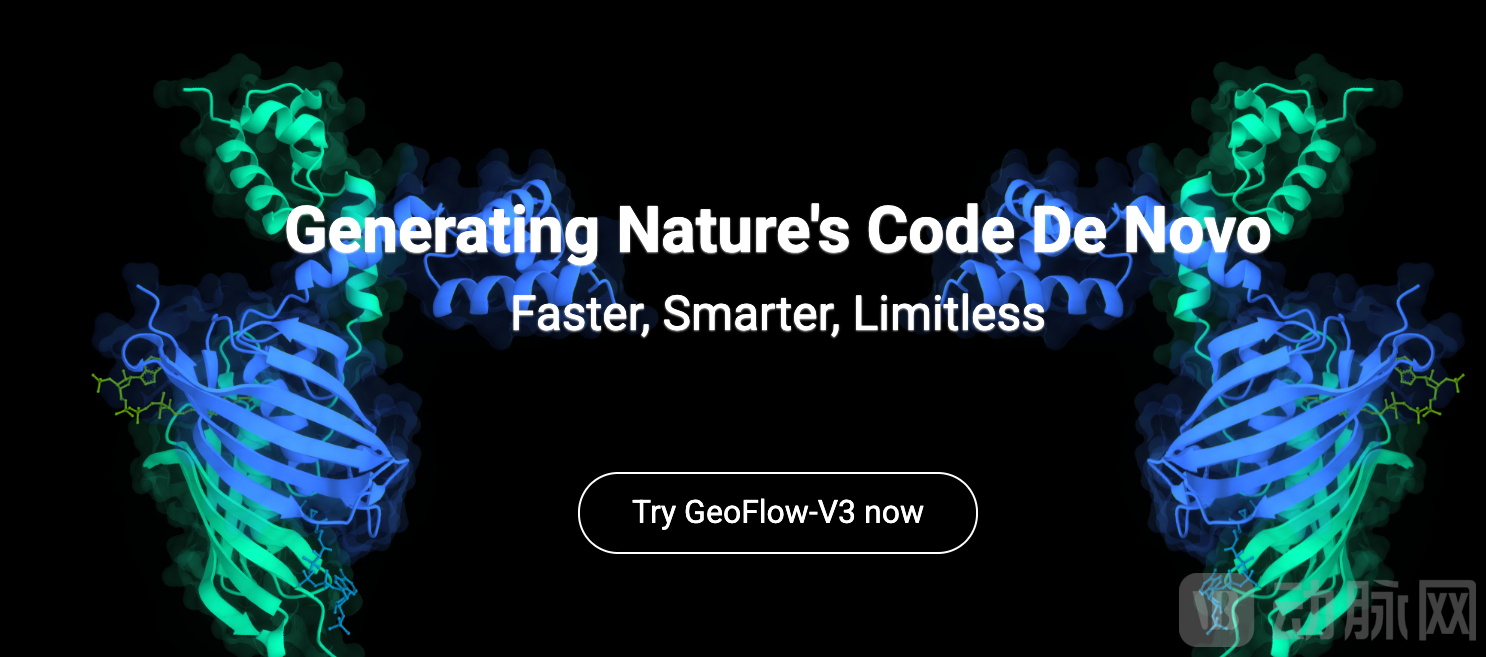
Whether we can truly understand and precisely design molecular interactions at the microscopic level is the most fundamental question in life sciences. BioGeometry's solution is to develop a "microscopic world model" — the GeoFlow series — designed to decipher the laws of life and matter. From the evolutionary trajectory of the GeoFlow series, it is clear that BioGeometry has continuously led the field and firmly established itself among the global first tier in terms of technical capability.
GeoFlow Evolution Milestones:
GeoFlow V1 (June 2024) – Proprietary model achieves structure prediction performance on par with AlphaFold 3.
GeoFlow V2 (April 2025) – World's first model unifying "structure prediction + de novo design," achieving a breakthrough from 0 to 1 in antibody de novo design in China.
GeoFlow V3 (October 2025) – First introduction of a multi-step reasoning closed loop, increasing hit rates for hit molecules by nearly two orders of magnitude.
1. Generational Advantage in All-Atom Modeling (GeoFlow V1)
Mainstream protein AI models typically treat proteins as linear sequences and perform approximate modeling at the amino acid residue level. In contrast, GeoFlow directly and accurately models three-dimensional space at the atomic level, fully incorporating the spatial coordinates and bond angles of every atom. In protein–protein complex structure prediction tasks, GeoFlow V1 achieved performance on par with AlphaFold 3 upon release, securing its foundational position among the global first tier.
2. A Global Breakthrough: Seamless Integration of Prediction and Design (GeoFlow V2)
Previously, even powerful models like AlphaFold focused primarily on structure prediction, requiring researchers to switch to other tools for designing new molecules. GeoFlow V2, for the first time worldwide, unified protein structure prediction and de novo design within a single model and became the first AI large model in China to achieve a breakthrough in antibody de novo design, directly breaking the monopoly of closed-source overseas models.
3. Leading the Global AI4S Large Model Trend: Introducing Multi-Step Reasoning (GeoFlow V3)
Just as large language models (e.g., OpenAI o1) are evolving toward long-chain reasoning, BioGeometry has pioneered the introduction of this cutting-edge trend into the microscopic world. GeoFlow V3 breaks through the traditional linear "generate–screen" pipeline and establishes a multi-step reasoning closed loop of "generation–evaluation–optimization," enabling autonomous evolution that mimics the natural affinity maturation process of antibodies. In de novo design tasks across over 20 targets, GeoFlow V3 achieved an average hit rate of nearly 20% for hit molecules — an improvement of nearly two orders of magnitude over previous-generation AI methods — compressing the lead molecule discovery cycle to under three weeks. This pace of evolution is setting the direction for global Bio AI development.
Currently, BioGeometry is developing its next-generation microscopic world model, GeoFlow V4, which will expand the modeling scale from molecular interactions to the more complex cellular level — moving from "designing individual molecules" to "designing molecular systems" — laying the foundational AI infrastructure for next-generation drug discovery and life sciences engineering.
BioGeometry, driven by its dual-engine approach of "collaborative development + proprietary pipeline," has already delivered multiple industry cases that have broken through previous ceilings in high-difficulty fields such as biomedicine and synthetic biology.
Biopharmaceuticals: Reshaping Antibody Drug and Vaccine Development
Tumor Immunology – De Novo Design of Highly Specific Antibodies: When faced with highly similar proteins within the same family that traditional methods could not distinguish, GeoFlow embedded "specificity" as a predefined constraint directly into the generation phase. By designing fewer than 100 sequences, it successfully generated two antibodies with both high selectivity and high affinity, reaching the limits of existing AI tools.
International Pharma Collaboration – Multi-Parameter Simultaneous Optimization of Lead Antibodies: In a multi-parameter optimization project that a well-known international pharmaceutical company's internal team had been unable to resolve for over a year, GeoFlow, under a zero-shot scenario (without fine-tuning on target data), delivered an ideal molecule through just a single round of design. The results included a tenfold improvement in affinity, an eightfold increase in expression level, and over 90% humanization optimization. The project delivery cycle was shortened by more than 80% compared to the client's initial expectations.
Vaccine Development – From "Naturally Impossible" to "Engineerable": Addressing the long-standing industry challenge of a viral natural antigen protein's inability to stably form dimers, GeoFlow directly increased the dimerization ratio of the protein from less than 10% to over 90%, while simultaneously boosting expression levels by several tens of times, fundamentally overcoming the limitations posed by the natural structure.
Synthetic Biology: Reconstructing Industrial Enzyme Design, Multiple Pipelines Complete Pilot-Scale Amplification
Natural Borneol: Achieved biosynthesis for the first time globally, with chiral purity reaching 99.9%, and production costs reduced by 80% compared to traditional plant extraction.
Alpha-Ketoglutarate: Achieved directed optimization of key enzyme activity, reducing costs by over 60% compared to existing biosynthetic technologies on the market.
From molecules to cells, from understanding life to designing life — BioGeometry is building the fundamental infrastructure that enables life to be engineered and programmably written.
According to sources familiar with the matter, dozens of top-tier institutions rushed to participate in this round of several hundred million RMB financing. The core reason is that BioGeometry has successfully transitioned from a "technological high ground" to an achievable "commercial high ground." Several investment firms noted that "BioGeometry is one of the rare native (AI Native) fundamental infrastructure definers in the global life sciences field," representing "a key breakthrough in breaking the monopoly of overseas closed-source models," with "high recognition of the team's technical capabilities and global influence in the AI4S field." They added that "the business model is gradually becoming clear, and the company may be approaching a valuation inflection point."
The injection of this several hundred million RMB financing has officially pressed the fast-forward button on BioGeometry's exponential valuation growth. With the development of the next-generation GeoFlow V4 model, which will extend the modeling scale from "individual molecules" to "molecular systems at the cellular level," the company's technological moat and commercial ceiling are set to be further elevated.