

JD Health to Build a New-Generation Smart Hospital Service System: What’s the Foundation?

JD Health
Internet Medical and Health Service Platform Provider
In March 2019, the National Health Commission issued the “Graded Evaluation Standard System for Smart Hospital Services (Trial)” and launched the evaluation process. Guided by these standards, the initiative aims to direct medical institutions in scientifically and standardizingly advancing smart hospital construction, gradually establish a graded evaluation system for smart services in medical institutions suited to national conditions, and promote the development of hospitals’ smart service capabilities. Currently, more than 70 medical institutions have met the national grading standards, representing a high level of smart hospital services across China.
Meanwhile, following the evaluation of electronic medical records (EMR) systems, the assessment of smart services has emerged as another pivotal component in the “trinity” framework for building smart hospitals. This evaluation employs key common dimensions as indicators to provide reference standards for hospital development. In practice, there remains substantial room for imagination and numerous opportunities for innovative breakthroughs in smart services.
On December 3, JD Health articulated its new value proposition for digital and intelligent healthcare at the “2023 Digital and Intelligent Healthcare Conference”: leveraging its technological expertise, supply chain capabilities, and medical service resources, JD Health focuses on three key scenarios—smart hospitals, regional health informatization, and smart elderly care—to deliver innovative applications to the healthcare system.
In the realm of smart hospitals, JD Health announced a strategic partnership with the First Affiliated Hospital of Wenzhou Medical University (hereinafter referred to as “WYMU-FAH”) at the conference. The two parties will jointly develop “Future Hospital Smart Services” to create a next-generation smart hospital service system that leads the nation.
The First Affiliated Hospital of Wenzhou Medical University ranks 59th on the China Hospital Technology Influence Ranking (Comprehensive), with 25 disciplines listed among the top 100 nationally for disciplinary technological influence. It also secured the 24th position nationwide in the National Performance Evaluation of Tertiary Public Hospitals, demonstrating outstanding overall comprehensive strength.
In recent years, the First Affiliated Hospital of Wenzhou Medical University has achieved remarkable results in smart healthcare services. By implementing applications such as seamless medical care, same-day completion of examinations, automated appointment scheduling for tests, and internet-based outpatient clinics, the hospital has realized a full-process smart service model for “one-stop medical care.”
In the seamless healthcare experience, The First Affiliated Hospital of Wenzhou Medical University has deployed smart cameras that, with patient consent, automatically identify arriving patients, arrange their care pathways, push context-aware notifications, and filter scenario-specific functions to eliminate the need for patients to make selections.
"The One-Stop Medical Care List" primarily provides patients with comprehensive lists of medications, laboratory and imaging tests, expenses, and health education materials, enabling them to access a holistic overview of their medical care information.
In many large hospitals, the appointment process and waiting periods for major diagnostic examinations have long been a challenge. Issues such as complex scheduling procedures and excessive wait times from appointment to examination remain to be resolved.
In response, The First Affiliated Hospital of Wenzhou Medical University has set a goal of “Same-Day Completion of Examinations.” Building on efforts to expand examination equipment, improve equipment utilization efficiency, and boost staff motivation, the hospital has implemented an intelligent appointment system: the system automatically schedules the earliest available examination slot for each patient, who may then reschedule if the assigned time is inconvenient.
Thanks to optimal resource allocation and the application of smart solutions, The First Affiliated Hospital of Wenzhou Medical University has significantly improved service efficiency for diagnostic procedures. As of November 20, 2023, all CT scans in the Department of Radiology and ultrasound examinations across all sections have achieved same-day completion, while the appointment wait time for 3.0T MRI has been substantially reduced compared to 2022.
In terms of internet outpatient services, The First Affiliated Hospital of Wenzhou Medical University has launched 45 clinical specialties, with more than 300 physicians providing consultations on a daily basis. Since its launch, the average monthly volume of internet outpatient visits has grown from 5,000 in 2021 to 30,000 in 2023. Meanwhile, under the pre-consultation model, an increasing number of follow-up patients are able to access closed-loop services that seamlessly integrate online and offline care.
At the JD Health Digital Intelligence Medical Conference, Gao Zhihong, Director of the Information Department at the First Affiliated Hospital of Wenzhou Medical University, discussed plans for future smart hospital services. These initiatives include establishing an AI Brain Command Center, leveraging artificial intelligence to reshape patient care services, utilizing data to assist physicians in efficient diagnosis and treatment while supporting patients’ disease management and health maintenance, constructing smart wards that integrate in-hospital and out-of-hospital care, and creating a “hospital without walls” model.
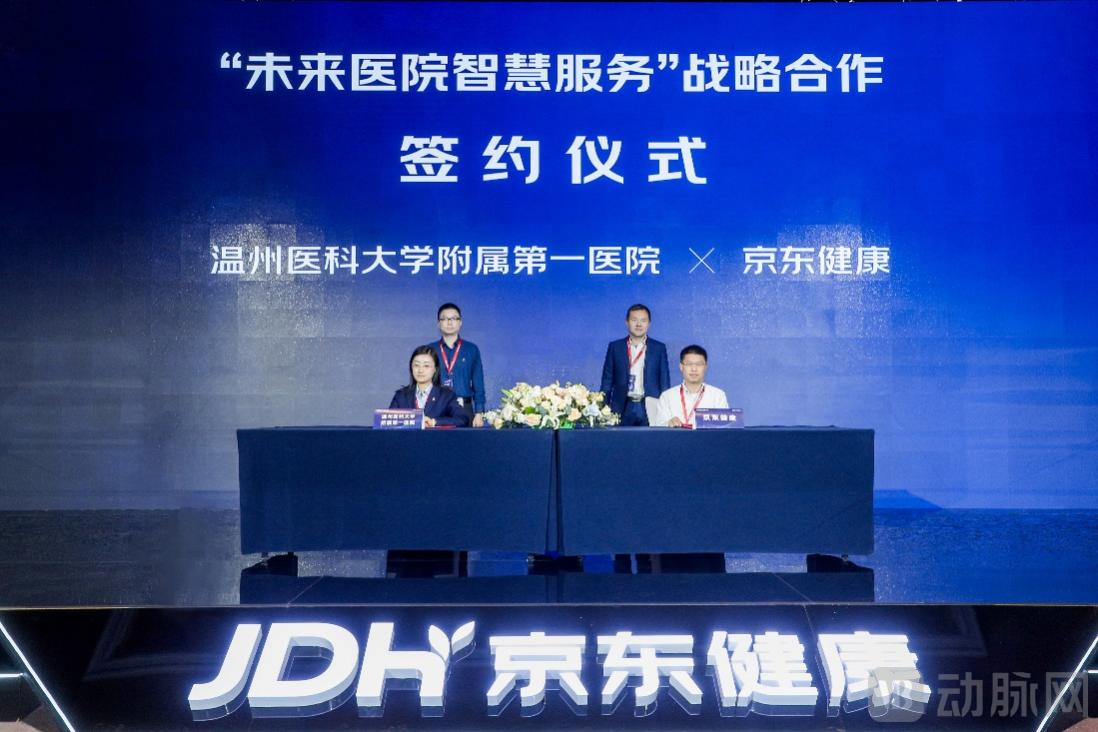 JD Health and the First Affiliated Hospital of Wenzhou Medical University Collaborate to Build “Future Hospital Smart Services”
It is understood that JD Health and The First Affiliated Hospital of Wenzhou Medical University can pool their respective advantageous resources to build “Smart Services for the Future Hospital” following their collaboration.
For example, in terms of the patient care journey, both parties will leverage technologies such as medical AI, large healthcare models, big data analytics, and cloud computing. Aligning with the “One-Stop Healthcare Service” concept, they will jointly conduct top-level design for smart services to build a next-generation smart hospital service system that leads across China, thereby shaping the future model of hospital services and maximizing convenience for patients seeking medical care.
In terms of regional health, we will jointly explore innovative models of tiered diagnosis and treatment, build corresponding information technology support systems, enhance the service capabilities of primary healthcare institutions, and promote the rational allocation of medical resources.
In terms of resident health services, by leveraging clinical knowledge graphs in conjunction with resident health data and big data analytics technologies, we construct a full-lifecycle health graph and data model for residents. This initiative enables the provision of personalized health services, such as health predictions and disease early warnings, for residents; offers enhanced decision-support assistance to physicians; and improves the quality and efficiency of medical services. Meanwhile, in strict compliance with national data security regulations, data is classified, mined, and analyzed to establish a smart hospital service model driven by digital intelligence and guided by the integration of prevention and treatment. Furthermore, through the sharing of joint intellectual property rights and the transformation of scientific achievements, we aim to create benchmark smart service solutions.
The First Affiliated Hospital of Wenzhou Medical University already boasts a high level of smart healthcare services. Its collaboration with JD Health signifies that both parties will build on this foundation to jointly explore feasible pathways for advancing smart healthcare services to a higher level.
“How Can ‘Smart Services for Future Hospitals’ Be Effectively Implemented?” A review of JD Health’s key products and applications reveals that the company has accumulated corresponding technical capabilities.
Large language models are undoubtedly one of the hottest tech applications in 2023, with medical large language models emerging in succession. In July 2023, JD Health released its own medical large language model—Jingyi Qianxun.
Taking hospital scenarios as an example, Jingyi Qianxun currently covers thousands of common diseases and employs 20 quality evaluation indicators, designed with the participation of medical expert teams, to ensure its safety. It also possesses the capability to address medical needs across the entire care continuum, supporting the use of auxiliary plugins and health management tools to help physicians better manage complex clinical conditions and healthcare scenarios.
Supported by Jingyi Qianxun, JD Health has established a patient-centered medical and healthcare service system that covers the entire process of “health monitoring + risk assessment,” “disease diagnosis + pharmaceutical and device-based treatment,” and “post-diagnosis follow-up + rehabilitation and care management.”
In the pre-consultation phase, JD Health can perform multimodal analysis of text, image, and video information provided by patients to efficiently achieve doctor-patient matching and precise triage.
During the consultation phase, JD Health leverages medical AI for intelligent quality control, smart prescription review, and automated medical record management, enabling AI-assisted diagnosis and intelligent Q&A to help improve physicians’ work efficiency and service quality.
In the post-diagnosis phase, JD Health has established a patient management platform to conduct comprehensive, dynamic monitoring of patients' health status and provide timely interventions throughout their recovery process. Through this platform, JD Health facilitates efficient collaboration among physicians, physician assistants, and rehabilitation therapists, ensuring that patients receive the highest quality healthcare services.
Leveraging Jingyi Qianxun as its foundational technological capability, JD Health enables healthcare institutions to reshape medical service workflows while enhancing physician efficiency.
In terms of regional health, JD Health has promoted the construction of regional health information systems in many places in recent years; in addition to having implemented multiple "Healthy Cities," JD Health also uses smart technology to help grassroots levels improve their service capabilities.
In support of the development of Haidian District’s smart healthcare system, JD Health partnered with the Haidian District Health Commission to pilot an AI-based regional pre-prescription review project—the Haidian Regional Cloud Prescription Review System—helping physicians identify common prescription issues and patient risk factors. As of November 2023, the AI-powered pre-prescription review system had been deployed in nearly 100 primary healthcare institutions across Haidian District, processing over 20,000 prescriptions daily on average.
Enhancing the service capacity of primary healthcare institutions is one of the prerequisites for the genuine implementation of tiered diagnosis and treatment. Only by fostering close collaboration among healthcare institutions at all levels within a region to provide interconnected smart services for patients and residents can such services align with future trends. Therefore, JD Health’s technical service experience in regional healthcare has also laid the foundation for building “smart services for hospitals of the future.”
Regarding health records, JD Health has accumulated a vast volume of patient health records and adopted standardized front-end product designs. These records can be leveraged by big data analytics to enhance the precision of diagnosis and treatment. After secure de-identification, they are also made available for medical research, thereby supporting scientific endeavors.
Physical medical institutions have accumulated vast amounts of patient data over a 30-year period of informatization. However, hospital information systems have undergone multiple iterations, resulting in varying degrees of data structuring.For hospitals, data governance and the extraction of data value are both critical issues and significant challenges. Only by overcoming these challenges can “future hospital smart services” truly embody the significance of precision medicine. Leveraging its big data technologies, JD Health collaborates with medical institutions to conduct data governance and unlock deep data potential.
JD Health proposes “Next-Generation Smart Services” because, in addition to exporting its technological capabilities, its smart service solutions can also share its patient service expertise.
JD Health’s financial report shows that for the year ended June 30, 2023, the platform’s annual active users reached 169 million, an increase of 38 million from the same period in 2022.
In the first half of 2023, JD Health leveraged innovative technologies and digital operational capabilities to further optimize the user experience of its medical and healthcare service products, with the average daily volume of online consultations exceeding 440,000; in 2022, the average daily volume was 300,000.
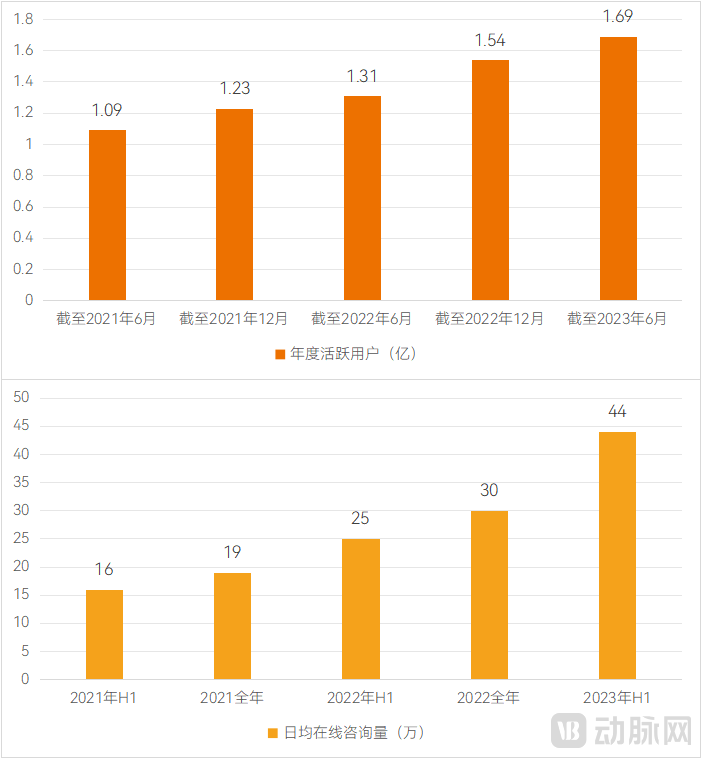 JD Health User Data Growth, Source: Company Financial Reports
As can be seen from the chart above, JD Health’s core user metrics are growing rapidly, which intuitively demonstrates that an increasing number of users recognize and utilize JD Health’s services.
JD Health provides information-based and intelligent technical services to stakeholders in the medical service sector, yet it differs from traditional IT vendors: the company possesses inherent internet and e-commerce DNA, excelling in prioritizing user experience and focusing on the operational outcomes of products in practical application. Taking the pre-consultation task assignment feature as an example, data shows that JD Health’s positive rating for this function exceeds 98.5%. User feedback serves as a key metric for JD Health in developing and optimizing its features.
For hospitals, especially large tertiary Grade A hospitals, patient volume is not a concern. However, delivering a patient-centered service experience remains a critical imperative for healthcare institutions.
First, patient service-related items are a key component of the "National Examination" for public hospitals.For example, in the "Performance Assessment Indicators for Tertiary Public Hospitals," both the average appointment-based consultation rate for outpatient patients and the average waiting time after appointment scheduling are included as assessment indicators.
These metrics must be enabled through an appointment scheduling system, yet their realization depends on more than the information system alone. Behind online appointment booking, resource allocation, process design, and rule formulation all require a patient-centric approach, prioritizing the options that best enhance patient experience. Any unreasonable or redundant step in this workflow may compromise the ultimate outcomes.
Secondly, high-quality development has become the mainstream trend in hospital development, with patient service experience being a crucial component thereof.
According to Chen Jinxiong, Vice President of the Medical Informatics Branch of the Chinese Research Hospital Association, if business growth, efficiency improvement, medical quality, and cost control constitute the first curve for hospitals to scale up and strengthen, then health, online services, out-of-hospital care, and research represent the second curve for their innovative development.
It is evident that several key elements in the second curve are closely related to the patient service experience.
Overall,JD Health not only delivers “functional” solutions tailored to the needs of medical institutions, but also has the capability to provide practical and user-friendly solutions designed from the patient’s perspective.
Since November 2023, there has been a high incidence of respiratory infectious diseases, with medical institutions across many regions in ChinaAppearanceThe "overwhelming crowds" of patients are particularly severe in children's hospitals and pediatric departments.
At some popular hospitals, hundreds of pediatric patients have been seen queuing up, with hospital notices indicating wait times of over 10 hours. Inside the hospital, faces are filled with anxiety and exhaustion; outside, many people are still circling around in search of parking spaces.
Admittedly, smart services still play a role in such scenarios—outpatient appointment scheduling, displaying real-time waiting counts, and calculating estimated waiting times—which are fundamental and ubiquitous features in the development of smart healthcare services. From a technical perspective, implementing these functions is not particularly difficult.
However, is this the full extent of smart healthcare services? The answer is no.
According to the "Hierarchical Evaluation Standard System for Smart Hospital Services (Trial)," the criteria for the highest existing level of smart services (i.e., Level 5) are as follows: Basic smart medical and health services within the hospital have been established; medical and health information generated by patients across hospitals, primary healthcare institutions, and home settings within a certain region can be interconnected; and the hospital can collaborate with other medical institutions to provide patients with precise, lifecycle-spanning smart medical and health services.
Imagine what the clinical scenario for respiratory infections might look like during peak seasons within a smart healthcare framework based on the aforementioned model. It could unfold as follows: patients undergo testing either at home or at primary care institutions, with data rapidly shared across the region. Primary care facilities collaborate with secondary and tertiary hospitals to provide continuous diagnosis, treatment, and management for pediatric patients with varying degrees of severity, both inside and outside the hospital setting. By leveraging intelligent platforms for more proactive interventions, the discomfort of young patients and the anxiety of their parents can be alleviated.
ThisWhile the envisioned scenario can be articulated concisely, its implementation is far from easy, requiring continuous interaction and integration between intelligent technologies and a patient-centric service mindset.
In recent years, the “trinity” model of smart hospital construction has significantly improved the order of medical services. Key players such as JD Health and the First Affiliated Hospital of Wenzhou Medical University have continuously innovated and explored new possibilities. JD Health has also opened up its refined and validated technologies and service expertise to empower external partners, creating complementary capabilities with industry allies. It is firmly believed that the potential for “smart services in future hospitals” is boundless, and their realization is just around the corner.