

Trinomab Announces NMPA Acceptance of NDA for TNM002, the World’s First Recombinant Fully Human Anti-Tetanus Toxin Monoclonal Antibody
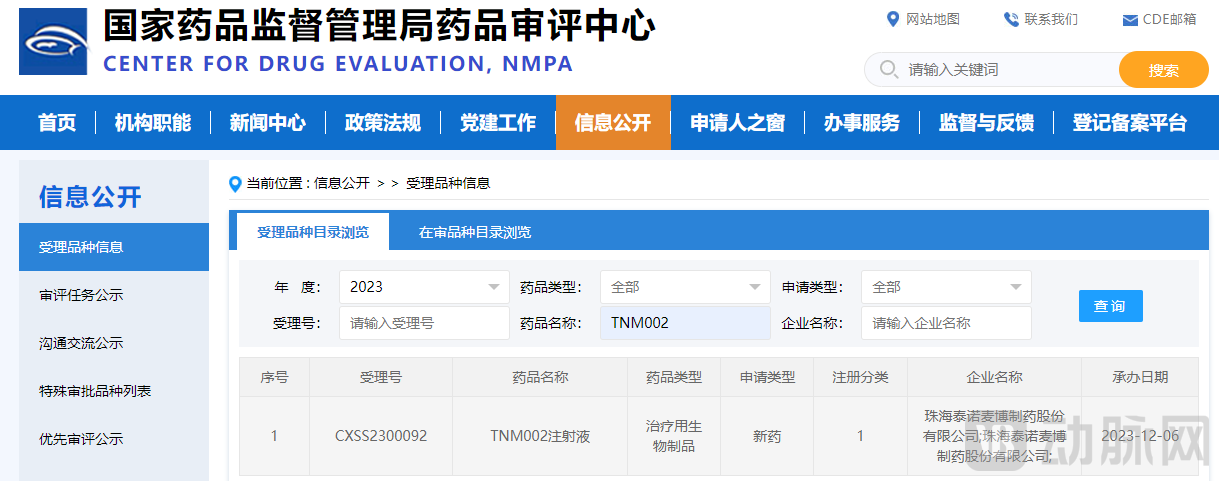
Zhuhai Trinomab Biopharmaceutical Co., Ltd. (hereinafter referred to as “Trinomab”) announced on December 7 that the New Drug Application (NDA) for TNM002 Injection, independently developed by the company, has been formally accepted by the National Medical Products Administration (NMPA) of China and included in the priority review program. TNM002 Injection is intended for emergency prophylaxis against tetanus and represents the world’s first recombinant fully human monoclonal antibody in the field of tetanus prevention.
Currently, the passive immunization agents used clinically for the prevention and treatment of tetanus mainly include Tetanus Antitoxin (TAT) and Human Tetanus Immune Globulin (HTIG).
TAT is a protein preparation derived from the plasma of horses immunized with tetanus toxoid. The incidence of allergic reactions ranges from 5% to 30%, and skin testing is required prior to clinical use. Patients who test positive on the TAT skin test require desensitization injection, during which the incidence of allergic reactions remains at 14.1%, with anaphylactic shock occurring in 1.2% of cases.[1], most developed countries have banned the clinical use of TAT.
Human Tetanus Immunoglobulin (HTIG) is a high-titer specific immunoglobulin prepared from the plasma of donors immunized with tetanus vaccine. Although it has a low incidence of allergic reactions, there is a risk of transmitting certain known or unknown blood-borne pathogens. Meanwhile, factors such as shortages of plasma sources limit its production and clinical application. In the field of passive immunization agents for tetanus prophylaxis, there is a substantial unmet clinical need.
According to the World Health Organization (WHO), human tetanus immunoglobulin (HTIG) is preferentially recommended for passive immunization in the prevention of post-traumatic tetanus (e.g., when wounds are contaminated and the injured person has not completed the immunization schedule); it is also essential for the treatment of tetanus cases.[2]. In the 1960s, countries in Europe and America successively developed HTIG for clinical use, gradually replacing TAT.[3]. In 1991, the WHO removed TAT from the Model List of Essential Medicines.[4]。
According to Frost & Sullivan, global production of HTIG is primarily concentrated in Europe and North America, mainly because the world’s blood product companies are clustered in these regions. In 2020, sales of HTIG exceeded 25 million vials across Europe, North America, China, Japan, Southeast Asia, and India. Local plasma collection volumes in Southeast Asia and India may be insufficient, resulting in a shortfall in raw material supply for immunoglobulin products and limited production capacity; consequently, these regions rely heavily on imported plasma-derived products or tetanus antitoxin (TAT).
In China, due to the limited production of human tetanus immunoglobulin (HTIG), long-standing supply has failed to meet demand, making tetanus antitoxin (TAT) still the primary agent for passive immunization against tetanus. In 2022, the consumption of passive tetanus immunization agents in China exceeded 60 million doses, with TAT accounting for over 50 million doses and HTIG for approximately 10 million doses.
TNM002 Injection (hereinafter referred to as TNM002) is developed by Tranome Biopharma using HitmAb®The recombinant fully human monoclonal antibody against tetanus toxin, developed on a proprietary technology platform, is administered via intramuscular injection for the emergency prophylaxis of post-traumatic tetanus. Its primary advantages are reflected in the following four aspects:
● Favorable safety profile: Clinical trial results demonstrated that TNM002 had a favorable safety and tolerability profile with low immunogenicity. In Phase I–III clinical trials, the overall incidence of adverse events associated with TNM002 was similar to that of the placebo/HTIG group.
● Good therapeutic efficacy: Following administration of TNM002, the titers of anti-tetanus neutralizing antibodies were significantly higher than those in the HTIG group, rapidly achieving protective levels against tetanus and sustaining protection for a prolonged duration. Phase III clinical trial results demonstrated that TNM002 injection was significantly superior to the current standard of care, 250 IU HTIG, in terms of efficacy endpoints.
● High controllability: TNM002 is a recombinant single-molecule drug. Subjected to rigorous quality control, it can be manufactured on a large industrial scale to meet market demand, and it does not carry the potential risk of transmitting blood-borne infectious diseases associated with blood products.
● High AccessibilityCompared with tetanus-specific immunoglobulin derived from human plasma products, TNM002 features a shorter production cycle, unrestricted raw material supply, scalable manufacturing capacity, and improved drug accessibility. Tainuomaibo has completed the construction of its commercial-scale manufacturing facility and obtained the Drug Manufacturing License, enabling it to meet current market demand.
Given its significant clinical advantages over existing therapies in terms of safety, efficacy, and accessibility, TNM002 was included in the Breakthrough Therapy Designation list by China’s Center for Drug Evaluation (CDE) in March 2022 and was granted Fast Track designation by the U.S. FDA in August of the same year. Under current domestic policies, TNM002 is eligible for the Priority Review procedure during the New Drug Application (NDA) stage, with priority arrangements for inspections, testing, and approval of the generic drug name, which is expected to significantly accelerate the market launch of TNM002.
Dr. Liao Huaxin, Co-founder, Chairman, and CTO of Tynor Biopharmastated, “We are delighted to see the positive clinical trial results for TNM002 and the successful submission of its New Drug Application (NDA), marking the first NDA submission in the eight years since the company’s establishment. We will maintain close communication with China’s National Medical Products Administration to expedite the approval and market launch of TNM002, thereby accelerating the iterative upgrade of passive immunization agents for tetanus and providing a novel therapeutic option for global tetanus prevention.”
Zhuhai Trinomab Biopharmaceutical Co., Ltd. is a global-oriented innovative biopharmaceutical company, primarily engaged in the research and development of original natural fully human monoclonal antibody drugs. The company’s core technology is the “HitmAb Integrated Technology Platform for Natural Fully Human Monoclonal Antibody Development.”®”, dedicated to developing novel, highly differentiated, and efficient fully human monoclonal antibody drugs with independent intellectual property rights, particularly by leveraging genetically engineered recombinant antibodies to replace plasma-derived specific immunoglobulins.
Tainuomaibo is committed to its mission of “creating clinical value.” The New Drug Application (NDA) for the company’s core product, TNM002 injection (anti-tetanus toxin monoclonal antibody), has been accepted; TNM001 injection (long-acting anti-RSV monoclonal antibody) has entered large-scale clinical studies; TNM009 injection (anti-NGF monoclonal antibody) and TNM005 injection (anti-VZV monoclonal antibody) have initiated Phase I clinical trials in China and the United States, respectively; TNM006 injection (anti-hCMV monoclonal antibody) has received clinical trial approval from the National Medical Products Administration (NMPA) of China and is poised to commence Phase I clinical trials. Additionally, several other products are in the Investigational New Drug (IND) application preparation stage, while multiple early-stage development projects continue to advance.
* References
[1] China Trauma Care Alliance, Peking University Center for Traumatic Medicine. Expert consensus on tetanus immunoprophylaxis in China[J]. Chinese Journal of Surgery, 2018, 56(3): 161-167.
[2] WHO Position Paper on Tetanus Vaccines, http://cdcp.gd.gov.cn/attachment/0/321/321115/3442910.pdf
[3] Luo Shiding. Human tetanus immunoglobulin and its application [J]. Chinese Journal of Emergency Medicine, 2022, 11(4): 285-286.
[4]https://list.essentialmeds.org/recommendations/1000