

Prismlab's Micro/Nano 3D Printing Breakthrough: Solving the Precision-Speed Paradox and Powering Next-Gen Medical Devices

Prismlab
3D Printing Technology R&D Developer
Recently,CCTV13News Channel introduced China's use of micro-nano3DFrontier Medical Advances in Organ-on-a-Chip Fabrication via Printing Technologies. As introduced in the video, Wang Xiaolin’s team at Shanghai Jiao Tong University constructed a hierarchically vascularized organ-on-a-chip model. Based on this model, they further investigated multi-stage delivery strategies for magnetically controlled micro/nanorobots, providing a new research approach for precise and efficient in vivo targeted drug delivery. The related findings were published in a prestigious journal in the field of microfluidics.
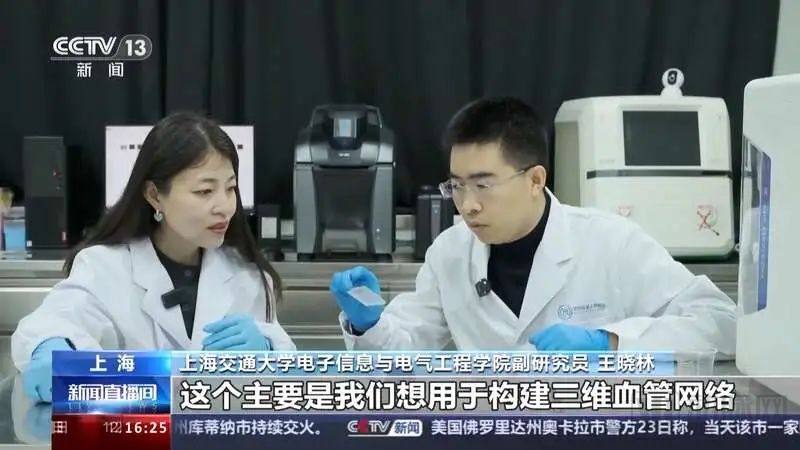
Screenshot of CCTV Report
Among them, the company providing core micro-nano 3D printing technology is a provider of 3D printing digital application solutions that has been deeply engaged in the industry for nearly 20 years—Shanghai Prismlab 3D Technology Co., Ltd. (hereinafter referred to as “Prismlab”).
Hou Feng, General Manager of Prismlab, stated in an interview with CCTV: “Internationally, 3D printing is increasingly advancing toward more cutting-edge and high-precision applications. For instance, photolithography machines used to fabricate integrated circuits at 7-nanometer and 14-nanometer nodes are essentially a form of microfabrication on machinery. Conventional 3D printing has long faced a paradox between printing speed and resolution. By employing sub-pixel micro-scanning technology, we reduce the spot size and then perform scanning within each pixel. We found that this approach can multiply printing precision with virtually no increase in processing time. Our current printing speed is tens of thousands of times faster than two-photon polymerization and approximately one hundred times faster than conventional mask-based stereolithography.”

Prismlab General Manager Hou Feng Interviewed by CCTV
“3D printing addresses the issue of personalization, and the essence of personalization lies in the individual. Without people, the concept of personalization would be meaningless.”
Hou Feng, General Manager of Prismlab, told VCBeat that in medical practice, individuals exhibit varying degrees of sensitivity to pharmaceuticals and medical devices due to biological differences. Current solutions generally seek the greatest common divisor within the range of efficacy and safety. With advancements in healthcare standards and technological progress, personalized precision medicine tailored to individual patients is gradually becoming a reality. As a powerful tool for personalized manufacturing, 3D printing is poised to bring unprecedented transformation to the medical field.
At present, 3D printing in healthcare is primarily applied at the macroscopic level, such as in dentistry and orthopedics. With the trend toward minimally invasive medical devices and surgical techniques, micro- and nano-scale 3D printing, leveraging its ultra-high precision manufacturing capabilities, can address the processing and fabrication challenges of intricate miniature products and complex components that are difficult to handle with conventional technologies. This will foster a fertile ground for innovation in medical devices within the microscopic domain.
Once manufacturing processes and medical application scenarios were addressed, another challenge emerged—The longstanding paradox in conventional 3D printing between printing speed and precision, wherein higher precision results in slower printing speeds.The reason lies in the fact that 3D printing involves objects in three-dimensional space, representing a cubic relationship.Doubling the precision requires eight times the computational time.Thus, the “curse” that print speed and print precision cannot be achieved simultaneously is a tight constraint borne by every 3D printing company.
Where there is a question, there is an answer; where there is a difficulty, there is a solution. After years of research and hundreds of thousands of attempts, Prismlab has finally found the key to unlocking mass production in 3D printing—Sub-pixel Micro-scanning Technology (SMS).
As early as 2013, Prismlab pioneered “Sub-pixel Micro-scanning Technology (SMS)” and holds full independent intellectual property rights. The technology integrates microlens array technology, piezoelectric ceramic micro-vibration scanning technology, and sub-pixel electronic control technology to generate sub-pixel light spots (with a minimum spot size of 500 nm) and achieve precise control over spot positioning and on/off switching.
Its advantage lies in the fact that sub-pixel micro-scanning (SMS) technology requires no stitching, completely eliminating stitching errors, and can enhance printing precision to 2 μm without increasing or with only a minimal increase in printing time.. Its printing precision is tens of thousands of times higher than that of two-photon polymerization and hundreds of times higher than that of conventional mask-exposure-based 3D printing.Moreover, its printing efficiency has increased a hundredfold, making it technically feasible for 3D printing to enter the realm of industrial-scale production.
Dental Giants Proactively Take on Medical Devices,
Providing Flexible Solutions with Micro-Nano 3D Printing
The earliest and most mature application of 3D printing technology in the medical field is dentistry. Similar to the development path of most 3D printing enterprises in the healthcare sector, Prismlab has previously focused extensively on its dental business, distinguishing itself with benchmark solutions in orthodontics and a complete closed-loop application of digital dental technologies.
Leveraging its strengths in 3D printing, Prismlab has launched a comprehensive solution for clear aligner therapy centered around 3D printing equipment. This solution covers the entire industry chain—from 3D printing and orthodontic film materials to automated thermoforming and cutting—establishing a complete manufacturing process system for clear aligners. With this offering, Prismlab has secured a commanding lead in market share within China.
Meanwhile, Prismlab has launched a digital manufacturing system for dental laboratories, deeply integrating additive manufacturing with intelligent manufacturing to help enterprise clients achieve their development goals of digital transformation, cost reduction, and efficiency improvement.
With the enhancement of independent innovation and R&D capabilities for minimally invasive surgical instruments in China, coupled with the deepening adoption of the concept of minimally invasive and precise diagnosis and treatment, the development of medical devices is trending toward integration and miniaturization. Traditional manufacturing methods are increasingly unable to meet the production demands of ever-more-precise medical devices. Furthermore, many medical devices feature extremely complex geometric structures based on anatomical configurations, which are severely limited in terms of what can be produced through conventional machining techniques.
Prismlab leverages micro-nano 3D printing to deliver flexible solutions for personalized therapy and precision medicine. It addresses the processing and manufacturing challenges of intricate, miniaturized products and complex devices that are difficult to handle with any traditional technology.
In addition to the organ-on-a-chip featured in this CCTV report, Prismlab has pursued a multi-pronged strategy in the medical field, with in-depth layouts inCeramic impellers, hollow microneedles, glaucoma drainage devices, precision gears, endoscope tips, microfluidic chips, microsphere manufacturing, cell scaffolds, capillaries, and dozens of other medical devices.
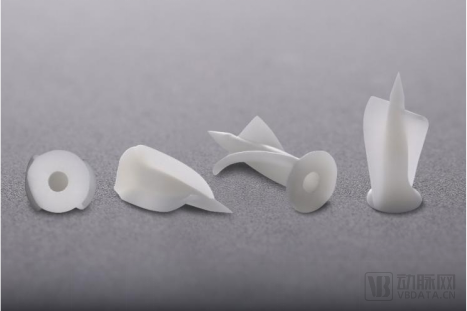
Prismlab's ceramic impeller blades feature ultra-high full-surface smoothness,
Tolerance < 5 μm, with high wear resistance and good biocompatibility
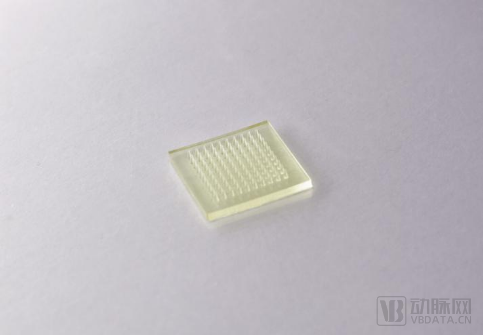
Prismlab’s hollow microneedles feature a pore diameter of only 20 μm to 80 μm,
Microneedle length: 300 μm–1200 μm, offering advantages of good biocompatibility, effective penetration, and painless drug delivery.
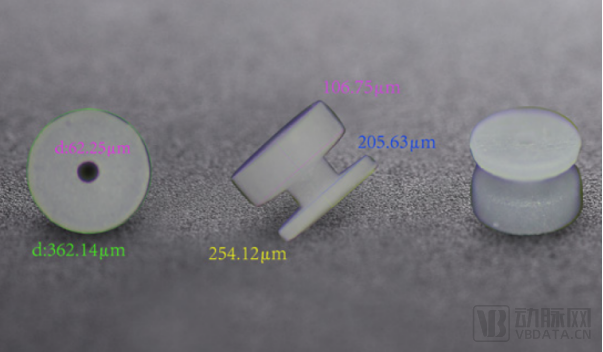
Prismlab’s drainage pin has an inner diameter of only 60 μm–80 μm,
Overall height: 0.3 mm–0.4 mm. Features include good biocompatibility and a smooth surface.
Beyond application scenarios, Prismlab also possesses unparalleled advantages in personalized manufacturing, manufacturing efficiency, production costs, and the processing of precision complex devices.
“Although the printing cost of Sub-pixel Micro-scanning (SMS) technology is higher than that of traditional 3D printing, its overall cost is relatively lower when comprehensive efficiency is taken into account,” explained Hou Feng. Low production efficiency inevitably leads to high product costs. Prismlab can now achieve an effect 100 times greater than conventional area-array exposure. While traditional 3D printing technologies could previously produce only about a dozen units per month, Prismlab can manufacture hundreds at once and supports mass production on the scale of tens of billions, thereby meeting the specialized treatment needs of all patients. For instance, the eye stent mentioned above for glaucoma treatment features a complex structure and unique shape, with a diameter of merely 0.3 millimeters. Traditional manufacturing methods entail extreme difficulty and high costs, whereas Prismlab can precisely produce hundreds of these units in a single run, driving costs down to the absolute minimum.
Meanwhile, Hou Feng emphasized that Prismlab is not a manufacturer of 3D printing equipment, but a provider of advanced manufacturing solutions. Prismlab focuses on the integration of internet technologies into 3D printing equipment. The company has already implemented digital twin capabilities and IoT-enabled retrofits for its devices, and will continue to pursue digital upgrades.
With precise hardware upgrades and intelligent software iterations, Prismlab will join forces with more medical device manufacturers to leverage micro-nano 3D printing technology as a core platform, delivering innovative solutions that address diverse personalized healthcare needs.
What Is Good 3D Printing?
To this day, many still believe that a 3D printer capable of printing “anything” is inherently superior. However, while the ability to print “anything” may seem like the perfect solution, it is in fact a hidden reef that has stranded many 3D printing companies.
“3D printing has only been around for two or three decades since its inception. If we were to compare it to a human, it would still be in the ‘childhood’ stage of growth and development. Expecting a technology that is still being perfected to handle all products is akin to claiming there is a single pill that can cure every disease.” Hou Feng believes that the notion of being able to “do it all” is actually a technological trap; an excessive pursuit of personalization will inevitably severely hinder large-scale commercial application.
Based on this perspective, Prismlab has proposed the concept of "Limited Personalization," which involves concentrating all technologies, resources, and efforts to achieve breakthroughs at specific points. By adopting reverse engineering thinking rooted in user pain points and needs, the company develops products and equipment. With cutting-edge technology, optimal cost-performance ratio, and superior service, Prismlab provides customers with 3D printing solutions that deliver maximum efficiency, best-in-class products, optimal user experience, and minimal costs.. In short, it involves developing exclusive 3D printers tailored for specific clients and industries.
Hou Feng cited an example: when receiving user demands, Prismlab would first verify the authenticity of the 3D printing application needs, then study adaptive materials for related products through 3D printing, and subsequently work backward to research equipment for producing such materials or optimize existing equipment, thereby providing customers with solutions for automated and continuous production.
Prismlab’s products have gained significant market favor due to their notable advantages, including rapid forming speed, high printing precision, and low overall costs. The company has customized and operates a 3D printing base for the leading enterprise in China’s dental orthodontics market, achieving the ambitious business goals of increasing production speed by fivefold and reducing production costs by 60%. This facility represents an industry-first, true Industry 4.0-compliant, 24/7 unmanned smart 3D printing factory.
Exports surged by 150%, with best-selling presence in over 50 countries,
Committed to Becoming the Global Leader in Commercial Applications of 3D Printing
Currently, Prismlab offers a diverse portfolio of 3D printing equipment for various applications, along with customized resin materials co-developed with the global chemical giant BASF from Germany. By integrating R&D, sales, and service, the company markets its products to more than 50 countries and regions worldwide, achieving an impressive 150% growth in export sales in 2023.
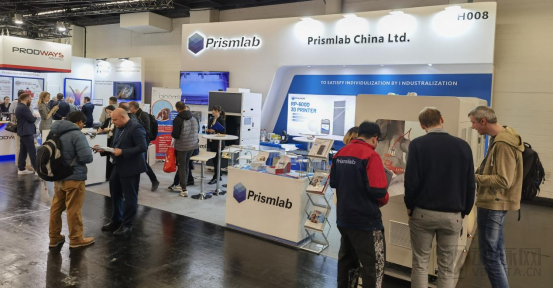
“Making traditional industries stand out with micro-nano 3D printing” is the original aspiration behind the founding of Prismlab, as well as its consistent highest guiding principle for action. Meanwhile, Prismlab remains committed to addressing personalized needs through industrialized methods, aspiring to become the “world’s leading provider of commercial 3D printing solutions.”
“We only do what we are good at, which is the industrialization of 3D printing,” said Hou Feng. He noted that the 3D printing market is highly fragmented. Prismlab has been continuously exploring truly suitable applications, serving them well, and turning these applications into mass-produced cash cows. “As research into micro-nano 3D printing for medical devices deepens, I believe this path will become increasingly smooth.”
As a pioneer in China’s 3D printing industry, Prismlab has never ceased its exploratory efforts. The company has secured dozens of patents for core technologies and, over the past five years, has led the completion of major national research initiatives, including the “National Key R&D Program: Additive Manufacturing Processes and Equipment for Micro-Nano Structures” and the “Intelligent Dental 3D Printing Service Project.” Prismlab has been successfully included in the lists of “Shanghai Specialized, Refined, Differential, and Innovative Enterprises” and the “Shanghai Little Giants Cultivation Project,” establishing itself as one of the few domestic 3D printing companies that tightly integrate technological innovation with industrial commercialization.
At the end of the interview, Hou Feng remarked with deep emotion, “It is a great privilege to engage in innovation and R&D in China. The country’s vast application market offers abundant opportunities for us to continuously seek out and iterate our products. No other country boasts such a wide array of application scenarios. Therefore, we hope to collaborate with and learn from more established medical device companies, jointly advancing the standard of medical devices in China to benefit more patients.”