

2023 Internet Healthcare Service Insight Report: Exploring Emerging User Needs and Building a New Service Ecosystem
Since 2023, internet healthcare has entered a period of true normalization. In this more rational environment, the key to breaking through market constraints in the next phase lies in transforming past highlights into consolidated capabilities.
To better understand the alignment between user demand and service supply in internet healthcare during this new phase, VCBeat and JD Health have jointly released the “2023 Internet Healthcare Services Insight Report: Exploring New Demands and Building a New Service System.” This report analyzes innovative pathways based on user needs, providing valuable references for the industry.
In 2023, the overall volume of medical services in China increased significantly, showing marked growth compared to both the same period in 2022 and the pre-pandemic levels of 2019 and earlier, with the healthcare service system, particularly offline services, fully resuming operations.
While offline medical services have recovered and experienced rapid growth, online healthcare continues to expand. As of June 2023, the number of internet healthcare users in China reached 364 million, an increase of 1.62 million from December 2022, accounting for 33.8% of the country’s total internet population.
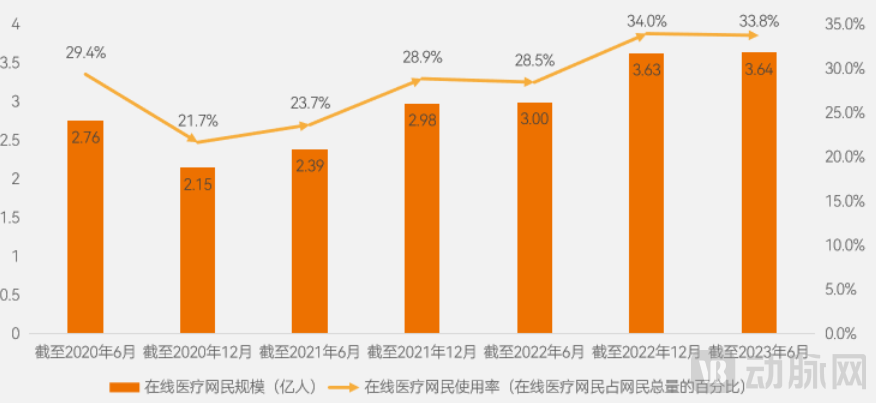
Trends in the Number of Internet Healthcare Users in China
Data source: China Internet Network Information Center; Chart by VCBeat
Over the three years following 2020, internet healthcare experienced rapid development, with a portion of offline medical demand shifting to online platforms. Patients, physicians, and administrative authorities have all demonstrated greater recognition of internet healthcare.
However, it remained uncertain at the time whether healthcare demands that had shifted online would return to offline channels. Judging by the latest user figures and trends since 2020, online and offline medical services are not in a zero-sum relationship. Essential services such as diagnostic tests, examinations, surgeries, and hospitalizations must be conducted offline, while online healthcare can complement offline services through innovations in service models.
At present, young people constitute the main user base of internet healthcare services, but elderly users already account for a certain proportion, with the share of middle-aged and elderly users increasing year by year.
Sample data indicates that among users of online consultation services, those aged 19–40 account for half. This demographic exhibits a high reliance on mobile internet applications, gradually extending their usage from various aspects of daily life and work—such as shopping, dining, and travel—to healthcare. Meanwhile, elderly users (aged 61 and above) constitute 12.83% of the user base. Internet healthcare platforms have enhanced accessibility for older adults through measures such as optimized page design and smart terminal configurations.
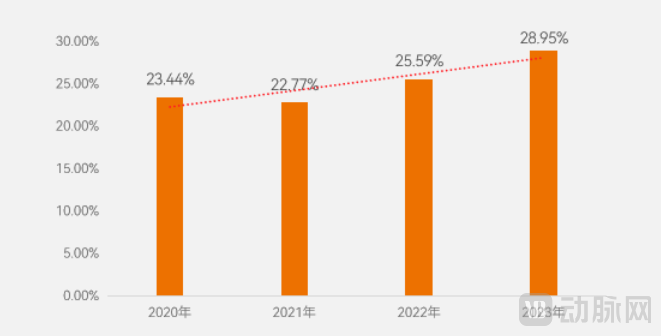
Proportion of Users Aged 41 and Above Among Online Consultation Users
Data source: JD Health; Chart by VCBeat Research Institute
More importantly, the proportion of middle-aged and elderly users (aged 41 and above) has been increasing year by year, rising from 22.77% in 2021 to 28.95% in 2023. As a population with a high prevalence of chronic diseases, the growing share of middle-aged and elderly users has expanded the potential user base for internet healthcare.
Internet healthcare users exhibit diverse yet highly focused consultation needs, with a high volume of inquiries for common conditions in dermatology, respiratory medicine, and obstetrics and gynecology. Among these, skin diseases—represented by eczema, dermatitis, and acne—account for the largest proportion.
Among the sample data, when categorized by first-level departments, Traditional Chinese Medicine (TCM), Internal Medicine, Nutrition, Obstetrics and Gynecology, and Dermatology and Venereology recorded the highest consultation volumes. When categorized by second-level departments, those with the highest consultation volumes included Pharmacy, Nutrition, TCM Internal Medicine, Nursing Consultation, and Dermatology.
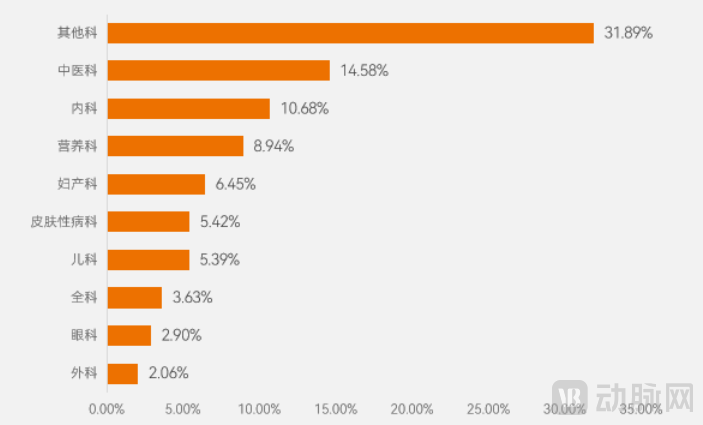
Top-Tier Department with the Highest Volume of Online Consultations
Data source: JD Health; Chart by VCBeat Eggshell Research Institute
Departments with high service volumes correspond to disease categories with similarly high service demands. Sample data indicate that the top 20 diseases by volume of online consultations include eczema, respiratory tract infections, and dermatitis, among which seven are skin conditions. Dermatology relies minimally on in-person laboratory tests and examinations, as it can leverage high-resolution images and video consultations. Consequently, it has long been regarded as one of the specialties most suited for delivering internet-based healthcare services.
Respiratory and obstetrics/gynecology-related diseases are also among the categories with high volumes of online consultations. These conditions and health issues, characterized by either high prevalence or diverse intervention options, are well-suited for online services.
Furthermore, a growing number of users are opting for online self-administered psychological scale assessments and psychological counseling services, with data for both services showing an upward trend. Over the past two years, workplace stress and academic pressure have become prominent topics, drawing significant societal attention to related mental health services. Online psychological assessments and counseling have provided users with convenient access to these resources.
From the perspective of consultation frequency, users are gradually forming the habit of using internet healthcare services and tend to seek medical advice multiple times for diseases or health issues within the same specialty. According to the sample data, 16.11% of users conducted 2–4 consultations within the same department over the course of a year.
Sample data also reveals that 13.1% of all online consultation orders were for convenient follow-up visits, where patients initiated follow-ups through previous orders, allowing continued access to prior medical records (with no change in condition) and prescription information, or enabling them to supplement updates on their health status. This facilitates more efficient communication between doctors and patients, further demonstrating user acceptance of internet-based healthcare services, particularly online follow-up consultations.
However, issuing prescriptions is not always the primary purpose of online consultations. After the consultation is completed, most orders do not result in a prescription being issued, as these users require more diversified services beyond prescriptions.
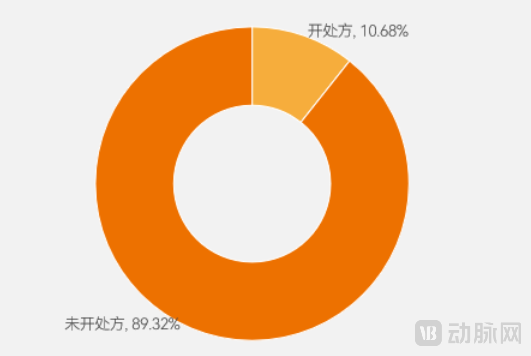
Online Consultation on Prescription Issuance
Data source: JD Health; Chart by VCBeat Eggshell Research Institute
As evident from the sample data, only 10.68% of consultation orders resulted in prescriptions, while a significant 89.32% did not. For orders without prescriptions, users may have received health advice on exercise and diet, data monitoring and self-management, or home-based rehabilitation and nursing care, or they may have been advised to seek offline medical attention.
Centered on user needs, internet healthcare should establish a new service system in the new phase.
For example,Efficient and precise doctor-patient matching, with timely responses to users' needs throughout the entire process.For Internet Healthcare UsersConsultationRegardless of whether patient safety or user experience is considered, consultation practices should promptly address patients’ needs throughout the entire medical and pharmaceutical care continuum and precisely match service resources.
Users demand efficient and convenient access to all types of internet applications, and internet-based healthcare is no exception. Meanwhile, patients have limited ability to assess the urgency of their own conditions; even though platforms provide guidelines on cases unsuitable for online consultations, it remains inevitable that patients with urgent medical needs will initiate consultations, necessitating timely responses from the platform. Furthermore, it is common for patients to be uncertain about which department or physician to choose when seeking care, requiring the platform to precisely match them with appropriate service providers and content.
Fully integrate resources to build integrated services centered on specialized disciplines and specific diseases.Data analysis indicates that users have a pronounced need for continuous medical care centered around disease management. The fragmented nature of traditional healthcare services struggles to meet these needs. While online consultations and remote prescription renewals transcend temporal and spatial constraints, representing an innovative approach, they only address a portion of the demands related to disease and health issues.
The new service system must center on the continuum of diagnosis, treatment, and rehabilitation, integrating corresponding service resources to break down barriers across disciplines, among medical services, pharmaceuticals, and insurance offerings, and between online and offline channels, thereby providing users with integrated, specialty- and disease-specific care.
Segment user groups and focus on key populations to match them with personalized healthcare services.In addition to providing integrated services for patients centered on disease management, personalized services must also be provided to high-risk populations, including pregnant and postpartum women, infants and young children, students, occupational groups, and the elderly.
On the one hand, personalized healthcare services are tailored to individual differences in age, lifestyle, and health status, thereby enhancing service quality. On the other hand, such personalization enables more precise allocation of medical resources and reduces healthcare costs; for patients, it helps promote and maintain health, lowers disease risk, and consequently decreases the consumption of medical resources.
Accumulate data across the entire healthcare process and deeply mine its value.On the foundation of establishing specialized departments and disease-specific programs, as well as personalized services, precise medical and health data can be accumulated, with a focused effort on unlocking its value.
Data accumulation and value extraction enable internet healthcare platforms to promptly capture patient feedback and optimize product and service workflows. Furthermore, comprehensive multi-dimensional data can provide larger-scale samples for medical research, facilitating in-depth exploration of disease pathogenesis, treatment regimens, and the value of internet healthcare within this context.
Furthermore, the development of a new service system for internet-based healthcare requires concerted efforts in technological innovation, service standardization and quality assurance, as well as partner empowerment.
Recently, at the “2024 JD Health Annual Doctor Gala,” JD Health unveiled its innovative pathway for internet-based medical services: cumulative investments exceeding RMB 2 billion in areas such as technological research and development, quality assurance, and operational management; adhering to a long-term strategy by specializing, deepening, and strengthening online consultation services; achieving end-to-end regulatory compliance, comprehensive safety, and system-wide quality control across the entire internet healthcare process; and leveraging large medical language models to accelerate the upgrading of clinical decision support tools and enhance the efficiency of online medical practice.
Overall, JD Health is striving to create a model for a new type of internet-based healthcare service system.
It is understood that the full text of the “2023 Internet Healthcare Services Insight Report—Exploring New Demands and Building a New Service System” will be released in the near future. Please stay tuned to the VCBeat website and its WeChat official account.