

BridgeBio Pharma Secures $1.25 Billion Royalty Financing Following FDA NDA Submission for Acoramidis in ATTR-CM
On January 18, biopharmaceutical company BridgeBio Pharma, Inc. (BridgeBio) announced the completion of a $1.25 billion (approximately RMB 8.99 billion) drug royalty financing transaction. Under this agreement, upon FDA approval of acoramidis, BridgeBio will receive $500 million, with $300 million paid by Blue Owl Capital and $200 million by the Canada Pension Plan Investment Board, in exchange for a 5% royalty on future global sales of acoramidis.
In addition, Blue Owl Capital will provide a $450 million credit facility to support the commercialization of the drug, as well as a $300 million credit facility for strategic pipeline expansion and accelerated development.
Acoramidis is a therapeutic agent for the treatment of transthyretin-mediated (ATTR) amyloidosis with cardiomyopathy (ATTR-CM), developed by Eidos Therapeutics, a subsidiary of BridgeBio. BridgeBio is a clinical-stage company focused on developing treatments for genetic diseases and cancer. The company currently has more than 15 candidate products in its pipeline, ranging from early discovery to late-stage clinical development, covering therapeutic areas such as cardiorenal diseases, Mendelian disorders, and cancer. Among these, two products have reached the commercialization stage, and four candidate products, including Acoramidis, are in Phase 3 clinical trials.
Acoramidis is an investigational, next-generation, orally administered, high-affinity small-molecule stabilizer of transthyretin (TTR). It is designed to mimic the protective function of the TTR T119M genetic variant, considered a “rescue mutation” that can prevent or minimize ATTR amyloidosis in individuals carrying pathogenic or likely pathogenic TTR mutations. By maintaining the native tetrameric conformation of the TTR protein and preventing the formation of toxic amyloids, Acoramidis is effective against both wild-type and V122I mutant TTR.
In December 2023, BridgeBio submitted a New Drug Application (NDA) to the U.S. Food and Drug Administration (FDA) for acoramidis for the treatment of patients with ATTR-CM accompanied by cardiomyopathy. The application was based on the results of the pivotal Phase 3 clinical trial, ATTRibute-CM, which was designed to evaluate the efficacy and safety of acoramidis.
In July 2023, BridgeBio announced positive topline results from the ATTRibute-CM trial, with clinical data at 30 months demonstrating high statistical significance.
Data analysis of the trial results, including all-cause mortality (ACM), frequency of cardiovascular-related hospitalizations (CVH), changes from baseline in N-terminal pro-brain natriuretic peptide (NT-proBNP), and changes from baseline in 6-minute walk distance (6MWD), demonstrated an all-cause win ratio of 1.8 for the primary endpoint (p<0.0001). This indicates that acoramidis has a potent TTR-stabilizing effect and is well tolerated, with no potential safety signals identified.
In the ATTRibute-CM trial, treatment with acoramidis demonstrated an absolute survival rate of 81% (versus 74% in the placebo group), which is comparable to the 85% survival rate observed in an age-matched general population from a US database. The cardiovascular health (CVH) score among participants was 0.29, similar to the 0.26 reported for the general Medicare population in the US database. Results from ATTRibute-CM also indicated that patients receiving the drug achieved clinical benefits more rapidly with respect to the composite endpoint of all-cause mortality (ACM) and CVH.
Notably, in contrast to the results observed in previous TTR stabilizer trials, acoramidis demonstrated a consistent reduction in the risk of cardiovascular-related hospitalization across all prespecified patient subgroups at 30 months. The Kaplan-Meier curves for time to first occurrence of ACM and CVH began to diverge between the treatment and placebo groups at month 3 and continued to separate steadily through month 30, with a hazard ratio of 0.645 (p=0.0008).
In addition, acoramidis was also compared with Pfizer’s Vyndamax (tafamidis). Vyndamax was approved in 2019 for the treatment of ATTR-CM and is the first drug approved for this indication.
The study results showed that at month 30, acoramidis demonstrated a 92% improvement in heart failure outcomes compared with patients receiving placebo or Vyndamax, and the time to first separation of the Kaplan-Meier curves was one-third that of Vyndamax, which took approximately 9 months to show separation.
BridgeBio Chief Financial Officer Brian Stephenson stated that although no FDA approval decision date for acoramidis has been received yet, the $1.25 billion transaction validates the long-term potential of acoramidis, and the company will submit additional marketing authorization applications to global health authorities this year. Josh Schimmer, an analyst at financial services firm Cantor Fitzgerald, also noted in a report that this royalty deal implies peak sales for acoramidis will reach approximately $5 billion.
Following the announcement of successful Phase 3 clinical trial results for acoramidis, BridgeBio’s stock surged 75.85% in pre-market trading on the same day, with its market capitalization soaring by $2.4 billion to exceed $5 billion, once again drawing the market’s attention to the company.
Although BridgeBio had already been “widely known” before this.
In 2015, Andrew, a finance professor at the Massachusetts Institute of Technology (MIT), founded BridgeBio in the San Francisco Bay Area of California, focusing on rare diseases within the biopharmaceutical industry. Over the following two years, Andrew and CEO Neil Kumar continuously raised capital and built their research team. Between 2016 and January 2019, BridgeBio completed four rounds of financing, raising a total of over $470 million. Despite having no approved products at that time, BridgeBio remained highly sought after by numerous investors.
On June 26, 2019, BridgeBio made its debut on the Nasdaq in the United States. During the IPO, the number of shares offered increased from 15 million to 20 million, ultimately raising $348 million. The stock closed up more than 62% on its first day of trading, reaching a market capitalization of $3.3 billion, setting a new record for biotech IPO fundraising in 2019 and earning the title of “Largest Biotech IPO” of the year.
From that point until 2021, BridgeBio enjoyed remarkable success: its stock price doubled within less than a year and a half of going public, and its market capitalization briefly surpassed $10 billion at its peak. Notably, its investigational candidate acoramidis garnered significant favor from investors and the market, enabling the company to secure nearly $1 billion in financing following its IPO.
However, Acoramidis, which brought BridgeBio its moment in the spotlight, also once pushed the company into a trough.
In December 2021, the Phase 3 Part A clinical trial of acoramidis for ATTR-CM failed. Clinical data showed that at 12 months, the change in 6-minute walk distance (6MWD) was 9 meters in the acoramidis group and 7 meters in the placebo group, indicating that acoramidis did not outperform placebo. Prior to the completion of this trial, BridgeBio had been highly optimistic about acoramidis and predicted it would seek FDA approval in 2022.
However, contrary to expectations, news of the clinical failure sent BridgeBio’s stock plunging 69%, with shares continuing their downward trajectory. By May 2022, its market capitalization had shrunk to just $800 million, a stark contrast to the $10 billion peak recorded a year earlier.
Since then, BridgeBio has faced severe financial pressure. In the first quarter of 2022, the company held only $370 million in cash and cash equivalents, while its total operating costs and expenditures reached $650 million in 2021. Compared with pursuing FDA approval, emerging from this trough and ensuring survival became BridgeBio’s top priority.
Layoffs, divestiture of pipeline assets, and the sale of Priority Review Vouchers (PRVs) have become BridgeBio’s self-rescue measures. During its trough period, BridgeBio underwent two rounds of layoffs, and Cameron Turtle, its Chief Strategy Officer who had served the company for five years, departed. The company partnered with Bristol-Myers Squibb (BMS), securing a $90 million upfront payment, up to $815 million in milestone payments, and tiered royalties for its candidate product, the SHP2 inhibitor BBP-398. Additionally, it sold one PRV for $110 million. These measures helped BridgeBio sustain its operations for more than two years.
Fortunately, BridgeBio never gave up on acoramidis. After more than two years of persistence, acoramidis has once again brought the dawn of victory to BridgeBio, which currently has a total market capitalization of $6.534 billion.
Currently, drugs approved globally for the treatment of ATTR include Alnylam’s Onpattro (patisiran), Ionis Pharmaceuticals’ Tegsedi (inotersen), and Pfizer’s Vyndaqel (tafamidis meglumine) and Vyndamax.
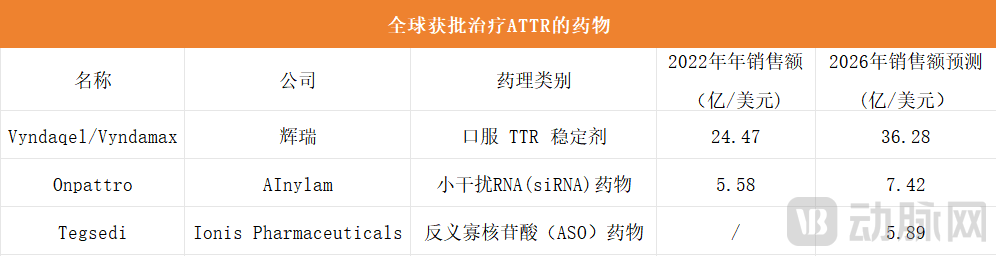
Global Overview of Approved Drugs for the Treatment of ATTR
Source: Compiled from public data; graphic by VCBeat
Currently, there are 300,000 to 500,000 patients with ATTR-CM worldwide. Among reported cases of hereditary amyloidosis, more than 50% involve cardiac involvement. The average survival time after clinical diagnosis is relatively short, approximately 2 to 3.5 years, with death usually resulting from progressive heart failure, imposing a substantial medical burden. According to a new report by the U.S. market research and consulting firm Grand View Research, Inc., the global market size for ATTR therapeutic drugs is projected to expand at a compound annual growth rate (CAGR) of 7.6% from 2022 to 2030, reaching an estimated USD 9.17 billion by 2030.
If successfully approved for market launch this time, Acoramidis could become the next blockbuster drug with annual sales exceeding $1 billion.