

CVS Health Announces Strategic Overhaul: 900 Store Closures and Executive Leadership Restructuring to Navigate 2024 Challenges

CVS Health
Pharmaceutical Retailers
On January 12, CVS Health announced that it would close certain CVS pharmacies located within Target stores in early 2024, with the process scheduled to begin in February and conclude in April. CVS Health currently operates more than 9,000 pharmacies, nearly 1,800 of which are situated inside Target stores.
Amid the healthcare sector’s weak performance in 2023, U.S. chain pharmacies, including CVS’s rival Walgreens Boots Alliance, have been implementing cost-cutting initiatives to adapt to market changes. In addition to strategic realignments made after assessing demographic shifts, consumer purchasing patterns, and future health needs, CVS’s ongoing strategic transformation has also been a key driver behind this move. CVS stated that, as part of its business transformation, it will close approximately 900 stores by 2024 at the latest.
Meanwhile, starting January 5, CVS has been successively adjusting its corporate management team. Tom Cowhey was appointed as the new Chief Financial Officer (CFO). Mike Pykosz, head of the acquired Oak Street Health, was named President of Healthcare Delivery while continuing to oversee related business operations. Erin Condon was appointed as Chief Marketing Officer (CMO) and simultaneously serves as Vice President of Store Marketing and Store Experience.
Before joining CVS, Tom Cowhey held long-term strategic and financial roles at Aetna Insurance. The subsequent $69 billion acquisition of Aetna by CVS marked a milestone in the company’s development. As CFO, Tom Cowhey will oversee CVS’s overall financial strategy. In addition to his responsibilities for Oak Street Health, Mike Pykosz will help unify CVS’s care delivery operations, fostering organic integration between legacy and new business lines. Meanwhile, Erin Condon will drive the further transformation of CVS Pharmacy following store closures.
At the start of the new year, following the announcement of its store closure plan, CVS Health has taken frequent actions across its financial, new business, and pharmacy segments. This not only indicates that issues have arisen in these three business lines but also foreshadows that 2024 is destined to be a turbulent year.CVS, established over 60 years ago, is undergoing a mid-life transformation through radical reinvention.
As of Q3 2023, CVS Health’s revenue continued to grow at a year-over-year rate of 10%; however, hidden dangers lurked beneath the surface.
Although best known for its chain pharmacies, CVS has evolved over the years into a comprehensive health solutions provider spanning multiple sectors.
In 2023, CVS adjusted its business segments into Health Care Benefits, Health Services, Pharmacy & Consumer Wellness, and Corporate/Other. In contrast, the business segments in 2022 were Health Care Benefits, Pharmacy Services, Retail/LTC, and Other.
From a business model perspective, CVS has long moved beyond the traditional pharmacy model to evolve into a comprehensive healthcare services provider. Spanning insurance to care, and physicians to pharmaceuticals, CVS aims to keep users within its service network “permanently.” However, numerous challenges have arisen in actual operations, which are also reflected in its financial reports.
Although overall revenue continued to grow in 2023, profits failed to increase. Financial report data show that adjusted operating profit decreased by 5.1% and 10.4% year-over-year in Q1 and Q2, respectively. Although there was a slight year-over-year increase of 2.5% in Q3, no upward trend was observed on a quarter-over-quarter basis.
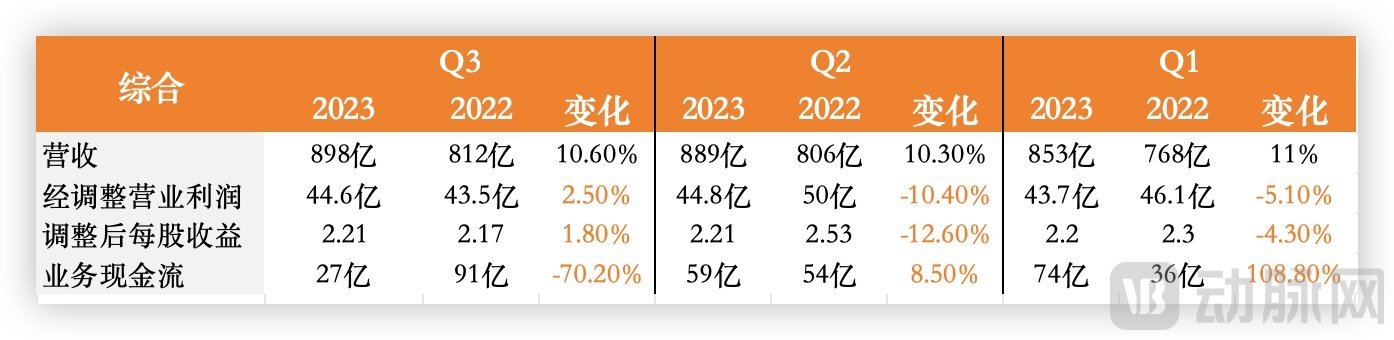
CVS Health’s Partial Revenue Performance in Q1–Q3 2023, Data Sourced from Corporate Financial Reports
CVS Health projected its total revenue for 2023 to range between $351.5 billion and $357.3 billion. Its adjusted earnings per share (EPS) stood at $2.21, surpassing the Wall Street consensus estimate of $2.13. However, the company also revised its 2024 earnings forecast, projecting total revenue of approximately $366 billion. This marks the third consecutive time it has lowered its annual performance targets. The adjusted EPS for 2024 is now expected to be between $8.5 and $8.7, down from the previously forecasted $9. Meanwhile, CVS Health withdrew its guidance of $10 for adjusted EPS in 2025. Unsurprisingly, CVS Health’s stock price fell by 3% in response.
If we attempt to identify the reasons from the financial reports, the pharmacy and consumer health segments may be key factors.
Following the successive acquisitions of two companies, CVS adjusted its business structure in its 2023 financial reports, with the Pharmacy and Consumer Health segment now encompassing the former Pharmacy Services and Retail Pharmacy businesses. Although data indicates strong performance for this segment, marked by year-over-year growth across three quarters, CVS’s simultaneous changes to its segment reporting structure as well as its accounting and reporting practices have raised some concerns among market participants.
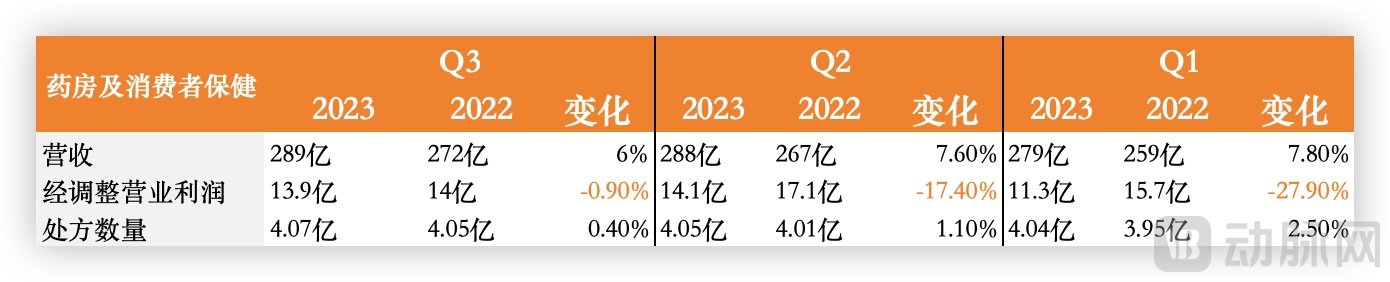
Revenue from Pharmacy and Consumer Health Businesses, Data Sourced from Corporate Financial Reports
The adjusted operating profit for the Pharmacy and Consumer Health segments was RMB 1.13 billion, RMB 1.41 billion, and RMB 1.39 billion in the first three quarters, respectively, representing year-on-year declines of 27.9%, 17.4%, and 0.9%. CVS attributed this to a decline in sales of pandemic-related testing and diagnostic products. Nevertheless, it was precisely the outbreak of the pandemic that drove a strong surge in CVS’s stock price, which nearly doubled from $56 per share to approximately $103 between October 2020 and February 2022.
Numbers do not lie. Maintaining double-digit revenue growth in the challenging environment of 2023 indicates that CVS Health’s multi-year strategic business layout is beginning to yield results. However, the continued decline in profits also underscores the numerous challenges the company currently faces.
CVS Health: Born from Pharmacy Retail, Yet Trapped by It
The growth logic of retail pharmacies hinges on scale. As revenue increases, costs rise correspondingly; only when a pharmacy achieves sufficient scale can it effectively boost profits by reducing drug acquisition and operational costs. In the United States, the role of Pharmacy Benefit Managers (PBMs) must also be considered. Driven by cost-containment objectives, payers and PBMs are highly motivated to suppress drug prices. This tightening on the payment side continues to compress pharmacy profit margins.
Pharmacy Benefit Managers (PBMs), a healthcare fund control model designed by U.S. commercial insurers to improve the efficiency of health insurance fund utilization, have long balanced and coordinated the interests of multiple stakeholders—including the government, insurance institutions, pharmaceutical manufacturers, and patients—through PBM organizations. PBM organizations provide services such as formulary management, mail-order pharmacy services, processing of prescription reimbursement claims, drug utilization review, clinical pathway recommendations, and disease management. Previously, PBM organizations accounted for 80% of the U.S. prescription drug market.
Despite CVS Health’s status as one of the three largest pharmacy benefit managers (PBMs) in the United States, achieved through vertical integration, and its control of over 30% of the prescription drug market share, its PBM business faced challenges in 2023.
In August 2023, Blue Shield of California, a U.S. non-profit health insurance company, announced that it would discontinue its use of the PBM services under CVS and instead adopt a subcontracting model, causing CVS’s stock price to drop by more than 9%.
Blue Shield Insurance has unbundled its PBM requirements across five different vendors, including Amazon for medication delivery services, MCCPDC for low-cost medications, Abarca for prescription drug claims processing, and Prime Therapeutics for drug price negotiations, while CVS continues to provide only specialty pharmacy services and patient education.
Judging from the results, MCCPDC is a company that provides affordable medications. It was previously sued by AbbVie for selling Yusimry, a biosimilar of Humira, at a price 85% lower than that of the originator drug. Blue Shield’s decision to partner with it clearly signals an intent to reduce medication costs.
From the perspective of the spin-off itself, although challenges remain in ensuring collaborative efficiency among the various subcontracted entities, these issues can be temporarily overlooked in light of Blue Shield’s intent to gain direct control over its PBM operations. In fact, it is not only insurers like Blue Shield that are seeking to diminish the influence of PBMs; regulators are doing so as well.
From the U.S. Congress and the Federal Trade Commission to state legislatures and various regulatory agencies, stricter regulatory policies are being formulated to address the PBM model. For instance, the U.S. Senate Committee on Finance passed a bill that removes rebates and fee structures from drug formularies to curb PBMs’ practice of listing more expensive medications on prescription plans. The House Committee on Ways and Means also advanced legislation requiring PBMs to disclose how they leverage rebates to boost profits rather than improve public health, and mandating that all discounts be used to reduce patient out-of-pocket costs.
In U.S. state legislatures, more than 40 states introduced nearly 150 bills in 2023 to regulate pharmacy benefit managers (PBMs), with over ten already enacted. Weakening the influence of PBMs has become a trend for the foreseeable future.
Although PBM organizations and for-profit insurers have shown little willingness to reform, CVS Health has been compelled to implement a series of reforms to align with market demands, driven by cost-conscious clients such as non-profit insurers and self-insured employers operating under the Administrative Services Only (ASO) model. After all, these corporate clients constitute a significant portion of CVS Health’s customer base, and losing them would have a substantial impact on its profitability.
Having been established for decades, CVS has followed a path of development defined by continuous transformation in response to market demands.
Since its establishment in 1963, CVS has grown through decades of mergers and acquisitions to become a leading pharmacy chain in the United States. As early as 1999, CVS entered the online business by acquiring the e-pharmacy Soma.com. In 2005, CVS surpassed its competitor Walgreens to become the largest pharmacy chain in the nation.
CVS is well-versed in the path of transformation through mergers and acquisitions.
Following its $8 billion acquisition of Signify Health in 2022, CVS acquired Oak Street Health for $10.6 billion in 2023.
Oak Street Health operates primary care centers across 21 U.S. states, predominantly in underserved areas characterized by lower socioeconomic status, inferior quality of medical services, unmet healthcare needs, and high levels of medically unnecessary expenditures. Its target population primarily consists of individuals eligible for Medicare, a U.S. government health insurance program mainly covering adults aged 65 and older, as well as certain younger individuals with long-term disabilities.
Both Signify Health and Oak Street Health, despite having slightly different business models, fall under the home-based healthcare sector.
The CEO of CVS Health stated that although home-based healthcare accounts for only about 10% of national healthcare expenditures, it exerts a significant influence on the healthcare sector. This assertion stems from the fact that the home-based healthcare business is not merely a new additive to existing operations, but rather complements and synergizes with current offerings. By integrating customer bases across different business lines to achieve comprehensive coverage and merging multiple service streams, the company can effectively reduce costs and win the favor of payers through more competitive bundled service pricing.
For pharmacy businesses, competition has intensified in recent years; relying solely on existing service models for expansion is clearly unsustainable. Home healthcare, which is closely aligned with core operations, offers a substantial customer base, and enhances corporate revenue, has naturally emerged as a new strategic pillar.
However, to fully leverage this pivotal role, CVS must rapidly break down the barriers between its legacy and new businesses to achieve member sharing and business integration. The appointment of Mike Pykosz, head of Oak Street Health, as President of Healthcare Delivery is also aimed at this objective.
Faced with such a strategic pivot point, CVS Health’s path of expansion through mergers and acquisitions has not been smooth sailing. Not only has its long-time rival Walgreens frequently competed in the same space, but internet giant Amazon has also entered the fray, notably outmaneuvering CVS Health in its attempt to acquire One Medical.
Furthermore, amid increasingly stringent regulatory scrutiny of high drug prices, CVS has announced a transformation of its prescription drug reimbursement model. The new pricing method, called the CostVantage program, bases reimbursements on a transparent formula comprising drug costs, a fixed markup, and patient management fees, covering approximately 9,500 pharmacies nationwide. CVS plans to launch this reform in 2024, driving it forward through its integrated network of retail pharmacies, pharmacy benefit managers (PBMs), and various partners.
CVS’s move may align with the pricing model of MCCPDC, such as setting prices at approximately 15% above drug costs plus pharmacy operating expenses. Under the new model, CVS will receive fixed-rate reimbursements from PBMs. CVS stated that it will roll out the new reimbursement model to select third-party cash discount card partners in the second quarter of 2024, further transforming the way retail medical insurance reimbursements are handled.
As can be seen, macroeconomic pressures have already been transmitted to the traditional pricing model for prescription drugs. The Executive Vice President of CVS Health has publicly stated that due to inflation and rising costs of new drugs, prices for brand-name drugs continue to rise, further widening the cost gap between generic and brand-name drugs. The existing reimbursement model is no longer applicable to the present and future; the time for change has arrived.
Compared to the other two PBM firms, CVS has adopted a more direct approach to promoting generic drugs.
In August 2023, CVS announced the establishment of a subsidiary named Cordavis to enter the generic drug market.
At its inception, Cordavis entered into an agreement with Sandoz to launch a biosimilar named Hyrimoz starting in 2024, priced at 80% of Humira’s list price. According to AbbVie’s data, Humira’s U.S. sales reached $18.6 billion in 2022, but fell to $9.42 billion in the first three quarters of 2023, reflecting a significant decline in market share as multiple biosimilars eroded its dominance.
At the start of 2024, Cordavis announced that it would remove Humira, the former “blockbuster drug,” from certain drug reimbursement lists effective April, prioritizing recommended use of its generic versions. This move also compelled AbbVie to reach an agreement with CVS to launch a co-branded version of Humira through Cordavis in the second quarter for patients who insist on continuing Humira treatment. CVS Caremark members will achieve significant cost savings as a result.
CVS started as a chain pharmacy and subsequently pursued mergers and acquisitions to integrate the entire vertical supply chain, yet it still holds significant bargaining power in drug sales. The maneuvering around the blockbuster drug Humira is just the beginning; driven by the need to reduce drug costs, Cordavis, its generic drug subsidiary, is likely to appear more frequently in the spotlight in the future.
“Shifting from the real economy to the virtual” is not the future of pharmacies.
Although many voices in the market suggest that CVS is shifting its core business focus from brick-and-mortar stores to its digital platform—citing reasons such as the layoff plan affecting approximately 5,000 employees announced in 2023 and the ongoing closure of chain pharmacies—CVS itself holds a different view. In its latest Rx Report, CVS commissioned a third-party agency to survey more than 4,000 consumers and hundreds of physicians and pharmacists, aiming to identify the future direction for chain pharmacies.
First, a set of numbers:
Nearly 70% of Americans prefer to visit pharmacies to meet their healthcare needs.
Nearly one-third of Americans visit their pharmacy once a week.
Ninety percent of Americans believe that digital pharmacy experiences can enhance patients’ overall experience.
Approximately 40% of ethnic minorities visit a pharmacy in person at least several times per month to discuss their healthcare needs with pharmacists.
The conclusion of CVS is straightforward:The Future of Pharmacies Is Both Digital and Face-to-Face。
Digital innovation can enhance the efficiency of patients and pharmacy teams, thereby improving the experience for both consumers and pharmacy staff. Eighty-one percent of consumers report using digital technologies to interact with pharmacies, with digital tools playing a critical role in prescription tracking, dispensing, medication delivery, and pharmacist appointments.
The CVS report also noted that patients have become more reliant on and trusting of pharmacy team services in the wake of the pandemic. More than three-quarters of Americans stated that discussing their personal health or family members’ health issues with their local pharmacist provides them with reassurance, and 84% of consumers indicated that pharmacists play a significant role in delivering health management services, including improving medication adherence and providing chronic disease management recommendations.
Not only for patients, but also for pharmacists working in pharmacies, the integration of digital tools has improved the efficiency of counter operations, allowing pharmacists to devote more energy to face-to-face interactions with patients. Most pharmacists have expressed interest in providing additional services to customers beyond their traditional prescription dispensing duties.
To this end, CVS believes that community pharmacies with digital capabilities represent the future, and those within a five-mile radius of residential areas will be the focal point of digitalization efforts.
Specifically, CVS has begun to prioritize the development of its HealthHub stores. Compared to standard locations, HealthHub stores feature additional functionalities such as MinuteClinic convenient care clinics, laboratory testing areas, and health management zones. Meanwhile, CVS has integrated its CarePass membership service with these locations, enabling users to consult online via MinuteClinic, obtain prescriptions, and have them delivered to their doorsteps by CVS Pharmacy.
CVS aims to deliver comprehensive community-based services, ranging from consultations and prescription dispensing to chronic disease management and health advisory. Going forward, as CVS integrates its Signify and Oak Street operations, it will leverage its pharmacy network to provide in-home medical care to local community users, thereby strengthening customer retention within its service ecosystem.
From this perspective, closing some pharmacies located within Target stores while focusing on building community pharmacies closer to consumers aligns with its strategic intent.
Furthermore, the recent development trends of digital health platforms also corroborate the conclusions of this CVS Health report.
Taking Teladoc Health, another U.S. digital healthcare provider, as an example, its business saw no significant growth in 2023, with both the number of members per contracted member and revenue declining. Its stock price has fallen by approximately 70% since the outbreak of the pandemic. Moreover, it is not only Teladoc; other online healthcare service providers such as Babylon Health, Talkspace, UpHealth, and American Well have also experienced substantial declines in their stock prices. It appears that the market has lost interest in these purely digital healthcare platforms.
Although we live in a world reliant on apps, algorithms, videos, and AI, where it might seem logical to readily accept remote medical consultations to reduce the burden of in-person visits, reality tells a different story. Both healthcare professionals and patients still require face-to-face interactions beyond digital tools.
As can be seen, community pharmacies are becoming an important component of the healthcare system. Although CVS faces some short-term challenges, building a valuable medical service network centered on community pharmacies has become CVS’s firm strategic direction. Whether it is payment reform, entry into the generic drug market, or management adjustments, all these initiatives serve this overarching goal.
A review of CVS’s development offers valuable insights for major pharmacy chains in China: after achieving scale, what path should they follow? We look forward to a future where domestic chain pharmacies navigate through challenges and embark on their own broad avenue of success.
References:
Biopharma Dive:CVS launches new venture in biosimilar drug experiment ,Biosimilar makers split strategies in bid to take on top-selling Humira
prnewswire.com/news-releases/cvs-caremark-accelerates-biosimilars-adoption-through-formulary-changes-302025679.html
CVS’drug price revamp may not help consumers much