

Why Did 20 Medical Companies Withdraw Their IPOs in Succession?
At the turn of the year, a storm is sweeping through the entire pharmaceutical industry.
According to statistics from VCBeat, from mid-December 2023 to mid-January 2024,In less than a month, a total of 20 medical companies have either “terminated” their IPOs or seen their listing hearings expire.. Among them are many star enterprises, either striving to become the first publicly listed company in their respective niche segments or industry unicorns backed by multiple top-tier institutions. Take, for example, a certain CDMO company that recently terminated its IPO plans; it had as many as 40 institutional investors behind it.
However, constrained by the capital winter and tightened IPO regulations, among other factors, it is hardly surprising that healthcare companies are currently facing obstacles in their listing efforts. According to statistics from Zero2IPO Research Center, intuitive data shows thatIn 2023, 36 healthcare companies in China went public, representing a nearly 40% decrease from 2022, a trend that essentially reflects the blocked IPO pathways for a large number of medical enterprises.。
Yet even so, it is still quite rare to see a wave of IPO failures like the recent one. On the other hand, as of January 14, 2024, there were more than 520 companies waiting in line for an initial public offering on China’s A-share market, many of which are healthcare firms. So what lies ahead for these companies awaiting their listings?
The answer may lie within the 20 medical companies that recently failed in their IPO attempts.
The First Major Hurdle for Going Public: Monetization Capability
The secondary market is inextricably linked to capital, especially amid the current market winter.Stable “monetization capability” is more important than ever before, and thus it has become a key focus of regulatory authorities.
According to VCBeat, among the 20 healthcare companies that recently “terminated” their IPOs, five were operating at a loss, though the reasons for their losses varied and could be broadly categorized into two main types:One category is the “non-revenue-generating” type, meaning that no products have achieved commercialization to date; the other is the “deficit-running” type, where inputs and outputs are disproportionate.。
Let us first address the “non-profitable” category, which is primarily concentrated in the biotechnology sector. Taking as an example a certain innovative pharmaceutical company that recently terminated its listing, it holds multiple star pipeline assets, with several having completed Phase III clinical trials and submitted New Drug Applications (NDAs) to the National Medical Products Administration (NMPA). However, these drugs have not yet received marketing approval, and thus commercial production and sales have not commenced. Nevertheless, its future potential is widely recognized. According to public information, the company completed at least nine rounds of financing in the primary market before filing for its initial public offering (IPO) on the STAR Market.
In fact,“Extensive pipelines and heavy upfront investments, with no profitability in the short term” have now become a “common affliction” among many biotech companies.However, this is not difficult to understand. After all, these companies are largely focused on original innovative technologies, which involve high R&D difficulty and significant risks. Coupled with the current market cooldown and tighter regulatory policies, their “path to monetization” will be even more challenging than before.
However, this is not irreconcilable. Some investors have offered suggestions in this regard, arguing that while it is understandable for biotech companies to focus on cutting-edge technologies and solidify long-term value and goals at present,At the same time, it is essential to balance short-term interests by developing products capable of generating continuous cash flow over the next two to three years, thereby ensuring a certain degree of “self-sustaining” financial capability. This approach serves as a catalyst for the secondary market, which currently prioritizes profitability.。
Having discussed the “non-profitable” category, we now turn our focus to the “deficit-running” type. It is reported that among the five loss-making companies that terminated their IPOs this time, four fall into this latter category. These companies typically demonstrate a certain degree of monetization capability but incur substantial expenditures, primarily allocated to research and development (R&D) or marketing and promotion. Taking as an example a company whose listing application lapsed, despite its significant revenue growth in recent years, it spent as much as $117 million on R&D over the past two years. Meanwhile, another medical device company that terminated its listing process directed its investments mainly toward marketing activities; according to its prospectus,Its sales expenses account for more than 50% of total revenue.。
In this regard, a senior expert remarked, “Currently, the entire A-share market has clear requirements for profitability and net profit scale, so it is currently more difficult for loss-making companies to go public."In addition, he added,"Requirements also apply to the business ceiling, performance stability, and growth potential; if the net profit scale meets the target but future growth prospects are weak, approval is still expected to be difficult.”. Among the other 15 profitable companies delisted this time, many were hindered by issues related to “earnings stability and growth potential.”
So, how should this be understood?
Taking the several IVD companies delisted this time as an example, their core businesses were largely closely tied to the pandemic. As a result, they benefited to varying degrees from the “mask business” boom in recent years. However, entering 2023, with the pandemic subsiding and related testing demand declining significantly, their overall revenues experienced a precipitous drop. It is precisely for this reason thatIn 2023, the entire IVD sector performed quite poorly in the secondary market, with no companies listing on the A-share market throughout the year.。
In this regard, some investors analyzed, “The market benefits brought by accidental events like COVID-19 are clearly not competitive. As the pandemic fades, the original dividends will quickly turn into pressure on the company’s future performance.”After all, neither regulators nor the market would welcome a company whose performance deteriorates sharply shortly after its initial public offering.。”
So, in what aspects are the “performance instability and poor growth” of non-pandemic-related enterprises reflected? By observing the 20 medical companies that recently “terminated” their IPOs,VCBeat found that its main issues are a relatively small market share or an extreme reliance on a single product and a single customer.。
It is reported that some of the companies that have “terminated” their IPOs operate in highly competitive niche markets, which have long been dominated by foreign enterprises while domestic competitors are also eyeing them aggressively. Moreover, these companies entered the industry relatively late. As a result, although their market share ranks third among Chinese manufacturers, there remains a significant gap compared to the first and second place holders, leading regulators to question their market potential.
Of course, the “singularity” of a business is also a critical lifeline. According to observations by VCBeat, although several medical companies planning to go public have demonstrated impressive performance, their core business accounts for a high proportion of total revenue, reaching as much as 90%.As the market winter intensifies, the risk associated with its over-reliance on a single revenue stream may accelerate in the future.。
In this regard, industry veterans have remarked, “The reasons for a healthcare company to terminate its IPO are often complex and cannot be generalized; however,”The primary critical flaw is typically the failure to pass “financial verification,” including issues such as losses, questions regarding the authenticity of performance, and concerns about sustainability.. In the inquiry letters sent to companies that withdrew their IPOs, it is not difficult to spot high-frequency terms such as “market space” and “sustainability.” The underlying rationale is straightforward: regulators are assessing the companies’ “monetization capability,” as this directly impacts post-listing performance.”
The Last Straw That Broke the Camel’s Back: “Compliance”
If “monetization capability” controls the first major hurdle for an IPO, then “compliance” is the final gatekeeper. Of course, “compliance” here carries multiple layers of meaning,including whether the company's technology meets the criteria for scientific and technological innovation attributes, whether promotional expenses can withstand scrutiny, and whether there are any compliance issues.。
First, let us address the aspect of scientific and technological innovation attributes. On August 27, 2023, the China Securities Regulatory Commission explicitly stated that, in light of recent market conditions, it would temporarily tighten the pace of initial public offerings (IPOs) to promote a dynamic balance between financing and investment.Strictly require that funds raised by listed companies be invested in their core businesses, and strictly limit diversified investments.. Based on this, a more sophisticated way to put it is that regulators will guide the allocation of capital market resources toward major strategic initiatives, key sectors, and areas of weakness. Put simply,This requires listed companies to possess certain “hard capabilities,” meaning they must either operate in a cutting-edge field or offer products with exceptional innovativeness.。
In fact, such demands are entirely justified. Currently, the pace of investment across the entire healthcare sector has slowed significantly, and the criteria for project selection are undergoing fundamental changes. Investors are now prioritizing whether portfolio companies possess hard-core innovation, rank among the top three in their respective niche markets, and have the potential to achieve global best-in-class or first-in-class status.
This transformation is driven, on one hand, by the escalating and iterative nature of unmet clinical needs, and on the other, by cyclical shifts within the healthcare industry as it rapidly transitions from follower innovation to source innovation. Consequently, it is evident that the A-share market has tightened its criteria for defining the “hard tech” attributes of listed healthcare companies, as only such enterprises are poised to stand out in the future.
Having discussed the company’s technological innovation attributes, the second point—“compliance”—is reflected in its marketing and promotion expenses. According to industry insiders,Since the onset of the anti-corruption campaign in the pharmaceutical sector, promotional expenses that may conceal commercial bribery have remained a key focus of stringent regulatory review and inquiry.。
Among the 20 medical companies that “terminated” their IPOs this time, many were “deeply embroiled,” primarily due to their high proportion of marketing and promotion expenses; consequently, during the inquiry process,“Key Components of Promotional and Advertising Expenses” and “Existence of Commercial Bribery”Such issues have also arisen frequently. In this regard, an investor remarked, “Against the backdrop of sustained high-pressure anti-corruption efforts in the pharmaceutical sector, elevated marketing expenses indeed pose certain risks. On the other hand, this also suggests, to some extent, a lack of market competitiveness, with revenues largely driven by aggressive marketing expenditures.”
Nevertheless, even so, a high sales expense ratio should not lead to a blanket rejection of all companies. For instance, Xinghao Pharmaceutical and Baili Tianheng, which successfully went public in 2022, had sales expense ratios exceeding 40% at the time of their listings. In this regard, senior industry experts have stated that if the expenses stem from reasonable business practices and are sufficiently substantiated with evidence, companies may still achieve successful listings despite high sales costs. However, according to insights from a certain professional,Amid the current anti-corruption storm in the pharmaceutical sector, many healthcare companies are akin to “birds startled by the mere twang of a bow,” fearing that their sales expenses will be “misinterpreted” by external parties.。
The final point, “compliance,” refers to conflicts of interest, primarily concerning the issue of “benefit transfer” between companies planning to go public and their clients.. An examination of 20 healthcare companies that recently terminated their IPOs reveals complex situations, such as major customers being shareholders of the companies themselves, major customers being competitors, or close familial relationships between the actual controllers of the companies and key figures among their major customers. For instance, in one pharmaceutical company, four out of its top five customers were its own shareholders, two of whom had made sudden equity investments just one year prior to the submission of the IPO application.
In this regard, an investor remarked, “Under such complex relationships, whether transactions between pre-IPO companies and their major customers can be guaranteed as genuine, necessary, and reasonable has naturally drawn heightened scrutiny from regulators. Looking deeper, the existence of ‘close affiliate relationships’ between pre-IPO companies and their major customers also indicates, to some extent, that these companies lack sufficient capability to expand into external markets.”
In recent years, the introduction of the “Fifth Listing Standard” on the Shanghai Stock Exchange’s STAR Market and the “Chapter 18A Listing Rules” on the Hong Kong Stock Exchange has provided more inclusive institutional support for innovative biopharmaceutical companies, bringing historic opportunities to the healthcare industry. At the same time, regulatory authorities have imposed stricter requirements on the legal and regulatory compliance of healthcare companies seeking initial public offerings (IPOs).
Therefore, in retrospect, amid the current wave of healthcare companies collectively withdrawing their IPOs, many attribute this trend to the phased tightening of IPO policies. While this is undeniably a major factor, it is by no means the only one.
In this regard, industry veterans have summarized that over 90% of healthcare companies that have voluntarily withdrawn their IPOs recently are in this situation, and among them,Some companies voluntarily delay their IPOs because they believe their intrinsic value exceeds current market valuations; others are forced to postpone due to significant fluctuations in financial metrics caused by changing economic conditions, which temporarily render them non-compliant with listing requirements; and a final group withdraws their applications upon regulatory scrutiny due to serious deficiencies in their submission materials, primarily referring to issuers and intermediaries attempting to “push through while flawed.”。
Where Is the Path to IPO Heading? The Beijing Stock Exchange May Be the Next Big Trend
It is reported that a significant number of healthcare companies are currently queuing for IPOs on China’s A-share market. Although the Spring Festival holiday is approaching in January, there are already medical dressing manufacturersJianerkang、A Full-Industry-Chain Platform Enterprise for Recombinant CollagenTrauMedand medical chain brandsBlue Sky Dental, among other medical companies, are striving for IPOs.
So, how should they navigate their path to an initial public offering amid a challenging market landscape?
Based on this, there are two main schools of thought within the industry.One approach is to selectively forgo an initial public offering (IPO) and pivot toward more diversified exit strategies.. Taking the pharmaceutical sector as a typical example, a seasoned investor remarked, “For today’s innovative pharmaceutical companies, the optimal strategy is not to fixate solely on an IPO; rather, maintaining a flexible position that allows for either going public or pursuing business development (BD) partnerships or acquisition opportunities is preferable.”
In particular, business development (BD) has remained robust. In fact, while pharmaceutical companies have frequently terminated or withdrawn their initial public offering (IPO) applications, the BD transaction market has continued to thrive. According to the “2023 Report on BD Transactions of Chinese Pharmaceutical Companies” recently released by VCBeat New Medicine, as of December 28, the total value of BD transactions in China’s pharmaceutical industry reached $50.59 billion in 2023, with a total of 124 deals. Although the number of transactions decreased compared with 2022, the total annual transaction value increased by $14.73 billion, representing a year-on-year growth of 41%.
In this regard, some investors believe that “BD is the most pragmatic monetization strategy for Chinese biotech companies today, offering clear and viable pathways for both securing incremental capital and delivering cash returns to shareholders.“Riding this momentum, at the beginning of 2024, Bowang Pharmaceutical entered into two exclusive licensing agreements with Novartis for RNAi therapies. Under these agreements, Bowang will receive an upfront payment of $185 million from Novartis and is eligible for potential option fees, milestone payments, and tiered royalties on commercial sales, with the total potential value of the two transactions reaching up to $4.165 billion. It was reported that”The upfront payment for this deal has ranked among the top 10 in outbound transactions by Chinese pharmaceutical companies.。
Of course, the ultimate goal remains an IPO; however,How to go public, the approach to listing, and the choice of listing venue are all highly strategic considerations.。
First and foremost, a company must meet the “hard criteria” for an initial public offering (IPO), such as demonstrating stable and sustainable “monetization capability” as previously mentioned. It must also ensure “compliance,” meaning it possesses STAR Market attributes and can withstand anti-corruption scrutiny, particularly the rigorous examination of marketing and promotion expenses.
On the other hand, there is the issue of direction. For numerous healthcare companies planning to go public, choosing which board for their initial public offering (IPO) has become a critical decision at present. And within this context,The Beijing Stock Exchange, which has garnered significant attention in the past year or two, may represent a new direction.。
On September 1, 2023, the Beijing Stock Exchange (BSE) officially released the “19 Measures for Deepening Reform,” explicitly allowing high-quality small and medium-sized enterprises (SMEs) that already meet listing requirements to conduct initial public offerings (IPOs) and list on the BSE, provided they align with the exchange’s market positioning. In other words, at a time when IPO thresholds in both the Shanghai and Shenzhen stock markets as well as overseas markets have been raised for various reasons,The Beijing Stock Exchange (BSE) offers a new listing option for a large number of innovative small and medium-sized enterprises (SMEs), characterized by its high inclusiveness, compact and controllable timelines, and rapid review process.。
It is precisely for this reason that the Beijing Stock Exchange (BSE) has become a preferred choice for many healthcare companies in their 2024 IPO plans. For instance, Guangzhou Pharmaceutical Holdings, which recently withdrew its IPO application voluntarily, disclosed in its prospectus that after terminating its Hong Kong listing, it plans to list on the National Equities Exchange and Quotations (NEEQ) before transferring to the BSE. Notably, as a pharmaceutical distribution company,Guangzhou Pharmaceutical’s revenue scale has approached RMB 50 billion., with its revenue and net profit reaching RMB 49.383 billion and RMB 619 million, respectively, in 2022.This means that Guangzhou Pharmaceutical Holdings could become the highest-revenue IPO since the establishment of the Beijing Stock Exchange.。
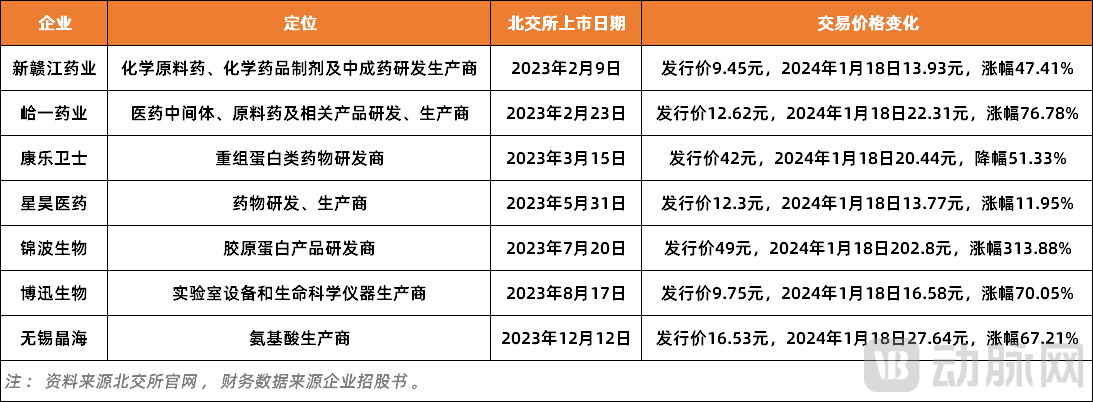 Figure 1. Overview of Selected Healthcare Companies Listed on the Beijing Stock Exchange in 2023 (Source: Public Information)
Prior to this, there were already numerous cases of healthcare companies successfully listing on the Beijing Stock Exchange (BSE). For instance, Jinbo Bio, a developer of collagen-based products, successfully listed on the BSE in July 2023. After being rejected by the STAR Market earlier that year, the company decisively chose the BSE and ultimately achieved a successful listing. Its stock price surged post-listing, reaching RMB 202.8 per share on January 18, 2024, representing a 313.88% increase from its issue price of RMB 49.
Therefore,“Questioning the Beijing Stock Exchange, Understanding the Beijing Stock Exchange, Embracing the Beijing Stock Exchange” is becoming an industry consensusIn this regard, an investor remarked, “In the past, the Beijing Stock Exchange (BSE) has long been stereotyped as having small market capitalizations and low valuations. However, this visible gap is narrowing, and companies no longer need to worry about valuation inversion after listing on the BSE as they once did.”The future Beijing Stock Exchange will no longer play the role of a beneficial supplement to the Shenzhen and Shanghai Stock Exchanges within the pyramid structure of China’s capital market as commonly perceived; instead, it will chart an independent market trajectory.。”
As for 2024, market participants generally believe that the landscape for healthcare IPOs will continue to be influenced by the broader A-share IPO environment. Furthermore, given the impact of recent industry policies—such as centralized volume-based procurement and anti-corruption campaigns in the healthcare sector—on profitable enterprises, coupled with tighter regulations on listings of non-profit entities, the number of healthcare IPOs on the Main Board, the STAR Market, and the ChiNext Board is highly likely to decline compared to previous years. However, the Beijing Stock Exchange (BSE) is expected to present more opportunities in 2024, benefiting from the imminent introduction of a direct IPO mechanism.
1. “The 2023 IPO Market: Challenging, But Not Dead!” — Dushu Yizhi;
2. “Dynamic Balance of Investment and Financing in the Capital Market” — Economic Daily;
3. “Zhu Pai of Yifeng Capital: Expecting Innovative Drug Companies to Have the Option of an IPO or Acquisition” — E-Drug Manager;
4. “One IPO Withdrawn Every Three Days, While $1 Billion BD Deals Blossom Everywhere: A Song of Ice and Fire for Innovative Drugs!” — E-Drug Manager