

Tianjin Recognized Again: Home-Based Doctor Contracting with Capitation Payment Named One of China's Top 10 Healthcare Reform Initiatives of 2023
On January 12, the 2023 list of “Top Ten New Initiatives and Top Ten News Figures in Advancing Healthcare Reform and Serving Public Health” was officially released. Tianjin Municipality was included in the national “Top Ten New Initiatives” for its reform of “promoting capitated global budget payment for family doctor contract services” through the Digital Health Community. This marks the second time Tianjin has been nationally recognized for its outstanding reform achievements, following its 2020 inclusion for “innovatively building the ‘Four Clouds’ platform to advance the development of grassroots Digital Health Communities.”
In recent years, Tianjin has comprehensively advanced the development of Digital Health Communities, leveraging this framework to promote family doctor contract services. By focusing on outpatient care for diabetes as a specific chronic condition, the city has implemented capitation-based global budget payment reforms and explored the establishment of health outcome-oriented incentive mechanisms. These efforts have effectively facilitated the transition of medical institutions from a “disease-centered” to a “people’s health-centered” model, establishing the “Tianjin Model” for deepening medical consortium construction, enhancing primary care capacity, and promoting the coordinated development and governance of healthcare, medical insurance, and pharmaceuticals in China.
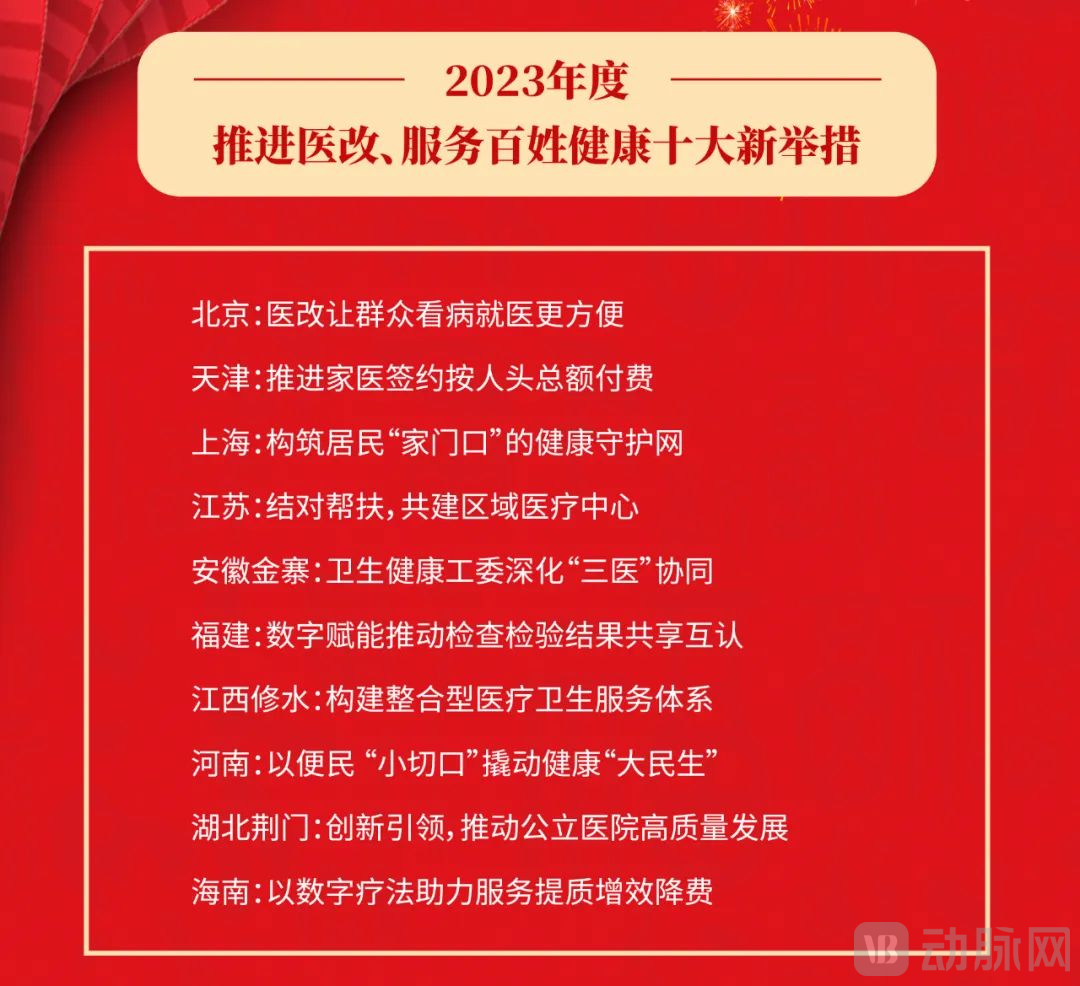
Figure | Top 10 New Measures in 2023 to Advance Healthcare Reform and Serve Public Health
The “Double Top Ten” List, guided by the Department of System Reform and the Department of Publicity of the National Health Commission, and hosted by China Health Magazine and Health News, aims to promptly, effectively, and multi-dimensionally promote typical measures and outstanding individuals emerging from the healthcare system reform, encouraging exploration and reform innovation. After the release of this list, the selected cases will be promoted nationwide.
The ranking, in highlighting Tianjin’s approach, noted that Tianjin has implemented capitation-based global budgeting reforms oriented toward health outcomes. By introducing a health stewardship responsibility system for diabetes outpatient special care, implementing capitation-based global payments for such care, and establishing outcome-oriented incentive mechanisms, the city has fully leveraged the incentivizing and constraining roles of medical insurance. These efforts have achieved reform outcomes characterized by “increased medical revenue, enhanced health management, and facilitated tiered diagnosis and treatment.”
Capitation-Based Global Payment, Health Outcomes-Oriented
Tianjin has transitioned the payment model for outpatient special diseases related to diabetes from fee-for-service to capitated global budgeting, and has clearly defined the contents of the health management service package for these conditions. Under this framework, the health management organization serves as the payer entity, with the health management service package constituting the basis for payment. Medical institutions may voluntarily apply to become designated health management organizations for diabetes-related outpatient special diseases. They may strengthen collaboration independently or by forming medical consortia with other medical institutions to provide health management services to patients with diabetes-related outpatient special diseases. Member units of a medical consortium are supported in applying jointly as a single service entity to be designated as a health management organization for diabetes-related outpatient special diseases. Patients with diabetes-related outpatient special diseases may voluntarily select one such designated organization as their primary health management provider, which will then deliver the corresponding health management services.
The global capitation budget for health authorities is primarily based on the total actual expenditures incurred in 2019 for outpatient patients with diabetes covered under special disease programs, and is further determined in accordance with principles such as volume-based procurement integration, financial risk protection with expenditure ceilings, and overall fiscal balance. This policy design not only accounts for variations in medication costs driven by differences in disease severity but also allocates the cost savings from national centralized volume-based procurement to healthcare institutions as incentives, thereby fully safeguarding patients’ access to medications and ensuring reasonable revenue for healthcare providers.
Furthermore, Tianjin Municipality stipulates that diagnosis, treatment, and medication practices for outpatients with diabetes under special disease coverage must be standardized in accordance with their actual clinical conditions and health status, while robust health management services should be provided. It is strictly prohibited to base the formulation of diagnostic, therapeutic, and medication plans on patients’ actual medical expenses incurred in previous years, thereby effectively safeguarding patients’ rights and interests.
Full Play of the Incentive and Constraint Role of Medical Insurance
A powerful lever for driving the implementation of reforms in Tianjin is the deep integration of medical consortium development with family doctor contract services. Leveraging the grid-based capacity for integrated medical and preventive care established through initiatives such as the Tianjin Digital Health Community, policy measures have been formulated to implement capitated global budgeting for family doctor contract services, thereby establishing a health-outcome-oriented incentive mechanism. It is explicitly stipulated that any surplus funds retained shall be recorded as medical service revenue by the health management authorities in accordance with regulations, and shall be primarily used for the compensation of medical personnel, thus incentivizing them to consistently deliver high-quality health management services.
Since the implementation of capitation-based global budgeting for family doctor contracts, Tianjin’s primary healthcare institutions have enhanced their health service capabilities, increased medical revenue, and effectively advanced the tiered diagnosis and treatment system. Since the introduction of the health manager responsibility system for patients with diabetes covered under special outpatient programs, 230,000 such patients in Tianjin—accounting for more than 50% of all diabetic patients in these programs across the city—have received health management services at their chosen health manager institutions. As of September 2023, the cumulative approved capitation-based global budget for special outpatient diabetes care reached RMB 2.2 billion. Through standardized practices, cost control, and health management initiatives, health manager institutions achieved an overall surplus of RMB 500 million, representing a surplus rate exceeding 20%.
Guided by outcome-based incentive mechanisms, health authorities have standardized clinical practices and medication use for diabetes while strengthening health management for outpatients with special chronic disease coverage. These efforts actively encourage patients to adopt healthy lifestyles and adhere to rational medication regimens. In particular, primary healthcare institutions have proactively enhanced the capabilities of family doctor contracting teams by assigning assistants and health managers, thereby substantially improving grassroots capacity for chronic disease management. Statistical data show that from January to September 2023, the hospitalization rate among 230,000 diabetic outpatients with special chronic disease coverage who received health management was 2.1 percentage points lower than that of similar patients who did not receive such management during the same period.
In the process of advancing the health stewardship responsibility system for patients with diabetes covered under special outpatient programs, active efforts have been made to encourage these patients to select primary healthcare institutions as their designated health stewards. Leveraging the development of medical consortia, primary healthcare institutions collaborate with tertiary hospitals through a two-way referral system to jointly provide high-quality diagnosis and treatment services for diabetes patients in special outpatient programs, thereby increasing patient willingness to remain within primary care settings. As of September 2023, among the 230,000 diabetes patients in special outpatient programs who had designated a health stewardship institution, more than half chose primary healthcare institutions within the Tianjin Digital Health Community, while only 19.3% opted for municipal public tertiary hospitals.
Notably, Tianjin has achieved significant phased results in comprehensive healthcare reform through institutional and technological innovations, creating a favorable environment for advancing capitated global budget payment models. In 2020, the Tianjin Municipal Government entered into a strategic cooperation agreement with WeDoctor, a digital intelligence health platform, to comprehensively implement the special healthcare reform initiative known as the “Tianjin Digital Health Community.” Under the guidance of the Tianjin Municipal Health Commission and the Municipal Healthcare Security Administration, WeDoctor Internet Hospital took the lead in collaborating with 266 primary healthcare institutions across the city to establish the Tianjin Digital Health Community. This initiative has built an integrated healthcare service system centered on user health, leveraged by healthcare insurance payments, enabled by digitalization, and driven by health accountability mechanisms, thereby providing strong support for Tianjin’s reform toward capitated global budget payments for family doctor contract services.
Currently, the Tianjin Digital Health Community has established standardized chronic disease management centers in over 200 primary healthcare institutions across the city. While strengthening whole-process disease management for patients with chronic conditions such as diabetes—covering pre-consultation, during-consultation, and post-consultation phases—professional medical staff and health managers provide continuous health management services both inside and outside hospitals, as well as through online and offline channels. Recently, at a press conference held by the National Health Commission, special emphasis was placed on promoting Tianjin’s distinctive experience in leveraging the Digital Health Community to build chronic disease management centers at the grassroots level, thereby providing residents with integrated, comprehensive, and full-cycle health services that combine online and offline care.
As the implementation of the 14th Five-Year Plan enters a critical phase, leveraging the momentum of deepening healthcare reform to further improve the medical and health service system and provide comprehensive, full-lifecycle health services to the people has become a key task for the next stage of healthcare reform efforts across various regions. The 2024 National Health Work Conference also put forward requirements, emphasizing the need to “continuously strengthen primary-level capabilities in disease prevention, treatment, and health management, and actively develop a chronic disease integrated prevention and control system centered on health management” from the perspectives of enhancing primary care service capacity and strengthening the prevention and control of major chronic diseases. The nationwide promotion of the “Tianjin Model” provides a systematic and replicable reform solution for other regions.