

KeyLights & CosMai: Leading Global IVD Instrument Brand and CDMO Supplier with Over 5,000 Installed Systems Worldwide Submits IPO Prospectus
Immunodiagnostics is one of the major segments within the in vitro diagnostics (IVD) field, with chemiluminescence technology emerging as the mainstream approach following continuous iterations and upgrades. According to the report “Current Status and Future Outlook of China’s Immunodiagnosis Market” released by Deloitte China, the Chinese immunodiagnostics market has maintained an overall growth rate of approximately 20% over the past five years, reaching a market size of RMB 52.4 billion in 2022.
Compared with other immunodiagnostic techniques, chemiluminescent immunoassay features high sensitivity, a wide detection range, simple and rapid operation, good stability of labels, no pollution, and a high degree of instrument automation.In 2022, chemiluminescence accounted for more than 85% of the immunoassay diagnostics market, with its scale surpassing RMB 40 billion.
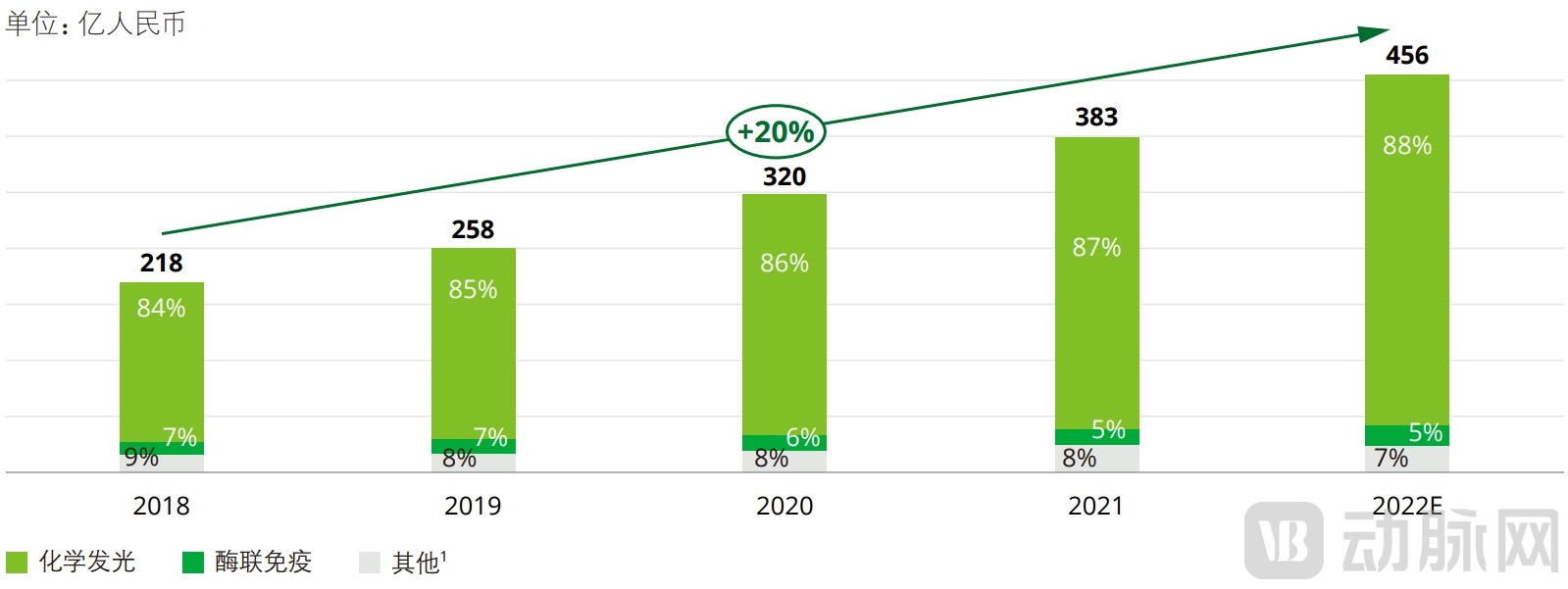
Market Size of Medium- and High-Throughput Immunoassay Diagnostics, 2018–2022
Image source: Deloitte China
Against this backdrop, Kelaisi (Shenzhen) Technology Co., Ltd. (hereinafter referred to as “Kelaisi”), a technology-driven enterprise dedicated to the research and development, manufacturing, and sales of in vitro diagnostic (IVD) instruments and supporting reagents, has gradually grown into a global supplier of proprietary IVD instrument brands and contract development and manufacturing organization (CDMO) services. Leveraging its fully independent intellectual property rights in open-platform, fully automated chemiluminescence immunoassay analyzers and other IVD instruments, Kelaisi’s products are now used by more than 800 renowned Grade A tertiary hospitals and third-party medical testing institutions across China, and have been successfully installed and put into use in the United States, Germany, France, Spain, Brazil, India, Pakistan, Nepal, and other countries.
When discussing the original intention behind starting the business, Wang Yongdong, Founder and CTO of Kelaisi (Shenzhen) Technology Co., Ltd. and a professor at a renowned Chinese university, stated that it stemmed from an incidental finding during a health check-up ten years ago.At that time, chemiluminescence analyzers on the market suffered from prominent issues such as low precision, poor stability, cumbersome operation, and low sample throughput. More importantly, imported products nearly monopolized the domestic market in China, keeping equipment costs persistently high.
Against this backdrop, Wang Yongdong, who specializes in digital electronics, has been exploring whether technological innovation can enhance the detection performance and automation level of chemiluminescence analyzers, thereby breaking the monopoly held by imported products.
Driven by their original aspiration, Wang Yongdong joined forces with several entrepreneurial partners to establish Chongqing Keysmile Biological Technology Co., Ltd. (hereinafter referred to as “Keysmile,” now a holding subsidiary of Kelaisi) in 2013. In September 2013, leveraging an innovative design concept, the company successfully developed the Smart 3000, a fully automated microplate chemiluminescence immunoassay analyzer that is user-friendly, highly efficient, and possesses complete independent intellectual property rights.
Since then, Chongqing Keysmile Biological Technology Co., Ltd. has embarked on a “rapid acceleration” journey in the in vitro diagnostic instrument sector, led by chemiluminescence technology.
Chemiluminescence is the mainstream technology in immunodiagnostics. In 2017, the company officially launched the SMART 6500 high-speed fully automated chemiluminescence analyzer, achieving a market-leading position with its high throughput of 360 tests per hour. This product broke through the typical "one-to-one" matching mechanism between existing chemiluminescence analyzers and test reagents on the market at that time, creating an open universal testing platform. The platform allows for software structure adjustments based on differences in reagent kits and technical processes from various manufacturers, providing comprehensive support for both enzyme-catalyzed and direct chemiluminescence detection systems.
As a domestically produced, fully automated chemiluminescence immunoassay analyzer with independent intellectual property rights, the SMART 6500 gained recognition in the Chinese market before successfully expanding to Europe in 2018, where it was installed and put into use in developed countries such as Germany and Spain.
To date, Kelaisi has established a comprehensive product portfolio in the chemiluminescence immunoassay analyzer sector, comprising over ten models across its SMART and Venus series. These products offer throughput capabilities ranging from 120 to 900 tests per hour, single-load sample capacities of 40 to 360 positions, instrument precision with a coefficient of variation (CV) of less than 3%, and carryover contamination rates below 0.1 ppm. This fully customized product lineup enables Kelaisi to achieve globally leading technical standards while meeting the practical operational needs of healthcare institutions across different countries, regions, and tiers.
Taking the Venus 9000 series, approved in September 2023, as an example, the Venus 9000 boasts advantages such as high throughput, high precision, and high reliability, with multiple performance indicators reaching global leading levels. Specifically, the one-step single-unit throughput of the Venus 9000 reaches 900 tests per hour (T/h), while the four-unit linked system achieves 3,600 T/h. The instrument dimensions are 1270 x 1015 x 1450 mm, with a single-unit space efficiency of 495.7 T/m².2Industry-leading performance; the system’s intelligent algorithms adapt to all complex reaction processes and are fully compatible with magnetic particle-based AE/AP/HRP systems. The modular design enables flexible parallel operation, integrating seamlessly with biochemistry, flow cytometry, and coagulation automation lines to meet one-stop testing needs.
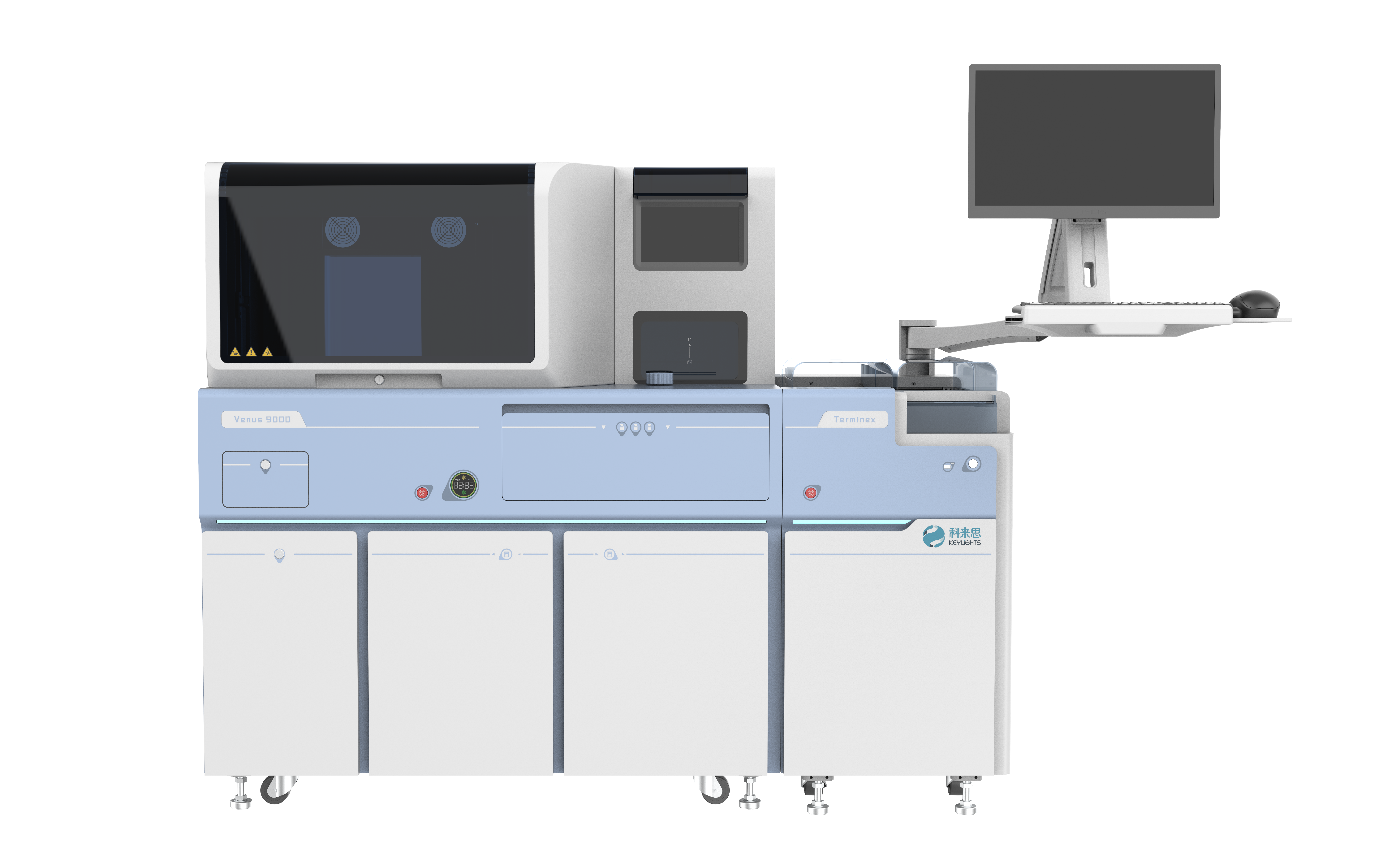
Venus 9000 Series
In addition, Kelaisi has also entered the in vitro diagnostic (IVD) instrument sectors of immunofluorescence, flow fluorescence, and mass spectrometry sample preparation. Its pioneering products have already entered the commercial promotion stage. The company’s development goal is to create a comprehensive product portfolio, offering cost-effective products and services tailored to all application scenarios and diverse customer needs.
Wang Yongdong commented, “Taking flow fluorescence, a current industry hotspot, as an example, flow fluorescence is an optimal technical platform for multiplex testing, capable of simultaneously measuring multiple parameters. It represents a distinct detection technology from chemiluminescence. Although flow fluorescence exhibits lower analytical sensitivity than chemiluminescence, the two technologies can complement each other effectively.”Currently,"The flow cytometry fluorescence technology jointly developed by the company has completed its R&D phase and has now entered the product registration testing stage. It will be officially launched at the Chongqing exhibition in March 2024."
“The in vitro diagnostics (IVD) industry is characterized by rapid technological iteration, with significant technical barriers and limited compatibility between various diagnostic reagents and instruments. Therefore, CDMO providers that facilitate specialized collaboration play a crucial role throughout the entire lifecycle of diagnostic product development, manufacturing, and commercialization. They help concentrate resource advantages, leverage technical expertise, improve R&D efficiency, accelerate product registration and market launch, reduce mass production costs, and ensure product quality,” said Wang Yongdong.
While Kelaisi drives innovation in R&D and manufacturing, diversifies its product portfolio, and expands its international business, it also leverages its fully independent intellectual property rights in an open chemiluminescence analyzer platform, its extensive accumulation of expertise in meeting clinical application needs, and its system integration advantages in professional automation control technology platforms.Launch new business models encompassing proprietary brands, OEM, ODM, CDMO, and smart services.
As a leading domestic R&D and manufacturing enterprise for in vitro diagnostic (IVD) instruments, Kelaisi is capable of providing customers with customized development products and services for IVD instruments,Covering the full product lifecycle, including complete system development, core module development, design transfer, product registration, precision manufacturing, supply chain management, and after-sales service., empowering partners to achieve rapid commercial success with cost-effective products.
Especially in the current highly competitive IVD industry, compared with the “one-to-one” service model of first-tier enterprises—such as Hitachi, which has been Roche’s exclusive supplier for forty years,Kelaisi has built a comprehensive CDMO platform for in vitro diagnostic instruments, serving a wide range of diagnostic reagent manufacturers and researchers. Meanwhile,Kelaisi has also continuously refined and enhanced its R&D and design capabilities by providing customized development and manufacturing services to various manufacturers, evolving into a global platform-based CDMO supplier with stronger customization attributes.
According to reports, Kelaisi has become a core partner for numerous listed companies and those preparing for initial public offerings. Its products have reached over 800 renowned Grade A tertiary hospitals, leading third-party medical testing institutions, and more than 2,000 other healthcare facilities. The company has successfully installed and deployed its systems in multiple countries, including Germany, France, Spain, the United States, Brazil, India, Peru, and Nepal, with cumulative global installations exceeding 5,000 units.
Meanwhile, to more efficiently respond to customer demands across China, Kelaisi has established a robust team for technical assessment and medical device registration services, and set up 10 offices nationwide equipped with a comprehensive after-sales service support system. Furthermore, regarding after-sales services in international markets, in addition to collaborating with local service providers, Kelaisi is actively cultivating overseas engineers. To date, the company has invited multiple batches of local engineers from regions such as Europe to China for after-sales training, thereby enhancing its international marketing and after-sales service systems and building a strong brand image.
In terms of technological innovation advantages, Kelaisi currently holds 144 patent applications and 116 granted patents. The company has been successively recognized as a National High-Tech Enterprise, a Chongqing Intellectual Property Advantage Enterprise, a “Specialized, Refined, Differential, and Innovative” (SRDI) Enterprise, and a Gazelle Enterprise.
This innovation, grounded in independent intellectual property rights, is driven by strong team support. The in vitro diagnostics (IVD) industry is characterized by its broad interdisciplinary scope and numerous specialized segments, thereby imposing exceptionally high demands on R&D teams. According to available information, Kelaisi (Shenzhen) Technology Co., Ltd. has a workforce of over 300 employees, including more than 130 R&D personnel. The R&D team comprises outstanding talents from renowned domestic and international universities, spanning multiple interdisciplinary fields such as mechanical automation, software engineering, electronic science and technology, optical engineering, and biotechnology.
At the conclusion of the interview, Wang Yongdong stated, “In the early days of our startup, when we were determined to tackle the ‘hard nut’ of developing a fully automated chemiluminescence immunoassay analyzer, my team and I sequestered ourselves in a hotel across from our office for a month, working around the clock on coding and experiments. This intensive effort enabled us to complete the design of the proof-of-concept prototype ahead of schedule. It was precisely through this dedicated, immersive development process that we successfully launched the Smart 6500 in 2017, a system based on magnetic microparticle technology with fully independent intellectual property rights. Now, having completed the critical Series B financing round, Kelaisi will continue to deepen its understanding of the industry and analysis of customer needs. We remain committed to the path of indigenous innovation, providing domestic and international clients with ultra-stable, high-performance, cost-effective products and CDMO services, with the aim of growing into a leading independent brand in in vitro diagnostic instruments and a global CDMO supplier.”