

IFlytek Healthcare, China's Most Profitable AI Medical Company, Files for IPO in Hong Kong

Xunfei Healthcare
Developer of Intelligent Medical Service Platforms
On January 26, 2024, iFlytek Healthcare Technology Co., Ltd. (hereinafter referred to as “iFlytek Healthcare”), a leading domestic medical AI company, filed its prospectus with the Hong Kong Stock Exchange.
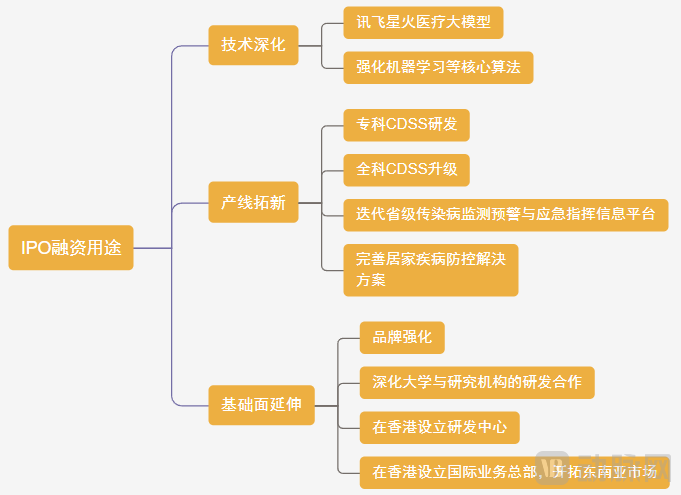
According to the prospectus, IFLY TEK plans to use the proceeds to strengthen core technologies such as the iFlytek Spark medical large language model and machine learning; expand product lines including general and specialized clinical decision support systems (CDSS), regional management platform solutions, and private platforms; and enhance commercialization capabilities, for instance, by establishing an international business headquarters in Hong Kong to tap into the Southeast Asian market.
As one of the first medical AI enterprises in China, IFLY TEK adopted a distinctive strategy from its inception. Rather than focusing exclusively on top-tier (Grade 3A) hospitals, it has been dedicated to empowering primary healthcare institutions with intelligent solutions to enhance their foundational capabilities.
In 2021, 2022, and the first nine months of 2023, iFlytek Healthcare generated revenues of RMB 372 million, RMB 472 million, and RMB 324 million, respectively, with year-on-year growth rates of 26.88% and 29.08%, maintaining a growth level far exceeding the industry average despite the economic downturn. According to Frost & Sullivan, iFlytek Healthcare ranked first in terms of revenue size in China’s medical artificial intelligence industry in 2022.
IFLY TEK Healthcare: Overview of Operating Performance
IFLY TEK was established in 2016. By that time, concepts such as the “three-medical linkage” and tiered diagnosis and treatment had been proposed for many years; however, various policies issued by higher-level authorities often deviated during implementation at lower levels. The situation of overcrowded large hospitals and deserted small clinics remained unchanged.
At the root of the issue, the inadequate infrastructure of primary healthcare is the primary factor constraining policy implementation. On one hand, physicians in primary care institutions are insufficient in both competency and numbers. On the other hand, health informatics at the primary care level lags behind, with medical data lacking completeness and accuracy, and poor interoperability across different healthcare facilities. The compounding effect of these two factors makes it difficult for primary care to earn patient trust. Consequently, even when advanced medical equipment is procured, it often remains underutilized, failing to deliver its intended value.
Addressing this critical pain point, companies such as IFLY TEK have leveraged Clinical Decision Support Systems (CDSS) as a strategic solution to develop a new generation of AI-powered general practice CDSS. This innovation effectively “creates” a virtual assistant equipped with comprehensive general medical knowledge, thereby assisting primary care physicians in clinical diagnosis and treatment.
The initial implementation proceeded smoothly. Empowered by AI, the informatization level of primary healthcare and the effectiveness of primary care diagnoses improved rapidly. However, as the application period extended, the limitations of a standalone general practice Clinical Decision Support System (CDSS) gradually became apparent.
In practice, while AI can indeed address issues such as resource shortages within individual institutions, it has failed to achieve the flow of medical data between different levels of care or standardize data within regional healthcare systems. In 2019, a municipal Health Commission in Guangxi published the document “New Measures, Existing Problems, and Recommendations for Implementing the Tripartite Coordination of Medical Care, Health Insurance, and Pharmaceuticals,” which pointed out that one of the difficulties in executing tripartite coordination was the incomplete implementation of “coordination.” Specifically, without a comprehensive database containing complete patient information, regulatory authorities cannot effectively supervise and manage the institutions involved in patients’ healthcare-seeking behaviors.
To address this issue, IFLY TEK has identified an effective solution by collaborating with regional Health Commissions to establish standards for electronic medical records (EMRs) in primary care settings, thereby facilitating the regional rollout of its general practice Clinical Decision Support System (CDSS), “Zhiyi Assistant.” This approach not only resolves interoperability challenges among primary care institutions and between primary and tertiary healthcare providers but also provides a practical foundation for the commercialization of medical AI.
With its comprehensive solutions, IFLY TEK has rapidly widened the gap with competitors. According to data from the prospectus: IFLY TEK’s AI Doctor Assistant has covered more than 400 districts and counties across over 30 provinces in China, providing over 740 million AI-assisted diagnostic recommendations and more than 280 million standardized electronic medical record suggestions. In terms of revenue, this product ranked first in China’s CDSS market for primary healthcare institutions in 2022, capturing a market share of 76.6%.
The widespread adoption of internet technology across various industries has significantly reduced the costs of connecting demand with supply, sparking rapid growth on the demand side. In the consumer sector, this surge in demand can be quickly met by a synchronous increase in supply, which underpins the booming development of the “internet economy” in recent years. However, in the healthcare sector, the number and capabilities of physicians—the primary service providers—cannot be rapidly enhanced in the short term, resulting in relatively slower progress for “internet healthcare.” Against this backdrop, IFLY TEK empowers physicians with AI technologies, effectively increasing the supply of medical services and meeting the growing demand driven by the rise of internet healthcare.
For IFLY TEK, the benefits of this strategy extend beyond merely reducing sales costs and achieving bulk revenue growth. In the long run, integrating with electronic medical record (EMR) systems at the primary care level lays a solid foundation for building an AI ecosystem in primary healthcare. When new needs emerge, IFLY TEK can develop solutions based on its already deployed AI systems. This approach not only ensures seamless synergy between new solutions and existing systems to enhance overall performance but also accelerates the commercialization of new products, enabling rapid capture of market share.
Based on this approach, IFLY TEK has expanded its solution matrix to cover scenarios such as public health, medical insurance, and chronic disease management. For instance, in 2022, IFLY TEK deployed a chronic disease management system in Gansu Province targeting conditions including hypertension, diabetes, chronic obstructive pulmonary disease (COPD), and stroke.
As of the latest practicable date, the relevant products have covered approximately 19,000 primary healthcare institutions across more than 80 counties and districts in Gansu Province, serving over 3 million elderly residents. Furthermore, with the implementation of chronic disease management in Gansu Province, the standardized management rate for hypertension increased from 51% to 71%, while that for diabetes rose from 52% to 68%.
In other words, IFLY TEK has completed the leap from infrastructure construction to comprehensive AI empowerment of the healthcare system, positioning itself to capitalize on the emerging multi-billion-dollar market.
Return to Tertiary Hospitals at the Right Time
IFLY TEK has largely focused its business efforts in recent years on primary healthcare, while still maintaining a layered presence across tiered hospitals. After all, government investment in primary care services is inherently limited, whereas the numerous departments and diverse needs of tertiary hospitals ultimately hold greater value.
According to the prospectus, IFLY TEK’s services for tiered hospitals comprise two business lines: “Smart Hospital Solutions” and “Clinical Diagnosis and Treatment Assistant.” The former focuses on improving physicians’ efficiency in patient management by providing patients with 24/7 access to holographic diagnostic and treatment information, generating electronic medical records and clinical recommendations for physicians, and offering operational data statistics and analysis to hospital administrators to support decision-making. The latter aims to enhance the overall efficiency and service quality of physicians in tiered hospitals, with specialty-specific Clinical Decision Support Systems (CDSS) being a typical application.
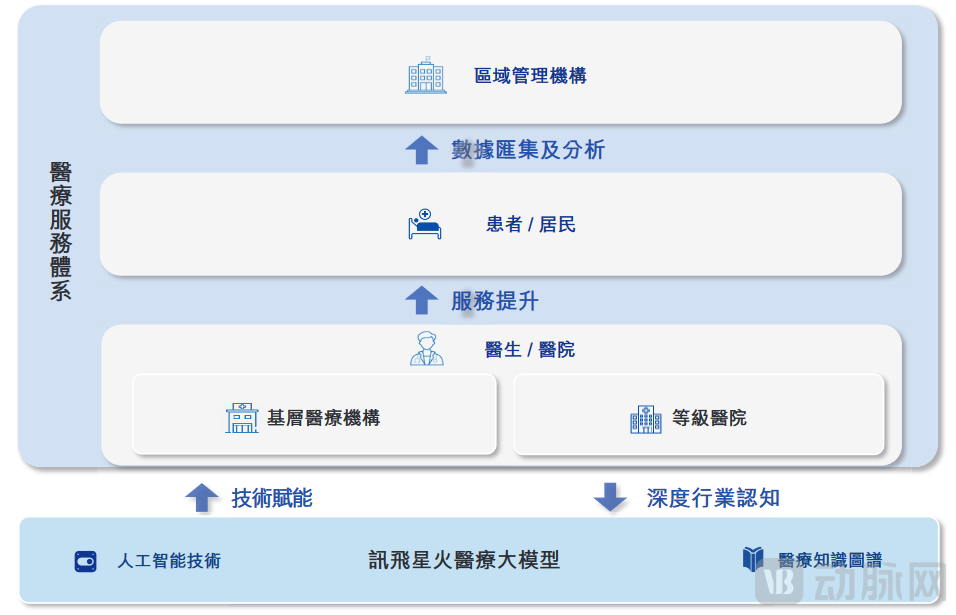
IFLY TEK’s AI-Enabled Logic
For IFLY TEK, expanding from primary care CDSS to specialized CDSS in tiered hospitals is not only a response to market changes but also a strategy to establish deeper technical barriers.
In terms of the market, specialty-specific Clinical Decision Support Systems (CDSS) represent the fastest-growing segment within the hospital CDSS market. By intelligently evaluating patient data, recommending treatment plans, and improving guideline adherence, these systems play a crucial role in the prevention and treatment of complex diseases, such as the management and prevention of Venous Thromboembolism (VTE).
Data from Frost & Sullivan shows that the market size of specialized clinical decision support systems (CDSS) in Chinese hospitals grew from RMB 2 million in 2018 to RMB 92.4 million in 2022, with a compound annual growth rate (CAGR) of 161.6%. It is projected to further increase to RMB 1.06 billion by 2032, representing a CAGR of 27.6% from 2022 to 2032. In contrast, although primary care general practice CDSS held an absolute advantage in market volume during 2018–2022, its limited growth rate has compelled IFLY TEK to shift its focus toward specialized CDSS.
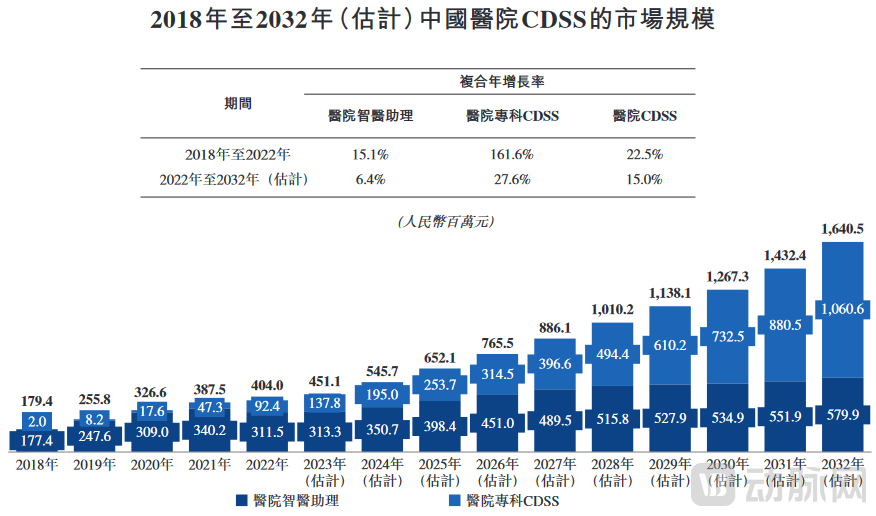
Market Size of Hospital CDSS in China, 2018–2032 (Estimated)
Technologically, the emergence of ChatGPT at the end of 2022 redefined the interactive capabilities of AI technology. Benefiting from iFLYTEK’s investments in large language models, IFLY TEK’s proprietary iFLYTEK Spark Medical Large Model experienced rapid development in 2023.
According to a test conducted by the China National Science and Technology Information Resource Comprehensive Utilization and Public Service Center (STI), the iFLYTEK Spark Medical Large Language Model outperforms GPT in natural language processing (NLP) tasks across six medical scenarios: expert-level medical knowledge graph question answering, clinical language understanding, medical document generation, disease diagnosis and treatment recommendation, multi-turn medical dialogue, and multimodal interaction.
Furthermore, IFLY TEK is the only enterprise involved in customizing the “Technical Evaluation System and Standard Specifications for Large Language Models in the Medical Field.” This system belongs to China’s first batch of technical evaluation frameworks and usage guidelines for medical large language models developed based on industry standards, providing a comprehensive assessment of the application of artificial intelligence technologies in the healthcare sector.
The emergence of large medical AI models can effectively enhance the capabilities of general practice Clinical Decision Support Systems (CDSS) in patient communication, data processing, and diagnostic recommendations. However, to differentiate the technological advantages among various enterprises, these models must be evaluated within hospital settings characterized by more complex knowledge systems.
Therefore, to fully leverage the advantages of large language models (LLMs), IFLY TEK must further deepen its research and development of smart hospital solutions, such as specialty-specific Clinical Decision Support Systems (CDSS). Benefiting from the data processing and learning capabilities of LLMs, specialty-specific CDSS may also usher in a new period of rapid development.
Although iFLYTEK Healthcare’s financial results have not escaped the common plight of losses in the medical AI sector, its annual revenue exceeding RMB 400 million and gradually narrowing deficits still demonstrate to the outside world the application potential of this emerging technology.
It should also be noted that at the time of the prospectus data release, IFLY TEK was still part of the iFlytek system and needed to devote certain resources and capital to align with the parent company’s strategic layout. Now, with its spin-off listing, IFLY TEK will have an independent financing platform, enabling it to deepen its focus on core business operations. This will help strengthen IFLY TEK’s technological reserves and market expansion capabilities, thereby enhancing its overall competitiveness and improving the company’s future profitability.
From primary care to tertiary hospitals, IFLY TEK has powerfully demonstrated its strength in grasping medical AI trends over the past eight years.
As we enter the era of large language models, iFlytek Healthcare, with its mature vertical models, may once again lead the industry and achieve profitability for its medical AI business in the shortest possible time.