

ArriVent Biopharma Raises $175M in Nasdaq IPO Backed by Chinese-Origin Drug Furmonertinib
CG Oncology
Oncolytic Immunotherapy Developer

ArriVent
Biopharmaceutical Product Developer
At the start of 2024, the U.S. biopharmaceutical stock market was unusually active.
Oncolytic Virus Company CG Oncology Successfully IPOs Yesterday, Becoming the First Biopharmaceutical Company to Go Public in 2024. CG’s Listing Sends a Positive Signal to the Industry: The Company Raised $380 Million in Its Initial Public Offering, Selling 20 Million Shares at $19 Per Share, Which Was 8 Million Shares More Than Expected.
Following in the footsteps of CG Oncology’s public listing is another innovative oncology drug company, ArriVent Biopharma, which is set to ring the opening bell on the Nasdaq later today Beijing time.
ArriVent was established to identify potentially transformative new drugs for cancer patients. The company aims to source novel drug candidates in China, Europe, South Korea, and Japan, and to forge close partnerships with collaborators, thereby providing new therapeutic options for oncology patients.
Previously, according to documents filed by ArriVent with the U.S. Securities and Exchange Commission, the biotechnology company will issue 8.3 million shares at a price between $17 and $19 per share. ArriVent stated that if the final share price falls within this range, it expects to raise $135.7 million from the IPO; if the underwriters fully exercise their option to purchase an additional 1.2 million shares, the proceeds would increase to approximately $156 million.
Latest news shows that ArriVent raised $175 million (approximately RMB 1.2 billion) in its initial public offering, selling 9,722,222 shares at $18 per share, exceeding expectations earlier this week. The industry’s optimism is evident, as besides CG Oncology and ArriVent, four other companies had queued for U.S. IPOs in January.
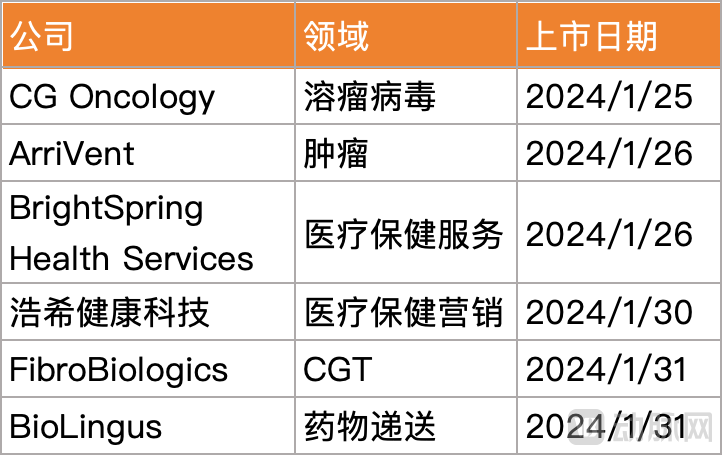
According to PwC’s forecast, the U.S. IPO window will “gradually reopen” this year, a trend seemingly corroborated by the crowded pipeline of healthcare and biopharmaceutical companies scheduled for listing in late January. In addition to the aforementioned five companies, several other biotech firms have filed for IPOs, including Metagenomi, a partner of Moderna; Kyverna, a developer of autoimmune CAR-T therapies; and Alto Neuroscience, a psychiatric drug research and development company.
PwC’s forecast also includes,U.S. IPOs are likely to favor companies with robust clinical data.The oversubscribed offerings of CG Oncology and ArriVent both demonstrate the market’s preference for biotech companies with clearer commercialization prospects.
Backed by Hillhouse, Sequoia, and Lilly Asia Ventures; Founder is a Serial Entrepreneur
ArriVent, established in 2021, is a young company whose founding team boasts extensive experience in drug research and development. In particular, Dr. Zhengbin Yao, the company’s co-founder, CEO, and Chairman, is a seasoned leader with a track record of serial entrepreneurship.
Prior to joining ArriVent, Zhengbin Yao served as Chief Executive Officer and Chairman of the Board of Viela Bio, an innovative biopharmaceutical company focused on autoimmune diseases. Backed by AstraZeneca, the company made its debut in 2018.
In February 2018, AstraZeneca spun off six early-stage inflammation and autoimmune projects from its global biologics R&D division, MedImmune, to establish an independent biotechnology company, Viela Bio. Thus founded, Viela Bio is dedicated to developing therapeutic drugs for severe autoimmune diseases. Subsequently, Yao Zhengbin, head of MedImmune’s Respiratory, Inflammation, and Autoimmunity (RIA) Innovative Medicines Unit, was appointed as Chief Executive Officer of Viela Bio.
Three years later, Viela was acquired by Horizon Therapeutics plc in 2021 for $3.1 billion. Viela had gone public in 2019 at $19 per share, and Horizon acquired it in 2021 at $53 per share. Through this transaction, AstraZeneca realized a net profit.
Under the leadership of Yao Zhengbin, Viela secured $283 million in investment from prominent venture capital firms such as Boyu Capital, Tonghe Yucheng, and Hillhouse Capital.
The names of these investment institutions also appear on ArriVent’s investor list. This indicates that, in addition to placing significant value on ArriVent’s pipeline and operational model, these investors hold the company’s founding team, particularly Zhengbin Yao, in high regard.
In 2021, after Yao Zhengbin co-founded ArriVent with his team, the company completed multiple rounds of financing totaling $305 million in just over two years. Investors included OrbiMed, General Catalyst, Sofinova Investments, Lilly Asia Ventures, Hillhouse, AIHC Capital, Boyu Capital, Catalio Capital Management, HBM Healthcare Investments, Octagon Capital Advisors, Sequoia China, Shanghai Bio-Medicine Industry Equity Investment Fund, HongShan Capital (formerly Hillhouse Capital’s private equity arm), and Sirona Capital Partners, among other prominent institutions.
Prior to the IPO, Hillhouse held a 17.6% stake in ArriVent, making it the largest institutional investor; OrbiMed, Lilly Asia Ventures, Catalio Capital Management, Sirona Capital Partners, Allist, and Sofinova Investments held stakes of 11.6%, 8.8%, 7.8%, 5.8%, 5.7%, and 5.6%, respectively, and were also major institutional investors.
The core pipeline was licensed from Allist and has been approved for marketing in China.
Currently, ArriVent has two core pipelines: one is Furmonertinib, and the other is an ADC pipeline developed in collaboration with Aarvik Therapeutics.
Furmonertinib is ArriVent’s lead asset,Currently under development for the treatment of non-small cell lung cancer (NSCLC). This pipeline originates from Allist, a Chinese pharmaceutical company.
In June 2021, Allist announced that, to expand the development and commercialization of its core product, furmonertinib, in overseas markets, the Company intended to enter into a Global Technology Transfer and License Agreement and a Common Stock Subscription Agreement with ArriVent, thereby establishing comprehensive collaboration on the development and commercialization of furmonertinib in overseas markets.
Under this collaboration, Allist intends to grant ArriVent an exclusive license to use patents and know-how related to furmonertinib for the development (including research and development, manufacturing, import, export, use, and sales) of furmonertinib in territories excluding Mainland China, Taiwan, Hong Kong, and Macau. The Company will receive a $40 million upfront payment, cumulative research and development and sales milestone payments of up to $765 million (upon achievement of agreed-upon R&D or sales milestones), sales royalties, and a certain percentage of equity in ArriVent, thereby making ArriVent an affiliate of Allist.
ArriVent is optimistic about the development potential of furmonertinib, claiming that it can stand out among numerous new drugs. Furmonertinib is a novel EGFR mutation-selective tyrosine kinase inhibitor (TKI) and represents a leading example of third-generation EGFR-TKIs originally developed in China.
Published clinical studies have demonstrated that furmonertinib features dual activity, high selectivity, potent tumor shrinkage, and a favorable safety profile. Compared with first- and second-generation EGFR TKIs, furmonertinib retains many of the key advantages of third-generation EGFR-TKIs, including the potential to overcome T790M mutation-mediated resistance, while also targeting a broader spectrum of EGFR mutations.
In 2022, Allist reported the results of the FURLONG clinical trial of furmonertinib for the first time. This was a Phase 3, double-blind, placebo-controlled trial conducted in China to evaluate furmonertinib as first-line treatment for patients with non-small cell lung cancer (NSCLC) harboring classical EGFR mutations.
In the FURLONG clinical trial, furmonertinib demonstrated superior therapeutic potential in progression-free survival (PFS) compared with the first-generation EGFR-TKI gefitinib, with a median PFS of 20.8 months versus 11.1 months for gefitinib. Furmonertinib’s ability to cross the blood-brain barrier was also evidenced by central nervous system (CNS)-specific objective response rate (ORR) data from this trial, which showed that furmonertinib achieved a 91% reduction in brain metastasis size, compared with 65% for gefitinib. In the FURLONG trial, the incidence rates of treatment-related serious adverse events (TRSAEs) and treatment-related adverse events (TRAEs) leading to discontinuation were comparable between furmonertinib and gefitinib.
Excellent efficacy is why ArriVent values furmonertinib. The drug has also demonstrated strong market performance.
In March 2021, furmonertinib was approved for marketing in China, with its sales revenue continuing to climb. In 2021, furmonertinib generated sales revenue of RMB 236 million; in 2022, sales revenue reached RMB 790 million, a year-on-year increase of 49.22%, accounting for 99.9% of total revenue; in the first half of 2023, furmonertinib’s sales revenue amounted to RMB 713 million, a year-on-year increase of 137.82%, with full-year sales expected to exceed RMB 1.5 billion.
Its strong commercialization prospects have served as the most powerful endorsement for ArriVent’s IPO. In October 2023, furmonertinib received Breakthrough Therapy Designation from the U.S. Food and Drug Administration (FDA) for the treatment of previously untreated locally advanced or metastatic non-squamous non-small cell lung cancer (NSCLC) with EGFR exon 20 insertion mutations.
If the Phase 3 clinical trial of FURVENT proves successful, ArriVent will use approximately $50 million to $60 million of the net proceeds from its IPO to support the submission of a New Drug Application (NDA) to the FDA and potential commercialization activities for furmonertinib. The results are expected to be announced in 2025.
It is reported that the drug is also being studied in another subset of lung cancer patients with PACC mutations, with data from the proof-of-concept study expected to be released this year.
Which Types of Enterprises Are More Favored for IPOs?
After enduring a market downturn for much of the past two years, the biotechnology industry will welcome the resurgence of initial public offerings as good news.
Initial public offerings (IPOs) are a critical financing milestone for biotechnology companies and a means of generating returns for investors, but such plans have been particularly challenging to execute recently.According to data from BioPharma Dive, the number of stock issuances in 2022 and 2023 fell by nearly 80% compared with the peak in 2021. Only 19 companies priced their initial public offerings (IPOs) in 2023, marking the lowest total in at least six years.
Stock market performance was mixed, with fewer than half of the 2023 IPOs trading at or above their offering prices. Following a slight rebound in IPO activity in recent quarters, the market has once again fallen into a prolonged slump. For instance, prior to CG Oncology’s listing, the last biotechnology IPO had been that of Cargo Therapeutics in early November 2023.
Nevertheless, spurred by the Federal Reserve’s interest rate cuts, the biopharmaceutical industry finally showed signs of optimism in 2024.A trend is becoming increasingly evident: the industry is showing a stronger preference for biotech companies with products in mid-to-late-stage clinical trials and promising commercialization prospects.
For example, CG Oncology has a drug in Phase 3 clinical trials. Among the seven biotech companies that recently went public, six have products at least in Phase 2 clinical trials. Among the other four biotechnology companies that have recently filed for issuance, three—ArriVent, Alto Neuroscience, and Kyverna—also meet this criterion.
By contrast, data from BioPharma Dive show that nearly two-thirds of companies that went public in 2020 and 2021 were in the preclinical or Phase 1 clinical stage. In 2020, only five of the 79 companies that listed had Phase 3 clinical programs at the time of their IPOs. In 2023, six of the 19 companies that went public had clinical programs in late-stage development.
PitchBook senior analyst Kazi Helal stated that a few years ago, initial public offerings were primarily driven by emerging technologies, “but now we are actually waiting for those emerging technologies to mature.” This trend will continue this year.
References:
1. https://www.jiemian.com/article/5639857.html
2. https://mp.weixin.qq.com/s/lRl1oMjPr4YAKSCBdEvP-A
3. https://mp.weixin.qq.com/s/3WtQ_vTIE8_Rv1viH8nDkg