

Vertex's VX-548, the First-in-Class Nav1.8 Inhibitor, Achieves Positive Phase 3 Results with Projected $5.1B Annual Sales by 2030

Vertex
Breakthrough Small Molecule Drug Developer
January 30, 2024,Vertex Announces Positive Topline Results from Phase 3 Clinical Trial of VX-548, a Second-Generation Highly Selective Nav1.8 Inhibitor, for the Treatment of Moderate-to-Severe Acute Pain. The Phase III program includes two randomized, double-blind, placebo-controlled pivotal trials in patients following abdominoplasty and bunionectomy surgeries, as well as a single-arm safety and efficacy study enrolling patients with various surgical and non-surgical pain conditions.
Trial data show that,Significantly reduced postoperative pain in patients within 48 hours after abdominoplasty and bunionectomy, compared with placebo. The results of the single-arm study showed that,VX-548 was effective for various surgical and nonsurgical pain conditions, with effects lasting up to 14 days. VX-548 demonstrated a favorable safety profile and was well tolerated in all three studies.
Based on these positive data,Vertex Plans to Submit New Drug Application (NDA) for VX-548 to the FDA by Mid-Year, with the target indication being the relief of moderate-to-severe acute pain. According to disclosures, VX-548 has received FDA Fast Track designation and Breakthrough Therapy designation for the treatment of acute pain; optimistically,VX-548 is expected to be approved for marketing this year, becoming the world’s first Nav1.8 inhibitor and ending the two-decade void in non-opioid drugs for acute pain.
Wall Street analysts have high expectations for VX-548. An analyst from Leerink Partners stated that the investment community has significantly underestimated the potential of VX-548. In his view, the current pain management market bears similarities to the obesity market two years ago. HeAnnual sales of VX-548 are projected to reach $5.1 billion by 2030.
Vertex’s stock price rose 2.35% following the announcement of VX-548’s Phase III results.
Phase III Trial Results: Met the Primary Endpoints of NPRS and SPID48, but Failed to Meet the Key Secondary Endpoints
The primary endpoint of the Phase III clinical trial set by Vertex is a significant improvement in NPRS and SPID48 compared with placebo following abdominoplasty and bunionectomy. The first key secondary endpoint is superiority over opioid analgesics such as HB/APAP, and the second key secondary endpoint is the time to meaningful pain relief.
First, key trial data following abdominoplasty are presented. The results showed that the time-weighted sum of pain intensity differences over 48 hours post-abdominoplasty (SPID48) was significantly reduced compared with placebo, thereby meeting the primary endpoint of the trial. Compared with baseline levels, all doses of VX-548 demonstrated statistically significant and clinically meaningful reductions in the weekly average of daily pain intensity, as assessed by the Numeric Pain Rating Scale (NPRS), which constituted a primary endpoint: the least squares (LS) mean difference in SPID48 versus placebo was 48.4 (95% CI: 33.6, 63.1; P<0.0001).
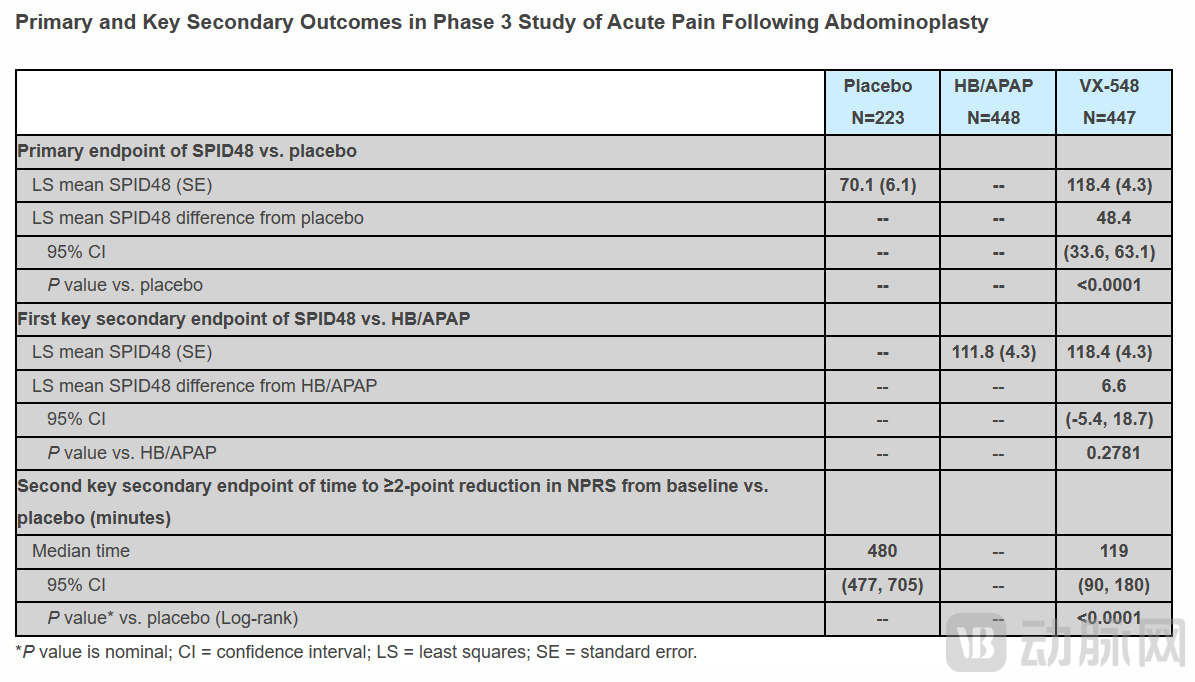
Key secondary endpoint 1, demonstrating superiority over HB/APAP, was not met; the least squares (LS) mean difference in SPID48 between VX-548 and placebo was 6.6 (95% CI: -5.4, 18.7; P=0.2781).
For key secondary endpoint 2, NPRS decreased by ≥2 points from baseline compared with placebo. In the two pivotal trials, the median time to meaningful pain relief was 8 hours in the placebo group, which was significantly shortened to 2 hours after abdominoplasty (P<0.0001), indicating a markedly faster onset of action.
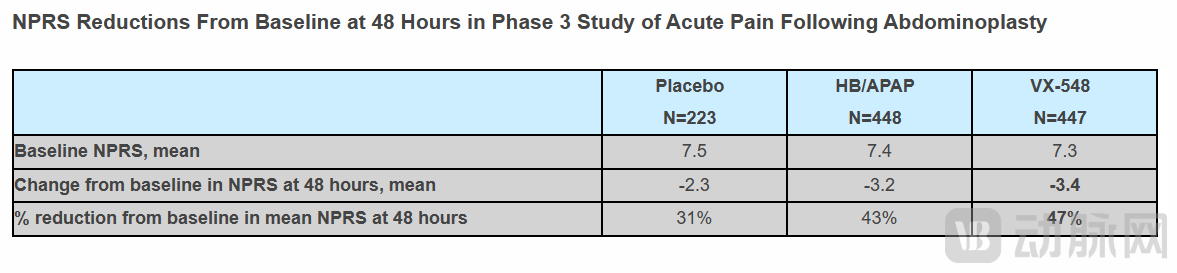
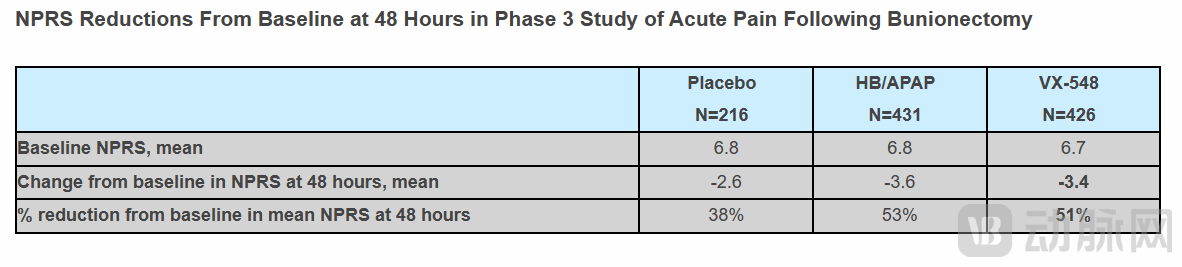
Next are the data following bunionectomy. The results showed that the time-weighted sum of pain intensity differences over 48 hours post-bunionectomy (SPID48) was significantly reduced compared with placebo, thereby meeting the primary endpoint of the trial. Compared with baseline, all doses of VX-548 demonstrated statistically significant and clinically meaningful reductions in the weekly average of daily pain intensity assessed by the Numeric Pain Rating Scale (NPRS), a key endpoint: the least squares (LS) mean difference for SPID48 was 29.3 (95% CI: 14.0, 44.6; P=0.0002).
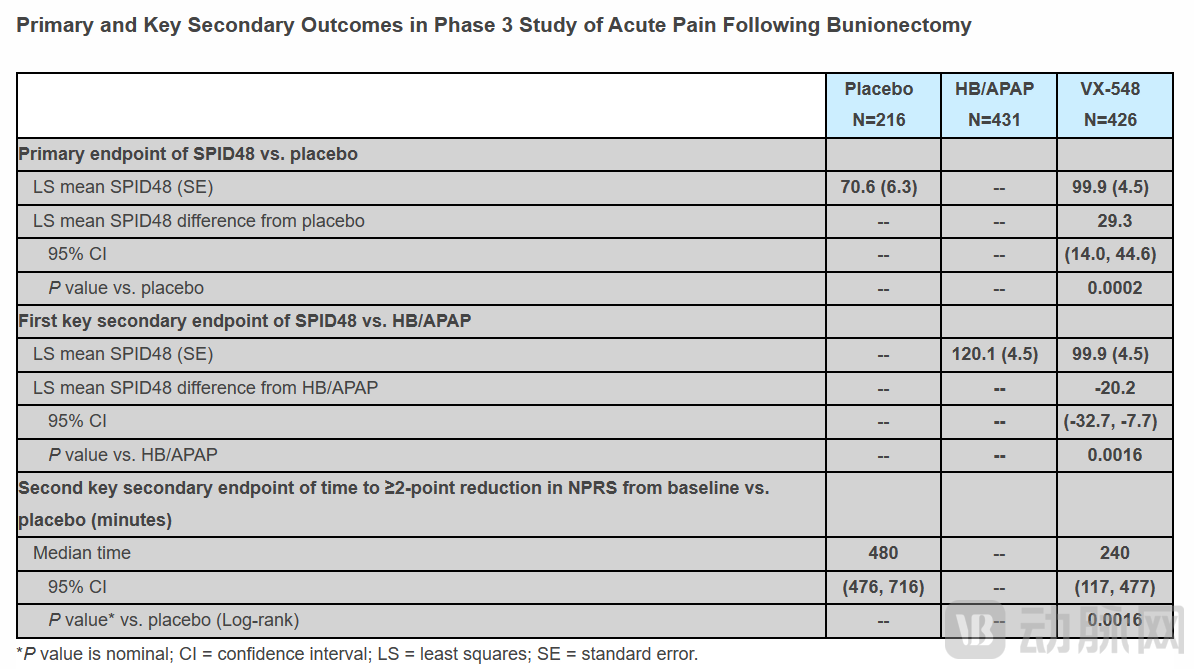
However, it also failed to meet the key secondary endpoint of superiority over HB/APAP, with the least squares (LS) mean difference in SPID48 between VX-548 and placebo being -20.2 (95% CI: -32.7, -7.7; P=0.0016).
For the second key secondary endpoint, there was a statistically significant improvement, with the time to bunionectomy reduced to 4 hours (P<0.0016).
VX-548 demonstrated good overall tolerability in this trial. Adverse events (AEs) with an incidence ≥5% in any treatment group (VX-548, placebo, or HB/APAP) included nausea (8.2%, 10.6%, 14.4%), headache (4.9%, 9.3%, 10.4%), constipation (3.5%, 4.2%, 5.1%), and dizziness (3.5%, 5.1%, 5.3%). No serious adverse events (SAEs) occurred.
In a single-arm safety and efficacy trial, Vertex enrolled 256 patients to evaluate the safety and efficacy of VX-548 in moderate-to-severe acute pain settings, both post-surgical and non-surgical. Oral treatment with VX-548, initiated at a dose of 100 mg followed by 50 mg every 12 hours for up to 14 days, demonstrated favorable safety, tolerability, and efficacy. The safety profile observed in this study was consistent with that reported in randomized controlled trials.
Will Nav1.8 Be the Next GLP-1?
Last December, following the successful Phase II clinical trial of VX-548, a second-generation highly selective Nav1.8 inhibitor, Vertex Pharmaceuticals’ stock price surged by 13.23% in a single day, adding $12.2 billion to its market capitalization and reaching an all-time high since its IPO, thereby welcoming a new member into the pharmaceutical industry’s $100 billion club.
But in the view of Wall Street analysts, the potential of VX-548 is still severely underestimated, with “the pain market having the potential to become the next weight-loss drug market.” According to Zhiyan Consulting, the global analgesic industry’s market size was approximately $91.14 billion in 2022.
For two decades, no new drug has successfully emerged in this billion-dollar market segment, leaving highly addictive opioids with low tolerance as the only option. The first to cross the finish line is the Nav1.8 inhibitor VX-548.
Studies have found that pain signal transmission depends on voltage-gated sodium channels (Nav) on the cell membrane. Inhibiting abnormal sodium channel activity and developing Nav inhibitors can help treat and alleviate pain. The Nav family has nine subtypes. Except for Nav1.8 and Nav1.9, which are only distributed in peripheral neurons, other subtypes are widely distributed in sympathetic neurons, cardiomyocytes, skeletal muscles, the central nervous system, etc. Inhibiting these subtypes may lead to some side effects.
Based on the currently available data for the Nav1.8 inhibitor VX-548, its 30,000-fold subtype selectivity for Nav1.8 enables selective inhibitory effects, delivering superior analgesia while avoiding the side effect of increased addiction risk. This may well point to the next “GLP-1” in the pain therapeutics sector.
Vertex has higher expectations for VX-548, following positive results from its Phase II study in pain associated with diabetic peripheral neuropathy, and the company has already planned to initiate pivotal clinical trials. In addition to VX-548, Vertex is simultaneously developing a broader pipeline of non-opioid small-molecule analgesics. Currently, two other Nav1.8-targeted candidates, VX-993 and VX-973, have entered clinical development, while additional Nav1.8- or Nav1.7-targeted therapies administered via intravenous injection are in the preclinical stage.
Furthermore, multinational corporations (MNCs) such as Merck & Co. and GSK have also made strategic investments in the NaV1.8 target, with all their programs currently in the preclinical stage. In China, multiple drug candidates have entered clinical development, including HRS-4800 from Jiangsu Hengrui Pharmaceuticals, JMKX000623 from Shanghai Jiyu, HBW-004285 from Haibowei Pharmaceutical, and FZ008-145 from Fermion Therapeutics (for which Regeneron has obtained exclusive rights for the Greater China region).
At present, the frontrunner VX-548 is on the verge of approval, paving a proven path for the development of Nav1.8 inhibitors.