

Following Shanghai, Sichuan Unveils New Reforms to Accelerate Commercialization of Scientific Research
As 2024 has just begun, the field of scientific and technological achievement transfer is witnessing a “new trend.” Following Shanghai’s “32 New Regulations,” Sichuan Province has also taken action.
On January 17, 2024, the Sichuan Provincial Department of Science and Technology and nine other departments issued"Implementation Plan for Comprehensively Deepening the Reform of the Ownership System for Job-Related Scientific and Technological Achievements"(hereinafter referred to as the “Plan”), with a view to further improving the policy framework for the reform of ownership rights in job-related scientific and technological achievements, and accelerating the transformation of such achievements into real productive forces.
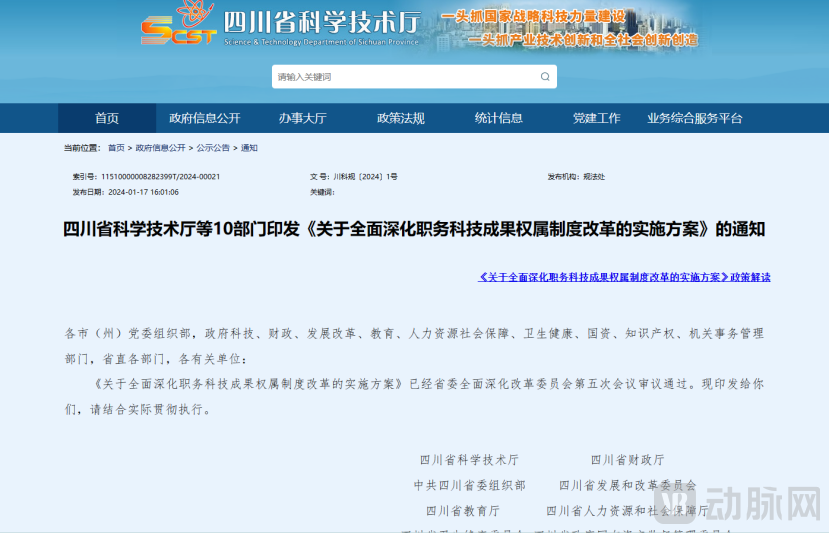
"Implementation Plan for Comprehensively Deepening the Reform of the Ownership System for Job-Related Scientific and Technological Achievements" (Image source: Sichuan Provincial Department of Science and Technology)
I. New Measures in the “Plan”: Decentralized Authority for Equity Valuation and Investment, and Free Flow of Capital
The release of this “Plan” also follows a clear trajectory. Previously, Sichuan had made multiple attempts to reform the ownership rights of scientific and technological achievement transfers, and revised and issued several measures, including the Regulations of Sichuan Province on Promoting the Transformation of Scientific and Technological Achievements, the Implementation Opinions on Deepening the Reform of Granting Researchers Ownership or Long-Term Use Rights to Job-Related Scientific and Technological Achievements, and the Implementation Plan for Pilot Reforms in Non-Asset-Based Management Prior to the Transformation of Job-Related Scientific and Technological Achievements.
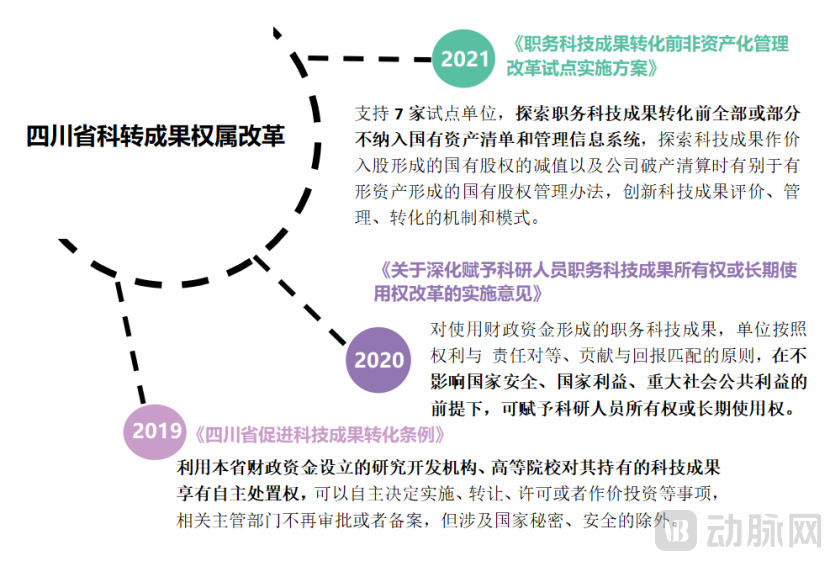 Historical Policies on the Ownership of Scientific and Technological Achievement Transformation in Sichuan Province
This "Plan" focuses on the following three directions:
1Promote a New Model for the Management of Job-Related Scientific and Technological Achievements
First, to further promote the decentralization of authority in scientific and technological achievement transformation,The “Plan” promotes a new model for the management of job-related scientific and technological achievements."The Plan" particularly emphasizesCapital Contribution in KindState-owned assets formed through the conversion of job-related scientific and technological achievements, via methods such as equity incentives, shall be subject to disposal decisions—including reduction of holdings, transfer, assignment, exit, impairment, and bankruptcy liquidation—made autonomously by research institutions. Such disposals differ from the management practices for tangible state-owned assets; they require no approval or filing, and are excluded from the performance evaluation framework for the preservation and appreciation of state-owned assets.
For research teams with limited energy and market capabilities, equity contribution through valuation offers a higher success rate compared to other commercialization pathways such as founding startups. On one hand, it combines the R&D strengths of researchers with entrepreneurs’ acute sensitivity to market demands, creating complementary advantages during the productization phase; on the other hand, it fosters deeper collaboration between the research and market sectors. However, in practice, the benefits of equity contribution through valuation have not been fully realized—some researchers, concerned about crossing the “red line” related to state-owned assets, hesitate to commercialize their achievements despite having viable results.
Therefore, this delegation of authority addresses researchers’ primary concern about the “loss of state-owned assets,” enabling them to pursue their innovations with greater confidence, while also providing indirect incentives such as benefit-sharing mechanisms.
2Expand the Autonomy of Research Institutions in the Conversion of Job-Related Scientific and Technological Achievements
In addition to delegating authority, the Plan also proposesExpand the autonomy of research institutions in the conversion of job-related scientific and technological achievements.Research institutions not only have a clear understanding of the status of technology transfer by frontline researchers but are also most aware of the pain points in this process. Therefore, further expanding their autonomy in disposing of job-related scientific and technological achievements—through assignment, licensing, or equity investment based on valuation—provides these institutions with the opportunity to “tailor-made” policies that better align with the specific needs of their research outputs, thereby bridging the “last mile” in achievement commercialization.
In addition, the "Plan" also mentions encouraging research institutions to extract from the net income of achievement transformation.10% FundingAs a fund for technological innovation and achievement commercialization; allowing horizontal scientific research projectsSurplus FundsDetailed Rules on the Allocation of Funds for Capital Contributions, Technology Transfer, and Related Matters.
Both scientific research and translational work rely on financial support. In the past, however, many special-purpose funds were subject to strict “earmarked use” restrictions, leading to situations where unspent balances in one project could not be used to cover deficits in another. The current Plan now allows surplus funds to be redirected toward translational activities, enabling greater flexibility in fund allocation. This approach better aligns with researchers’ actual funding needs during both the research and translation phases, ensuring that more resources flow to where they are most needed.
3Improve the Market-Oriented Transformation Mechanism for Job-Related Scientific and Technological Achievements
The stakeholders in the translation of scientific and technological achievements are not limited to researchers and research institutions; it also requires the joint efforts of enterprises, technology transfer professionals, various incubators, and concept verification centers. The current "Plan" also emphasizes the importance of these participants.
·EncourageEnterpriseImplement “dual-class share structures” in the commercialization of scientific and technological achievements to safeguard researchers’ voting rights and protect the legitimate rights and interests of both researchers and investors.
·EncourageTechnology Transfer and Commercialization Specialist(including technology managers, technology brokers, etc.) participate in the transfer and transformation of scientific and technological achievements by making cash capital contributions for equity stakes.
·SupportResearch InstitutionIntroduce, hire, or collaborate with third-party institutions to cultivate a high-caliber team of technology transfer and commercialization professionals through market-oriented approaches, and implement flexible internal compensation systems based on performance.
At different stages of the commercialization of scientific and technological achievements, leadership should be assumed by different “specialized professionals.” Only by engaging all stakeholders deeply in this process can the research and market ends be tightly integrated into a community of shared interests, thereby increasing the success rate of commercialization.
II. Local Policies Blossom, Propelling the Acceleration of Technology Transfer
Reviewing 2023,Jiangxi, Shaanxi, ZhejiangOther regions have also tailored policies to local conditions, introducing measures that support technology transfer within their respective provinces (or municipalities). After reviewing these initiatives, Chengguo Bureau found that they primarily fall into three categories: emphasizing collaboration, advancing empowerment reforms, and developing institutions such as proof-of-concept centers and incubators.
 2023 Provincial and Municipal Policies on Scientific and Technological Achievement Transfer (Excerpts)
1Emphasizing Collaboration: Fujian and Jiangxi
As mentioned above, the commercialization of scientific and technological achievements requires support from multiple stakeholders. Beyond Sichuan, the 2023 technology transfer policies in Fujian, Jiangxi, and other regions also reflect this perspective.
In the "Implementation Plan for the Industrialization of Scientific and Technological Achievements in Jiangxi Province (Trial)", quantified targets are emphasized: by 2025, the province will optimize and establish market-oriented demonstration institutions for technology transfer.More than 30, Establish Provincial-Level Bases for the Transformation of Scientific and Technological Achievements and Technology Transfer in Universities20+; Total number of professional technology brokers trainedReaching 2,300 people, among whom the proportion of intermediate and senior technology brokers reaches>5%。
Behind these figures, it is evident that Jiangxi Province is intentionally strengthening the technology transfer capabilities of various stakeholders and consolidating them into a powerful synergy, with the aim of further facilitating the practical implementation of achievement transformation.
Notably, the “Notice of the People’s Government of Fujian Province on Accelerating the Development of Scientific and Technological Innovation” outlines similar measures: establishing a provincial public service platform for the transfer and commercialization of scientific and technological achievements, launching a “bridging” initiative to facilitate the conversion of such achievements, and vigorously fostering technology transfer institutions. These efforts underscore the government’s determination to lead and mobilize diverse stakeholders in jointly advancing scientific and technological innovation.
2Empowerment Reform: Qinghai, Hainan, Shanghai, Zhejiang, Shaanxi
Empowerment ReformIt can be described as a “buzzword for translation” in 2023.
The “Ten Measures (Trial) for Deepening the ‘Three Reforms’ in the Transformation of Scientific and Technological Achievements” (Shaanxi) emphasizes exploring the “equity transfer” model for achievement transformation and launching pilot programs for “investment-first, equity-later.” The “Several Measures for Jointly Promoting the Transformation of Scientific and Technological Achievements” (Zhejiang) also includes provisions supporting state-owned enterprises and public institutions—such as universities, research institutes, new-type R&D institutions, and medical and health institutions—in carrying out achievement transformation and industry-academia-research collaboration through models like “use-first, transfer-later.” In addition, the “Implementation Plan for Pilot Programs on Innovative Reforms in the Transformation of Scientific and Technological Achievements in Shanghai” highlights measures focused on reforming the property rights system for scientific and technological achievements.
These policy measures are all aimed at one goal: delegating authority to those responsible for scientific and technological achievement transformation, thereby enhancing the capabilities and motivation of participants in this process.
3Develop proof-of-concept centers and incubators: Beijing, Tianjin, Jiangsu
The “Valley of Death” in the translation of scientific and technological achievements is also a crucial factor affecting the success rate of such translation. Therefore,Proof-of-Concept CenterandIncubatorThe establishment has also drawn significant attention.
The “Guiding Opinions of Beijing Municipality on Promoting the Innovative Development of Technology Business Incubators” emphasizes that, in addition to strategically laying out incubators serving frontier technological innovation and the commercialization of scientific and technological achievements within the “Three Cities and One Zone,” incubators are also required to deepen their industrial incubation services. Furthermore, the “Notice on Several Measures to Further Promote the High-Quality Development of University Technology Transfer Offices” (Tianjin) highlights that universities should enhance their capabilities in proof-of-concept services and sci-tech financial support, thereby helping researchers bridge the “valley of death” at the institutional level.
Proof-of-concept centers and incubators act as a “vaccine” for the translation of scientific and technological achievements, bringing latent risks in later stages to light and enhancing their risk resilience, thereby minimizing the premature failure of research outcomes during the early phase of commercialization.
III. Consensus on Departmental Transfers: From Policy Advocacy to Voluntary Action
In 1996, China promulgated its first policy on the commercialization of scientific and technological achievements, the “Law of the People’s Republic of China on Promoting the Transformation of Scientific and Technological Achievements.” Subsequently, as market demands evolved and practical experience accumulated, the policy underwent multiple revisions, refinements, and supplements.
Over the past three decades, we have witnessed the Law on Promoting the Transformation of Scientific and Technological Achievements evolve from centralized management to a more balanced approach: ownership has been progressively decentralized to local authorities, research institutions, and even individual researchers, while the approval requirements for professional practitioners such as technology transfer managers have become increasingly stringent.
Furthermore, the entities driving the translation of scientific and technological achievements have become increasingly diversified. Guided by policy, researchers are no longer fighting alone; enterprises, incubators, and various funds have become reliable partners in their commercialization journey.
Yet the most pronounced shift lies in societal attitudes toward commercialization: translating research outcomes into practical applications has evolved from a policy mandate into a consensus among researchers. As a result, China’s innovation capacity and commercialization capabilities are steadily growing. Looking ahead, the translation of scientific and technological achievements in China will delve further into uncharted territory, with more disruptive innovations ultimately reaching the market.