

Shenzhen Institute of Advanced Technology Develops Optogenetic Approach for Precise Clearance of Aβ Toxic Proteins in Alzheimer’s Disease
On January 30, 2024, the research team led by Dr. Zhan Yang from the Institute of Brain Cognition and Brain Disorders, Shenzhen Institutes of Advanced Technology, Chinese Academy of Sciences / Shenzhen-Hong Kong Institute of Brain ScienceNeuronThe journal published a study on Alzheimer’s disease treatment online.
The research team has developed a novel neuromodulation approach capable of precisely regulating microglia, thereby eliminating pathological proteins associated with Alzheimer’s disease (AD). The innovation of this method lies in its proposal of a new neuroprotective strategy,While clearing Aβ toxic proteins from the brain, it effectively avoids damage to other normal neurons.
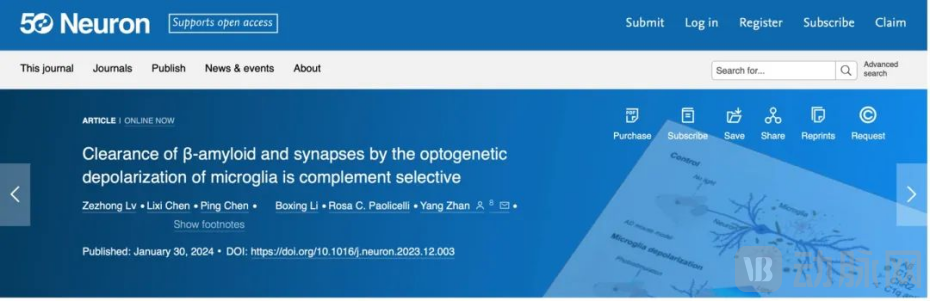
Clearance of β-amyloid and synapses by optogenetic depolarization of microglia is complement selective, image from the official Neuron website
Clearing AD Toxic Proteins to Protect Functional Neurons
A toxic protein is present in the brains of patients with Alzheimer’s disease. The clearance of these toxic proteins is of significant importance for the treatment of Alzheimer’s disease and represents a key research direction in therapeutic development. Microglia, the immune cells of the central nervous system that monitor and clear harmful substances, are among the primary focuses of research on the precise clearance of toxic proteins.
After five years of exploration, the research team successfully established a method for the specific depolarization and activation of microglia both in vitro and in vivo. By employing optogenetic regulation as an effective stimulation strategy, they discovered that stimulating microglia enhances their phagocytic function, thereby accelerating the clearance of amyloid-beta (Aβ) toxic proteins in Alzheimer’s disease. Furthermore, by inhibiting the complement system signaling pathway within the immune system, this approach effectively prevents activated microglia from inadvertently damaging other healthy neurons.
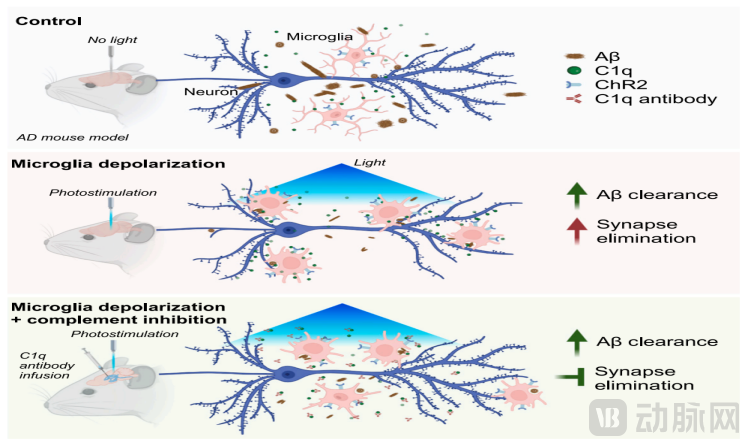
Neuromodulation of Microglial Aβ Clearance and Complement Pathway Inhibition Protects Synapses. Image source: Neuron official website
AD Research Is Booming, with Pathogenesis Remaining a Key Focus
Research on Alzheimer’s disease (AD) treatment continues to prioritize the elucidation of pathogenesis and the identification of drug targets. Scholars both in China and abroad are exploring these areas from multiple perspectives, including biological structure, immunology, neuroscience, and drug discovery.
From a structural perspective,In 2018, the research group led by Shi Yigong at Westlake University reported the cryo-electron microscopy structure of the human γ-secretase–Notch fragment complex in *Nature*. This structure revealed the critical role of γ-secretase in the pathogenesis of Alzheimer’s disease and provided important insights into how γ-secretase acts on the β-amyloid precursor protein. In 2020, the team further elucidated the entire process of γ-secretase substrate binding and drug interaction.
In 2022, a research team from the University of Cambridge in the United Kingdom utilized cryo-electron microscopy to extract β-amyloid filaments from human brain tissue, thereby resolving for the first time the structures of two types of Aβ42 protein fibrils derived from human brain tissue. The related findings were published in the journal Science.
In the field of immunologyIn 2019, Michael Heneka’s research group at the University of Bonn in Germany discovered that tau protein can activate the NLRP3 inflammasome. Moreover, loss of NLRP3 inflammasome function significantly attenuates hyperphosphorylation of tau protein; the interplay between these two factors influences the pathogenic progression of Alzheimer’s disease;
In 2021, Greg Lemke’s team published an article in Nature Immunology, revealing the critical roles of Mer and Axl in microglial recognition and response to Alzheimer’s disease-associated amyloid-β (Aβ) plaques;
A research paper by Professor Chen Xiaofen and Associate Professor Zhong Li’s team at Xiamen University was published online in the journal *Immunity*. The study reveals that the TREM2 receptor in microglia can inhibit complement activation and complement-mediated synaptic loss in the Alzheimer’s disease (AD) brain by binding to the complement protein C1q, providing new mechanistic insights into the protective role of TREM2 in AD.
In the neurological direction, in 2020, Shen Yong's team proposed a new hypothesis that dysfunction of the GABAergic system in the Alzheimer's disease brain disrupts the excitation-inhibition balance, thereby triggering neurodegenerative changes, which provides new insights for the development of Alzheimer's disease drugs;
In 2021, Professor Mei Feng’s team from the Army Medical University published a research paper online in the journal *Neuron*. Using cell-specific fluorescent reporter transgenic mice to observe newly formed myelin and track established myelin, the study revealed unique myelin dynamics in the brains of Alzheimer’s disease (AD) mice. Furthermore, by employing conditional knockout mice, behavioral assays, and electrophysiological recordings, the researchers demonstrated that promoting myelin renewal can alleviate memory deficits and hippocampal electrophysiological abnormalities in AD mice.
Furthermore, Nave’s team systematically elucidated the role of chronic demyelination in promoting a key pathological feature of Alzheimer’s disease—amyloid-beta deposition. Their study revealed that demyelination may further disrupt brain homeostasis and accelerate plaque formation by both accelerating Aβ production and impairing microglial clearance of Aβ.
In drug discovery, the research team led by Yuan Zengqiang at the Center for Brain Science, Academy of Military Medical Sciences, discovered that the flavonoid compound rutin can specifically target microglia, the immune cells in the brain, improve their energy metabolism status and enhance their ability to clear Aβ, thereby delaying the pathological progression of Alzheimer's disease;
A research team led by Yao Yonggang at the Kunming Institute of Zoology, Chinese Academy of Sciences, published findings in the journal Autophagy, elucidating the molecular mechanisms underlying the anti-Alzheimer’s disease effects of the nuclear receptor peroxisome proliferator-activated receptor alpha (PPARα) agonists gemfibrozil and pirinixic acid.
The team led by Geng Meiyu at the Shanghai Institute of Materia Medica, Chinese Academy of Sciences, discovered that GV-971, a novel therapeutic agent for Alzheimer’s disease, achieves its treatment effect by reshaping gut microbiota balance, reducing the accumulation of related metabolites phenylalanine and isoleucine, and alleviating neuroinflammation in the brain.
In recent years, the success of clinical trials for anti-amyloid disease-modifying therapies, coupled with updates to the diagnostic framework for Alzheimer’s disease (AD) biomarkers, has heralded the emergence of more precise and efficient diagnostic and therapeutic strategies. Meanwhile, advances in big data and multi-omics technologies are empowering researchers worldwide to further elucidate the complex pathogenic mechanisms underlying AD.
New Drug Approvals See a Glimmer of Hope
On January 9, 2024, the new Alzheimer’s disease (AD) drug Leqembi (lecanemab) was approved for marketing in China for the treatment of mild cognitive impairment and mild dementia due to AD.
Leqembi is a monoclonal antibody targeting beta-amyloid (Aβ) in the brain. In January 2023, the U.S. FDA granted accelerated approval to Leqembi for the treatment of Alzheimer’s disease. In July 2023, the FDA announced the conversion of Leqembi’s approval to full traditional approval following confirmation of its clinical efficacy. This marks the first new drug for Alzheimer’s disease to receive full FDA approval in nearly two decades.
Prior to this, pharmaceutical giants conducted extensive research based on the amyloid-beta (Aβ) hypothesis. Johnson & Johnson/Pfizer developed the monoclonal antibody bapineuzumab; Merck & Co. developed the small-molecule drug verubecestat (MK-8931); Roche initiated the development program for gantenerumab; and Eli Lilly pursued the development of solanezumab. However, all these major pipelines led by industry giants stalled at Phase III clinical trials, with none reaching the market.
As of January 1, 2024, there were 364 Alzheimer’s disease drugs in clinical stages globally, with 172 updated in the past three years; those targeting Aβ and microtubule-associated protein tau (MAPT) were the most numerous.
Reference link:
https://mp.weixin.qq.com/s/Kzx-FBNwYuRd7S-lPTEgjA
http://bcbdi.siat.ac.cn/index.php/news/showNews/nid/627.shtml