

Domestic Breakthrough: First Nature Paper on Ferroptosis Unveils 7-DHC as a Novel Therapeutic Target for Cancer and Ischemia-Reperfusion Injury
On January 31, 2024, Professor Wang Ping’s team from the School of Medicine, Tongji University/Shanghai Tenth People’s Hospital (with Yaxu Li, Qiao Ran, Qiuhui Duan, and Jiali Jin as co-first authors) published an article in Nature on the regulation of ferroptosis by 7-dehydrocholesterol (7-DHC). Notably, this is the first paper on ferroptosis research from China to be published in Nature.
This study identified and elucidated the mechanism by which key enzymes in the distal cholesterol synthesis pathway regulate ferroptosis sensitivity by modulating 7-dehydrocholesterol (7-DHC) levels, suggesting that pharmacological modulation of 7-DHC levels represents a promising novel strategy for treating cancer and ischemia-reperfusion injury.
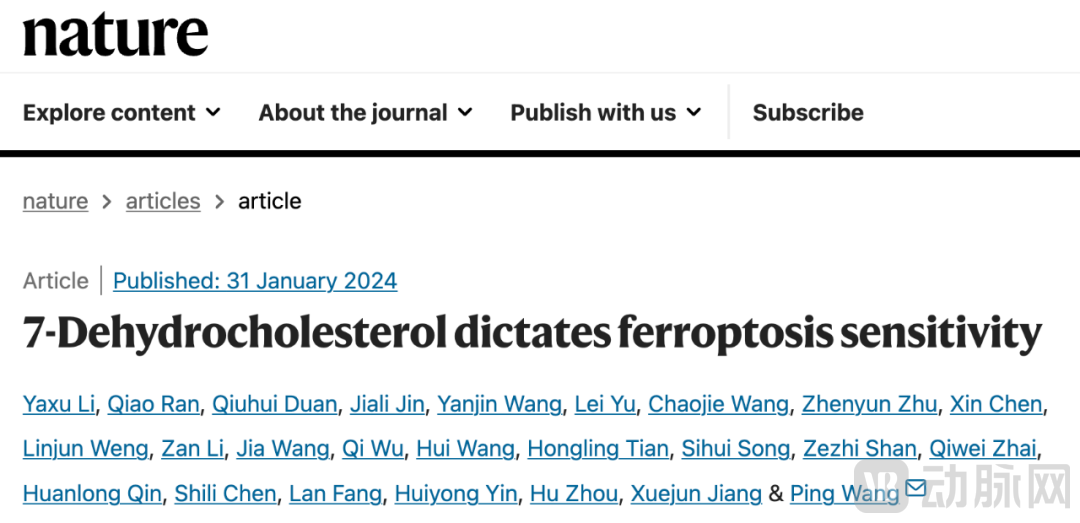
Tongji University Wang Ping Team“7-Deh“Hydrocholesterol dictates ferroptosis sensitivity,” image from Nature
Ferroptosis is a regulated form of necrotic cell death, discovered in 2012 by the laboratory of Brent Stockwell at Columbia University. It is characterized by iron-dependent lipid peroxidation and excessive accumulation of reactive oxygen species (ROS).
Notably, in certain contexts, cancer cells may exploit intracellular ferroptosis defense pathways to evade ferroptotic cell death, thereby promoting tumor progression. Consequently, research targeting these ferroptosis defense mechanisms in cancer cells may offer novel therapeutic targets and strategies for oncology treatment.
Furthermore, the mechanism of ferroptosis involves the metabolism and regulation of various intracellular molecules, playing a pivotal role in the pathogenesis and progression of neurodegenerative diseases, ischemic organ injury, and other conditions. Since its discovery, ferroptosis has remained a focal point in research on cell death mechanisms and disease development.
7-DHC is a metabolic intermediate in the cholesterol biosynthesis pathway, formed from cholesterol in the body under the action of dehydrogenases. It is widely present in the sebaceous glands and their secretions within animal skin, and can be converted into vitamin D upon exposure to ultraviolet radiation.
This sterol is associated with various diseases, such as skin cancer, cardiovascular disease, diabetes, and obesity. Some studies suggest that high concentrations of 7-dehydrocholesterol may be linked to the onset and progression of these conditions, potentially serving as a predictive biomarker for them.

Professor Wang Ping, image from Tongji University School of Medicine
Professor and Doctoral Supervisor, School of Medicine, Tongji University / Shanghai Tenth People's Hospital; Vice Dean, School of Medicine, Tongji University.
Professor Wang Ping’s research group investigates the regulatory mechanisms and therapeutic targeting of the tumor microenvironment. In recent years, focusing on tumor metabolism and the innate immune microenvironment, with protein post-translational modifications (PTMs) as the core, the group has integrated genome-wide screening and multi-omics technologies to study how tumor cells sense and respond to signals such as nutrient availability, growth factors, and mechanical stress within the microenvironment. The group has also explored the reciprocal regulatory mechanisms between tumor cells and innate immune cells in the microenvironment, particularly phagocytes. Furthermore, the laboratory is actively expanding its translational research efforts, including drug screening, identification of tumor immune biomarkers, and the application and clinical translation of tumor immune cells.
Through a series of experiments, the team discovered that 7-dehydrocholesterol (7-DHC) regulates ferroptosis by modulating intracellular reactive oxygen species (ROS) levels. Elevated intracellular 7-DHC levels lead to a corresponding increase in ROS levels, thereby enhancing cellular sensitivity to ferroptosis; conversely, reduced intracellular 7-DHC levels result in decreased ROS levels, thereby diminishing cellular sensitivity to ferroptosis.
Furthermore, the team discovered that either inhibiting 7-DHC synthesis or promoting its metabolism can reduce cellular susceptibility to ferroptosis. This study provides new insights into the regulatory mechanisms of ferroptosis and offers novel therapeutic targets for cancer and metabolic diseases.
In addition to 7-DHC, cells possess multiple endogenous defense pathways against ferroptosis, the most prominent of which is mediated by glutathione peroxidase 4 (GPX4). This is a recently discovered cell death mechanism, with key international contributors including Brent Stockwell, Krzysztof Palczewski, Yi Zhang, and David Huang.
Brent Stockwell is one of the pioneers in ferroptosis research. He proposed the concept of ferroptosis in 2012 and, in subsequent studies, elucidated its molecular mechanisms and biological significance. His research team discovered that ferroptosis is associated with the onset and progression of various diseases, including neurodegenerative disorders, cardiovascular diseases, and cancer.
Krzysztof Palczewski’s research team identified several genes and proteins associated with ferroptosis and investigated their roles in retinal degenerative diseases.
Yi Zhang’s research team discovered the interplay between ferroptosis and other forms of cell death, such as autophagy and apoptosis, providing new insights into the mechanisms underlying ferroptosis.
Furthermore, David Huang and his colleagues have made significant contributions to the mechanisms and regulation of ferroptosis. His research team identified several molecules and compounds capable of inducing ferroptosis and explored their potential applications in cancer therapy.
In China, in addition to Wang Ping’s team, researchers such as Professor Min Junxia and Professor Fudi Wang have also made outstanding contributions.
Among them, Professor Min Junxia has not only revealed the critical role of ferroptosis induced by iron overload in various cardiac and hepatic diseases but also demonstrated in animal disease models that targeting ferroptosis is a potential therapeutic strategy for these conditions. Her team further identified a transporter named Slc39a14, which induces ferroptosis in hepatocytes by promoting hepatic uptake of non-transferrin bound iron (NTBI), thereby leading to the development of liver fibrosis. This discovery holds promise as a novel target for the prevention and treatment of liver fibrosis.
Professor Wang Fudi’s team has conducted in-depth research in areas such as “ferroptosis and heart disease,” “ferroptosis and iron-induced liver disease,” and “the role of iron in kidney disease and longevity.” In the field of “ferroptosis and heart disease,” they identified free iron as a key pathogenic mechanism and multiple target genes in ferroptosis-mediated cardiomyopathy and heart failure. This represents the first breakthrough research achievement globally in the field of ferroptosis and heart disease.
In the field of “ferroptosis and iron-induced liver diseases,” the team has elucidated the regulatory pathways and molecular mechanisms underlying ferroptosis-mediated liver injury and hemochromatosis. He and his collaborators are developing novel drugs that target ferroptosis for the treatment of liver injury caused by thalassemia and non-alcoholic steatohepatitis.
In the realm of “The Role of Iron in Kidney Disease and Longevity,” Professor Wang Fudi’s team has elucidated the clinical side effects and molecular mechanisms by which the “wonder drug” metformin exacerbates acute kidney injury through iron-mediated ferroptosis, thereby providing a definitive resolution to the century-old debate over whether metformin exhibits nephrotoxicity.
Professor Wang Fudi not only identified novel key genes involved in iron metabolism but also elucidated a new mechanism underlying the degradation of ferroportin, the sole known iron export pump. This series of findings has made significant contributions to mapping the molecular regulatory network of iron metabolism.
With the ongoing deepening and clarification of research into ferroptosis mechanisms, multiple startups have been incubated in the industry.
For example, Reata Pharmaceuticals, a U.S. company, has omaveloxolone, a ferroptosis inducer, in its pipeline for the treatment of neurofibromatosis and amyotrophic lateral sclerosis (ALS). The drug is currently in clinical trials, and Reata Pharmaceuticals was acquired by Biogen in July 2023 in a deal valued at $7.3 billion.
Japanese pharmaceutical company Astellas Pharma also has an investigational drug based on the ferroptosis mechanism, namely the Hsp90 inhibitor AT13387. This drug can treat cancers such as glioma and pancreatic cancer by inducing ferroptosis and has currently entered the clinical trial stage.
Kojin Therapeutics, founded by Professor Stuart L. Schreiber, co-founder of the Broad Institute, leverages his discovery of GPX4 to develop drugs targeting ferroptosis-sensitive, drug-resistant tumors through GPX4 inhibitors. The company announced in June 2021 that it had completed a $60 million Series A financing round.
In China, Sironax publicly disclosed a patent on ferroptosis modulators or inhibitors in November 2021. Founded in 2018 by Dr. Wang Xiaodong and Dr. Zhang Zhiyuan, the company focuses on the apoptotic and necrotic signaling pathways to develop first-in-class (FIC) chemical drugs for the treatment of tissue injury diseases associated with aging.
Ke Yin Biotech, an AI-driven new drug development company, focuses on the field of ferroptosis. Yilong Zou, a Distinguished Researcher at the School of Life Sciences, Westlake University, serves as the company’s scientific advisor. The company is advancing its basic research and drug development based on his research. Leveraging Dr. Zou’s findings, the company has designed and optimized compounds that are orally bioavailable and demonstrate robust efficacy in animal models. These compounds inhibit proteins that suppress ferroptosis, thereby promoting ferroptosis to inhibit tumor growth. To date, the company has secured support from multiple investors, including Sherpa Capital and FreeS Fund.
Beijing DeepModel Technology is dedicated to leveraging artificial intelligence and quantum chemistry methods to provide efficient computational platforms and solutions for drug discovery and materials design. Currently, the company is investigating the mechanisms and regulatory pathways of ferroptosis to identify novel therapeutic strategies.
Since ferroptosis is implicated in the pathogenesis and progression of various diseases, leveraging ferroptotic mechanisms enables the development of diverse diagnostic products for early disease detection and prediction. For instance, Reata Pharmaceuticals is not only engaged in therapeutic drug development but also exploring methods to utilize ferroptosis mechanisms for disease diagnosis. The company has developed a ferroptosis inducer named “Omaveloxolone” and is investigating its diagnostic potential for neurofibromatosis and amyotrophic lateral sclerosis (ALS).
In China, more companies focus primarily on research services, such as Shenzhen’s Xinbosheng Biology. However, within the scientific community, some researchers are already attempting to assess cellular viability and function by detecting ferroptosis-related biomarkers, such as ferritin and glutathione, thereby providing references for disease diagnosis and treatment. The diseases involved in these studies include not only tumors and neurodegenerative disorders but also metabolic diseases and gynecological conditions.