

Bolt Biotherapeutics Files for IPO: Can the ISAC Pioneer Validate Its Immuno-Oncology Platform with Support from Novo Holdings and Innovent?

Bolt Biotherapeutics
Biological New Drug Developer
The explosive growth in the antibody-drug conjugate (ADC) sector of the biopharmaceutical industry in 2023 has continued into 2024. This has led to a broader extension of the concept that “everything can be conjugated.”
This has been followed by the emergence of more conjugation technologies, with dozens of novel conjugated drugs—including SMDCs, RDCs, ISACs, and FDCs—flourishing in a diverse landscape. Among these, ISAC therapy has garnered high expectations due to its potent tumor-killing capability.
Unlike ADC therapy,ISAC consists of three components: an antibody, a linker, and an agonist, with its payload being an innate immune agonist or modulator.ISAC has the ability to transform cold tumors, which have low sensitivity to immune checkpoint inhibitors, into hot tumors with higher sensitivity.This therapy works by activating dendritic cells within the tumor, stimulating the pattern recognition receptors (PRRs) expressed on these cells to elicit an immune response in the human body. Unlike antibody-drug conjugates (ADCs), which engage in a “direct assault” by delivering cytotoxic agents directly to the tumor site, ISACs infiltrate the tumor interior, inciting “internal turmoil” within the tumor.
The pioneer in this field is Bolt Biotherapeutics.
Favored by numerous star investors, it has received unwavering support from Novo Holdings.
In 2015, Dr. Edgar G. Engleman of Stanford University founded Bolt Biotherapeutics in the San Francisco Bay Area, aiming to expand his pioneering work in cancer immunotherapy and bone marrow biology.
To ensure the Company’s efficient and sustainable development, Bolt has assembled a high-caliber management team whose members have extensive experience in the discovery, development, and commercialization of immuno-oncology therapeutics.
Current CEO Randall Schatzman joined Bolt Biotherapeutics in 2019, bringing with him over 30 years of experience in the biotechnology industry.Prior to joining Bolt, Schatzman co-founded the biopharmaceutical company Alder BioPharmaceuticals with a team of scientists in 2004. From 2004 to 2018, Schatzman served as President and Chief Executive Officer of Alder, spearheading the approval of the company’s monoclonal antibody therapy, Vyepti (eptinezumab). As the fourth CGRP antibody approved globally, Vyepti is indicated for the preventive treatment of migraine in adults. Before founding Alder, Schatzman held the position of Senior Vice President of R&D Discovery Research at Celltech, a long-established pharmaceutical company in the United Kingdom. Leveraging his extensive experience in bringing drugs to market, Schatzman has been entrusted with leading Bolt’s efforts to advance ISAC, an innovative therapeutic platform, toward clinical realization.
Another key leader at Bolt is Dr. Edith A. Perez, who joined Bolt as Chief Medical Officer (CMO) in 2020 and is an internationally recognized expert in translational medicine and oncology. She practiced for over two decades at the Mayo Clinic, a globally leading medical center, where she was appointed Professor Emerita. Prior to joining Bolt, Dr. Perez served as Vice President and Head of Bio-Oncology at Genentech, a member of the Roche Group, where she oversaw all hematology and oncology pharmaceutical programs. She led hundreds of clinical trials and contributed to the market approval of six drugs, including Gazyva for the treatment of lymphoma and Perjeta for early-stage HER2-positive breast cancer. Dr. Perez’s arrival has set the direction for Bolt’s clinical strategy and development.
Furthermore, CBO Grant Yonehiro, CFO Willie Quinn, and other executives each bring over 20 years of management experience in their respective areas of expertise. The clear division of responsibilities within the executive team has enabled Bolt Biotherapeutics to secure leading advantages in drug R&D, clinical development, business development (BD) collaborations, and cash flow management, thereby providing robust support for the translation of ISAC therapy from concept to commercial realization.
Therapeutic innovation and the management team’s extensive experience alsoBolt has attracted a host of investors, including prominent biopharma venture capital firms such as Novo Holdings, Vivo Capital, and RA Capital. Novo Holdings’ financial support for Bolt has been consistent throughout.
Bolt’s $17 million Series A financing was led by Novo Holdings and Vivo Capital. In 2019, Bolt completed a $54 million Series B financing round, with investors including Novo Holdings, Pivotal bioVenture Partners, Nan Fung Life Sciences, and Vivo Capital.
In the oversubscribed $93.5 million Series C financing round completed in 2020, new investors such as Pfizer joined. The round was led by Sofinnova Investments, with participation from Novo Holdings, Vivo Capital, and Pivotal bioVenture Partners, among others. Newly joining investors also included well-known firms such as RA Capital Management, Surveyor Capital, and Pfizer Ventures.
Bolt Biotherapeutics’ appeal to investors enabled it to successfully complete an initial public offering (IPO) the year after closing its Series C financing round. In 2021, Bolt listed on the Nasdaq, issuing 8.825 million shares and raising a total of $176 million. On its trading debut, Bolt’s opening price was $26.10 per share, representing a 30.5% increase over the IPO price; its closing price reached $32.15 per share, up 60.75% from the IPO price. Its market capitalization exceeded $1 billion.
Building the Boltbody™ ISAC Platform to Activate Innate Immune System Warriors
Currently, most immunotherapies focus on the adaptive immune response, wherein antigen-specific T and B lymphocytes are stimulated by antigens to mediate tumor cell killing. Bolt Biotherapeutics goes a step further, aiming to successfully activate the innate immune system and ultimately trigger the adaptive immune system to generate a robust anti-tumor immune response. Bolt Biotherapeutics focuses on myeloid cells.
Myeloid cells are immune cells belonging to the innate immune system, comprising cell types such as monocytes, macrophages, dendritic cells, and granulocytes. They play a crucial role in regulating T-cell responses, thereby bridging the innate and adaptive immune systems. Due to various immunosuppressive factors generated within the tumor microenvironment, the normal functions of these cells may be inhibited, limiting their ability to mount an effective anti-tumor response.
When functioning properly, myeloid cells can stimulate antitumor activity in the body by directly killing tumor cells and activating tumor-specific T cells, thereby supporting durable antitumor immune responses and immunological memory. Activated myeloid cells also secrete pro-inflammatory chemokines and cytokines to recruit additional immune effector cells, helping to convert immunologically “cold” tumors into “hot” tumors. Consequently, these myeloid cells, which typically support tumor growth, can be transformed into tumor-destructive myeloid cells, thereby amplifying both innate and adaptive immune responses and generating sustained and effective antitumor immunity.
To support the implementation of this idea,Bolt has established its proprietary Boltbody™ ISAC technology platform, which reprograms the tumor microenvironment by activating and recruiting myeloid cells to elicit novel anti-tumor immune responses.
Boltbody ISAC comprises three main components: a tumor antigen-targeting antibody, a cleavable or non-cleavable linker, and a proprietary immune stimulant designed to activate the patient’s innate and adaptive immune systems.These components ensure that Boltbody ISAC can trigger the human innate and adaptive immune systems at different stages of the cancer-immunity cycle, thereby generating long-term anti-tumor activity.
Among the three main components, the proprietary immune stimulant is a bone marrow modulator. To this end, Bolt has established a proprietary bone marrow modulator platform and identified Dectin-2, a novel cell surface protein capable of binding to and activating tumor-supportive macrophages. Activation of these macrophages via Dectin-2 leads to the production of pro-inflammatory cytokines, consistent with the phenotype of tumor-destructive macrophages. Bolt’s technology platform holds promise for reprogramming tumor-supportive macrophages into tumor-destructive macrophages, thereby eliciting potent anti-tumor immune responses.
Introduction to Bolt: Its innovative ISAC therapy will provide more options for the treatment of solid tumors. Furthermore, this therapy can generate immune memory to deliver long-term anti-tumor responses and prevent recurrence.
Supported by its technology platform, Bolt has advanced two first-in-class pipelines: BDC-1001 and BDC-3042.
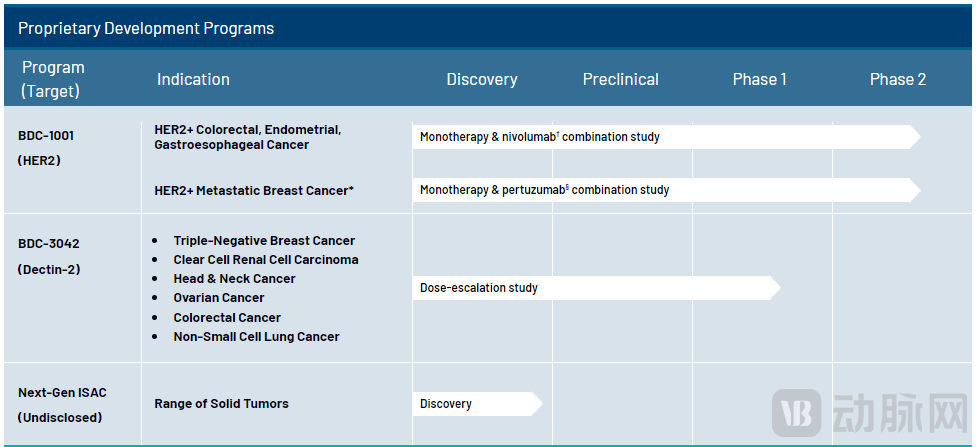
Image source: Bolt Biotherapeutics official website
BDC-1001 is currently in Phase 2 clinical development for the treatment of patients with HER2-positive colorectal cancer, endometrial cancer, gastroesophageal cancer, and metastatic breast cancer. The drug consists of trastuzumab, a HER2-targeting biosimilar antibody, conjugated to one of Bolt’s proprietary TLR7/8 agonists, designed to maximize potential antitumor responses. BDC-1001 stimulates antitumor activity through a three-pronged approach: directly killing tumor cells via trastuzumab-mediated mechanisms, eliminating HER2-expressing tumor cells through activated myeloid antigen-presenting cells (APCs), and inducing durable immunity via T-cell responses.
BDC-3042 is a bone marrow-modulating agonist antibody that reactivates bone marrow cells to attack tumor cells. Its indications focus on various cancers, including triple-negative breast cancer, head and neck cancer, non-small cell lung cancer, and colorectal cancer. It is currently in Phase I clinical trials.
Does the ISAC Therapy Really Work? Bolt Faces a Crucial Test
Following Bolt Biotherapeutics’ IPO, its therapies have also drawn attention from innovative pharmaceutical companies in China.
In August 2021, Innovent Biologics and Bolt Biotherapeutics announced a collaboration to develop three new oncology Boltbody™ ISAC programs.
The two parties will leverage Innovent Biologics’ proprietary therapeutic antibody portfolio and its capability to discover undisclosed oncology targets, combined with Bolt’s advanced ISAC technology and bone marrow biology expertise, to develop three ISAC-based cancer therapies. Upon execution of the agreement, Bolt will receive a $5 million cash upfront payment from Innovent Biologics and potential future equity investments of up to $10 million. Furthermore, both companies are eligible to receive corresponding milestone payments and royalties upon achieving development and commercial milestones in their respective territories.
In addition to Innovent Biologics, Bolt has also established business development (BD) partnerships with Genmab and TORAY. From financing to its initial public offering (IPO) and BD collaborations, Bolt has enjoyed widespread favor and support. However, the true efficacy of its product pipeline remains the core determinant in proving a biotech company’s strength.
Bolt has encountered setbacks due to clinical data from its core pipeline.
In December 2021, Bolt Therapeutics announced Phase 1/2 clinical data for its ISAC drug BDC-1001. Among 40 evaluable patients, the overall response rate (ORR) was only 2.5%, and the disease control rate (DCR) was 32.5%. This unsatisfactory result led to a 55.8% plunge in Bolt Therapeutics’ stock price following the announcement.
Similarly, in August 2022, Bolt announced that it would halt the advancement of its core preclinical program, BDC-2034. Previously, BDC-2034 had garnered significant attention due to promising mouse study data, with preclinical results indicating efficacy in treating pancreatic cancer. However, upon observing off-target toxicities associated with the targeting antibody, Bolt decided to discontinue development, thereby terminating the progression of BDC-2034 into clinical trials, and refocused its efforts on two other programs: BDC-1001 and BDC-3042.
Disappointing clinical trial results have raised questions within the industry about whether ISACs can truly emerge as potent therapies distinct from ADCs, subjecting Bolt to greater scrutiny.
However, the theoretical framework of ISACs has garnered significant attention within the industry. Novartis and Mersana Therapeutics are strengthening their strategic positioning in this field, while Chinese pharmaceutical companies such as Hengrui Medicine and BeiGene are entering the ISAC arena through independent research and development.
Anticipating further progress from Bolt Biotherapeutics and more sparks igniting in the ISAC track.