

Dowen Doctor: Transforming Second Medical Opinions in the Era of Large Language Models
In 2023, the global large language model (LLM) industry witnessed a surge of activity. On one hand, LLMs continued to undergo iterative upgrades; on the other, their industrial-scale application was prioritized, with various sectors actively seeking practical implementation scenarios, thereby driving profound transformations in industries such as finance, education, and healthcare.
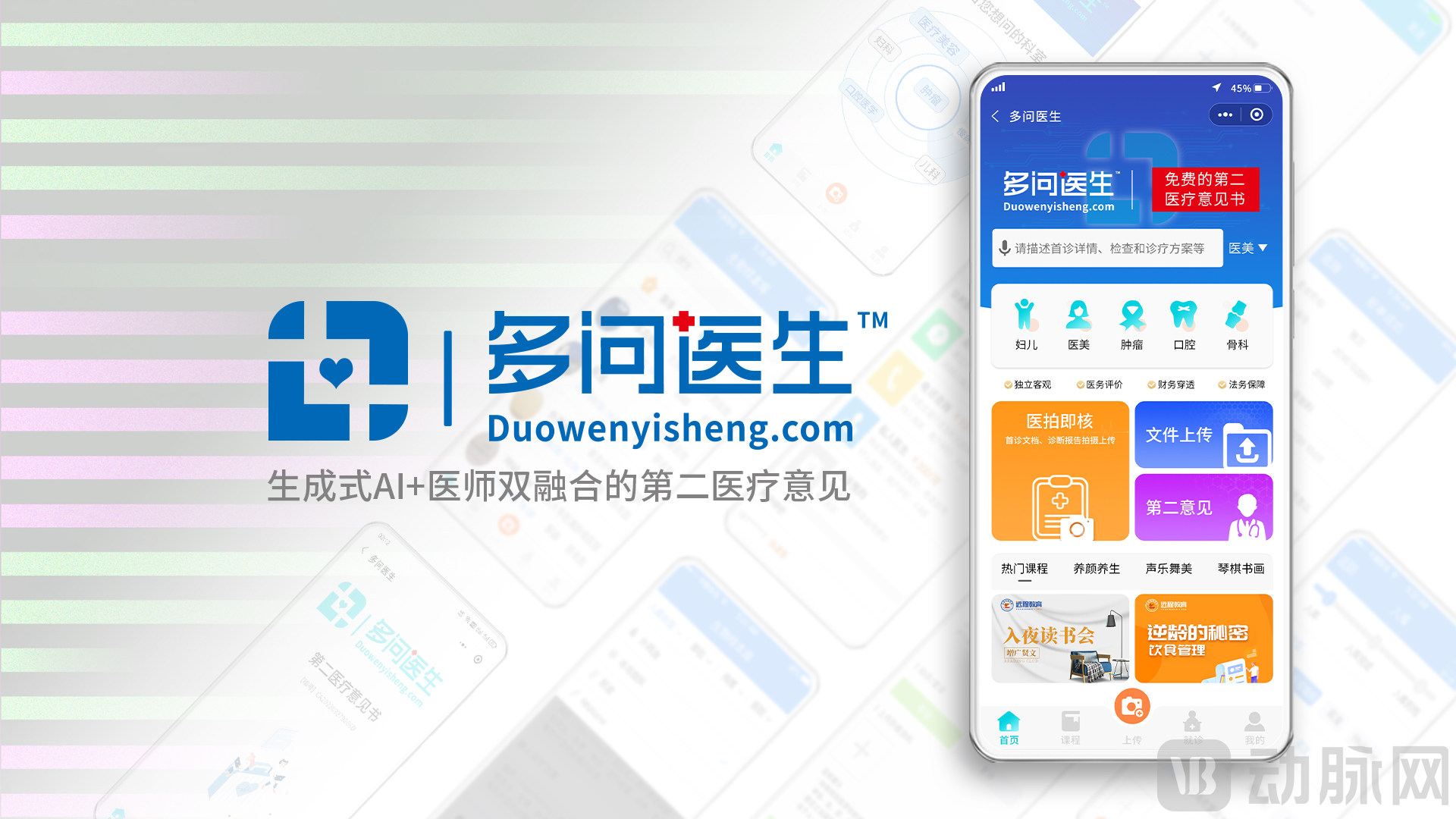
Recently, VCBeat connected with Duo Wen Yisheng, a vertical platform specializing in second medical opinions. After completing its seed funding round in 2023, the company embarked on a transformation toward generative AI-powered second medical opinions, aiming to leverage large language models to enhance the efficiency of generating second opinion reports and improve users’ experience in medical information search.
The so-called second medical opinion (hereinafter referred to as the “second opinion”) refers to an independent diagnostic and treatment recommendation provided by a second physician, based on the initial consultation records, at the request of a patient who has already undergone an initial diagnosis. An overseas study indicates that approximately 90% of patients are inclined to seek a second opinion after their initial consultation. Organizations such as the American Cancer Society, Stanford University, and the Mayo Clinic are also actively advocating for second opinions.
In China, the practice of patients seeking second opinions is actually more prevalent, with a stronger willingness to do so. Moreover, beyond providing more reasonable and higher-quality medical plans based on the initial diagnosis, second opinions in China often serve additional functions, including disease guidance, healthcare cost containment, patient education, and emotional support and counseling. Therefore, from the perspective of Duo Wen Yisheng, second opinions in China are not only a rigid market demand but also an important “tool” for alleviating psychological barriers between doctors and patients and rebuilding mutual trust.
Thus, the Duo Wen Yi Sheng team embarked on its entrepreneurial journey centered around second opinions: integrating online second opinions with offline second-opinion clinics, while also laying the groundwork for future entry into pharmaceutical R&D through the second-opinion channel.
The predecessor of "Duo Wen Yi Sheng" was the internet healthcare project—"Famous Doctors Are Here."®APP, originally focused on mid-to-high-end second opinions and associated multi-site practice services. Since its inception, it has received financial support from the first Fudan University–Yunfeng Capital Fund, Shanghai’s “Eagle Fledgling Program,” the Shanghai EFG Entrepreneurship Fund, and the Shanghai Science and Technology Innovation Fund.
Li Xiyi, founder of Duo Wen Yi Sheng, graduated from Fudan University with a major in Clinical Oncology (Western Medicine) and completed a seven-year integrated bachelor’s and master’s program in Integrated Traditional Chinese and Western Medicine (TCM Clinical Practice). He holds the Class A Legal Professional Qualification Certificate and is an entrepreneur with expertise in TCM, Western medicine, and pharmaceutical law. The founding shareholder, Yunshengwu, is an advanced technical service provider specializing in translational medicine and clinical research. Founding partner David Yu is a U.S.-based postdoctoral fellow specializing in mathematics and artificial intelligence. Other team members include clinical PhDs in both TCM and Western medicine, as well as pharmacy professors who have obtained National New Drug Certificates.
In 2023, Duowen Doctor, following its strategic transformation, actively embraced the wave of large language models (LLMs), bringing its previously mid-to-high-end positioned second medical opinion service to the mass market. “Given that online initial consultations are prohibited, coupled with the seriousness and complexity inherent in initial diagnoses,” Li Xiyi observed, “second opinions have naturally emerged as a high-quality application scenario for large language models in the healthcare sector. Large language models such as ChatGPT, much like second medical opinions, initially relied primarily on text-based Q&A and text summarization as their main forms of presentation. Thus, their integration from the outset was almost inevitable.”
At the same time, Li Xiyi emphasized that the application of large language models does not mean that second opinions can be detached from physicians’ oversight. In other words, when “Ask More Doctors” generates a second medical opinion, physicians still conduct rigorous reviews to achieve a deep integration of human expertise and artificial intelligence.
Specifically, DuoWen Doctor first interacts with the Large Model Plaza based on prompts generated from the initial consultation, then couples with a second-opinion sub-model, and finally optimizes the output to produce an online second-opinion report containing diverse content such as evaluation of the initial treatment plan, disease risk prediction, patient education and health care, and referral recommendations. Furthermore, DuoWen Doctor analyzes the rationality of medical bills based on rules including treatment guidelines, the national medical insurance directory, and personalized treatment protocols, thereby safeguarding patients' legal rights and ensuring that medical practices return to the core principles of value-based healthcare.
“In contrast to the strong adversarial nature of second opinions relative to initial consultations in European and American countries, second opinions in China tend to focus on explanation and communication, thereby effectively mitigating the doctor-patient conflicts frequently triggered by the phenomenon of ‘waiting two hours for a two-minute consultation.’” Li Xiyi stated in an interview with VCBeat.
Within Duowen Doctor’s business ecosystem, in addition to providing second opinions for critical illnesses such as cancer, the company also focuses on the medical aesthetics sector and has established preliminary collaborations with medical aesthetics institutions, upstream brands, and multi-site practice initiatives.
In the interview, Li Xiyi also explained to VCBeat why second medical opinions are applicable to medical aesthetics: First, the commercialization of beauty products increasingly needs to align with medical evidence and clinical entry points, with a clear trend toward functional development and co-creation between medical professionals and researchers. Second, commission-based, non-professional channels for medical aesthetic services are gradually becoming obsolete; professional and standardized medical advice represents the future front-end model of the industry. Finally, medical aesthetics is closely tied to individual physicians’ aesthetic judgments and clinical practices. Concepts such as the “three facial thirds and five eye widths” vary from person to person, leading to diverse standards and aesthetics, which in turn easily give rise to disputes. Therefore, seeking multiple consultations and opinions from different doctors is particularly common among consumers of medical aesthetic services, driving the application and development of second opinions in this field.
Meanwhile, with the emergence of beauty collection stores and cosmeceutical & beauty collection stores, the lifestyle beauty industry has shown an increasingly obvious trend toward “collection-based” models. This trend is also set to extend into the medical aesthetics sector, where second opinions can naturally serve as a customer acquisition channel for medical aesthetic institutions. “Therefore, ‘consumer healthcare collection stores’ represent one of the most accessible and ideal forms for the implementation of second opinions in the field of medical aesthetics,” Li Xiyi told VCBeat.
Furthermore, DuoWen Yisheng holds that Traditional Chinese Medicine (TCM) and Western medicine can serve as second opinions for each other. Therefore, based on patients’ preferences for TCM or Western medicine and a careful assessment of their clinical conditions, DuoWen Yisheng offers four types of second-opinion services: referrals from Western medicine to TCM, from TCM to Western medicine, within Western medicine, and within TCM. Among these, the “Western-to-TCM” second opinion holds significant clinical value in promoting innovation in Chinese herbal medicine.
The reason lies in the fact that a preliminary “Three-Combination” framework has been established for the review and approval of innovative traditional Chinese medicine (TCM) drugs—namely, an evidence system for TCM registration and evaluation that integrates TCM theory, human use experience, and clinical trials. Unlike chemical drugs, clinical experience represents a distinct advantage of TCM and serves as a unique shortcut in the research and development (R&D) of innovative TCM products. Within the Duo Wen Doctor service ecosystem, second-opinion consultations involving a shift from Western medicine to TCM—following an initial Western medicine diagnosis and demonstrating efficacy no inferior to standard care—can qualify as the “human use experience” required by the innovative TCM review and approval system, thereby facilitating the R&D of innovative TCM drugs.
Specifically, according to Li Xiyi, Duo Wen Doctor utilizes Traditional Chinese Medicine (TCM) regimens generated by large language models (LLMs) as recommendations and guidance. By integrating these with actual decision-making and clinical feedback from offline TCM outpatient clinics, the approach not only enables iterative optimization of the model but also facilitates the mining of dry and wet data accumulated through second opinions. Methods such as molecular herbal medicine, network pharmacology, and topological computation are employed to gradually explore the efficacy characteristics and benefit data of target formulations and even individual monomer components in clinical practice. In this process, LLM training is grounded in TCM theory, complemented by the determination of pharmaceutical preparation processes, and supported by confirmatory clinical practices aimed at regulatory registration. Furthermore, the “Western-to-TCM” second opinion serves as scientific evidence of human use experience, thereby addressing the key questions required for innovative TCM drugs and constituting the chain of evidence for TCM product registration.
Meanwhile, Li Xiyi emphasized that second opinions are equally important for modern pharmaceutical R&D. Because second opinions initiated outside hospitals can not only accelerate patient enrollment and facilitate cross-sectional and longitudinal comparisons among different treatment regimens and interventions, but also help establish cohort pilot studies and scenario-based controls, thereby enhancing the efficiency of clinical phase advancement in pharmaceutical R&D.
VCBeat has learned that, as a next step, DuoWen Doctor will advance its multimodal large language models, enhance the visualization and structured curriculum design of its generative second medical opinion reports, and explore the establishment of China’s first second-opinion outpatient clinic in the format of a “consumer healthcare collective store.” By continuously optimizing the Chinese and Western medicine vector models for second opinions and improving the clinical front-end interface, the company aims to engage in collaborative medical research and development. Leveraging its team’s composite expertise in traditional Chinese and Western medicine as well as artificial intelligence, it seeks to provide stronger clinical research support for the development of the traditional pharmaceutical, modern pharmaceutical, and health consumer industries.