

Jianshang Global: Pioneering a New Path for Chinese MedTech and Healthcare Companies Entering the Middle East

Meddcom Goes Global
Overseas Solution Consulting Service Provider
"Going global will undoubtedly be a major buzzword in 2024."
Currently, many Chinese medical device companies are targeting markets in developed countries such as Europe and the United States, or neighboring Asian markets with geopolitical advantages, choosing to expand overseas either independently or through partnerships. However, these are clearly not the only destinations for global expansion. Regions such as the Middle East and South America are increasingly becoming new frontiers for Chinese healthcare enterprises going global.
Among these, the Middle East, with its rapidly developing economy and culture, has become one of the most prominent new destinations for healthcare companies expanding overseas. However, global expansion is not as easy as it may seem; healthcare companies face numerous challenges stemming from information asymmetry, including issues related to laws and regulations and market entry.
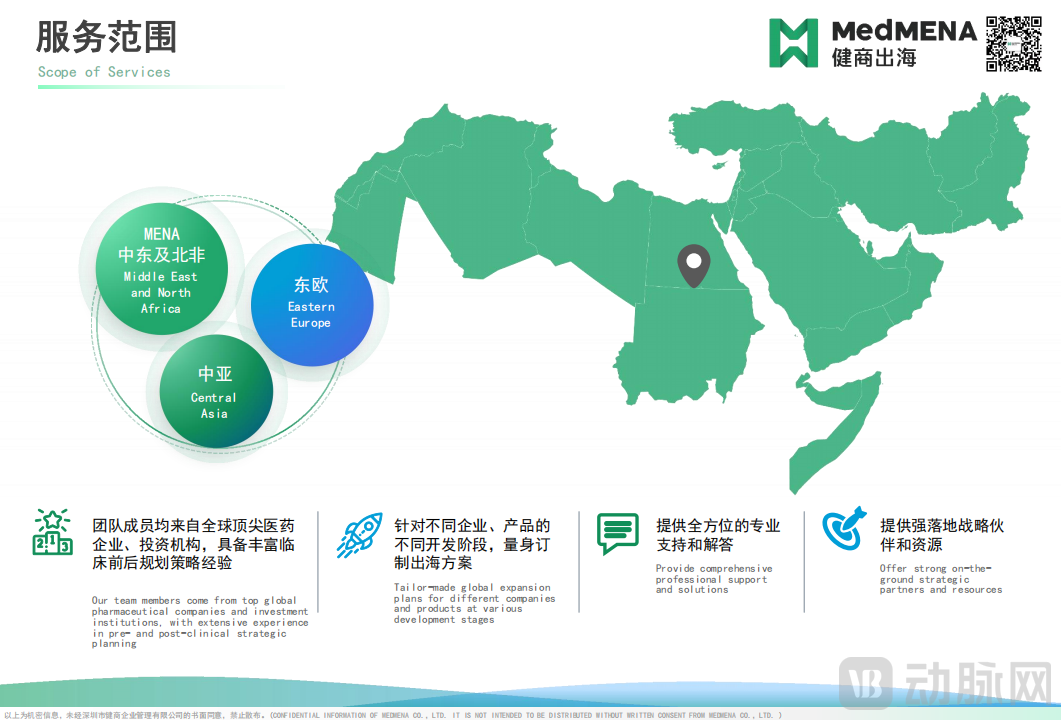
To rapidly establish a presence in overseas markets, enterprises undoubtedly need a powerful assistant.Founded in 2023, Shenzhen Meddcom Enterprise Management Co., Ltd. (hereinafter referred to as “Meddcom Goes Global”) is precisely such a company, dedicated to providing one-stop services for medical and healthcare enterprises expanding into the Middle East.
There are good reasons why going global has become a trending phenomenon. Shawn Choi, Executive Director of Meddcom Goes Global, mentioned that,The Convergence of Domestic and International Factors Has Driven Chinese Healthcare Companies to Expand Overseas.
From a domestic perspective, Chinese-made innovative drugs and medical devices have achieved remarkable results but face market pressures. First, policy factors such as centralized volume-based procurement under the national medical insurance scheme have further squeezed profit margins for innovative drugs and devices, placing significant pressure on manufacturers. Second, homogenization among certain domestic innovation pipelines has intensified local competition. In response, companies are actively seeking to open up “second fronts” to expand their development space.
From an external perspective, overseas markets undoubtedly provide Chinese medical device companies with a “higher ceiling” for growth. On one hand, taking developed countries in Europe and the United States as examples, their robust regulatory systems and healthcare coverage create favorable conditions for drug market entry and sales, while their higher pricing provides sufficient momentum for revenue realization of subsequent products. Furthermore, multinational pharmaceutical companies tend to adopt license-in strategies rather than in-house R&D to capture cutting-edge markets; strong capabilities in product research, development, and design also help accelerate the R&D and market launch of innovative drugs and medical devices by these enterprises. On the other hand, in markets represented by Southeast Asia, the efficiency and cost advantages of Chinese biosimilars clearly align with these regions’ demands for healthcare cost containment, offering significant growth potential. For instance, Indonesia, Thailand, and Malaysia may consider waiving clinical trial requirements for urgently needed products.
Internal and external factors have driven a wave of Chinese medical and health enterprises to expand overseas. Likely due to the aforementioned reasons, many such companies have chosen to first establish their presence in the European, American, and neighboring Asian markets, where third-party enterprise services are already relatively mature and well-developed. However, this strategy has effectively exported the intense domestic competition to these overseas destinations. To change this situation, companies undoubtedly need to target new markets with sufficient growth potential—The Middle East is an ideal destination for overseas expansion.
When introducing the Middle East region, Shawn Choi used Saudi Arabia, which ranks first in per capita healthcare expenditure in the Middle East, as an example to present a basic overview of this market—
First, Saudi Arabia demonstrates a high willingness to pay in the healthcare sector, including pharmaceuticals and medical devices.Saudi Arabia has long completed its primitive capital accumulation through the reserves and sales of natural endowments such as oil, demonstrating strong demand and willingness to pay in the healthcare sector. The National Biotechnology Strategy, newly issued by Saudi Arabia on January 25, 2024, states that the country aspires to position itself as the most important biotechnology hub in the Middle East and North Africa (MENA) region and even globally, necessitating continued strengthening of local biomanufacturing capabilities. Establishing advanced biopharmaceutical capabilities and state-of-the-art local end-to-end biomanufacturing platforms is an urgent priority for the implementation of this strategy.
Second, due to geopolitical factors, Saudi Arabia aims to gradually reduce its reliance on developed countries and build its own healthcare industrial chain.In its “Vision 2030,” Saudi Arabia plans to enhance the quality and accessibility of healthcare services and improve public health outcomes by building more medical facilities, training healthcare professionals, and providing comprehensive healthcare services. Achieving these goals requires localizing the medical industry supply chain, which presents a significant opportunity for Chinese medical and health enterprises seeking to expand overseas.
Third, Saudi Arabia has a rapidly growing women's health market.Shawn Choi noted that “currently, each family in Saudi Arabia has four to five children, and overall spending on maternal and infant health consumption is two to three times higher than in Europe and the United States.” He further stated that “as Saudi Arabia’s secularization steadily advances under the leadership of Crown Prince and current Prime Minister Mohammed bin Salman, women’s rights and status will continue to improve in the future, leading to a more robust health and beauty consumer market in Saudi Arabia and other Middle Eastern countries.”
According to estimates by Meddcom Goes Global, the Saudi Arabian medical device market alone is projected to reach USD 2.1–3 billion by 2030, with a compound annual growth rate (CAGR) of over 5%, and the market continues to expand.
The Middle East encompasses far more than just Saudi Arabia, and such a market undoubtedly offers vast potential for enterprises expanding overseas.
Opportunities in the Middle East market continue to attract Chinese healthcare enterprises and institutions to seek their fortunes.
According to Shawn Choi, since 2020, as the COVID-19 pandemic raged globally, BGI Genomics, under the leadership of government departments such as the Ministry of Foreign Affairs, took the lead in entering Saudi Arabia, providing local facilities with equipment and instruments such as nucleic acid testing reagents and laboratory infrastructure. After the end of the pandemic, these “COVID-related infrastructures” are also facing transformation. In 2023, investment exchanges between the Middle East and China have been increasingly strengthened. In the first half of the year, Middle Eastern sovereign wealth funds successively opened offices in China, seeking high-quality investment targets and continuously increasing their stakes in Chinese enterprises. In the second half of the year, domestic investment institutions flocked to the Middle East to raise funds. Accompanying this trend, driven by both internal and external factors, Chinese medical and health enterprises have been continuously expanding their presence in the Middle East.
However, expanding overseas is not always smooth sailing. Some companies that ventured into the Middle East ultimately failed and withdrew. According to Shawn Choi’s observations, this is largely attributable to many companies blindly following the trend of going global, lacking a clear assessment of the competitive landscape they would face, and failing to formulate market strategies at a macro level.
“Companies expanding overseas often face numerous challenges, such as unfamiliarity with local regulatory compliance and market access procedures (navigating uncharted waters, resulting in prohibitively high trial-and-error costs), lack of experience in liaising with certification bodies (leading to protracted material submission and approval processes that severely impede market access timelines), and insufficient understanding of local distributors (making it difficult to identify suitable product distributors).”
To better address the aforementioned challenges and facilitate the global expansion of Chinese healthcare enterprises, Meddcom Goes Global has developed a one-stop service solution to help companies achieve successful market entry. In short, Meddcom Goes Global provides services from the perspectives of market assessment, overseas clinical trials (market access), and local operational setup—
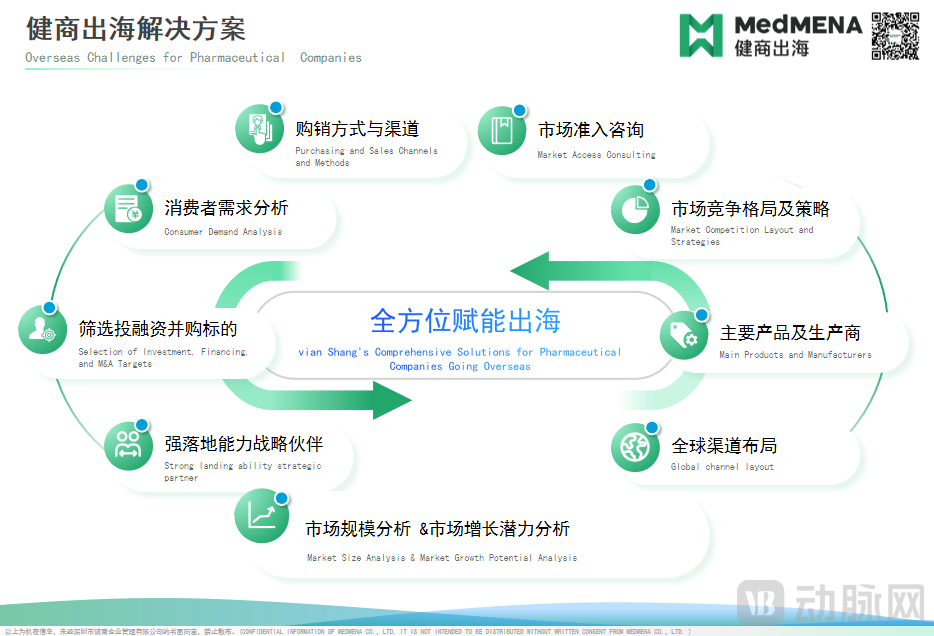
During the preliminary preparation phase of enterprises, Meddcom Goes Global can help enterprises address market research needs for expanding into the Middle East, including assessments of market potential in target destinations, analysis of the competitive landscape, evaluation of corporate product and technological capabilities, and projections of future market growth potential, thereby enabling businesses to gain deeper insights into the current state of their target markets.
During the Implementation Phase of Enterprise Registration and Market Access, to address needs such as legal compliance and market entry during this process, Meddcom Goes Global can leverage its strong strategic resource partners in multiple countries and regions to provide compliance services through locally authorized registration representatives, helping enterprises better understand local certification standards and requirements and avoid duplicate certifications; furthermore, it can monitor the market in accordance with regulatory and product requirements, providing feedback and risk alerts to further reduce corporate costs.
To better serve clients and meet their diverse needs, Meddcom Goes Global has also built its own database resources.Meddcom Goes Global can tailor data information and analytics services for domestic and international pharmaceutical companies and institutional investors, leveraging its proprietary drug sales database. By utilizing its expert physician database—built from coverage of hospitals at various levels and doctors across different specialties—it provides enterprises with data research and clinical practice analysis services. Based on its database of M&A transactions and demands in China, it offers real-time updates on merger and acquisition activities and needs. Furthermore, by drawing on its repository of innovative biopharmaceutical projects both domestically and internationally, it helps enterprises and capital firms better screen and select projects worldwide.
Ultimately, leveraging its robust on-the-ground resources and strategic partnerships in the Middle East, Meddcom Goes Global has tailored efficient and precise global expansion solutions for a range of enterprises. These solutions help companies reasonably reduce overseas expansion risks, shorten market entry timelines, and cut costs, thereby providing maximum support for their international growth.
To the market, Meddcom Goes Global is merely a new company founded in 2023. Yet this has not prevented it from gaining the favor of leading domestic and international healthcare enterprises.
According to Shawn Choi, although their services currently cover numerous fields including pharmaceuticals, medical devices, health supplements, medical services, and biotechnology, they can be broadly categorized into three customer segments—
One category comprises pharmaceutical and healthcare companies, primarily consisting of manufacturers of innovative drugs and medical devices as well as high-end equipment, while also covering chains of medical aesthetic institutions.
One category is institutions. For example, investment firms may collaborate to empower their portfolio companies in global expansion, or establish partnerships with cross-border business institutions.
Another category comprises industrial parks and associations. Within healthcare-focused industrial parks, enterprises often have substantial demands for licensing out their technologies or products. Meanwhile, organizations such as entrepreneurs’ associations frequently seek to conduct field visits to the Middle East to assess local healthcare policies, the investment climate, and the development of pharmaceutical supply chains. Meddcom Goes Global is well-positioned to effectively meet these needs.
Such collaborations are made possible by Meddcom Goes Global’s team, which has deep expertise in the pharmaceutical sector. Some team members have prior experience with major pharmaceutical companies in the Middle East, giving them thorough familiarity with local policies, supply chains, and distribution channels. Furthermore, its services span the entire industry value chain—from upstream to downstream—fully meeting customer needs.
In response to the current wave of Chinese companies expanding overseas, Shawn Choi noted that, from a macro perspective, out-licensing innovative drugs has become a major trend. Through out-licensing, companies can further reduce the risks associated with new drug development and maximize returns by leveraging the sales networks of multinational pharmaceutical companies.Facts may further corroborate this trend. In 2024, a new wave of Chinese innovative drugs going global has emerged, with numerous domestic pharmaceutical companies—including WuXi Biologics, Mabwell Bioscience, ArriVent BioPharma, and Ribo Life Science—announcing collaborations with overseas pharmaceutical firms. Evidently, as China’s biomedical innovation industry continues to develop at a rapid pace, Chinese biomedical enterprises are gradually gaining recognition and entering a new stage of high-quality development.
Going global will play an increasingly important role in it.
However, Meddcom Goes Global also cautions enterprises against blindly expanding overseas. “Amid the current wave of globalization, companies must possess a certain level of market awareness when going global. For instance, the Middle East region is more interested in comprehensively introducing the entire healthcare industry chain to achieve technology localization, rather than merely product localization. Therefore, enterprises need to appropriately assess the demands of their target overseas markets. Additionally, given the market risks in the Middle East, it is advisable for companies to have prior operational experience in other overseas markets. Early-stage innovative enterprises are not recommended to enter the Middle Eastern market prematurely.” He emphasized, “The market always reserves its opportunities for those who are well-prepared.”
“Most importantly, for companies expanding overseas, it is crucial to understand that going global means ensuring products meet the needs of local consumers. To quote Liu Run once again, ‘Globalization essentially means localization in every country,’ a sentiment deeply resonated by enterprises engaged in international expansion. Meddcom Goes Global will provide comprehensive support and safeguarding services throughout your journey into the Middle Eastern market.”