

Peking University's Wei Lab Files Patent for AAV-Delivered Circular arRNAs Enabling Efficient In Vivo RNA Editing via Endogenous ADAR
On February 1, the Wei Wensheng Laboratory at the School of Life Sciences, Peking University, disclosed aTargeted RNA Editing Using Endogenous ADARpatent.
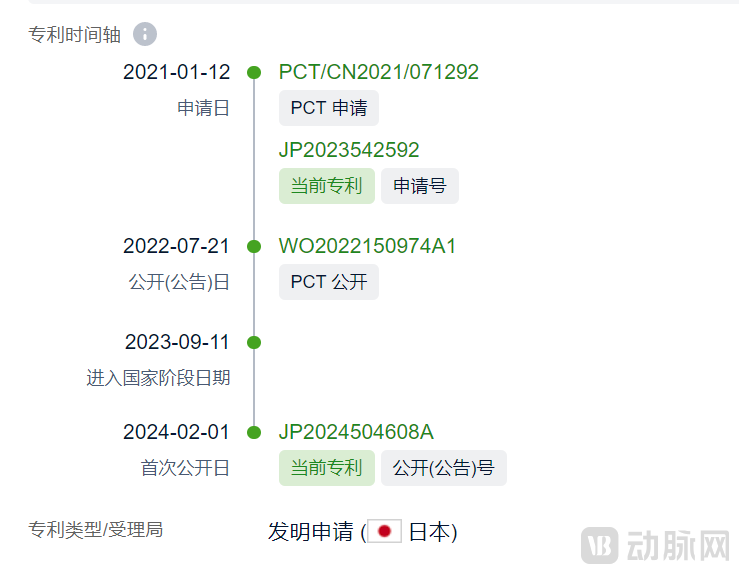
Patent Timeline, Image from Patsnap
This patent originates from Professor Wei Wensheng’s 2019 article, “Programmable RNA editing by recruiting endogenous ADAR using engineered RNAs.” The patent disclosed herein covers Japan; additionally, the team has filed applications in China, Europe, and worldwide.
 Patent Family, Image from Patsnap
Endogenous gene editing refers to the precise modification and regulation of genomes using naturally occurring gene-editing enzymes within living organisms. Among these, endogenous adenosine deaminase acting on RNA (ADAR) has been shown to catalyze the conversion of adenosine (A) to inosine (I), which is read as guanosine (G), in RNA molecules.
This patent enables effective RNA editing in non-human primates at therapeutically applicable doses through AAV-mediated delivery of circular ADAR-recruiting RNAs (arRNAs).
Within 4 to 13 weeks post-infection, the editing efficiency in AAV-infected cells can reach approximately 80%, with no significant toxicity observed even at high doses. Furthermore, when AAV-delivered circular arRNAs were systematically administered in a humanized mouse model of Hurler syndrome, they precisely corrected premature stop codons and restored the function of the IDUA enzyme, encoded by the Hurler disease-causing gene, across multiple organs.
Soaring Gene Editing Research
Gene editing has emerged as a highly prominent technology in both academia and industry in recent years. The “LEAPER” technology, independently developed and held by Wei Wensheng’s team,”technology, which was first published in 2019 and upgraded again in 2022. In addition to “LEAPER,”In recent years, the scientific research community has seen the emergence of numerous leading figures in gene-editing technology, most of whom are researchers specializing in CRISPR technology.
In 2012, Jennifer Doudna, Emmanuelle Charpentier, and others pioneered the advent of CRISPR technology. The team’sScience The journal published a paper that elucidated the detailed mechanism of action of CRISPR-Cas9 and highlighted its potential as a genome editing tool.
Professors Jennifer Doudna and Emmanuelle Charpentier were consequently awarded the 2020 Nobel Prize in Chemistry. Subsequently, Professor Doudna’s research team demonstrated that the CRISPR/Cas9 system can efficiently edit the human genome and developed CRISPR-based precise gene-editing tools for cancer therapy and research into genetic diseases. Professor Charpentier’s research team has also been dedicated to improving its precision and efficiency, as well as applying it to diverse biological systems and disease models.
Subsequently, Chinese-American scientist Feng Zhang improved this technology and was the first to apply it to gene editing in human cells cultured in vitro. His team also successfully applied CRISPR/Cas9 technology to mammalian and human cells. Furthermore, Professor Zhang’s research team developed new editing tools such as CRISPR/Cas12a and CRISPR/Cpf1.
Harvard University genetics pioneer George Church, in 2019, atNature Biotechnologypublished a novel CRISPR gene-editing method, and he pioneered the application of CRISPR technology in areas such as organ transplantation, aging reversal, and gene drives, further expanding the scope of CRISPR applications.
Professor Liu Ruqian’s team has developed a novel precision gene-editing tool called Prime Editing. This technology enables efficient free conversion of all 12 types of single-base substitutions without relying on DNA templates, and also achieves precise insertion and deletion of multiple bases, thereby addressing certain limitations of CRISPR technology. The team also successfully achieved in vivo delivery of the prime editor using engineered virus-like particles (VLPs) and demonstrated therapeutic efficacy in an animal model of a genetic disease.
In 2021, a research team led by Yang Hui, a researcher at the Institute of Neuroscience, Chinese Academy of Sciences, published their findings in Nature Methods. They successfully identified two novel proteins from the Cas family, Cas13x and Cas13y, and developed a new RNA editing technology based on these discoveries.
In addition to the researchers mentioned above, tens of thousands of scientists worldwide are conducting research on new gene-editing technologies, their applications, and their use in disease treatment and agricultural breeding. This technology is arguably one of the most remarkable scientific breakthroughs of recent decades, with profound impacts extending beyond academia and industry to allow the general public to deeply appreciate the brilliance of scientific advancement.
Leading Academics Enter the Fray
The explosive growth of technology has also driven leapfrog progress in the industry, with commercial application research related to gene editing technologies flourishing. From 2021 to 2022, the global market size of the gene editing industry grew from USD 4.811 billion to USD 5.412 billion, representing a year-on-year growth rate of 12.49% in 2022.The participants are not only pharmaceutical companies with a keen sense of smell, but also leading figures in academia.。
Jennifer Doudna founded three related companies: Caribou Biosciences, Mammoth Biosciences, and Intellia Therapeutics. Among them, Caribou Biosciences is dedicated to developing next-generation “off-the-shelf” CAR-T and CAR-NK cell therapies using CRISPR technology. The company currently has four self-developed pipelines and two collaborative pipelines with AbbVie.
Emmanuelle Charpentier founded CRISPR Therapeutics, which is dedicated to developing revolutionary gene therapies for a variety of diseases using its proprietary CRISPR/Cas9 platform. The company’s flagship product, CTX001 (Casgevy), was approved in late 2023. According to the latest announcements, CRISPR Therapeutics is scaling back its two CAR-T candidate drugs, CTX110 and CTX130, and shifting its primary focus to CTX112, which targets CD19, and CTX131, which targets CD70.
Professor George Church founded Manifold Bio, a company dedicated to developing next-generation protein therapeutics; Rejuvenate Bio focuses on developing anti-aging gene therapies.
Leveraging his expertise in CRISPR technology and the Broad Institute’s patent advantages, Feng Zhang founded eight companies—including Editas Medicine, Beam Therapeutics, Moonwalk Biosciences, and Arbor Biotechnologies—to pursue commercialization across diverse strategic directions.
Nvelop Therapeutics, founded by David Liu, is a biotech startup focused on developing novel delivery technologies. Resonance Medicine was a biotechnology company dedicated to the “development and commercialization of protease-related technologies,” but it has since decided to shut down. Additionally, David Liu co-founded multiple gene-editing companies, including Beam Therapeutics, Prime Medicine, Editas Medicine, Pairwise Plants, Exo Therapeutics, and Chroma Medicine.
In China, Professor Wei Wensheng established EdiaGene and CircleRNA to pursue commercialization of CRISPR/Cas9 gene-editing therapies and circular RNA technology, respectively. Notably, EdiaGene’s pipeline for β-thalassemia (an ex vivo therapy) has entered clinical trials.
Professor Yang Hui established Huada Gene to develop novel CRISPR gene-editing tools and disruptive, innovative gene therapies, with one pipeline for retinal diseases (gene replacement) having already entered clinical trials.
Dr. Wu Yuxuan, a researcher at the School of Life Sciences, East China Normal University, founded Yaotang Bio to develop the first CRISPR-Cas-based, virus-free gene therapy strategy for hemoglobin disorders, specifically for the treatment of thalassemia.
In addition, several domestic companies, including ReNovo Biologics, ImmunoMicro Medicine, Hesheng Gene, and NewAnGene Biotech, are engaged in research on gene-editing therapies for diseases, with all related products currently in the investigational stage.