

DeepRx.ai Files IPO Prospectus: AI-Powered COLOXIS Platform to Transform Precision Chemotherapy in Colon Cancer

UPMC
Healthcare and Insurance Service Providers

Professor Lu Xinghua of the University of Pittsburgh and Professor Sun Min of the University of Pittsburgh Medical Center (UPMC) believe that “machine learning-enabled genetic testing and analysis can effectively improve the accuracy of chemotherapy drug selection for colorectal cancer. In the current setting of adjuvant therapy for colorectal cancer, the use of oxaliplatin reduces cancer recurrence by 5% but induces neurotoxicity in approximately 90% of patients. This benefit-to-risk ratio is clearly unfavorable for the majority of patients and urgently needs improvement.”
Gastrointestinal tumors account for approximately one-quarter of all cancer types, with colorectal cancer being the most severe among them.According to data published in the Chinese Journal of Cancer in 2021, colorectal cancer ranks as the third leading cause of cancer-related mortality in China, surpassed only by lung cancer and gastric cancer. Globally, the International Agency for Research on Cancer (IARC) of the World Health Organization predicted in 2021 that the number of new colorectal cancer cases would rise from 1.8 million in 2018 to 4.7 million by 2070. Among all cancer types, colorectal cancer is projected to have the largest increase in incidence.
Patients with early-stage colon cancer typically receive adjuvant chemotherapy after surgical treatment, with the aim of reducing the risk of tumor recurrence.In the 1990s, the combination of fluorouracil and leucovorin (FULV) first became the standard regimen for adjuvant chemotherapy.The FULV combination significantly reduced the recurrence rate (HR = 0.64, P < 0.0001).1。
Around the year 2000, two large-scale clinical trials (MOSAIC2and NSABP C-073) confirmed that adding oxaliplatin to FULV can further reduce the absolute recurrence rate by approximately 5%.Currently, combination chemotherapy consisting of 5-FU/LV + oxaliplatin (FOLFOX) is the standard regimen for adjuvant chemotherapy in colon cancer.
Although FOLFOX, as a standard regimen, has been incorporated into clinical guidelines for adjuvant chemotherapy in patients with colorectal cancer after surgery,However, oxaliplatin causes acute neurotoxic side effects of varying severity in 90% of patients, with over 30% experiencing permanent neurotoxicity., leading to a significant decline in quality of life. Furthermore, the management of oxaliplatin-induced neuropathy imposes an additional burden on the healthcare system. In the United States, follow-up treatments solely for alleviating neurotoxicity can cost up to $18,000 per year.
Overall,Oxaliplatin offers a 5% benefit rate but has a 90% incidence of toxic side effects, resulting in an unfavorable benefit-risk ratio for most patients.
Maximizing the benefits of oxaliplatin while minimizing its toxic side effects is a major challenge in gastrointestinal oncology. In recent years, six international collaborative clinical trials have attempted to shorten the duration of FOLFOX therapy from six months to three months, aiming to reduce oxaliplatin exposure and thereby mitigate toxicity. However, the shortened regimen fails to achieve comparable efficacy in high-risk populations. The development of biomarkers or models to guide the precise use of oxaliplatin represents a significant priority in the field of precision medicine.
In addressing the neurotoxicity associated with oxaliplatin, Professor Lu Xinghua and his team leveraged artificial intelligence and causal algorithms as a breakthrough point,Conducted a study on an AI-based clinical decision support system for predicting the efficacy of oxaliplatin in adjuvant therapy for colon cancer.Currently, the study with Dr. Chen Lujia as the first author has been published in the Journal of Clinical Oncology (IF=45) under the title “Machine Learning Predicts Oxaliplatin Benefit in Early Colon Cancer”.
Professor Lu Xinghua is a tenured professor in the Department of Biomedical Informatics at the University of Pittsburgh. He previously served as the Cancer Program Director for the U.S. National “Big Data to Knowledge” (BD2K) Center. Professor Lu’s research group primarily leverages artificial intelligence to advance basic research, translational medicine, and clinical decision support. The group has received multiple grants from the National Institutes of Health (NIH) and funding from UPMC (University of Pittsburgh Medical Center). The team comprises multidisciplinary members, including Professor Sun Min, a clinician at the UPMC Hillman Cancer Center, and Dr. Chen Lujia, an Assistant Professor at the University of Pittsburgh.
Professor Lu and his team have given multifaceted consideration to this study and its implications.
On one hand, there is vast room for innovation in treatment regimens for colorectal cancer patients, driven by the highly imbalanced risk–benefit ratio mentioned earlier. On the other hand, there are innovations in leveraging artificial intelligence to guide chemotherapy.
As is well known, the development of innovative drugs often requires substantial financial investment and a lengthy timeline before reaching the market. Currently, “Genome-driven Precision Oncology,” which guides the application of targeted therapies based on genetic mutation biomarkers, has limited coverage. Chemotherapeutic agents remain dominant in the treatment regimens for the vast majority of patients.Professor Lu believes that more precise clinical application of existing chemotherapy drugs will undoubtedly better leverage the efficacy of these proven agents, thereby rapidly improving the overall benefit rate for cancer patients.
With these considerations in mind, the team proposed a unique research methodology: they developed an AI model named COLOXIS (COLon OXalIplatin Signature) to predict patient response to oxaliplatin. They collected data on responses to FOLFOX therapy in patients with advanced colon cancer from public databases and established the COLOXIS AI model. Biomarkers or models used in clinical practice can be broadly categorized into“Predictive Models” and “Prognostic Models”。
The former is used to predict a patient’s response to and benefit from a drug, while the latter predicts varying prognoses for patients under the same treatment regimen. A favorable prognosis may result from the inherent biological characteristics of the disease itself rather than from therapeutic benefit. In the context of precision medicine,The predictive model is the sole method for guiding medication use.。
Validating a predictive model requires comparative data from both a treatment group and a non-treatment (control) group. Professor Lu’s team collaborated with a Pittsburgh-based research institution specializing in clinical trials to validate the COLOXIS model using data from 1,065 patients enrolled in Phase III clinical trials. These cases comprised patients treated with 5-fluorouracil plus leucovorin (FULV; n=421) and those treated with FULV plus oxaliplatin (FOLFOX; n=644). Data from this treatment group (FOLFOX) and control group (FULV) were used to verify whether the COLOXIS model could predict the efficacy of oxaliplatin. The COLOXIS model stratifies patients into two groups: COLOXIS+ (oxaliplatin responders) and COLOXIS− (non-responders). The research team assessed the benefit of oxaliplatin in each group using 8-year recurrence-free survival (RFS) and evaluated the predictive value of the COLOXIS model using the P-value associated with the interaction term between model prediction and treatment effect (int P).
Among 1,065 patients, 526 were predicted as COLOXIS+ (oxaliplatin responders), while 539 were predicted as COLOXIS- (non-responders). Patients in the COLOXIS+ group derived significant benefit from oxaliplatin (HR=0.65, 95% CI=0.48-0.89, P=0.0065, interaction P=0.03), whereas those in the COLOXIS- group did not (HR=1.08, 95% CI=0.77-1.52, P=0.65) (Figure 1).The COLOXIS model can predict the efficacy of oxaliplatin.

Figure1 COLOXIS In large-scale (N=1065) Efficacy of oxaliplatin inferred from Phase III clinical trial data
COLOXIS’s success stems from its advanced AI approach.
In the process of screening for genes involved in pathogenesis, Professor Lu and his team skillfully employed causal analysis methods to predict individual tumor responses to chemotherapeutic agents.
Traditional biomarker models (such as Oncotype DX) are typically built using feature selection methods. It is highly challenging to use feature selection to identify an optimal combination of a dozen genes from more than 20,000 candidates. Moreover, due to the high noise level in single-gene quantitative data, the stability of such models is often suboptimal.
Modern AI methods, such as deep learning, predominantly employ feature learning and feature construction to learn or construct new features from data for downstream decision-making tasks.These methods can be used to extract key information from data and remove noise.Professor Lu’s team adopted a novel approach that integrates advanced AI-based causal analysis methods with eigenvalue construction.
Complex genetic mutations lead to significant heterogeneity among individual tumors, affecting different signaling pathways in various tumor cells and placing them in distinct states, which in turn results in differential responses of cancer cells to the same drug. The team employed advanced personalized causal analysis methods4Narrowing the search scope to identify genes whose expression is driven by genetic mutations and can reflect the functional status of intracellular signaling pathways. Through preliminary data screening, Professor Lu’s research team reduced the search space from over 20,000 genes to more than 2,000, and further constructed 15 new features. This ultimately improved data quality and led to the establishment of the COLOXIS model.
According to Professor Lu and Professor Sun, the success of the COLOXIS model holds multiple values.
For the vast population of colorectal cancer patients, predicting the efficacy of oxaliplatin prior to administration can effectively prevent overtreatment in non-responders and avoid the risk of adverse effects without therapeutic benefit. This optimization of treatment regimens significantly balances the benefit-risk ratio for patients post-surgery (Figure 2).
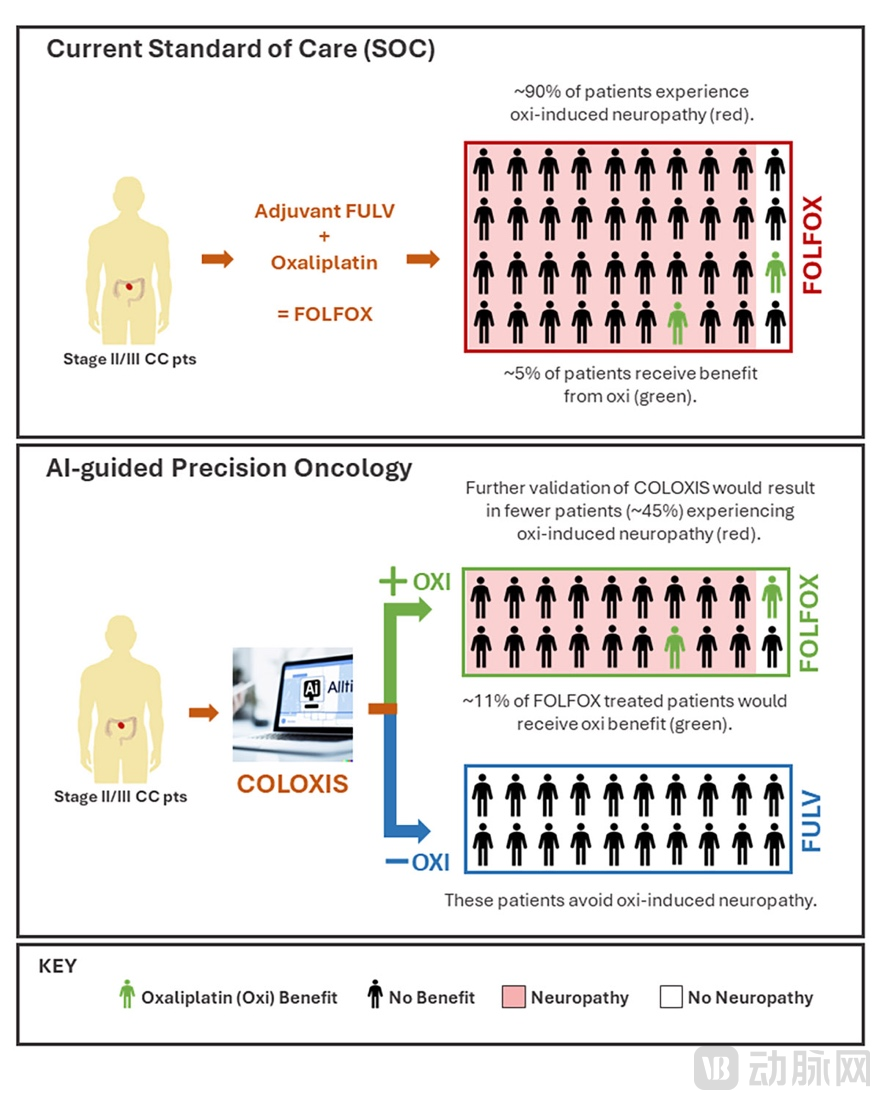 COLOXIS can spare approximately half of colon cancer patients receiving adjuvant therapy from unnecessary oxaliplatin-induced toxicities, significantly improving the overall benefit-risk ratio.
Another, even more significant value is that COLOXIS is currently the only model proven by large-scale clinical trial data from over 1,000 patients to be capable of predicting the efficacy of chemotherapy drugs using AI methods.As a precedent for AI-guided chemotherapy, the success of COLOXIS has demonstrated the feasibility of using artificial intelligence to guide the selection of chemotherapeutic agents.
It is conceivable that in the near future, as more AI models guide the clinical application of various chemotherapy drugs,Oncology Will Enter an AI-Driven Era of Precision Medicine in the “Post-Targeted Therapy” Age:
AI-driven methods are used to predict the efficacy of all FDA-approved anticancer drugs (including targeted therapies and cytotoxic chemotherapy agents) against a patient’s tumor, enabling physicians and patients to jointly select the treatment regimen with the optimal benefit–risk ratio. From this perspective, the success of COLOXIS represents an epochal milestone.
Regarding the future development of precision medicine, Professor Lu and Professor Sun have given further thought to the matter, advocating for a “point-to-area” approach. Before AI-guided pan-cancer, pan-drug treatment regimens can be widely accepted by clinicians and regulatory authorities, it is essential first to establish the credibility of AI models for single-cancer, single-drug applications, thereby gaining acceptance from both clinicians and regulators. Subsequently, this framework can be gradually expanded to encompass multiple single-cancer, single-drug AI models, or pan-cancer, single-drug AI models.
It is believed that in the near future, once sufficient data have validated the reliability of the aforementioned models, the application of AI in precision oncology will ultimately gain acceptance among clinicians and regulatory authorities. The development of such models requires extensive clinical and omics data, as well as close collaboration between hospitals and research institutions.
Given the widespread application of the FOLFOX regimen across multiple gastrointestinal cancers (esophageal cancer, gastric cancer, pancreatic cancer, and colorectal cancer),The COLOXIS model can be developed into the first AI model to guide the application of chemotherapy regimens across pan-cancer types, thereby providing a strong impetus for the adoption of AI in precision oncology.The team is further developing the COLOXIS clinical decision support system through a commercialization pathway (DeepRx.ai).
References
1 Wilkinson, N. W. et al. Long-term survival results of surgery alone versus surgery plus 5-fluorouracil and leucovorin for stage II and stage III colon cancer: pooled analysis of NSABP C-01 through C-05. A baseline from which to compare modern adjuvant trials. Ann Surg Oncol. 2010;17(4):959-966. Epub 2010/01/19. doi: 10.1245/s10434-009-0881-y. PubMed PMID: 20082144; PMCID: PMC2935319.
2 Andre, T. et al. Oxaliplatin, fluorouracil, and leucovorin as adjuvant treatment for colon cancer. N Engl J Med. 2004;350(23):2343-2351. doi: 10.1056/NEJMoa032709. PubMed PMID: 15175436.
3 Kuebler, J. P. et al. Oxaliplatin combined with weekly bolus fluorouracil and leucovorin as surgical adjuvant chemotherapy for stage II and III colon cancer: results from NSABP C-07. J Clin Oncol. 2007;25(16):2198-2204. Epub 2007/05/02. doi: 10.1200/JCO.2006.08.2974. PubMed PMID: 17470851.
4 Cai, C. et al. Systematic discovery of the functional impact of somatic genome alterations in individual tumors through tumor-specific causal inference. PLoS computational biology. 2019;15(7):e1007088. Epub 2019/07/06. doi: 10.1371/journal.pcbi.1007088. PubMed PMID: 31276486; PMCID: PMC6650088.