

Biomodal, Backed by GV and Sequoia Capital, Files IPO for Epigenetic Aging Biomarker Detection Platform

biomodal
Early Cancer Screening Technology Developer
In November 2021, gene sequencing company Biomodal (formerly Cambridge Epigenetix, CEGX) announced the completion of an $88 million Series D financing round. The proceeds will be used to commercialize its proprietary genetic and epigenetic sequencing technologies. The round was led by Temasek, a Singaporean investment company, with participation from new investors including the hedge fund Third Point, as well as existing investors GV (Google Ventures), New Science Ventures, Ahren Innovation Capital, and Sequoia Capital.
Biomodal is an innovative company dedicated to developing DNA methylation sequencing tools, aiming to achieve single-base resolution reading of DNA methylation modifications akin to DNA sequencing. Meanwhile, it leverages epigenetic detection technologies to explore and identify aging biomarkers, thereby gaining a deeper understanding of the aging process and elucidating the mechanisms by which DNA methylation contributes to age-related diseases, ultimately pinpointing potential therapeutic targets and treatment strategies.
Since its inception, Biomodal has attracted support from multiple renowned investment institutions, completing a funding round approximately every two years. To date, the company has completed five rounds of financing, raising a total of over $150 million. Notably, GV participated in its Series B round in 2016, Series C round in 2018, and Series D round in 2021.
After securing substantial funding, Biomodal launched a DNA sequencing product, the “Duet Multiomics Solution + modC,” in June 2022. This product is compatible with existing sequencers and enables the simultaneous acquisition of comprehensive genetic and epigenetic methylation information from DNA samples through a single workflow.
Since its inception, Biomodal has successfully translated its technological, talent, and financial resources into tangible outcomes. The company is now expanding from the DNA sequencing sector into the booming anti-aging field. What underpins this gene sequencing enterprise’s confidence in entering the highly competitive arena of aging biomarker detection? And how has it garnered favor from both capital markets and consumers? This article analyzes the reasons behind its significant prominence from the perspectives of its team, products, and technology.
Biomodal, founded in 2012, was initially incubated by Shankar Balasubramanian’s laboratory at the University of Cambridge. It is a spin-out company established to commercialize epigenetic sequencing technologies developed in the lab, such as oxidative bisulfite sequencing. Its co-founders are Professor Shankar Balasubramanian, from the Department of Medicinal Chemistry at the University of Cambridge and Senior Group Leader at the Cambridge Cancer Research Institute, and Dr. Bobby Yerramilli-Rao, a technology entrepreneur.
Shankar Balasubramanian is a scientist and entrepreneur, hailed as a pioneer in the field of DNA sequencing. In recognition of his significant contributions to medicine and science over the years, he has received numerous honors, including the Queen’s New Year Honours, the Royal Society’s Royal Medal, the 2020 Millennium Technology Prize, and the 2022 Breakthrough Prize in Life Sciences.
Shankar Balasubramanian’s entrepreneurial journey began in 1998.
Prior to founding his first company, Shankar Balasubramanian was dedicated to nucleic acid research at the University of Cambridge. In 1997, Shankar Balasubramanian and his colleague Dr. David Klenerman discussed their vision for next-generation DNA sequencing technology over drinks at the Panton Arms in Cambridge. This conversation laid the groundwork for the establishment of Solexa, an experimental sequencer company. A year later, they founded Solexa, launched its first-generation sequencing instrument (the GA1) in 2006, and took the company public on the NASDAQ that same year.
In 2007, Solexa was acquired by Illumina for $600 million, and its Sequencing by Synthesis (SBS) technology became the foundation of Illumina’s sequencers. This acquisition marked a turning point in Illumina’s entry into the sequencer market, establishing its dominant position in the sequencing industry; a 2018 valuation indicated that the company’s total market share was worth nearly $40 billion. According to incomplete statistics, Illumina/Solexa sequencing services have met approximately 90% of the global demand for DNA and RNA sequencing.
Following Solexa’s rise to prominence, Shankar Balasubramanian continued to deepen his work in the field of DNA sequencing, aiming to develop a next-generation sequencer capable of quantitatively analyzing the epigenetic marks 5-methylcytosine (5mC) and 5-hydroxymethylcytosine (5hmC), and decoding these modifications through DNA sequencing. To this end, in March 2012, Shankar Balasubramanian and Bobby Yerramilli-Rao co-founded Biomodal, with the aspiration of replicating the success of “Solexa.”Formulathe success of developing a brand-new epigenetic sequencing technology.
Following the establishment of Biomodal, Shankar Balasubramanian and Bobby Yerramilli-Rao assembled a multidisciplinary team, including Chief Executive Officer Peter Fromen, Chief Financial Officer Fiona Stewart, Board Chair Gail Marcus, and Wolf Reik, Program Leader in Epigenetics at the Babraham Institute.
Among them, Peter Fromen was appointed as the new CEO of Biomodal in 2022. Peter Fromen is a seasoned practitioner who previously held positions such as Chief Business Officer, Head of Market Development, and Head of Enterprise Sales at sequencing companies PacBio and Illumina before joining Biomodal. During his tenure at Illumina, he played a leading role in the launch of the company’s HiSeq X Ten sequencing system.
In addition, in 2023, Biomodal appointed Omead Ostadan as a new member of its Board of Directors and Professor Dennis Lo Yuk-ming as a member of its Scientific Advisory Board. Omead Ostadan brings 25 years of experience in the life sciences sector, having held various executive positions at companies such as Applied Biosystems, Solexa, Illumina, and Seer. Professor Dennis Lo Yuk-ming is an Academician of the Division of Life Sciences and Medicine of the Chinese Academy of Sciences, widely recognized as the "father of non-invasive prenatal testing (NIPT)" and a pioneer in liquid biopsy.
As is well known, DNA consists of molecular information stored in genetic and epigenetic bases, both of which are critical factors influencing the synthesis of proteins required for the proper functioning of biological systems.
However, epigenetic information not only influences protein synthesis but also regulates gene expression in response to behavioral or environmental changes, playing a critical role in numerous biological processes such as development, aging, and disease. Notably, DNA methylation is a common epigenetic phenomenon; studies have shown that DNA hypomethylation is proportional to the rate of cellular senescence, serving as both a mechanism for the programmed accumulation of mutations during aging and a biomarker for detecting senescence.1. Furthermore, variations in individual gene sequences are associated with DNA methylation alterations, which can functionally determine disease susceptibility.
Therefore, detecting genetic and epigenetic information is crucial for analyzing and elucidating the processes of cell growth and aging, as well as for understanding how gene variations/mutations play a role in age-related diseases such as neurodegenerative disorders.
However, current high-throughput DNA sequencing technologies still have limitations. Most sequencing methods either focus solely on genetic information or exclusively on epigenetic information, making it difficult to simultaneously capture comprehensive data from both aspects. Furthermore, while adenine (A), thymine (T), guanine (G), and cytosine (C) are the four canonical bases constituting DNA, methods currently widely used for detecting epigenetic DNA bases fail to capture common C-to-T mutations or distinguish between the most prevalent forms, 5-methylcytosine (5mC) and 5-hydroxymethylcytosine (5hmC). Notably, C-to-T transitions represent the most common mutations observed to date in mammalian genomes and cancers[2]. Additionally, high-throughput DNA sequencing is an extremely costly process, requiring substantial time and resources to sequence both genetic and epigenetic information for a single sample.
Biomodal provides solutions to the above problems.
In February 2023, the Biomodal research team published a paper in Nature, stating that they had developed a new sequencing technology capable of simultaneously obtaining accurate and phased genetic and epigenetic information through a single workflow. This technology is currently employed in the Duet Multiomics Solution +modC.2。
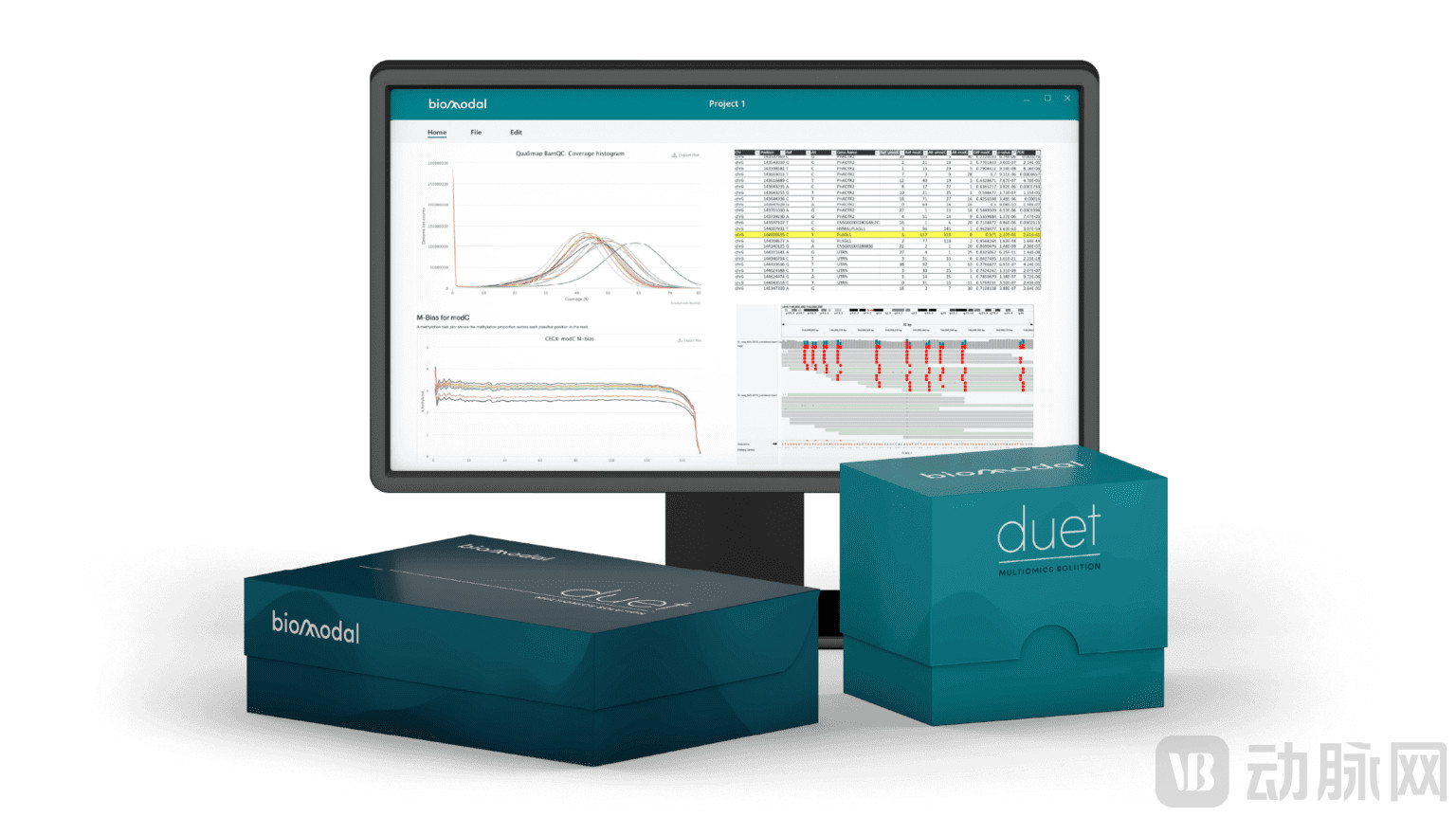
Duet Multiomics Solution + modC Product Example
Image source: Biomodal official website
Duet Multiomics Solution +modC is a whole-genome sequencing technology that enables phased sequencing of the four standard bases (A, C, G, T) and modified cytosine (modC) in a single workflow using low-input samples as small as 10 ng. It can decode up to 16 information states at once, allowing for the simultaneous reading of all four genetic states and multiple epigenetic states in a single run, thereby detecting both genetic and epigenetic information within the sample concurrently.
Notably, this detection method employs only enzymes to process DNA samples, eliminating the need for complex chemical treatments. This approach avoids DNA degradation associated with bisulfite treatment and prevents bias in genomic coverage.
Meanwhile, this detection method employs a dual-base encoding mechanism combined with decoding software to provide digital base reads. During data analysis, when bases on both the original and replicated strands are decoded simultaneously, it generates phased digital reads to account for errors arising from unintended base pairing, thereby inherently suppressing PCR (polymerase chain reaction) or sequencing errors and improving the accuracy of gene sequencing and variant detection.
Data corroborates that the Phred quality score is a standardized metric used in DNA sequencing data to assess base quality, where a higher score indicates a lower error rate. For instance, a Q40 score corresponds to a base error rate of approximately 1/10,000, signifying extremely high data reliability. Research data shows that the Phred quality score for the Duet Multiomics Solution + modC reaches Q40, indicating that the base calling data possesses very high reliability.
Furthermore, the Duet Multiomics Solution + modC is an end-to-end, full-process detection technology. Its product suite includes pre-sequencing workflow modules and post-sequencing analysis software, enabling seamless integration with existing sequencing platforms. This allows customers to incorporate the technology into their current workflows without the need to purchase new equipment or bioinformatics tools.
According to information published on the University of Cambridge’s official website, Biomodal’s annual turnover reached £4.6 million (approximately US$5.82 million) as of 2020, and the company is currently focused on the research and development of epigenetic biomarkers.3。
Biomodal’s official website also indicates that, as the anti-aging sector gradually heats up and becomes a focal point for market and capital attention, the company will prioritize the field of aging detection in the future. It aims to leverage existing sequencing technologies to explore and identify aging biomarkers, thereby gaining a better understanding of age-related diseases. In particular, elucidating the role of DNA methylation in common neurodegenerative diseases, such as Alzheimer’s disease (AD), has become a current R&D priority.
To this end, the genetic testing company also changed its name from “Cambridge Epigenetix” to “Biomodal,” and announced the launch of the Duet Multiomics Solution +modC on the same day. The product’s capability to simultaneously detect genetic and epigenetic information, combined with the company’s accumulated advantages over the years, has become Biomodal’s “confidence” in entering the aging field.
In recent years, tech giants and the world’s wealthiest individuals have flocked to invest in the anti-aging sector, aiming to discover methods for “prolonging lifespan.” However, aging is a complex physiological process, and various indicators of aging biomarkers can fluctuate over time. Currently, many researchers are striving to develop effective methods to quantify aging, with the goal of identifying aging biomarkers that clearly reflect the aging process and its regulatory mechanisms, ultimately guiding targeted anti-aging interventions based on these measurements.
In this context, the development of high-throughput technologies such as next-generation sequencing, proteomics, and metabolomics has provided researchers with new opportunities to understand the mechanisms of aging. These technologies enable the identification of distinct hallmarks of aging and reveal age-related changes at early stages when known biomarkers are significantly elevated.
For example, Professor Steve Horvath, known as the “father of the epigenetic clock,” developed the first-generation epigenetic clock, the Horvath Clock, based on the mechanism of age-related changes in DNA methylation. The sequencing technology and DNA methylation datasets used for this clock were derived from the Illumina 27K/450K array platforms. Human Longevity Inc., a precision medicine provider offering aging and health assessments, utilized Illumina’s HiSeq X Ten sequencing platform to analyze the genomic sequences of more than 20,000 individuals. Building on this data, the company launched Health Nucleus, a product capable of comprehensively assessing an individual’s overall aging and health status.
Although no aging biomarkers have yet been approved by U.S. regulatory agencies for clinical application, and conducting high-throughput genomic research on aging and translating it into practical applications remains a challenge, the field of aging detection is poised for new developments as sequencing technologies continue to advance.
References:
1. https://www.novopro.cn/articles/201410291124.html
2. Füllgrabe, J., Gosal, W.S., Creed, P. et al. Simultaneous sequencing of genetic and epigenetic bases in DNA. Nat Biotechnol 41, 1457–1464 (2023). https://doi.org/10.1038/s41587-022-01652-0
3. https://www.ch.cam.ac.uk/collaboration-and-impact/cambridge-epigenetix-0