

TruDiagnostic Files IPO Prospectus Highlighting OMICmAge, a Multi-Omics Epigenetic Clock with Over 88.9% Accuracy in Mortality Prediction

TruDiagnostic
Genetic Testing Service Provider
In 2013, a major milestone occurred in the field of aging research: Professor Steve Horvath, known as the “father of the epigenetic clock,” developed an analytical tool for measuring physiological age—the Horvath Clock—based on the mechanism of age-related changes in DNA methylation.
DNA methylation is a common epigenetic phenomenon. Studies have shown that its dynamic changes are associated with aging, serving as both a mechanism for the programmed accumulation of mutations during aging and a biomarker for detecting aging. Therefore, developing “epigenetic clocks” based on the patterns of DNA methylation during aging has become a new avenue for exploring the aging process.
Epigenetic clocks are methods for estimating physiological age by measuring epigenetic modifications such as DNA methylation, histone modifications, and non-coding RNAs. They help researchers understand the aging process, elucidate aging mechanisms, predict the risk of age-related diseases, assess an organism’s health status, and evaluate interventions aimed at delaying aging.
Ten years after the introduction of the Horvath Clock, a new epigenetic clock has emerged.
In 2023, TruDiagnostic, an innovative company focused on aging research using health data, published its latest study1 on the epigenetic clock OMICmAge, conducted in collaboration with researchers at Harvard University. OMICmAge is a multi-omics aging clock based on DNA methylation (DNAm) that measures an individual’s physiological age and disease risk by quantifying multi-omics data, including epigenomics, proteomics, metabolomics, clinical history, and DNAm data.
Research findings from TruDiagnostic demonstrate that OMICmAge achieves an accuracy of over 88.9% in predicting mortality within the next 5 and 10 years, whereas predictions based on chronological age yield an accuracy of only 75.6%.
TruDiagnostic’s journey in aging research began in 2019.
Biochemist Ryan Smith is the founder of TruDiagnostic. Previously, he was the pioneer behind Tailor Made Compounding, the fourth-fastest-growing specialty pharmacy in the U.S. healthcare sector, which provides patients with industry-leading health solutions and resources. Subsequently, to better help people prevent age-related diseases, Ryan Smith founded TruDiagnostic and promptly established a scientific advisory board comprising multiple experts in aging research, including Dr. Jessica Lasky-Su, Associate Professor at Harvard Medical School and Brigham and Women’s Hospital.
Dr. Jessica Lasky-Su is a statistician and epidemiologist specializing in the analysis of genetic, genomic, and metabolomic data from large-scale human studies, with her research published in over 225 peer-reviewed publications. Currently, she is leveraging multi-omics data on life-course trajectories from the Mass General Brigham Biobank (MGB-Biobank) to establish a large biobank cohort for aging research.
Dr. Jessica Lasky-Su has been appointed President of the Metabolomics Society and Chair of the Consortium of Metabolomics Studies (COMETS) at the National Institutes of Health, owing to her prominent research in the fields of aging and multi-omics; her work has received funding from multiple sources.
In addition, the Scientific Advisory Board includes Dr. Daniel L. Stickler, Co-Founder and Chief Medical Officer of precision medicine company Apeiron ZOH Inc. and Medical Director of supplement manufacturer Neurohacker Collective; Dr. David Haase, Medical Advisor to biotechnology companies Evoke Neuroscience and Metabolon; and Dr. Dominique Fradin-Read, Fellow of the American Academy of Anti-Aging Medicine.
Notably, Dr. Gregory Hannum, who co-developed the first-generation DNAm PhenoAge clock with Professor Steve Horvath, is also a partner of TruDiagnostic. The PhenoAge clock represents a new generation of aging clocks developed by him and his team, enabling more precise assessments of physiological age and mortality risk. Dr. Hannum’s involvement has brought additional R&D expertise and experience in epigenetic clocks to the company.
In 2020, TruDiagnostic partnered with Dr. Jessica Lasky-Su to quantify multi-omics data, aiming to gain deeper insights into various aging traits and processes and to develop novel methods for measuring physiological age. To this end, the research team established the MGH-ABC Aging Biobank cohort.
Using the MGH-ABC dataset, the team collected phenomic, metabolomic, proteomic, transcriptomic, epigenomic, and genomic samples from over 30,884 participants. Subsequently, researchers analyzed the samples using Seer’s Proteograph proteomics technology and Illumina’s EPIC 850k array. Building on this foundation, the team selected a cohort of 5,000 individuals for advanced metabolomic, epigenetic, and proteomic analyses.
Subsequently, the obtained sample data were subjected to untargeted global plasma metabolomics analysis using the Metabolon platform. After preprocessing and scaling, the team retained a total of 396 biomarker proxies (EBPs) encompassing metabolomic, proteomic, and clinical epigenetic markers. Finally, the integrated data were incorporated into the DNAm clock to generate OMICmAge.
The research team claimed that OMICmAge demonstrated relatively high accuracy in its test results. The team calculated the area under the curve (AUC) for 5-year and 10-year survival rates using OMICmAge, DNAmEMRAge, and PC GrimAge. The results showed that DNAmEMRAge had the highest AUC values (5-year: 0.894; 10-year: 0.889), followed by OMICmAge (5-year: 0.889; 10-year: 0.874), while the AUC values for PC GrimAge were approximately 5% lower than those of DNAmEMRAge and OMICmAge.
Research has found that changes in OMICmAge predictions may impact individual lifespan. For example, if a user’s physiological age is determined to be 60 years by OMICmAge testing, reversing their physiological age by one year through anti-aging interventions is projected to increase their lifespan by 1.7 years; if the OMICmAge test indicates a physiological age of 70 years, a one-year reversal in physiological age is expected to extend lifespan by 1.35 years.
In addition, TruDiagnostic states that OMICmAge can analyze over one million aging-related sites on DNA, which means that by establishing connections between aging patterns, protein, and metabolite components, OMICmAge can focus on more DNA methylation sites associated with aging. Furthermore, the team trained OMICmAge for accuracy and predictability using diverse data from more than 70,000 individuals.
Notably, in May 2021, TruDiagnostic signed an exclusive licensing agreement with Duke University, securing the rights to use the DunedinPoAm aging clock.
DunedinPoAm is a pace-of-aging clock based on DNA methylation aging biomarkers, developed by researchers from Duke University, Columbia University, and the University of Otago. The research team tracked changes in clinical chemistry and physiological biomarkers of 18 organ systems in 1,037 New Zealanders at ages 26, 32, and 38, and synthesized the rate of change for each biomarker between ages 26 and 38 to create DunedinPoAm, a metric measuring the pace of aging. The findings revealed that individuals with a faster pace of aging, as determined by the DunedinPoAm test, had a higher risk of disease and mortality, whereas those with a slower pace of aging had a lower risk.
Regarding the DunedinPoAm aging test results, the research team scaled the measured pace of aging to a mean value of 1, equivalent to one biological year per chronological year. For instance, a result of 0.90 indicates a pace of aging 10% slower than average, whereas 1.05 signifies a pace 5% faster than average. Consequently, even a value slightly above 1 indicates accelerated aging; individuals in this category are projected to have a 56% increased risk of mortality and a corresponding 54% increased risk of developing chronic diseases over the subsequent seven years.
Leveraging the OMICmAge and DunedinPoAm epigenetic aging clocks, TruDiagnostic has launched two aging assessment products—TruAge COMPLETE and TruAge PACE. Both products evaluate an individual’s overall biological aging status and disease risk through a single blood test. After purchasing the product, users collect their own blood samples using the provided kit and mail them to TruDiagnostic’s CLIA-certified laboratory for analysis. Results are made available via an online portal approximately 4–6 weeks later.
TruAge COMPLETE: Assess Overall Aging
TruDiagnostic states that TruAge COMPLETE provides a comprehensive and in-depth analysis of various biological factors associated with aging, addressing 11 age-related questions such as “Why am I aging?” “For each calendar year that passes, how many years does my body actually age?” “What is my risk of developing various age-related diseases?” and “How does exposure to tobacco smoke affect my DNA expression and aging process?” Ultimately, the test yields multiple aging-related metrics, including physiological age, rate of aging, disease risk, mortality risk, telomere length, immune cell levels, and the impact of alcohol consumption and smoking on DNA expression and the aging process.
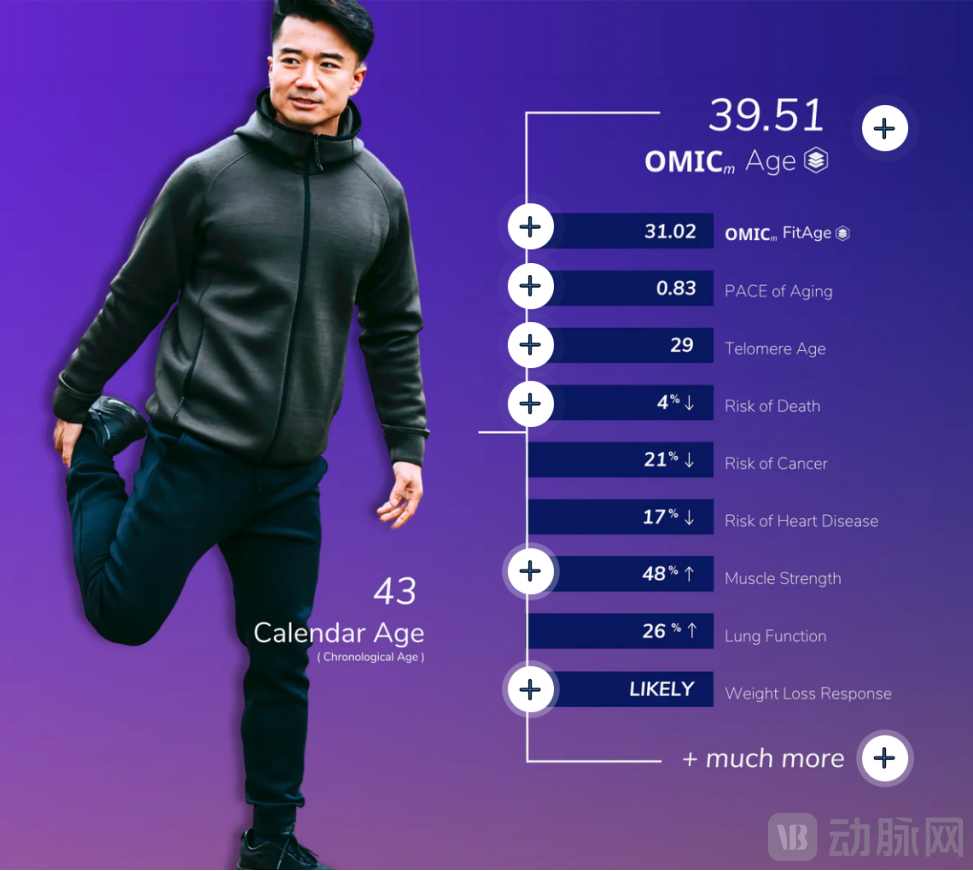
Example of TruAge COMPLETE Test Results
Image source: TruDiagnostic official website
Based on the analysis results, TruDiagnostic ultimately generates a comprehensive report exceeding 30 pages in length. This report comprises multiple sub-reports, including the OMICm Age Report, Health Report, Immune System Report, Aging Velocity Report, Telomere Length Report, Alcohol Consumption Report, Weight Loss Response Report, and Tobacco Exposure Risk Report. It provides a holistic assessment of the user’s aging status and offers recommendations to mitigate aging, as well as reduce the risks of mortality and disease.
Furthermore, users who wish to gain a more detailed understanding of their health status need to purchase the upgraded TruAge COMPLETE report. Building upon the previous comprehensive report, this version includes methylation scores for proteins, metabolites, and other clinical biomarkers, as well as data on walking speed, muscle strength, and lung function methylation scores.
TruAge PACE: Measuring Aging Speed
TruAge PACE is a “simplified” aging assessment product launched by TruDiagnostic, capable of quantifying users’ current aging rate and telomere length at the cellular level. Based on the test results, users receive a comprehensive report detailing their aging rate, telomere length, and recommendations for mitigating aging.
TruDiagnostic states that TruAge PACE is primarily used to track the impact of recent lifestyle, environmental changes, and medical interventions on biological aging. It is recommended that users first obtain comprehensive individual aging data through TruAge COMPLETE and implement anti-aging interventions before using TruAge PACE to assess the outcomes of these interventions.
Notably, in addition to offering aging assessment products to consumer customers, TruDiagnostic also provides laboratory analytical technologies to B-end clients such as research institutions and enterprises, including services such as proteomics analysis, genomic sequencing, and epigenomic processing.
In recent years, with the continuous advancement of high-throughput sequencing technology, this technique has been widely applied in aging research. The body of research on aging-related findings continues to grow, and numerous companies have entered the field of multi-omics aging research, including biotechnology firms such as BioAge Labs/Age Labs, U.S.-based startup Teal Omics, UK-based startup AgeCurve, and Chinese innovator Metanovas Biotech.
In January 2021, Dr. Tony Wyss-Coray, Professor of Neurology at Stanford University, founded Teal Omics with the aim of accelerating the discovery of novel aging biomarkers and the development of therapeutic interventions through technologies such as proteomics, genomics, and artificial intelligence (AI), thereby enabling prevention and precision treatment of age-related diseases. Currently, the company’s team has developed an AI algorithm based on plasma proteomics—called LASSO—to measure human organ aging, which can better predict individual risks of age-related diseases and mortality.
In the same year, Metanovas Biotech was established, becoming the first company in China to apply AI knowledge graphs combined with multi-omics analysis technologies to address aging-related issues. Currently, Metanovas Biotech has built the Meta-Omics multi-omics analysis and computing platform, which encompasses multi-omics data including genomics, transcriptomics, and metabolomics.
Furthermore, there is a substantial body of academic research on aging assessment using multi-omics technologies. For instance, researchers from the Beijing Institute of Genomics, Chinese Academy of Sciences, in collaboration with colleagues from the Institute of Zoology, Chinese Academy of Sciences, established the Aging Atlas, a multi-omics database for the biology of aging. This database integrates aging-related datasets across conventional transcriptomics, single-cell transcriptomics, epigenomics, proteomics, and pharmacogenomics, thereby enabling the convergence and integration of age-related trends in gene expression regulation under diverse conditions[2]. Additionally, Luigi Ferrucci’s team at the U.S. National Institutes of Health identified 232 aging-associated proteins and, through enrichment analysis, confirmed previously reported metabolic pathways linked to aging in both animal models and humans[3].
Currently, TruDiagnostic is continuing to explore the broad application of multi-omics technologies in aging assessment. Last March, TruDiagnostic partnered with the diagnostics company NADMED to launch an NAD (nicotinamide adenine dinucleotide) blood testing product in the United States, leveraging the latter’s testing technology. The Q-NADMED test kit is the only EU-approved NAD+ testing suite for measuring NAD+ and NADH levels in blood samples.
Furthermore, TruDiagnostic is currently evaluating the efficacy and accuracy of its two aging-assessment products in more than 30 clinical trials, and collaborating with academic institutions such as Duke University, Harvard University, Yale University, Cornell University, and the University of California, San Francisco, to continually uncover valuable epigenetics-related findings.
However, leveraging high-throughput technologies to conduct aging-related research on multi-omics data and translate these findings into clinical applications remains a challenge. At present, most companies are still confined to the experimental research stage, and no aging biomarkers have yet received approval from U.S. regulatory authorities for clinical use. Nevertheless, scientists are actively exploring the mysteries of aging. With advancing research and technological updates, this field is poised to yield a new generation of aging detection products in the near future.
References:
1. OMICmAge: An integrative multi-omics approach to quantify biological age with electronic medical records.https://www.biorxiv.org/content/10.1101/2023.10.16.562114v1
2. Aging Atlas Consortium. Aging Atlas: a multi-omics database for aging biology. Nucleic Acids Res. 2021 Jan 8;49(D1):D825-D830. doi: 10.1093/nar/gkaa894. PMID: 33119753; PMCID: PMC7779027.
3. Moaddel R, Ubaida‐Mohien C, Tanaka T, et al. Proteomics in aging research: A roadmap to clinical, translational research[J]. Aging Cell, 2021, 20(4): e13325.