

Nature Communications Publishes Dual Breakthrough Studies on Ionic Gel-Based Therapies for Melanoma
Recently, Nature Communications published two consecutive papers on melanoma:
·The paper by Guohua Qi and Jin Yongdong’s team from the Changchun Institute of Applied Chemistry, Chinese Academy of Sciences, is titled “A wearable electrostimulation-augmented ionic-gel photothermal patch doped with MXene for skin tumor treatment” (published on January 26, 2024).
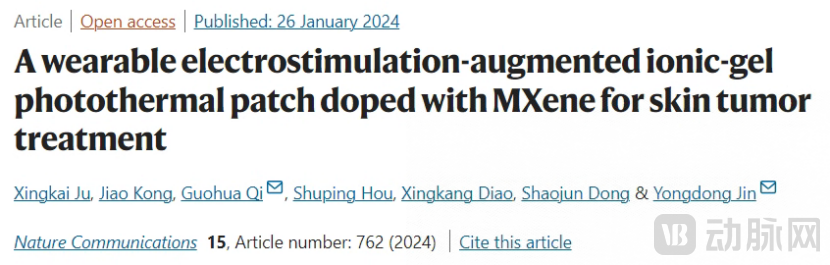 Screenshot of the paper (Image source: Nature Communications)
·The paper by Hou Jianwen and Zhou Shaobing’s team at Southwest Jiaotong University is titled “In-situ-sprayed therapeutic hydrogel for oxygen-actuated Janus regulation of postsurgical tumor recurrence/metastasis and wound healing” (published on January 27, 2024).
 Paper screenshot (Image source: Nature Communications)
Both papers point to the same biomaterial:Ionic Gel。
I. Physical and Pharmacological Therapies for Cancer Using Ionic Gels
Ionogels are solid mixtures with ionic conductivity, typically composed of polymeric organic polymers and salt-based electrolyte materials that can dissociate into ions. Due to the interconnection or entanglement of polymer molecular chains, the structural voids are filled with cations and anions serving as the dispersion medium, resembling the structure of traditional gels; therefore,TitleIt is an "ionogel."
Both research teams combined ionogels with other substances for the treatment of melanoma, albeit employing slightly different therapeutic approaches.
The team of Guohua Qi and Jin Yongdong at the Changchun Institute of Applied Chemistry, Chinese Academy of Sciences, focuses more on physical therapies. The team has developed aSkin-mountable electrostimulation-enhanced photothermal patch (eT-patch) composed of transparent ionogel and MXene-doped components, for 0.5 W/cm²2Light-Stimulated Therapy for Melanoma.
The MXene-doped ionogel within the patch exhibits high photothermal conversion efficiency and electrical conductivity as a medium; therefore, the designed eT-patch possesses superior photothermal and conductive properties. Under photo-thermo-electrical stimulation therapy, the eT-patch can synergistically trigger cancer cell apoptosis and heat shock, jointly leading to melanoma cell death.
Meanwhile, the ionogel-based eT patch exhibits excellent optical transparency, enabling real-time observation of skin responses and the melanoma treatment process under combined photothermal and electrical stimulation therapy.
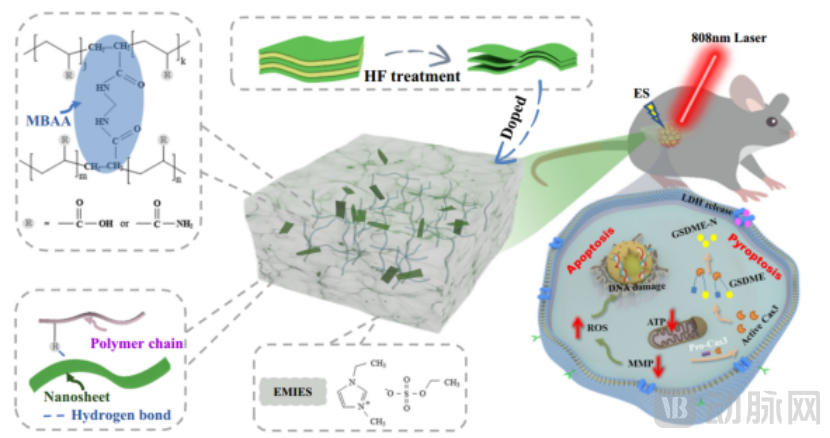 Ionogel-Based Electronic Patch for Subcutaneous Tumor Therapy (Image source: Nature Communications)
In contrast, the research conducted by Hou Jianwen and Zhou Shaobing’s team at Southwest Jiaotong University focuses on a pharmacological treatment regimen.The team developed a sprayable therapeutic hydrogel encapsulating tumor-targeting nanodrugs and photosynthetic cyanobacteria.
Nanomedicines can induce intracellular cascade reactions in tumor cells via photodynamic therapy, disrupting cellular redox homeostasis. This not only enhances oxidative stress-induced cell death and prevents local recurrence of residual tumor cells, but also blocks the hypoxia-inducible factor-1α (HIF-1α) signaling pathway to inhibit distant metastasis of tumor cells. Furthermore, when used as a dressing, they can accelerate wound healing.
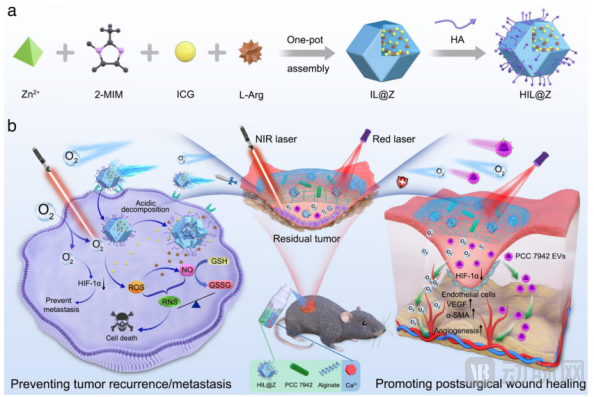 Schematic illustration of sprayable HIL@Z/P/H for effectively preventing tumor recurrence/metastasis and simultaneously promoting wound healing in postoperative cancer therapy (Image source: Nature Communications)
Overall, the ionogels serving as carriers in both studies demonstratedhigh biosafety, good stability, few side effects, and flexible regulation, demonstrating the diversity of its biomedical applications.
II. Diversity of Ionogel Research
In recent years, as a novel class of biomaterials, ionogels have been extensively studied for various applications. Beyond the treatment of melanoma, they are also being explored inWearable Strain Sensors, Wound Healing, and Biochemical Detectionare also particularly active in these fields.
Ionogels combine the high ionic conductivity and electrochemical stability of ionic liquids, offering not only excellent sensing performance but also considerable durability. Consequently, this material has become a popular choice for conductors in wearable strain sensors.
In 2022, a team led by Dr. Li Yusheng, Associate Chief Physician in Orthopedics at Xiangya Hospital of Central South University, and Dr. Li Zhou, Researcher at the Beijing Institute of Nanoenergy and Nanosystems, Chinese Academy of Sciences, synthesizedAn Ionic Hydrogel with Large Deformation Capacity and Rapid Self-Healing AbilityThe related paper, titled “Stretchable, Self-Healing, and Skin-Mounted Active Sensor for Multipoint Muscle Function Assessment,” was published in ACS Nano.
This ionic gel, based on the principles of electrostatic induction and electrostatic coupling, is not only stretchable and self-healing but can also be directly applied to the skin (Triple S). Experimental results demonstrate that the material exhibits excellent sensing properties and a high signal-to-noise ratio, enabling stable long-term use.
The ionogels synthesized by the team will be applied in research on triboelectric active sensors (TSAS), enabling real-time assessment of muscle function and rehabilitation training in the future.
In addition, in 2023, the team led by Professor Yao Xi and Sai Kishore Ravi at City University of Hong Kong also reported aMicrophase-Separated Bimodal-Pore Ionic GelsThis research achievement features skin-like mechanical properties and simulates the multimodal sensing capabilities of biological skin through ion-driven stimulus-to-electrical energy conversion. Its ease of fabrication, broad tunability, self-powered multimodal sensing, and excellent environmental tolerance provide a new strategy for the development of next-generation soft intelligent mechanotransduction devices.
Applications of Ionic Gels in Biochemical Detection: Primarily as Carriers for Analytes. Their high-performance molecular sensing capabilities and water retention properties effectively preserve test samples such as saliva and blood, thereby enhancing detection accuracy.
In 2022, the research team led by Professor Feng Liang at the Dalian Institute of Chemical Physics, Chinese Academy of Sciences, prepared via double cross-linkingApH-Sensitive, Stretchable, Antibacterial, and Stable Ionic Gel Artificial Tongue. This ionic hydrogel-based artificial tongue not only exhibits high ionic conductivity and antibacterial properties, but also possesses thermal stability and freeze resistance, thereby further ensuring sample viability. Most critically, the water-retention capability of the ionic hydrogel effectively addresses the issue of dehydration in saliva samples.
Experimental results demonstrated that the ionic gel exhibited excellent performance in artificial saliva simulation tests, and the team plans to advance its clinical application in the future.
Research on ionogels for wound healing is even more extensive. In 2021, a team led by Sun Shengtong at Donghua University synthesized an ionogel capable of complete self-healingStretchable Ionic SkinThe related paper, titled “Skin-like mechanoresponsive self-healing ionic elastomer from supramolecular zwitterionic network,” was published in Nature Communications.
In 2023, a research team led by Wu Mingyi from the Kunming Institute of Botany, Chinese Academy of Sciences, published a paper titled “A natural biological adhesive from snail mucus for wound repair” in the journal Nature Communications. This study identified a naturalPolysaccharide-based Adhesives, demonstrating strong adhesive properties to moist tissues, outperforming clinically used fibrin glue. This provides a new approach for the treatment of common skin wounds and hard-to-heal skin conditions such as diabetic foot ulcers.
The characteristic of accelerating wound self-healing has led to the widespread application of ionogels in medical aesthetics and surgical materials.3M, Novartis, Merck & Co., and other renowned biopharmaceutical companies have all established a presence in ionogel research.
III. Four Major Challenges Remain in the Research on Ionic Gels
In summary, the numerous properties of ionogels have led to significant breakthroughs in the biomedical field, as well as in functional materials and soft electronics, although challenges remain.
January 2024,Professor Yan Feng’s Team at Soochow UniversityIt comprehensively summarizes the recent advances in the preparation, properties, and applications of ionogels, and was published in Advanced Functional Materials under the title “Ionogels: Preparation, Properties and Applications”.
The research team noted that there are currently four major issues in the development of ionogel research.
First,The internal structure and interactions of ionogels are highly complex, and their structural characterization and structure–property relationships remain current research challenges;Second,In current research, the mechanical properties and conductivity of ionogels often exhibit a negative correlation;Third,The biological toxicity of ionic liquids poses certain challenges to the biocompatibility of ionogels;Fourth,The degradability of ionogels remains to be improved.
Current research on ionogels is still in its early stages, and more in-depth studies are needed before they can be applied in practical life.