

LivaNova Shuts Down Loss-Making Advanced Circulatory Support Unit to Refocus Strategy for 2024

LivaNova
Medical Device Supplier
In 2023, LivaNova’s high-speed growth, which exceeded Wall Street expectations for three consecutive quarters, gave analysts a mild shock.
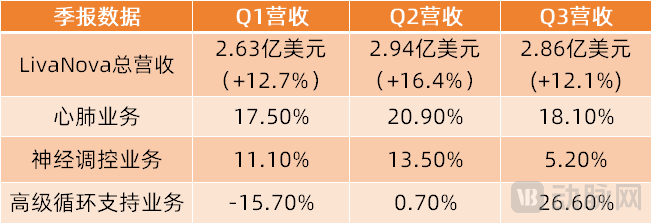
(LivaNova's Financial Report for the First Three Quarters of 2023)
Among the numerous medical enterprises worldwide, LivaNova stands out as a case study particularly worthy of attention at present. This is primarily because, from the vantage point of 2024, LivaNova has already made strategic foresights. Furthermore, since 2015, the company has repeatedly undertaken bold restructuring measures—divesting and selling off business units while adjusting its product portfolio—yet has maintained robust growth. These experiences offer valuable insights and lessons for Chinese companies that are heavily focused on product diversification.
Driven by rapidly growing revenue, LivaNova has raised its full-year performance guidance three consecutive times. At the end of the first quarter, LivaNova increased its full-year performance guidance to a growth rate of 4%-6%; at the end of the second quarter, it raised the guidance to 8%-10% growth; and at the end of the third quarter, it further increased the full-year performance guidance to 9%-11% growth.
LivaNova’s recent developments appeared promising; however, before the release of its fourth-quarter earnings report, the company divested its Advanced Circulatory Support business—one of its three core segments—at the start of 2024.On January 8, 2024, LivaNova announced that the company had decided to gradually wind down its Advanced Circulatory Support (ACS) business unit. Profitable products, such as cannulas and related accessories, would be transitioned to the Cardiopulmonary business unit in the first quarter of 2024, while products and services including the LifeSPARC and Hemolung systems would be discontinued by the end of 2024.
This decision came rather suddenly, given that the advanced circulatory support business had still achieved a year-on-year growth of 26.6% in the third quarter of 2023. Nevertheless, the secondary market responded very positively to the announcement. On the day of the announcement, LivaNova’s stock price surged by 6.89%, closing at $52.16 per share.
Why Does the Secondary Market Endorse LivaNova’s Dissolution of Its Core Department? What Does LivaNova’s Decision in Early 2024 Signify? How Will LivaNova Navigate 2024?
From 2007 to 2015, André-Michel Ballester served asCEO of Sorin. Subsequently, Cyberonics acquired Sorin for $2.7 billion, and the two companies merged to form a new medical device giant—LivaNova.André-Michel Ballester, asLivaNovaCEO, facilitating the business merger of the two companies.
In the initial phase following the merger, LivaNova’s core businesses were cardiac surgery, neuromodulation, and rhythm management, accounting for 50.4%, 28.9%, and 20.5% of its revenue, respectively.
Since its inception, LivaNova has demonstrated an imposing presence. Leveraging the strong foundations of Cyberonics and Sorin, LivaNova holds a leading position in the global markets for neuromodulation, cardiac surgery, and rhythm management, and is poised for even greater growth opportunities following this powerful merger.
Following the merger, André-Michel Ballester established a long-term strategic development plan for LivaNova.
First, to provide patients with high-quality products and better therapeutic outcomes, to supply physicians with useful data, and to deliver value to payers. “We hope this has always been listed as the company’s top priority,” said André-Michel Ballester at the time.
Second, focus on emerging growth platforms. Following the merger, LivaNova established a new investment division primarily dedicated to investing in companies and technologies with significant growth opportunities. Its strategic focus targets three key areas: mitral valve disease, obstructive sleep apnea, and heart failure.
Third, increase overseas revenue. At that time, 80% of LivaNova’s revenue came from the US and European markets, while 20% originated from markets outside Europe and North America. In light of this, LivaNova decided to expand its overseas revenue (i.e., revenue from regions outside Europe and North America). LivaNova also explicitly stated at the time: “China has always been a key market of focus for us.”
Fourth, embrace change. LivaNova believes that the healthcare industry is evolving at an accelerating pace, ranging from diverse payment models and the continued expansion of emerging markets to product iterations. To stay at the forefront of the industry, LivaNova must continuously assess and optimize its business model in response to the changing environment.
Although a long-term development strategy has been established,André-Michel Ballester did not have the opportunity to complete it. InLivaNovaAfter completing the integration period and with its teams beginning to function synergistically, André-Michel Ballester concluded his mission and departed at the end of 2016, succeeded byDamien McDonald Takes Over as CEO.
In fact, our analysis reveals that LivaNova’s CEO succession plan had already been structured prior to July 2016.
In July 2016, LivaNova announced an organizational redesign, adding the role of Chief Operating Officer (COO) to its existing corporate support functions. In October, Damien McDonald joined the company as COO, overseeing innovative product development and global commercial expansion. In November, LivaNova announced that Damien McDonald would succeed as CEO effective January 1, 2017.
According to reports, Damien McDonald previously served as an executive at Danaher, where he led a dental consumables company valued at $1.5 billion. He also served as President of the Kerr Group, where he was responsible for building the R&D pipeline. Additionally, he led Zimmer’s Spine division, guiding the team to achieve remarkable growth...
Upon assuming office, Damien McDonald also set the development strategy for LivaNova.
First, the company maintains its strong leadership in cardiac surgery and neuromodulation through innovative products and strategic investments. On one hand, it shares approved innovative technologies across internal teams to stimulate further innovation. For instance, remote monitoring algorithms and wireless technologies applied in neuromodulation also hold value in the treatment of heart failure and obstructive sleep apnea. On the other hand, LivaNova strengthens innovation through strategic investments, primarily focusing on innovative opportunities in three key areas: mitral valve disease, obstructive sleep apnea, and heart failure.
Second, achieve sustained revenue growth. LivaNova will leverage its strong market position, launch innovative products, and expand its geographic footprint to continuously drive revenue and profit growth. “We will improve our profit margins, increase our revenue and earnings per share, and build long-term shareholder value,” said Damien McDonald.
Again, improve financial health. The company will streamline its business model to enhance profitability; maintain financial discipline, utilize resources efficiently, and control expenses, ensuring that LivaNova sustains healthy cash flow and a sound financial position in the future.
Finally, the company aims to become a “premier workplace.” Damien McDonald believes that to maintain its market leadership, the company must attract, retain, and develop talent. Therefore, the company will continuously improve its management systems, foster teamwork, and instill its corporate culture to drive positive outcomes.
As can be seen, the two development strategies mentioned above differ significantly, with distinct priority areas; at the very least, they place different levels of emphasis on the cardiac rhythm management business. With theWith André-Michel Ballester’s departure, the strategic intent behind it also faded. AndDamien McDonald began moving toward the blueprint he had outlined.
July 2016,André-Michel Ballester has confirmed that he willLivaNovaResignation.In September 2016, LivaNova announced that it would not exercise its option to purchase the outstanding shares of Respicardia, as the investment no longer aligned with the company’s objectives. Previously,The Sorin Group, led by André-Michel Ballester, had previouslyIn October 2014, Respicardia received a $20 million investment.
Reportedly, the Remedē System developed by Respicardia is an implantable device that stimulates nerves to induce diaphragmatic movement, producing changes in carbon dioxide concentration and tidal volume similar to those seen in normal breathing. Also in September 2016, a study demonstrating the safety and efficacy of the Remedē System for treating central sleep apnea was published in The Lancet. Subsequently, ZOLL Medical Corporation acquired Respicardia in April 2021.
In 2017, after Damien McDonald assumed the role of CEO, LivaNova implemented more ambitious changes.From 2015 to June 2017, LivaNova’s cardiac rhythm management business experienced a continuous decline in revenue, placing significant pressure on its financial performance. For instance, the company’s cardiac rhythm management segment saw a year-over-year decrease of 2.9% in the first quarter of 2017 and 3.6% in the second quarter.
In response, LivaNova announced in September 2017 that it would explore strategic alternatives for its Cardiac Rhythm Management (CRM) business, and sold the CRM division to MicroPort Medical for $190 million in November. This move allows LivaNova to focus on neuromodulation and cardiac surgery, ensuring an optimized portfolio position to deliver long-term value.
Thereafter, LivaNova primarily focused on its two core businesses: cardiovascular and neuromodulation.Meanwhile, LivaNova also focuses on three key areas: transcatheter mitral valve replacement (TMVR), obstructive sleep apnea, and heart failure, strengthening its presence in these fields through the acquisition of innovative companies.
For example, in May 2017, LivaNova announced the acquisition of the remaining 51% equity stake in Caisson. It is understood that Caisson is one of the early companies globally to research transcatheter valve replacement technology. Its transcatheter mitral valve replacement (TMVR) implant device, a key focus of its R&D efforts, is considered by the industry to address a market more than twice the size of that for transcatheter aortic valve replacement (TAVR), indicating extremely broad prospects.
In January 2018, LivaNova acquired ImThera Medical, a company specializing in the treatment of obstructive sleep apnea. ImThera Medical developed an implantable hypoglossal nerve stimulator that expands the pharyngeal airway during sleep by stimulating the hypoglossal nerve muscles, thereby reducing upper airway collapsibility and enabling normal breathing.
Another key milestone for LivaNova was 2019.In June, it acquired Miami Instruments, a company engaged in the business of minimally invasive cardiac surgical instruments, and integrated it into its heart valve business segment. However, by November,LivaNova Suddenly Announces Termination of TMVR Program, Shuts Down Valve Device Factory, and Restructures Valve R&D Team。
Damien McDonald stated, “We have made the difficult decision to terminate our transcatheter mitral valve replacement (TMVR) program. We are disappointed by the termination of the TMVR project, having previously dedicated considerable effort to optimizing the product design in an attempt to address safety and efficacy concerns. However, significant technical challenges in product design, coupled with recent shifts in market dynamics, have increased the time and capital required to bring the product to market. Meanwhile, the continued decline in our valvular business revenue has made it difficult to sustain the R&D investment for TMVR.”
In early December 2020, LivaNova announced that its Board of Directors had approved the divestiture of its heart valve business to an entity controlled by Gyrus. The transaction was completed in June 2021. LivaNova’s Board of Directors believed that this move would enable the company to focus more on neuromodulation and cardiovascular care, and to allocate more resources to other promising product lines.
Through a series of acquisitions and divestitures,LivaNova's core business has evolved from its initial focus on cardiopulmonary, heart valves, rhythm management, and neuromodulation to cardiovascular and neuromodulation.Among these, the cardiovascular business includes the Cardiopulmonary Department and the Advanced Circulatory Support Department.
At first glance, it appears that LivaNova is divesting or shutting down any business lines affecting its financial statements and profitability. In reality, a closer analysis reveals that since Damien McDonald took the helm, LivaNova has focused on two key markets: cardiovascular and neuromodulation. The sale of its rhythm management business is a strategic move to concentrate on these core areas.
The decision to shut down the TMVR project further demonstrates its strategic judgment. As of early 2024, only one TMVR product had been approved in the global market, highlighting the significant challenges associated with its development. Meanwhile, the commercialization of this TMVR product remains in its early stages.
In the new year, as market competition intensifies, domestic companies may consider learning from LivaNova by making painful but necessary cuts—temporarily halting R&D on long-cycle projects and pursuing initiatives that can generate revenue and profits sooner.
On January 8, 2024, LivaNova announced the phased shutdown of its Advanced Circulatory Support (ACS) business unit. Given the development trajectory of the ACS business, this closure was not unexpected.
In April 2018, LivaNova acquired CardiacAssist for $200 million and operated it under the name TandemLife. According to its annual report, TandemLife falls under LivaNova’s Cardiovascular segment and is referred to as the Advanced Circulatory Support business, with products including pumps, oxygenators, and cannulas. The Cardiovascular segment also includes the Cardiopulmonary business and the Heart Valve business.
Subsequently, TandemLife developed the Tandem Lung and a series of cannulas based on the LifeSPARC platform. By varying cannulation strategies and combining them with artificial membrane lungs, the system enables right heart function support as well as VV-ECMO and VA-ECMO modes, thereby broadening its clinical applications.
It is worth noting that the TandemHeart system, developed by TandemLife (formerly CardiacAssist), is a globally renowned percutaneous mechanical circulatory support device. However, its commercial value has not been fully realized. In contrast, Impella, another well-known percutaneous mechanical circulatory support device, underpinned Abiomed’s valuation of over RMB 100 billion. In November 2022, Johnson & Johnson acquired Abiomed for $16.6 billion (approximately RMB 115 billion), with more than 95% of Abiomed’s revenue derived from Impella.
In the first quarter of 2020, LivaNova invested in ALung Technologies, a medical device company specializing in respiratory care, and acquired 100% equity ownership of ALung Technologies in May 2022. Reportedly, the Hemolung Respiratory Assist System developed by this company is the only FDA-approved product specifically designed for low-flow extracorporeal carbon dioxide removal (ECCO₂R) therapy in acute respiratory failure. This product was subsequently integrated into the Advanced Circulatory Support business unit.
According to LivaNova’s previous annual reports, its Advanced Circulatory business generated revenues of $19.46 million in 2018, $31.92 million in 2019, and $42.32 million in 2020.
By 2021, LivaNova revised the segment reporting in its annual report, changing from the previous two segments—Cardiovascular and Neuromodulation—to three segments, elevating Advanced Circulatory Support and Cardiopulmonary businesses to stand alongside Neuromodulation. In that year, its Advanced Circulatory Support business generated $55.46 million in revenue, marking the fourth consecutive year of double-digit growth for this segment.
This series of growth was driven by the global outbreak of COVID-19, which boosted demand for cardiopulmonary support products such as ECMO, thereby increasing the utilization rate of LivaNova’s advanced circulatory support products. Additionally, LivaNova strengthened its sales force to enhance its profitability.
In 2022, as the COVID-19 pandemic eased, LivaNova’s Advanced Circulatory Support business also faced challenges. With a decline in the number of COVID-19 patients, the overall revenue of its Advanced Circulatory Support business dropped significantly. Although the number of non-COVID-19 patients using advanced circulatory support products increased, this growth was insufficient to reverse the downward trend in the segment’s revenue.
In response, LivaNova shifted more of its commercial focus in 2023 toward driving higher penetration of high-volume ECMO. However, the financial performance of its Advanced Circulatory Support business remained unsatisfactory in 2023. During the first nine months of 2023, revenue from the Advanced Circulatory Support business accounted for only 4% of the company’s total revenue. Meanwhile, the 27% year-over-year quarterly revenue growth in this segment was attributed to the clearance of backlogged orders and a one-time adjustment related to European procurement. According to the financial report, the Advanced Circulatory Support business has become a loss-making operation.
In response, LivaNova has decided to transition profitable products such as intubation devices and related accessories to the Cardiopulmonary business unit in the first quarter of 2024, and to discontinue products and services including the LifeSPARC and Hemolung systems by the end of 2024.
Standing at the threshold of 2024, LivaNova’s decision signals a greater emphasis on profitability and cash flow, along with more prudent spending. It also reflects the company’s cautious outlook for 2024.
This perspective holds valuable lessons for Chinese healthcare enterprises. Whether to rise against the tide or pursue steady growth, entrepreneurs must make the final decision.