

Tangdong Files for IPO: Powering a Glucose Intelligence Ecosystem with Integration of Over 30 Smart Devices Across 7 Categories
An example may well illustrate the value and position of Tangdong in the medical ecosystem for blood glucose management:
Currently, a large number of CGM (continuous glucose monitoring) manufacturers proactively integrate with Tangdong and establish partnerships to achieve data interoperability before launching their products. Even if some CGM manufacturers do not initially choose to collaborate with Tangdong at the early stage of product launch, they eventually “come around” to partner with Tangdong after all.
Based on its own capability to connect diabetic patients with pharmaceutical and medical device companies,Currently, as a precision digital management service provider in the diabetes field, Tangdong has established an intelligent blood glucose ecosystem that integrates multi-type data from pharmaceuticals, medical devices, health monitoring, IoT, and food. It supports access and data fusion for over 30 intelligent hardware products across seven major categories within the blood glucose ecosystem, achieving near-complete coverage of mainstream blood glucose-related products in both domestic and international markets.
The development of Tangdong is closely tied to the market evolution in the blood glucose monitoring sector.
From a global market perspective, as one of the chronic diseases with the highest prevalence worldwide, diabetes is driving rapid expansion in the markets for diabetes monitoring and management, fueled by its large patient base and the ongoing trend of affecting younger populations.
According to the IDF Diabetes Atlas, the number of adults with diabetes worldwide reached 534 million in 2021, with China accounting for 140 million cases, representing 26.2% of the global total. Driven by deepening population aging and a trend toward earlier onset, the prevalence of diabetes in China continues to rise. The presence of various complications has further heightened awareness of the importance of treatment. Statistics show that global healthcare expenditure on diabetes reached $966 billion in 2021, an increase of approximately 316% over the previous 15 years. In China, diabetes-related healthcare spending amounted to $165.3 billion and is projected to reach $185 billion by 2030.
Among these, the blood glucose monitoring market has seen new changes—the market for continuous glucose monitoring (CGM) devices is continuing to expand.Compared with traditional blood glucose meters and other products, CGM is known for its advantages such as higher comfort (no need for daily finger pricks to monitor blood glucose levels), a broader monitoring range (capable of recording blood glucose fluctuations and setting thresholds for hyperglycemia and hypoglycemia alerts), and the ability to integrate with insulin pumps to function as an artificial pancreas.
CGM is still in its early stages of development, and due to the current low market penetration rate, there is significant room for market expansion. Recognizing this growth potential, Tangdong has also entered the CGM market.
With the entry of products such as Abbott’s FreeStyle Libre into the Chinese market in 2016, and the subsequent launch of an increasing number of continuous glucose monitoring (CGM) devices, Liu Feng, founder of Tangdong, recognized a significant opportunity: there was a lack of stable, high-quality software solutions designed to complement CGM devices. To better meet user needs and address prevailing market pain points, Tangdong developed and launched a software product specifically designed for use with CGM devices—In June 2021, the Tangdong app was launched. Relying on word-of-mouth, Tangdong quickly achieved rapid user accumulation and broke through to a broader audience.

It is worth noting that Abbott’s CGM products initially dominated the Chinese market, while Tangdong quickly gained a foothold by developing companion applications for the Abbott FreeStyle Libre system. Subsequently,Domestically produced CGM products have been successively launched, with manufacturers such as Silicon Based Bionics, Sinocare, and MicroTech all choosing to partner with TangDong.One interesting episode involved a manufacturer that initially discussed a partnership with Tangdong before the launch of its CGM product. However, considering its own capability to develop software products, the manufacturer ultimately chose to rely on in-house development for its accompanying software. After the product was launched, many users inquired whether it could be integrated with the Tangdong app. To meet user demand, the manufacturer eventually decided to collaborate with Tangdong.
For manufacturers, Tangdong primarily serves to empower CGM products. In the process of product empowerment, Liu Feng emphasized that, since CGM products are classified as Class III medical devices, regulatory compliance is particularly critical. Furthermore, it is equally important for manufacturers to shift from the relatively closed mindset typical of the medical sector to the more open mindset characteristic of the internet industry. These two factors constitute the foundational basis for Tangdong’s collaborations with manufacturers.
In 2021, Tangdong launched a mobile app based on its continuous glucose monitoring (CGM) products.
However, Tangdong quickly realized that “mere monitoring is insufficient; it is digital diabetes management that drives user stickiness by helping patients achieve better glycemic control. If digital glucose management is tied exclusively to a specific hardware product, it will limit users’ choices.” Liu Feng of Tangdong noted, “Given the anticipated increase in the number of CGM manufacturers, we believe an open platform should be developed to integrate CGM devices. In addition, other glucose-related devices, such as fingerstick blood glucose meters, insulin pens, and insulin pumps, should also be integrated. By consolidating all these data, we can provide patients with a basis for self-management. Meanwhile, the precise data provided to healthcare institutions can also support them in remote patient management.”
Based on this understanding, Tangdong has further expanded the scope and number of its partner manufacturers, thereby increasing its coverage of patient populations. Liu Feng pointed out that the current total number of CGM product users in China ranges from 600,000 to 800,000, while the number of patients managed by Tangdong is approximately 300,000.By integrating and fusing data from over 30 intelligent hardware products across seven major categories of blood glucose ecosystem devices, including IoT devices deployed in collaboration with manufacturers such as Xiaomi, OPPO, and vivo, Tangdong provides end-to-end digital management services for both healthcare providers (H-side) and consumers (C-side), covering multiple scenarios for diabetes patients, including home care, outpatient visits, and hospitalization.”
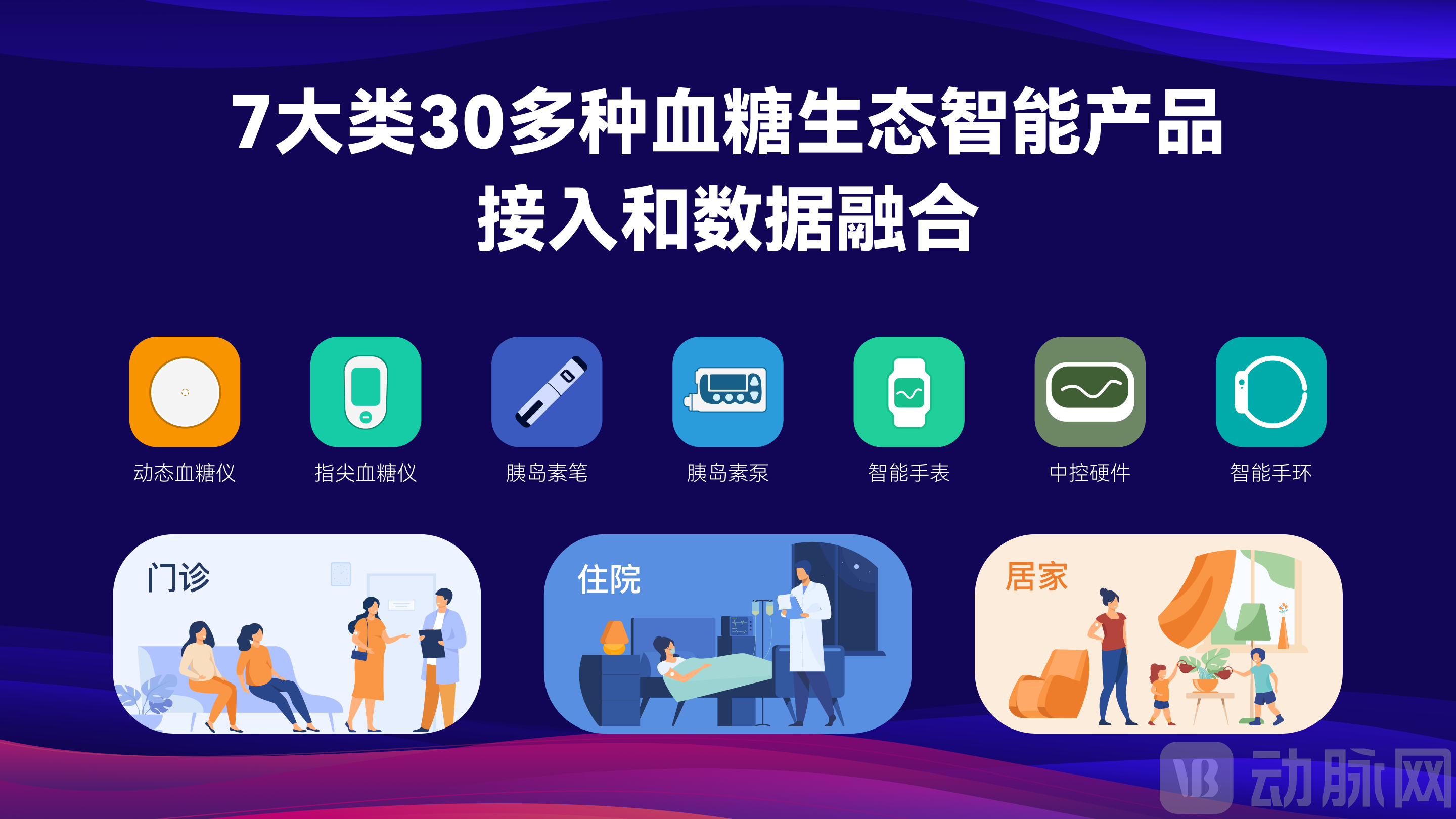
First, from the hospital perspective, leveraging its SaaS platform and precise data, TangDong can better assist medical institutions in serving patients.Diabetes is a chronic condition characterized by a long-term disease progression, necessitating sustained management. However, patients have historically become disconnected from their physicians after outpatient visits, making it difficult to assess whether glycemic targets are being met or to evaluate medication adherence. By building a SaaS platform for healthcare institutions, Tangdong helps bridge the communication gap between doctors and patients. This platform enables physicians to monitor patients’ glycemic control, addressing the previous discontinuities in blood glucose monitoring. Timely access to dynamic blood glucose data allows for more precise prescription adjustments, thereby enhancing diabetes management. Reportedly, Tangdong has already launched pilot programs with over 30 hospitals.
Secondly, from the consumer (C-end) perspective, by leveraging accumulated patient data, Tangdong can better guide patients, enhance their awareness of self-management, and improve treatment adherence.To further enhance patient services, Tangdong has also deployed nutritionists and health managers to support physicians and patients, transforming diabetes chronic disease management into a holistic health service process management model, thereby achieving better outcomes based on blood glucose control data.
Furthermore, as the industry develops, an increasing number of institutions have recognized the unique value of Tangdong.Currently, Tangdong has accumulated a substantial volume of real-world data, which can empower pharmaceutical companies by tracking the effectiveness of new drugs, among other applications. Additionally, Tangdong can provide customized management solutions for clients of health management institutions based on their specific needs.
According to Liu Feng, Tangdong’s current revenue primarily comes from B2B software customization and data services, as well as C2C e-commerce platform and personalized management services. Notably, most of Tangdong’s consumer-facing services are offered free of charge, with only select features requiring payment.
To fully leverage the 3 billion blood glucose data points and 20 million structured records of blood glucose-correlated diet, exercise, and medication data accumulated by Tangdong on a compliant basis, Tangdong is actively collaborating with government big data departments. As the first blood glucose-focused big data company to sign an agreement and establish operations with the National Health and Medical Big Data Center (North), both parties have agreed to compliantly utilize big data from the blood glucose ecosystem under the premise of data de-identification. They are continuously developing and optimizing AI algorithms to provide users with personalized algorithmic models for precise blood glucose control.
The development of digital healthcare is significantly improving people's health, and blood glucose management is undoubtedly a key area for future growth.
Liu Feng pointed out that blood glucose levels are in a state of continuous dynamic fluctuation, closely intertwined with medication, diet, emotional state, physical activity, and other factors; therefore, real-time monitoring of these dynamic changes is essential. However, blood glucose data obtained from traditional Blood Glucose Monitoring (BGM) devices have been insufficient to drive refined management. The emergence of Continuous Glucose Monitoring (CGM) has changed this landscape. “CGM will undoubtedly become the core of digital diabetes management, as without such tools and data, effective management is difficult to achieve. We also believe that the number of CGM device manufacturers in the future market will continue to grow.”
Tangdong is not the only company to have identified this trend. Glooko, a digital diabetes management company, has also emerged in the U.S. market. According to Liu Feng, while the two companies share similar strategic directions, their business models differ significantly. Furthermore, Liu emphasized that “Tangdong currently connects to a relatively larger number of devices.”
For VCBeat, its inherent advantages are evident.On one hand, continuous software iterations and upgrades based on the user experience of 300,000 individuals have enabled TangDong to deliver a relatively superior software experience and a robust ecosystem. On the other hand, TangDong’s integration of over 30 types of smart blood glucose hardware products across seven major categories is regarded as its “moat.” Among these assets, its base of 300,000 precise CGM (Continuous Glucose Monitoring) users constitutes TangDong’s unique competitive advantage.Moreover, Tangdong continues to engage in private-domain user operations to enhance user stickiness and improve the quality of service experience.
Currently, Tangdong is also actively collaborating with pharmaceutical and medical device companies, pharmacies, health management organizations, and insurance institutions.To better achieve its own development, Tangdong is also in contact with capital.It plans to increase investment in big data and algorithms, further expand the market to drive user paid conversions, and expand its team to provide patients with higher-quality personalized services.
"The shift from BGM to CGM in future glucose monitoring is an unstoppable major trend. The Chinese market will see more affordable, high-quality CGM devices.". The gradual adoption of CGM is a prerequisite for the digital management of diabetes, which will subsequently lead to the emergence of companies offering more personalized and precise digital diabetes management solutions. Leveraging artificial intelligence algorithms, these companies are expected to provide patients with superior management plans.“This is also our ultimate goal: to ensure that people with diabetes no longer view blood sugar management as a burden,” Liu Feng mentioned.