

Shift Bioscience Files for IPO: Pioneering AI-Driven Cellular Reprogramming to Reverse Aging with Proprietary Epigenetic Clocks

Shift Bioscience
Developer of Biological Aging Technologies
In 2006, Japanese scientist Shinya Yamanaka discovered that four transcription factors (Oct3/4, Sox2, Klf4, and c-Myc) could reprogram highly differentiated somatic cells into pluripotent stem cells, thereby restoring their capacity to differentiate into various cell types. For this breakthrough, Yamanaka was awarded the 2012 Nobel Prize in Physiology or Medicine, and these four transcription factors became known as the “Yamanaka factors.”
The process of reprogramming mature cells into stem cells is known as "reprogramming"Reprogramming technology exerts two effects: “dedifferentiation” and “rejuvenation.” It reprograms aging-associated epigenetic information in cells, shifting them to a state resembling embryonic stem cells, thereby resetting the epigenetic clock to zero and achieving cellular-level “rejuvenation.”
In 2016, researchers led by Ocampo discovered that cellular reprogramming technology could alleviate aging symptoms in mice with progeria, extending their median lifespan by 30%–50%. This finding has placed cellular reprogramming at the forefront of aging research. Numerous companies are seeking to leverage reprogramming technologies to reverse and reset the epigenetic clock, thereby achieving “longevity.”
Shift Bioscience is a company that leverages artificial intelligence to develop aging clocks and uses these clocks to explore methods for safely resetting cells and tissues, thereby achieving age reversal.. The company was founded in 2017 and is headquartered at the renowned Babraham Research Campus in Cambridge, UK. It was co-founded by Dr. Daniel Ives and Dr. Brendan Swain, biologists from the University of Cambridge, along with Steve Ives, a prominent Cambridge-based entrepreneur and father of Daniel Ives.
To date,Shift Bioscience has developed a single-cell transcriptomic aging clock, Aging Clock 2 (AC2)By integrating generative AI models, the company has built a high-throughput platform for exploring genomic space. Using this platform, Shift Bioscience predicts the genomes most likely to control specific cellular regeneration, and develops safer approaches to reverse aging and treat age-related diseases through cellular reprogramming technologies based on these genomic insights. These anti-aging interventions are then further tested, refined, and validated via AC2.
Shift Bioscience was founded based on an idea Daniel Ives had in 2009.
At that time, after reading *Ending Aging* by anti-aging expert Aubrey de Grey, he came to the realization that “we do not have to accept the inevitable; instead, we can take action to change it (aging).” This insight motivated him to embark on a research journey in the field of aging, with the goal of achieving healthy aging and extending lifespan.
During his doctoral studies at the University of Cambridge, Daniel Ives joined Ian Holt’s team in the MRC Mitochondrial Biology Unit at the Cambridge Biomedical Campus, where they jointly researched “biomarkers of aging” and how human mitochondrial function gradually declines with age.
During his research, Daniel Ives leveraged publicly available transcriptomic data from the NCBI GEO database and employed AI technologies to screen for small-molecule tools capable of identifying and eliminating mitochondrial DNA mutations. Throughout this process, he continually pondered, “How can this tool be applied to aging?” It was at this juncture that Steve Ives, after reading Daniel Ives’ paper on aging research, recognized that establishing a company would accelerate the translation of theoretical insights into practical applications. Thus, Shift Bioscience was founded.
Notably, Steve Ives is a serial entrepreneur based in Cambridge, UK. He holds a Master’s degree in Biochemistry from the University of Cambridge and an MBA from the Wharton School of the University of Pennsylvania. He has founded multiple information technology companies, including Torus Systems, Trigenix (acquired by Qualcomm), and Taptu.
With his father’s assistance, Daniel Ives secured the support of entrepreneur Jonathan Milner and longevity expert Karl Pfleger, and connected with Professor Steve Horvath, the “father of the epigenetic clock.”
Furthermore, Jonathan Milner mentioned Shift Bioscience during a lecture at the University of Cambridge. Brendan Swain, who was in the audience, was captivated by the company’s vision and sought an internship there. Ultimately, leveraging his research expertise in artificial intelligence and aging, Brendan Swain became a co-founder and Chief Technology Officer of Shift Bioscience, where he leads a research team that includes five scientists.
Notably, Professor Wolf Reik, Emeritus Professor of Epigenetics at the University of Cambridge, Director of the Babraham Institute, and Head of Altos Labs’ Cambridge laboratory, previously served as a scientific advisor to Shift Bioscience. Professor Reik is a leading authority in the fields of epigenetic reprogramming and cellular senescence, having made numerous contributions to aging research and published more than 250 related papers.
In addition, Lucas Camillo, the inventor of the histone aging clock AltumAge, serves as the company’s Head of Machine Learning. In August 2023, Lucas Camillo and his team published a research paper on AltumAge in Nature¹. The study demonstrated that AltumAge is a deep learning-based, pan-tissue DNA methylation epigenetic clock capable of predicting tumors, age-related changes such as immune and mitochondrial dysfunction, and conditions whose disease risk accelerates with aging. Under Lucas Camillo’s leadership, the development of Shift Bioscience’s high-throughput AI platform has been further accelerated.
In 2013, Professor Steve Horvath developed the first epigenetic clock, known as the Horvath Clock, based on the mechanism of age-related changes in DNA methylation. Since then, developing “epigenetic clocks” based on the patterns of DNA methylation during aging has become a common approach for researchers to explore the aging process.
Epigenetic clocks predict aging by measuring dynamic changes at cytosine-phosphate-guanine (CpG) sites on DNA that regulate gene expression; therefore, CpG sites are considered biomarkers for aging assessment in these clocks. Studies have found that the accuracy and reliability of epigenetic clocks in assessing aging increase with the number of CpG sites included. The four most widely used epigenetic clocks currently contain the following numbers of CpG sites: DNAm GrimAge (1,030), DNAm PhenoAge (513), Horvath (353), and Hannum (71)².
These data indirectly reflect that different epigenetic clocks exhibit substantial discrepancies in their measurements, and the results are not entirely accurate or reliable. Steve Horvath has also stated that there is a highly complex nonlinear relationship between DNA methylation age and actual lifespan, and the precision of different epigenetic clocks needs to be balanced³.
In response to this situation, scientists are investigating epigenetic modifications beyond DNA methylation, such as histone modifications and non-coding RNAs, with the aim of developing more reliable and accurate aging clocks.
Histone modifications play a pivotal role in the dynamic regulation of gene expression, shedding light on the complexity of epigenetic alterations during aging. Accordingly, Shift Bioscience has adopted a histone modification-focused approach to analyze their roles in human aging and, based on these insights, develop algorithmic models for predicting physiological age.
In August 2023, the company’s team published a preprint of this research paper on bioRxiv⁴. The results demonstrated that the histone-centric age prediction model exhibited robust accuracy and resilience against experimental and artificial noise. In simulation experiments, its performance in predicting aging was comparable to that of DNA methylation-based age predictors.
During the experiment, the team explored publicly available human chromatin immunoprecipitation sequencing (ChIP-Seq) data from the ENCODE database, focusing on seven key histone modifications: H3K4me3, H3K27ac, and H3K9ac, which are broadly associated with euchromatin; H3K9me3 and H3K27me3, which are broadly associated with heterochromatin; H3K36me3, which is associated with transcriptional elongation and heterochromatin; and H3K4me1, which is associated with enhancers. Furthermore, 62,241 genes were identified from the 3-billion-nucleotide human genome to serve as the basis for subsequent analysis of age-related coefficients.
Following a comprehensive analysis of these seven key histone modifications, they found that heterochromatin is lost with aging. Furthermore, histone marks at a large number of genes are significantly associated with age, and differences in genomic histone modifications increase with advancing age.
The team posits that developmental pathways and MicroRNAs (miRNAs) predominantly govern most histone modification-based age predictors. Regardless of the specific roles of individual histone modifications, they can be broadly categorized into two classes—activating or repressive—in the construction of age predictors. Interestingly, specific genes exhibit consistent age-related trends across both categories.
On this basis,The team proposed the potential of pan-histone modifications as biomarkers of aging and, based on this, developed a single-cell transcriptomic aging clock, AC2, to predict cellular-level aging and reveal the complexity of epigenetic alterations during the aging process.。
In addition to AC2, Shift Bioscience also possessesAltumAge, Another Histone Aging Clock: An Epigenetic Clock Capable of Capturing Age-Related Pan-Tissue Changes。
AltumAge utilizes the beta values of 20,318 CpG sites common to the Illumina 27k, 450k, and EPIC arrays for pan-tissue age prediction. Furthermore, the team trained this clock using 142 publicly available datasets derived from multiple human tissues.
Research results indicate that AltumAge may be sensitive to cellular exhaustion caused by cell passaging and can predict the status of tumors and cells exhibiting age-related changes in vitro, such as immune and mitochondrial dysfunction. Furthermore, by analyzing patient samples from conditions including multiple sclerosis, type 2 diabetes, and HIV, AltumAge can predict disease progression and aging status.
Building on the AC2 and AltumAge aging clocks and leveraging the 10X Genomics Chromium single-cell sequencing platform from U.S. biotech company 10x Genomics, Shift Bioscience has developed an AI-driven high-throughput screening platform for aging clocks. According to the company’s website, this platform accelerates its exploration of genomic space by more than 100-fold.
Through this platform, Shift Bioscience attempts to conduct CRISPR screening of aging-related genes to identify safer gene combinations that can reset cells and restore them to a youthful state, and then develop therapeutic drugs based on these combinations.
In this process, researchers first employed a high-throughput screening platform to perform gene knockouts, identifying novel gene combinations with the potential to reverse aging through cellular reprogramming. Subsequently, they overexpressed these genes in various combinations and analyzed their effects on cellular gene expression.
Subsequently, the predictive and actual effects of different gene combinations during cellular reprogramming were evaluated using AC2 and AltumAge. Through continuous improvement, updating, and validation, the most potent gene combination for restoring cellular vitality was identified. Following characterization of its gene expression profile related to cell identity and functional assays in fibroblasts, this combination was ultimately advanced into the drug development pipeline.
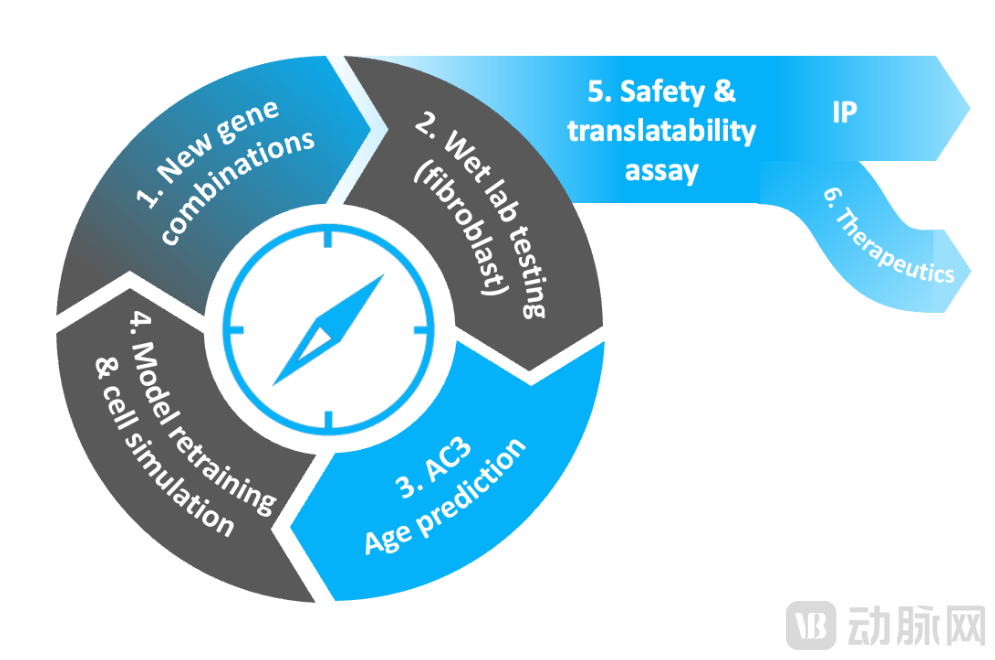
Shift Bioscience's Process for Screening Potential Gene Combinations
Image source: Shift Bioscience official website
After discovering gene combinations that can reset cells and tissues more safely, Shift Bioscience announced that it would collaborate with pharmaceutical companies to jointly develop novel drugs capable of delaying or even reversing aging and treating age-related diseases.
Since applying cellular reprogramming technology to the field of aging with the aim of developing safer gene combinations for reversing aging, Shift Bioscience has received support from multiple investors from 2017 to the present. In February 2022, the company announced the completion of its seed funding round, with the specific amount undisclosed.
Shift Bioscience’s existing investors include Healthspan Capital, F-Prime Capital, Boost VC, and Kindred Capital, among other investment firms, as well as individual investors Jonathan Milner and Karl Pfleger. Additionally, the company has received funding from Innovate UK SMART.
Shift Bioscience is one of the early innovators to apply cellular reprogramming technology to the field of anti-aging, but it is not the only player in this space.
Driven by Shinya Yamanaka’s 2012 Nobel Prize in Physiology or Medicine for somatic cell reprogramming technology, and the intensifying competition among major scientific enterprises and the world’s wealthiest individuals in the anti-aging sector, cell reprogramming technology has seen growing application and development in anti-aging research in recent years. An increasing number of companies are leveraging reprogramming technologies to study aging, aiming to develop drugs for age-related diseases and discover methods to restore youthful vitality to cells, tissues, organs, and even entire organisms.
Currently, companies positioned in the field of cellular reprogramming for anti-aging include Altos Labs, Calico, Retro Bio, Turn Biotechnologies, YouthBio Therapeutics, NewLimit, AgeX Therapeutics, Iduna Therapeutics, Gameto, and Xinrui Regenerative Medicine.
Most notably, Altos Labs secured $3 billion in angel funding, marking the largest investment to date specifically dedicated to anti-aging research through cellular reprogramming.Altos Labs aims to find a way to “defeat aging” within 20 years through cellular reprogramming technology. To this end, the company has spared no expense in recruiting a roster of scientists, including Shinya Yamanaka. Backed by substantial funding and a star-studded team, Altos Labs has become one of the fastest-advancing companies in this field.
On April 8, 2022, a team led by Professor Wolf Reik, Director of the Altos Labs Cambridge Institute, published a paper in the scientific journal eLife, reporting the development of a technique called “maturation phase transient reprogramming.” This method was shown to rejuvenate skin cells from a 53-year-old individual by nearly 30 years within 13 days, with cellular functions shifting toward those of younger cells.
However, despite numerous companies heavily investing in this sector and achieving certain research breakthroughs, none have yet entered human clinical trials. One reason is that cellular reprogramming technology remains a highly controversial anti-aging approach.
Professor Alejandro Ocampo of the University of Lausanne, Switzerland, stated that reprogramming technology carries high risks, including carcinogenic potential. It not only rejuvenates cells but also alters their intrinsic nature—for instance, converting skin cells into stem cells. Given the significant risks associated with its application in humans, this technology is unlikely to be translated into safe therapeutic agents in the near future.
Existing research findings also indicate that cellular reprogramming technology carries pathogenic risks. In 2013, a team led by Manuel Serrano at the Institute for Research in Biomedicine (IRB Barcelona) in Spain published a paper reporting that when Yamanaka factors were applied to mice, some mice exhibited signs of tissue rejuvenation depending on the extent of reprogramming, while others developed teratomas due to aberrant differentiation.
However, with technological advancements and deepening research, the risks associated with cellular reprogramming are likely to diminish gradually, ushering in a new era of development for the anti-aging sector based on this technology.
References:
1. de Lima Camillo, L.P., Lapierre, L.R. & Singh, R. A pan-tissue DNA-methylation epigenetic clock based on deep learning. npj Aging 8, 4 (2022). https://doi.org/10.1038/s41514-022-00085-y
2. Duan, R., Fu, Q., Sun, Y., & Li, Q. (2022). Epigenetic clock: A promising biomarker and practical tool in aging. Ageing research reviews, 81, 101743. https://doi.org/10.1016/j.arr.2022.101743
3. https://www.lifespan.io/news/steve-horvath-on-the-present-and-future-of-epigenetic-clocks/
4. Histone mark age of human tissues and cells.https://www.biorxiv.org/content/10.1101/2023.08.21.554165v2.full