

Avation Medical Submits IPO Prospectus for Its Breakthrough Non-Invasive Wearable System Vivally to Treat Overactive Bladder at Home

Avation Medical
Developer of Wearable Neurostimulation Therapy
Overactive Bladder (OAB), as a urological disorder, affects the daily activities and social lives of hundreds of millions of people worldwide. It can occur at any age or in either sex, with prevalence increasing with age. As the trend of population aging becomes increasingly pronounced, the prevalence of OAB is also on the rise.
Currently, common therapies for overactive bladder (OAB) include behavioral therapy, pharmacotherapy, percutaneous electrical stimulation, and invasive surgery. However, treatment rates remain suboptimal due to issues such as poor adherence, risks, and side effects, making innovation in related therapies urgently needed.
Avation Medical is a company dedicated to transforming the treatment of urinary incontinence and urgency. Headquartered in Columbus, Ohio, USA, the company has launched Vivally, a next-generation non-invasive neuromodulation therapy system. This wearable bladder control therapy and digital health system utilizes neuromodulation to treat patients with chronic overactive bladder (OAB) and urge urinary incontinence (UUI), addressing associated symptoms such as urinary urgency, frequency, and urge urinary incontinence.
Treatment options for overactive bladder (OAB) include behavioral therapy, pharmacotherapy, surgical intervention, and neuromodulation. Over the past 25 years, there have been no breakthrough innovations in OAB therapies.
Taking behavioral therapy as an example, interventions such as fluid management, scheduled voiding, use of incontinence pads, biofeedback, and pelvic floor muscle training are all aimed at improving bladder function and strengthening the urethral sphincter. However, these approaches require long-term adherence, are often associated with low patient compliance, and yield unstable therapeutic outcomes, with risks of recurrence and even adverse effects. For instance, fluid restriction may lead to dehydration or urinary tract infections; biofeedback and pelvic floor muscle training require professional guidance and equipment, and improper execution may result in muscle fatigue or injury.
Common medications for the treatment of overactive bladder (OAB) include anticholinergics, β3-adrenergic receptor agonists, and calcium channel blockers. These drugs require long-term administration and may lead to drug resistance or dependence. Furthermore, they can cause adverse effects of varying severity. For instance, anticholinergics may result in dry mouth, constipation, blurred vision, and cognitive impairment, while common adverse reactions associated with β3-adrenergic receptor agonists include urinary tract infections, hypertension, and tachycardia.
If behavioral therapy and pharmacological treatment fail to achieve satisfactory efficacy, surgical intervention may be considered, such as bladder hydrodistension, intravesical botulinum toxin injection, sacral neuromodulation (bladder pacemaker implantation), or cystectomy. However, invasive surgical procedures carry higher risks and may lead to complications such as hemorrhage, infection, urinary tract injury, and dysuria.
Revisiting Neuromodulation. Over the past two decades, neuromodulation has had a positive impact on the clinical treatment of overactive bladder symptoms, including urgency and urinary incontinence, and is now widely recognized as a safe and effective therapeutic option. It works by stimulating afferent nerve fibers within neural pathways to modulate the brain’s influence on involuntary bodily functions. In cases of urgency and urinary incontinence caused by overactive bladder, neuromodulation can alter the brain’s regulation of the detrusor muscle.
However, to date, traditional neuromodulation therapies require administration in clinical or hospital settings and are typically delivered via percutaneous approaches. The most common adverse reactions include pain at the puncture site (medial malleolus), local bleeding, and paresthesia. The need for non-home-based treatment and the invasive nature of these procedures have resulted in fewer than 10% of patients receiving therapy.
Following an in-depth analysis of the drawbacks of traditional therapies, Avation Medical has launched an innovative overactive bladder (OAB) treatment system—Vivally. Designed specifically for patients who wish to avoid the risks of surgery or the side effects of medication, Vivally offers a new therapeutic option characterized by its non-invasive nature, ease of use, convenience, comfort, and positive clinical outcomes. Furthermore, unlike other implantable neuromodulation methods used for bladder treatment, Vivally requires no surgery, medication, or implants.
The Vivally system is an innovative therapy for patients with urgency urinary incontinence and urinary urgency caused by overactive bladder (OAB) syndrome. This system combines non-invasive neuromodulation therapy for bladder control with a digital behavioral support mobile application, enabling patients to undergo effective neuromodulation treatment at home without the need for surgery, implants, or medication.
The Vivally system patient kit includes a stimulator with a rechargeable battery, wearable devices, gel pads, and accessories. In addition, the digital components of the Vivally system feature a mobile application and a HIPAA-compliant cloud-based portal.
Specifically, the ankle-worn device of the Vivally system is driven by an intelligent controller that delivers personalized neuromodulation energy to the tibial nerve. By electrically stimulating afferent nerves, it alters afferent nerve impulses, thereby inhibiting detrusor muscle activity. The device employs patented closed-loop control technology, utilizing proprietary algorithms and electromyography (EMG) sensors to detect and calibrate the energy levels delivered to the tibial nerve during stimulation. It continuously adjusts treatment parameters based on the patient’s individual response to ensure optimal, customized therapeutic outcomes in real-time closed-loop operation. Each treatment session lasts only 30 minutes and is administered at least once a week.
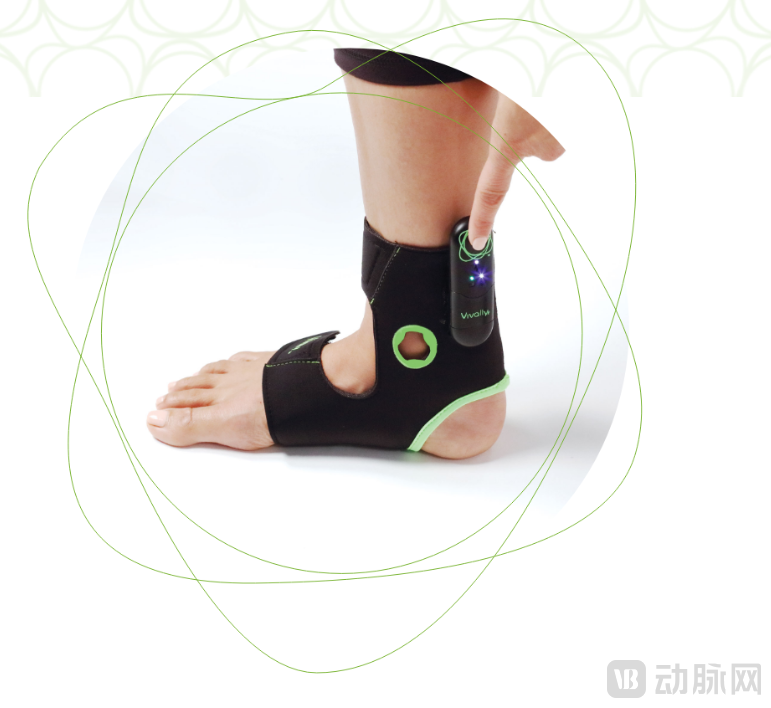
Vivally System's Ankle-Wearable Device
The Vivally system is managed through the Vivally App. Additionally, the Vivally App can monitor and adjust therapeutic efficacy, providing behavioral support and feedback. Avation Medical also offers patients an electronic diary service, “Vivally eDiary.” This tool helps patients record their treatment activities, progress, and outcomes, and facilitates communication with clinicians, thereby supporting patients in achieving prescribed goals.
The Vivally System can be used in the early stages of the treatment pathway. In two multicenter clinical trials, the Vivally System was proven to significantly reduce daily urinary frequency, urinary incontinence, and urgency episodes, while improving patients’ quality of life. The Vivally System is prescribed by clinicians following a brief clinical assessment that includes personalized calibration. This personalized calibration determines an EMG target and a range of neuromodulation energy levels correlated with the detected EMG signals to guide neural stimulation.
In April 2023, the Vivally System received FDA 510(k) clearance. According to Avation Medical, the Vivally System is one of the few non-invasive, wearable, home-use neuromodulation systems approved by the FDA on the market. It delivers closed-loop, self-adjusting electrical stimulation for the treatment of urgency urinary incontinence (UUI) and urinary urgency caused by overactive bladder syndrome (OAB).
On May 8, 2023, the Vivally system received the 2023 Best Healthcare Wearable Innovation Award from MedTech Breakthrough, in recognition of its breakthrough innovations in digital health and medical technology.
On November 15, 2023, Avation Medical announced that the results of the multicenter study “FREEOAB,” which demonstrated the safety and efficacy of the Vivally system, had been published in Urology.
This study was a prospective, multicenter clinical trial that enrolled 96 patients with overactive bladder, defining “patient response” as a symptom improvement of 50% or greater, or a return to normal. The results showed that 69% of patients responded in terms of urgency at the 6-month follow-up after using the Vivally system, and 63% of patients responded in terms of urge urinary incontinence at the 6-month follow-up. According to Avation Medical, researchers surveyed patient experiences with the Vivally system, and 98% of patients reported that the system was easy to use.
The study results also showed that, within 12 weeks of treatment with Vivally, patients experienced a significant reduction in the frequency of daytime urinary frequency, urinary incontinence, and urgency. Long-term efficacy outcomes remained stable at 12 months, with continued improvement in urinary parameters. Device-related adverse events were mild, and no major device-related adverse events occurred.
On February 1, 2024, Avation Medical announced that it had secured over $22 million in equity financing through an oversubscribed Series C round. The round was led by new investors ShangBay Capital and Asahi Kasei, with participation from Angelini Ventures, JobsOhio Growth Capital Fund, and others. Several existing investors, including Arboretum Ventures, Tonkawa, Medtronic, and Avestria Ventures, also provided additional capital. The proceeds will be used to launch the Vivally system in the United States. Additionally, representatives from Asahi Kasei and Angelini Ventures will join the board of directors of Avation Medical. According to Crunchbase, Avation Medical’s total funding has reached $34.9 million (approximately RMB 250 million) after two rounds of financing.
Avation Medical is set to launch the Vivally system in key markets in early spring 2024. Compared with existing invasive neuromodulation therapies, this patient-friendly, at-home wearable device presents a larger market opportunity; its home-based nature enables clinicians without surgical training to provide treatment and symptom relief. Currently, Avation Medical’s Series C financing round remains open. As it explores innovative therapies for overactive bladder (OAB), whether it can spark a transformation in the entire treatment paradigm remains to be seen.