

PegBio Submits Hong Kong IPO Application to Advance Commercialization of Lead GLP-1 Drug PB-119

PegBio
Developer of Innovative Therapies for Chronic Diseases
Since the GLP-1 boom, biotech companies focused on metabolic products have become increasingly active in the IPO market.On February 23, PegBio filed an IPO application with the Hong Kong Stock Exchange. Founded in 2008, the company focuses on metabolic disorders. It had previously planned to list on the STAR Market with a target fundraising amount of RMB 2.538 billion, but its IPO was terminated in April 2022.
In the year since halting its STAR Market listing, the metabolic disease sector has received unprecedented attention. Amidst fierce market competition and a race to advance development pipelines, PegBio’s core product—PB-119 (vepnaglutide injection), a once-weekly subcutaneous GLP-1 receptor agonist—has finally reached the stage of filing for marketing approval.In September last year, the National Medical Products Administration (NMPA) accepted the marketing applications for PB-119 as monotherapy for type 2 diabetes and in combination with metformin for type 2 diabetes. The drug is expected to receive approval and be launched in China as early as the fourth quarter of this year.
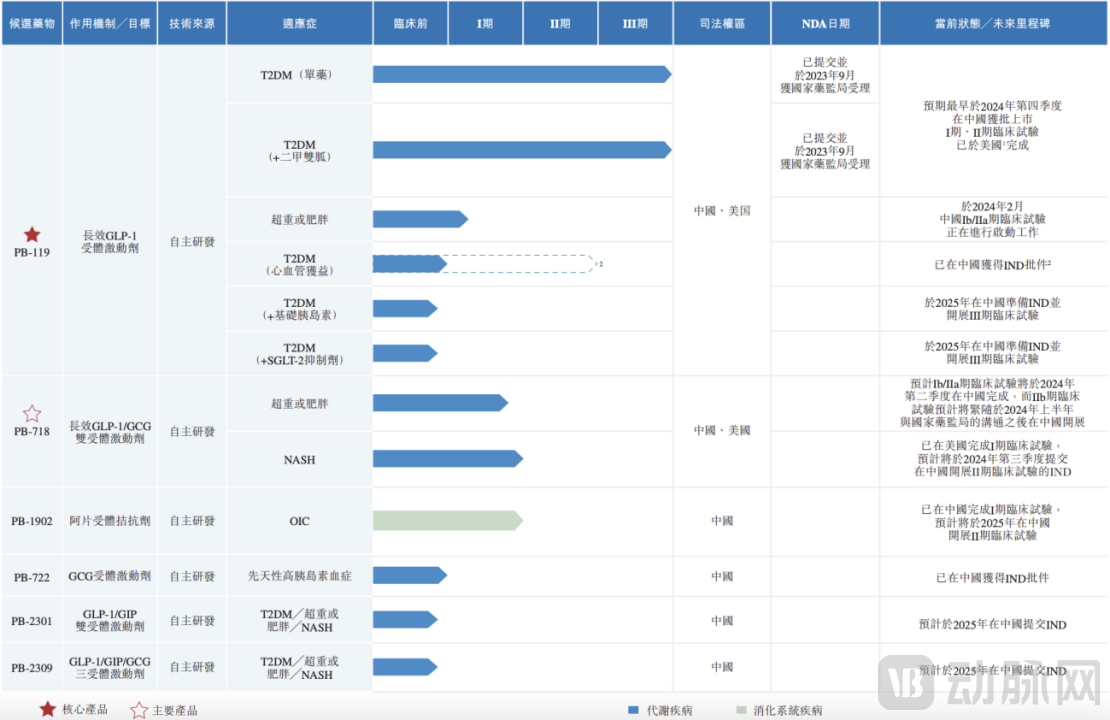
PegBio’s Pipeline, Source: Company Prospectus
Now shifting its focus to the Hong Kong Stock Exchange, PegBio aims to raise sufficient capital for the upcoming commercialization of its products. In fact, since 2008, PegBio has completed multiple rounds of financing, raising a total of over RMB 1.3 billion. Its shareholders include Legend Capital, Kaifeng Ventures, Lenovo Holdings, Tasly, Yusheng Venture Capital, and Yunfeng Capital. According to the company’s prospectus, PegBio’s last financing round took place in June 2023, with a post-money valuation of RMB 4 billion.
In addition to supporting its core product PB-119, PegBio requires additional funding to further expand its metabolic disease product portfolio.
PB-718 is a novel long-acting dual receptor agonist that simultaneously activates the GLP-1 receptor and the glucagon (GCG) receptor, primarily developed for the treatment of obesity and NASH. PB-1902 is an oral selective opioid agent in clinical development, intended for the treatment of opioid-induced constipation (OIC). PB-722 is a GCG receptor agonist being developed for the treatment of congenital hyperinsulinism. All these pipeline candidates are currently in the preclinical or Phase I clinical stage.
PegBio aims to capture market share in the gradually expanding metabolic disease drug market, which is characterized by the substitution of imported products with domestically produced alternatives. According to its prospectus, the number of confirmed cases of metabolic disorders and digestive system diseases worldwide was approximately 4.851 billion in 2022, and the patient population is projected to exceed 5.539 billion by 2030. In 2022, the market size for metabolic disorders and digestive system diseases in China was approximately RMB 215 billion, and it is expected to reach RMB 363 billion by 2032, with a projected compound annual growth rate (CAGR) of 5.8%.
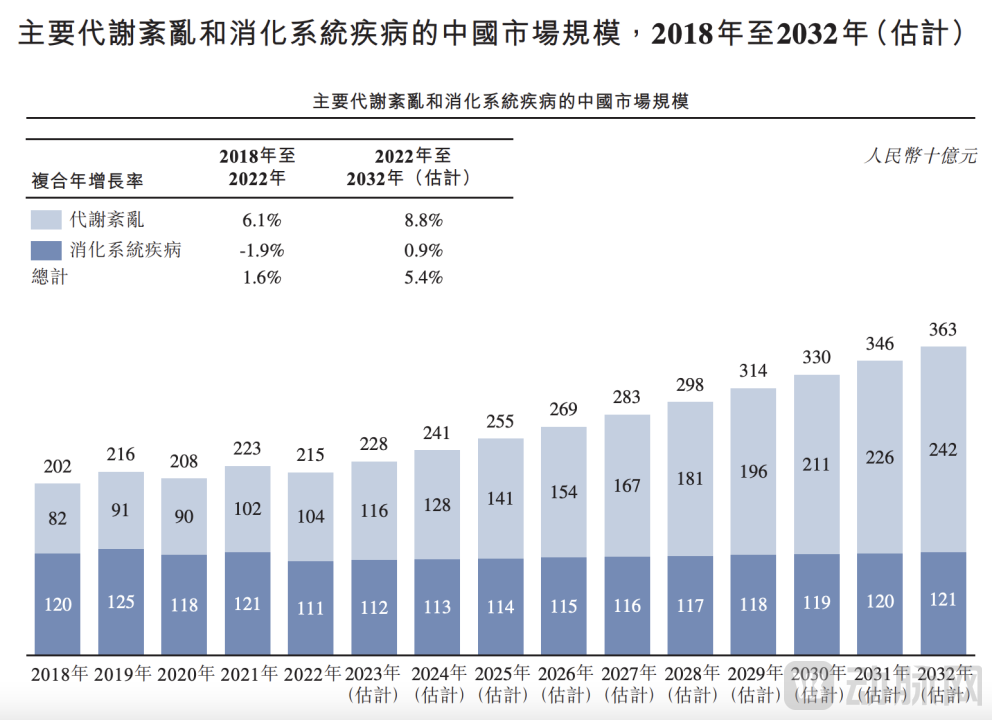
Source: Company Prospectus
Xiangya-Trained, with Over 15 Years of Entrepreneurial Experience in the Metabolic Field
Xu Min, the founder of PegBio, comes from a family of medical professionals. After graduating from Xiangya School of Medicine, he worked as an ophthalmologist at the Second Affiliated Hospital of Xiangya School of Medicine. Soon inspired to pursue further studies abroad, he went to the United States and studied in the Department of Physiology and Cellular Biophysics at Columbia University. One of his primary research focuses was elucidating protein structures. During his postdoctoral fellowship, he leveraged Columbia’s resources to complete a one-year MBA program. He was later invited to join Transpac Capital (Asia) Limited as the Chief Representative of its Shanghai Office, where he was responsible for venture capital investments and project incubation in the pharmaceutical industry.
During her five years in medical venture capital, Xu Min conducted an in-depth assessment of China’s entire pharmaceutical industry, with a particular focus on biopharmaceuticals. After gaining a preliminary understanding of the Chinese drug market, Xu Min identified a stark lack of innovation capability within China’s pharmaceutical sector.
“In 2002, the investment and policy environment for innovative drugs was not as favorable as it is today; essentially, no investment firms were willing to commit hundreds of millions to new drug R&D,” recalled Xu Min. “On one hand, China faced a shortage of new drugs; on the other, there was little support for their development.”
At this point, Xu Min considered PEGylation technology. Most protein and peptide drugs have relatively low molecular weights and are readily metabolized and excreted by the kidneys after entering the human body. By covalently conjugating drug molecules to polyethylene glycol (PEG) molecules, the strong hydrophilicity of PEG causes the PEG-drug conjugates to absorb a large amount of water upon entering the bloodstream. This increases their molecular volume and creates a steric hindrance effect. As a result, these originally small molecules are less susceptible to renal metabolism, thereby prolonging the duration of drug action in the body.
“At that time, I was wondering whether PEGylation technology could reduce the risks associated with new drug development.” Guided by this idea, Xu Min established the predecessor of PegBio as early as 2002.
Initially, the company adopted a business model of providing technical services to pharmaceutical manufacturers. Xu Min hoped that this would generate cash flow, or even profits, to support his own new drug research and development. However, things did not go as smoothly as expected. After 2007, with the improvement of the domestic biopharmaceutical venture capital environment, PegBio gradually embarked on the path of a Biotech startup supported by financing for R&D.
Prolonging the duration of action is one of the primary improvements in drug efficacy achieved through polyethylene glycol (PEG) modification. It can be said that PegBio recognized early on the importance of extending drug half-life and reducing dosing frequency.PEGylated PB-119 fully retains the effects of GLP-1 receptor agonists, including improving pancreatic β-cell function, promoting glucose-dependent insulin secretion, and reducing the risk of hypoglycemia; it also induces neogenesis and proliferation of pancreatic β-cells while inhibiting apoptosis, thereby increasing the number of pancreatic β-cells.
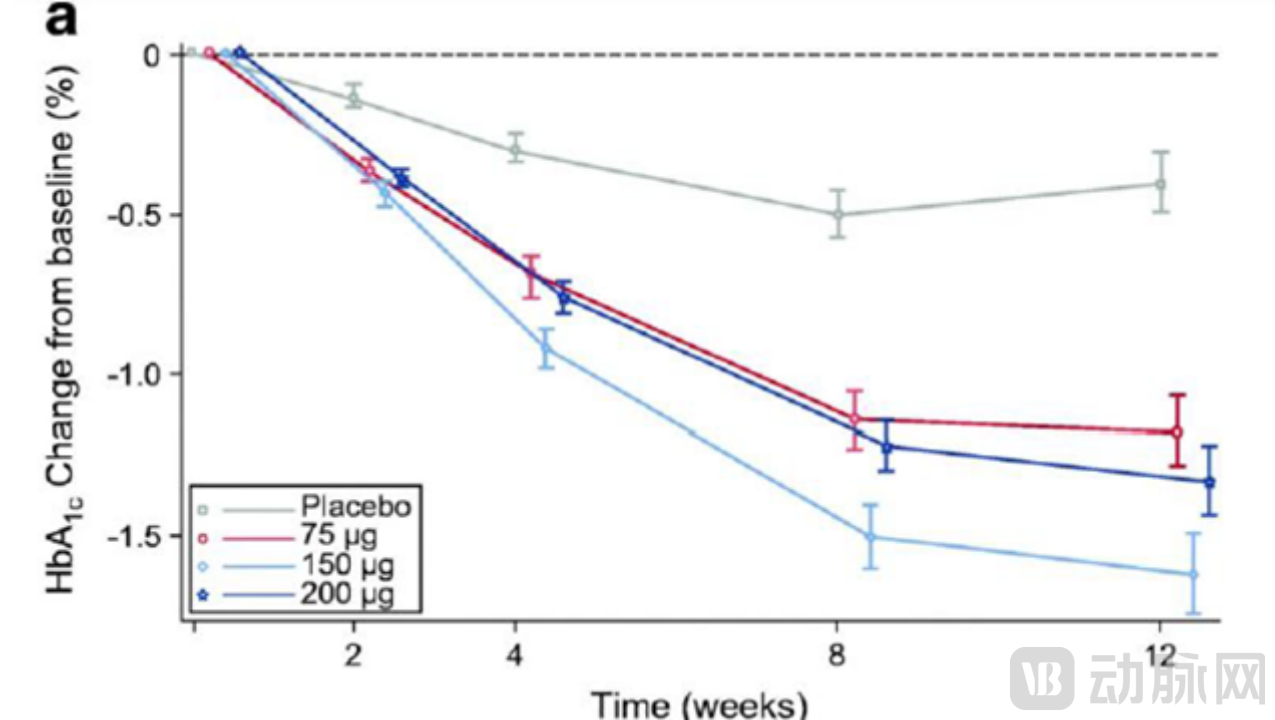
Clinical Data on PB-119’s Blood Glucose Reduction
Currently, PB-119 has been submitted for marketing approval in China for the treatment of type 2 diabetes and has completed Phase II clinical trials in the United States for the same indication. Clinical data from both China and the United States demonstrate that PB-119 exerts significant glucose-lowering effects, while also promoting weight loss and improving the overall lipid metabolism profile. The drug has shown good tolerability, and its efficacy at lower dose levels eliminates the need for titration, thereby enhancing dosing convenience and improving patient adherence.
How to Solve the Commercialization Challenge for Chronic Disease Biotechs?
PegBio is not the first company to launch a PEGylated drug for metabolic diseases. The world’s first PEGylated long-acting glucose-lowering agent is peglotide (brand name: Fulai Mei), independently developed and manufactured by Hansoh Pharmaceutical. Approved for marketing in 2019, it was also the third long-acting GLP-1 receptor agonist (GLP-1RA) launched in China. This product also utilizes PEGylation to extend its half-life, allowing for once-weekly subcutaneous injection.
Flumazenil was first included in the National Reimbursement Drug List (NRDL) in 2020 and has gradually become a key revenue-generating product for Hansoh Pharmaceutical. According to forecasts by CITIC Securities, Flumazenil is expected to generate RMB 2–2.5 billion in revenue for Hansoh Pharmaceutical by 2025.
The success of Fulaimi demonstrates that there is genuine market demand for PB-119; however, the greater challenge for chronic disease products lies in market promotion, particularly for biotech companies with strained resources.
“As a chronic disease, the promotion of diabetes medications is not limited to in-hospital specialists but must cover patient populations across different types and regions; therefore, building a sales and promotion team for diabetes drugs requires substantial investment in both manpower and financial resources,” said an industry professional with years of experience in promoting chronic disease medications to VCBeat.
According to the prospectus, PegBio reported other net income of RMB 23.55 million, R&D expenses of RMB 280 million, and a net loss of RMB 306 million in 2022; for the first nine months of 2023, its other net income was RMB 11.07 million, R&D expenses were RMB 193 million, and the net loss amounted to RMB 225 million. Clearly, PegBio requires strong promotional partners.
In July 2017, PegBio completed its Series E financing round, with Tasly leading the investment of $20 million and securing market priority rights for PegBio’s long-acting GLP-1 analogs and GLP-1/glucagon dual receptor agonists. Industry analysis at the time suggested that Tasly’s investment in PegBio’s advanced pharmaceuticals aimed not only to achieve strategic positioning in leading-edge technologies but also to accelerate the development of a closed-loop management platform for chronic diseases such as diabetes, thereby facilitating a transition from single-drug investments to platform-based medication solutions.
For PegBio, the goal is to leverage Tasly’s well-established distribution network, honed over many years, and its large, comprehensive sales team to handle the commercial promotion of products such as PB-119. Under this collaboration model, traditional pharmaceutical companies can more readily share in the GLP-1 dividend, while biotech firms focused on chronic disease products must continuously seek funding and partners until they achieve true commercial success.
Moreover, clinical trial costs in the field of chronic diseases are also extremely high. For instance, a non-inferiority trial conducted by Novartis for its flagship product, Entresto, against enalapril enrolled over 8,400 patients to evaluate outcomes related to hospitalization and cardiovascular mortality, at a cost of approximately $347 million. Such large-scale trials are among the key factors contributing to the success of chronic disease medications, yet the associated investment is often prohibitive for biotech companies.
Among the major M&A deals involving multinational corporations (MNCs) in 2023, many of the acquired companies were star biotech firms specializing in chronic diseases. It is likely that further consolidation and changes will occur in China’s GLP-1 and chronic disease sectors in the near future.
References