

Serendipitous Discovery by Professor Tian Zhou on Microvascular Endothelial Cell Phagocytosis Published in Nature Neuroscience

From microscopic neuronal activity to macroscopic cognitive behavior, brain science explores one of the most mysterious and complex domains of humanity. In this process, researchers, clinicians, and entrepreneurs play pivotal roles. They are dedicated not only to unraveling the mysteries of the brain but also to translating scientific discoveries into practical applications, thereby advancing the progress and development of the field of brain science.
To gain deeper insights into scientific innovation, translation, clinical application, and future prospects in the field of brain science, as well as entrepreneurial trends and development bottlenecks within the industry, Orange Bureau has launched the “Brain Talk Relay” interview series. Through dialogues with researchers, physicians, and entrepreneurs, we aim to present a comprehensive and in-depth view of the world of brain science, helping more people understand the latest advances and future trends in this field.
The expert for this issue of “Brain Talk Relay” is fromProfessor Zhou Tian, Southern Medical University’s Greater Bay Area Center for Science and Brain-inspired Research, she will bringMicrovascular Cell Phagocytosis Mechanismof research.
Coincidences are never in short supply in the scientific community. In 1964, American radio astronomers Arno Penzias and Robert Wilson accidentally detected faint radiation from the universe. They did not overlook this subtle anomaly, ultimately leading to the discovery of the cosmic microwave background radiation.
A similar story has unfolded in the field of neuroscience. Dr. Zhou Tian, who originally specialized in cardiovascular diseases, serendipitously discovered microvascular changes associated with brain disorders, which led him to pursue a research career in neuroscience. Together with his team, he has advanced the understanding of the pathogenesis of demyelinating diseases.
In 2019,Professor Yi Ren, Florida State Universityunder the leadership of,Dr. Tian ZhouCollaborated with the team to present research findings as“Microvascular endothelial cells engulf myelin debris and promote macrophage recruitment and fibrosis after neural injury”published online in a top-tier international neuroscience journal《Nature Neuroscience》。
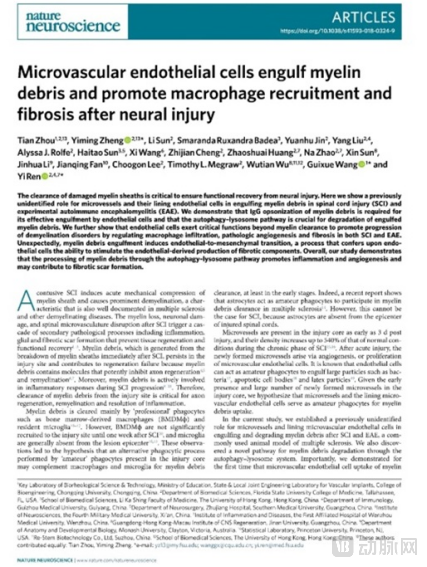
Screenshot of the paper (Image source: Nature Neuroscience)
The paper reveals for the first timeMicrovascular endothelial cells are a novel cell type that responds to myelin debris stimulation following demyelination, offering new insights for research into neurological diseases.Meanwhile, this research finding has also gained international recognition, with F1000 recommending it as a novel discovery and drug target.
I. Discovering New Mechanisms from the “Norm”
During her master’s studies, Zhou Tian’s supervisor primarily focused on atherosclerotic diseases. Thanks to this mentorship, she built a solid foundation in vascular research, which later paved the way for her discovery of microvascular changes in the nervous system.
By 2015, Zhou Tianzheng was pursuing his joint doctoral studies at Florida State University under the supervision of Professor Yi Ren. During one observation, they unexpectedly discovered changes in the microvasculature of mice with spinal cord injury: microvessels that originally had a diameter of 5–10 micrometers had dilated to approximately 20 micrometers.
This phenomenon is actually not rare, and precisely because of this, many researchers subconsciously regard it as normal, rarely paying attention to the underlying causes. However, for Zhou Tian, who had switched her field of specialization, this change was novel. What exactly causes such vascular pathology? And what consequences might it entail? A series of questions immediately sprang to mind.
In the subsequent years, under the leadership of Professor Ren Yi, the team conducted a series of studies on microvascular changes in spinal cord injury.In 2019, they pioneered a new research avenue into the novel phagocytic role of microvascular endothelial cells following nerve injury, offering hope to patients with demyelinating diseases.
II. Vascular Cell Research Offers the Potential to Reverse Demyelination
Demyelinating diseases are conditions caused by damage to the myelin sheath. Although this neurological disorder does not claim patients’ lives instantaneously like acute illnesses, it gradually erodes their normal quality of life.
Patients typically present with symptoms such as paralysis, emotional instability, and sensory deficits following onset, while complications progressively worsen. This not only compromises the patient’s quality of life but also imposes significant financial and psychological burdens on their families. Consequently, this condition is sometimes referred to as “the incurable disease that does not kill.”
Treating diseases requires addressing their root causes. Unfortunately, the precise pathogenesis of demyelinating diseases remains elusive. Currently, nearly all therapeutic approaches are supportive in nature, making it difficult to reverse or halt disease progression. If definitive pathogenic targets could be identified, patients would have hope for more tangible and effective treatment regimens.
In 2019, the team’s research revealed that microvascular endothelial cells can phagocytose myelin debris in demyelinating diseases and, through functional alterations, recruit bone marrow-derived macrophages. This process promotes chronic inflammation, angiogenesis, and fibrotic scar formation, thereby causing secondary injury in demyelinating diseases. This discovery has marked a turning point in the study of such conditions.
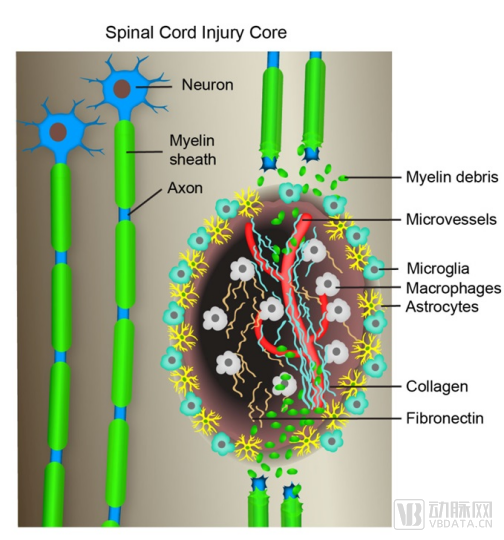
Distribution of Cell Types in the Spinal Cord Injury Area. Myelin Debris (Green), Microvascular Endothelial Cells (Red), Macrophages (Gray), Glial Cells (Yellow), and Neurons (Blue) (Image Source: Nature Neuroscience)
From this perspective,Inhibiting the phagocytic function of microvascular endothelial cells can alleviate chronic inflammation, angiogenesis, and scar formation in demyelinating diseases at their source, thereby exerting therapeutic effects on these conditions.
Following the publication of the paper, more teams began to focus on this direction, and emerged“follow-up study”: “In recent years, many experts and scholars have put forward their views on the study of microvascular endothelial cells at academic forums, which will undoubtedly accelerate the research on demyelinating diseases.”
In addition to demyelinating diseases, Dr. Zhou Tian is continuing to explore novel mechanisms of cellular phagocytosis, with the aim of providing solutions for more “incurable diseases.” For instance, in 2022,Discovery of the Clearance Mechanism for Microglial DebrisPublished in Nature Communications under the title “Microglial debris is cleared by astrocytes via C4b-facilitated phagocytosis and degraded via RUBICON-dependent noncanonical autophagy in mice,” this study fills a gap in the understanding of microglial debris clearance and draws scientific attention to this long-neglected area of research.
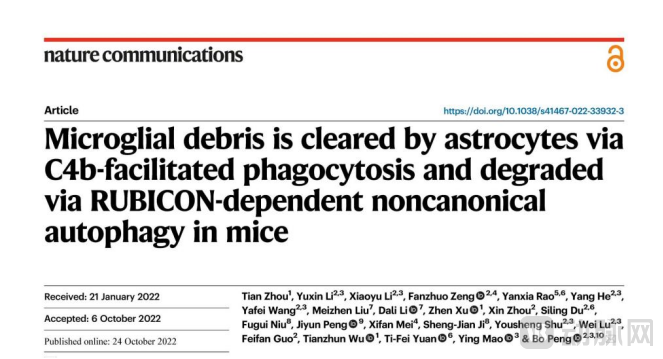 Screenshot of the paper (Image source: Nature Communications)
III. Bridging the Frontier and Clinical Practice
As a researcher, Zhou Tian is well aware that her research is still at the frontier stage and has a long way to go before clinical implementation. Nevertheless, she and her team are making efforts to translate some late-stage research findings into clinical applications. Currently, Zhou Tian’s team is collaborating with multiple domestic research teams specializing in demyelinating diseases, based on the mechanism of cellular phagocytosis,R&D of Nanomaterials for Microvascular Injury Repair. Additionally, the team maintains close communication with the research team at Xiamen University,Plan to jointly develop targeted drugs for microvascular cell pathology.
In the future, they hope their research will provide foundational support for more scientific teams in fields such as materials science and pharmacy, fostering collaborative development of innovative products applicable to clinical practice, thereby offering the possibility of a cure to more patients.
In fact, whether it is the discovery of the cosmic microwave background radiation or the exploration of the phagocytic mechanism of microvascular cells, what appears to be coincidence is actually an inevitability: if researchers lacked keen scientific intuition and a solid foundation of basic knowledge, these new phenomena would have gone unnoticed, and no new breakthroughs would have been achieved.
Therefore, Dr. Zhou Tian also wishes to share his experience with more young researchers: “Curiosity is indispensable in scientific research.” The ability to discover the unknown and maintain a constant thirst for knowledge are essential qualities for scientific inquiry.