

Fei Junheng Medical Files for IPO: Pioneering AI-Powered Smart Wristband Terminals and Generative Patient Data Computing Models for Next-Generation Smart Hospitals
Historical leaps in productivity have all resulted from the transformation, innovation, and development of production tools. With the emergence of technologies such as artificial intelligence, informatization, big data, cloud computing, and the Internet of Things, a new wave of transformation is now underway in the healthcare sector.
The intensive rollout of national policies on healthcare digitalization, coupled with the emergence of clinical operational needs in hospitals, has further sparked a nationwide boom in smart hospital construction. According to the “2023 Smart Hospital Vendor Landscape Report” by iFenxi, the market size for smart hospitals in China is projected to reach RMB 24.9 billion in 2023.
How to Seize Market Opportunities? VCBeat Interviewed Li Bo, CEO of Shenzhen Unequal AI Medical Co., Ltd. (hereinafter referred to as “Unequal Medical”), and Learned:
Based on the concept of "Smart Hospitals" first proposed by the National Health Commission in 2019, initiatives can be approached from three aspects: First, Smart Medical Care, targeting all medical staff within hospitals, with the goal of deeply enhancing hospital information technology infrastructure; Second, Smart Services, targeting all patient groups, with the goal of improving patient satisfaction and addressing challenges such as difficulties in accessing medical care; Third, Smart Management, targeting the administrative operations of all medical institutions, with the goal of improving the overall efficiency of administrative management.

“Non-Equilibrium Medical,” an innovative enterprise that provides hospitals with generative patient data computational models and smart hospital management services based on clinical digital language, enters the market through smart healthcare. It seizes the opportunities for digitalization and intelligent transformation in the medical administration sector. With its active concurrent computing system as the core and smart wearable hardware as the tool, it develops electronic wristband terminals. By performing real-time computations on computable data, it addresses current challenges such as passive information management within hospitals, irrational allocation of internal resources, healthcare worker burnout, risks associated with medical orders, and doctor-patient disputes.
The company has established close collaborations with institutions such as the Jiangsu Industrial Technology Research Institute, and its products are poised for deployment at multiple medical facilities, including South China Hospital Affiliated to Shenzhen University and Nanjing Ruihaibo Rehabilitation Hospital.
Create Smart Electronic Wristbands,
Achieving Efficiency Gains in Hospital Management Services and Unmanned Processes
Non-Equal Medical was in the preparatory stage in 2020 and officially established in 2021. Prior to the company’s founding, Li Bo, the founder of Non-Equal Medical, recognized the value of general-purpose artificial intelligence technology and believed that it could be applied across various industries in the future. Consequently, he decided to apply this technology to healthcare scenarios.
From the perspective of opportunities in healthcare scenarios, Li Bo identified three key needs:
First, the accreditation cycle for Grade A tertiary hospitals is four years. Within this framework, the direct evaluation score for information management is 25 points, allocated as follows: 1 point for mid-to-long-term IT strategic planning (per year), 1 point for annual work plans, 1 point for system architecture, 2 points for actual system operation, and a total of 3 points for providing support to hospital management decision-making and clinical practice. The significant disparity in scoring between legacy information systems and decision-support-oriented informatization constitutes a critical driver for the proactive implementation of IT infrastructure in newly built, renovated, or expanded hospitals. Consequently, the imperative for cost reduction and efficiency enhancement also underscores the need for intelligent, visualized management.
Secondly, the integration of artificial intelligence technologies with hardware services can significantly alleviate the excessive workload pressures on medical staff, thereby facilitating quality improvement and efficiency enhancement in hospitals. AI systems provide decision-making support and evidence, which can reduce medical errors and doctor-patient disputes, while also meeting hospital administrators’ needs for building a “visual and controllable information cockpit.”
Thirdly, the Hospital Authority’s Clinical Management System (CMS) in Hong Kong was established in 1990 and is currently implementing a new update policy. Based on the Hospital Authority’s five-year CMS renewal plan, its application in Hong Kong serves as both a springboard and an opportunity for expanding into overseas markets.
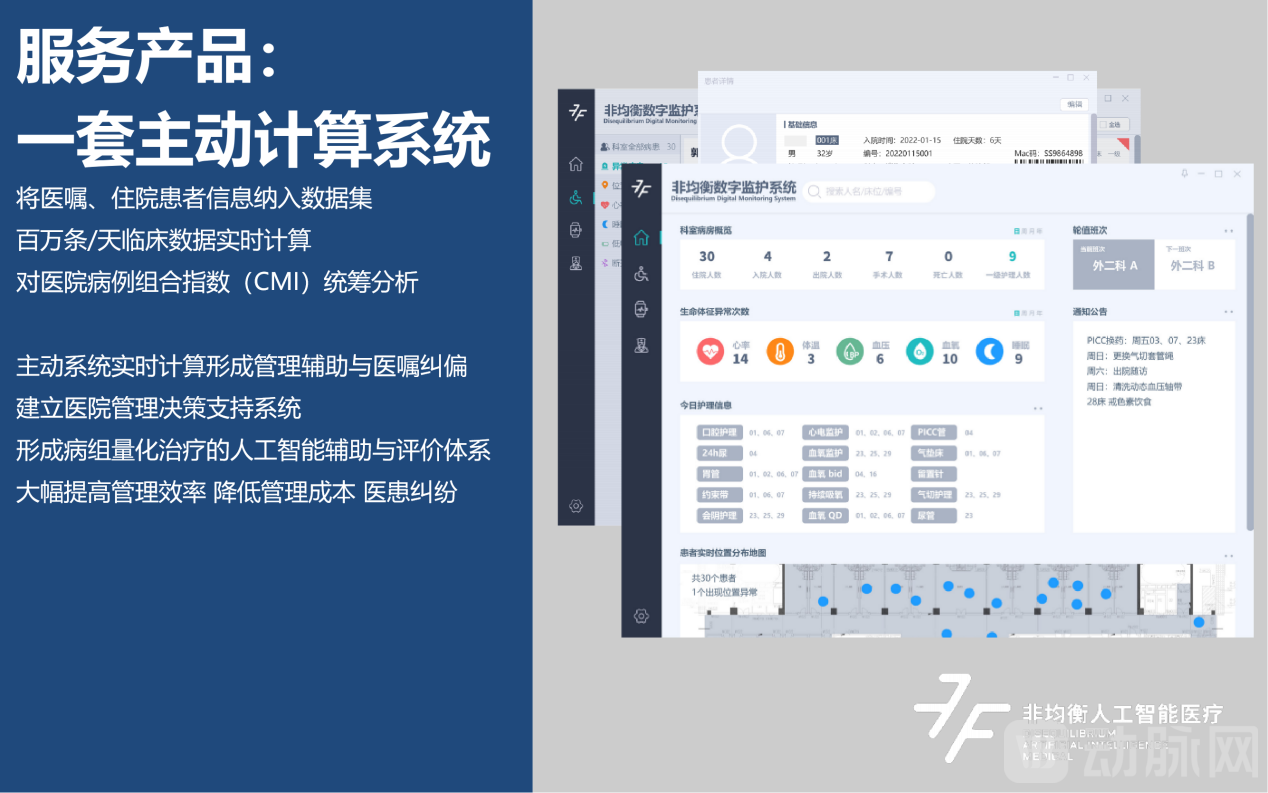
Thus, Li Bo and the Unbalanced Healthcare team developed an active computing system,Incorporate physician orders and inpatient information into the dataset, perform real-time computation on millions of clinical records per day, and conduct comprehensive analysis of the hospital’s Case Mix Index (CMI). Proactively generate management assistance and order correction through real-time system calculations, establish a hospital management decision support system, and develop an AI-assisted evaluation framework for quantified treatment by diagnosis-related groups. This aims to improve management efficiency, reduce administrative costs, and mitigate doctor-patient disputes.
andThe wristband device, serving as the carrier of this system, will replace existing paper wristbands. While ensuring compliant collection of patient data, it enables closed-loop management for inpatient scenarios such as departmental access control and electronic geofencing. It also optimizes the management of patient vital sign rounds (including morning and evening checks) and streamlines the process for disseminating and confirming broadcast notifications related to medical consultations.Meanwhile,The wristband device can also provide patients with daily reminders regarding their rehabilitation progress and tasks, thereby enhancing the effectiveness of in-hospital rehabilitation management.。
By wearing an electronic wristband, not only canDigitize and streamline patients’ medical records, while simultaneously providing in-hospital navigation services, visualization of rehabilitation information, and support for health insurance and public health emergencies. This approach not only visualizes patients’ daily data and simplifies management but also lays a digital foundation for smart healthcare.
Founding member of concurrent algorithms and behavioral semantics in the AI industry,
Form an interdisciplinary team with professionals in medical data, evidence-based medicine, and epidemiology.
Building such a system is no easy feat. It is precisely for this reason that, at the inception of the company, Li Bo joined forces with the former rotating president of iFLYTEK, who is also a jointly appointed professor in the Thrusts of Data Science and Analytics and Internet of Things at the Information Hub of the Hong Kong University of Science and Technology (HKUST), as well as the chief project manager engineer from ZTE and Nubia. Together, they addressed the pain points in smart healthcare development and co-created an electronic wristband product.
Furthermore, the Feijunheng medical team collaborates with multidisciplinary experts in evidence-based medicine, medical statistics, epidemiology, and medical data science to conduct research on clinical digital language computing, primary lesion datasets, and generative in-hospital management models, integrating these advancements into its products.
Currently, the parent company holds 36 proprietary intellectual property (IP) rights, while its partners hold 89 IP rights. Inventions account for over 65% of these assets, bringing the total accumulated IP portfolio to more than 120 items, with access to expedited registration channels. Among these, 65 IP rights pertain to proactive algorithms such as behavioral semantics, data tracking, and data analysis. The R&D strength in unbalanced healthcare technology not only establishes technical barriers for the enterprise but also provides momentum for subsequent product iterations and the expansion of application scenarios.
Leveraging computable human digital twins,
Expand into drug evaluation, remote management, and early screening of primary lesions
Based on existing technologies, Li Bo has outlined a future product pipeline for the company, focusing on three key areas: indication monitoring during medication use, remote and chronic disease management, and open computable datasets and hardware platforms.
First, the product can be used to monitor therapeutic indications during hospitalization while patients are on medication, assess drug efficacy, and provide data feedback to biopharmaceutical companies;
Second, through the regional medical consortium service network and electronic wristbands, physicians can provide remote management and services to home-based patients with chronic or severe diseases;
Third, establish a computable data subset of lesions for academic research and technological development on the open platform.
Next, Unequal Medical will seize the opportunities presented by digitalization and intelligence in healthcare. Leveraging computable human digital twins, it will expand into drug evaluation, remote management, and early screening for primary lesions. Meanwhile, using the market for newly built, renovated, and expanded hospitals in the Guangdong-Hong Kong-Macao Greater Bay Area as a starting point, it will gradually extend its business to AI-plus-healthcare scenarios across China through an IT subcontracting system.