

Shanghai Jiao Tong University's Professor Kai Xu Team Expands Indications for Single-Port Laparoscopic Surgical Robot
Recently,Professor Xu Kai's Team at Shanghai Jiao Tong UniversityThe surgical robot developed by the company has received approval from the National Medical Products Administration (NMPA) for a change in its medical device registration (Registration Certificate No.: Guo Xie Zhu Zhun 20233010833). The scope of application has been updated to: "This product allows physicians to control minimally invasive surgical instruments using a master-slave manipulation system, for use in urological and gynecological laparoscopic surgical procedures."
According to Shanghai Jiao Tong University’s Institute of Translational Medicine, the surgical robot developed by Professor Xu Kai’s team is the first of its kind in China, and alsoThe Only Multi-Specialty Single-Port Laparoscopic Surgical Robot Capable of Performing Both Benign and Malignant Laparoscopic Procedures in Urology and Gynecology. This groundbreaking advancement means that, following urology, gynecological surgery will also have more minimally invasive and precise options.
1. The First Domestically Produced Single-Port Endoscopic Surgical Robot
The endoscopic single-port surgical system developed by Professor Xu Kai’s team (Registration Certificate No.: National Medical Device Registration 20233010833) received market approval from the National Medical Products Administration (NMPA) on June 20, 2023. At that time, the product wasChina's First Single-Port Endoscopic Surgical System, also isThe Only Commercially Approved Single-Port Laparoscopic Surgical Robot Worldwide, Apart from the da Vinci SP。
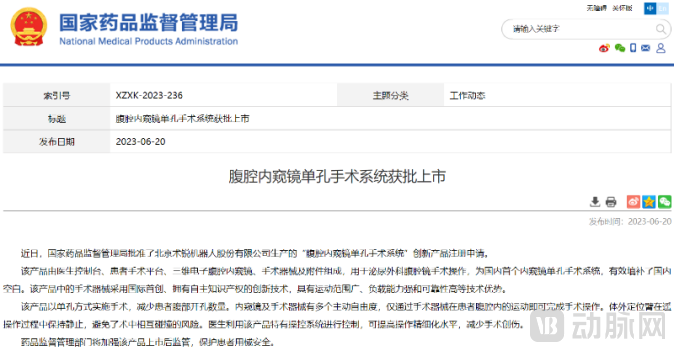 (Image Source: National Medical Products Administration)
It is reported that this surgical robot has successfully performed multiple urological and gynecological procedures, including Asia’s first pure single-port radical prostatectomy for prostate cancer and partial nephrectomy for renal cell carcinoma; the world’s first single-port retroperitoneal adrenalectomy and partial nephrectomy for renal cell carcinoma; and China’s first multi-arm pure single-port gynecological procedure as part of registered clinical trials.
II. Domestic Surgical Robots Are Concentrated in Five Major Segments
Currently, a wide array of surgical robots are emerging on the market. Based on different indications, they can be categorized into more than ten types, including joint surgery robots, spine surgery robots, neurosurgery robots, endoscopic surgery robots, and vascular interventional surgery robots. However, in terms of market share and clinical involvement, they are mainly concentrated inLaparoscopic surgical robots, orthopedic surgical robots, pan-vascular surgical robots, natural orifice transluminal endoscopic surgery (NOTES) robots, and percutaneous puncture surgical robots.
First,Laparoscopic Surgical RobotPrimarily designed to perform a variety of complex minimally invasive surgeries. This category of surgical robots represents the most commercially successful segment and is also the type with the most extensive deployment among domestically produced surgical robots in China. As of 2023, a total of six domestically produced laparoscopic surgical robots had received regulatory approval.
Innovations in Domestically Produced Laparoscopic Surgical RobotsFocusing primarily on the number of robotic arms, single-port versus multi-port systems, haptic feedback, and 3D visualization.For instance, Shanghai MicroPort’s surgical robot adopts a four-arm configuration (one endoscope arm and three operative arms) and is equipped with a closed 3D display system. In contrast, Shandong Weigao’s “Miaoshou” robot features a three-arm design (one endoscope arm and two operative arms), which can deliver an open 3D visual experience when used with 4D glasses. Additionally, there are designs featuring a single arm as well as configurations where the four surgical execution systems are completely independent.
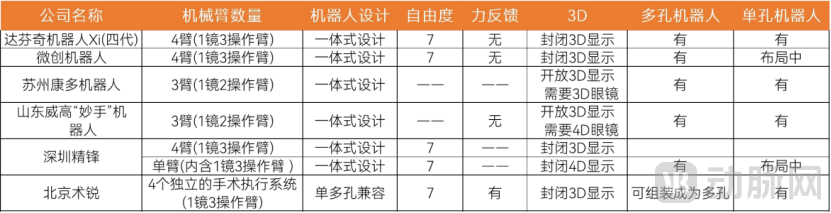 Key Features of Representative Domestic and International Laparoscopic Surgical Robots (Image source: VCBeat; data source: MicroPort MedBot prospectus)
andOrthopedic Surgical RobotAlthough it is one of the earliest surgical robots in human history, it is now commonly used to assist in orthopedic surgeries, addressing the challenges faced by traditional orthopedic procedures, such as complex structures and deep operative sites, poor visualization and difficulty in achieving precision, as well as significant trauma and slow recovery.
Based on the indications for orthopedic surgeries, orthopedic surgical robots can be subdivided into three categories: joint replacement surgical robots, spinal surgical robots, and trauma surgical robots. Domestic developers of orthopedic surgical robots often focus their strategic layout on one of these categories.
Additionally, currentlyPan-vascular surgical robots, natural orifice surgical robots, and percutaneous puncture surgical robotsIn this field, there is limited localization of manufacturing, and no domestically produced natural orifice surgical robots have yet been approved; most products remain in the R&D phase. These three categories of surgical robots demand high levels of image guidance and automation, creating a window of opportunity for Chinese surgical robot developers to achieve breakthroughs.
III. The Development of Domestically Produced Surgical Robots Shows a Trend Toward “Integration”
In addition to the traditional approach of designing surgical robots for single indications, the research and development of domestically produced surgical robots in recent years has also demonstratedThe “Integrated” Trend Across Multiple Disciplines and Fields。
Just like the surgical robot developed by Professor Xu Kai’s team, which can simultaneously meet the operational requirements of urological and gynecological laparoscopic surgeries, many other Chinese research teams are also making strides in this direction.
On October 10, 2023, the National Medical Products Administration officially issued the “Documents for Change Registration (Filing) of Medical Devices,” approvingTianzhihangAmendment to the Indications for Use of the Third-Generation Orthopedic Surgical Navigation and Positioning System (NMPA Registration No. 20213010095, approved in 2021)
Following approval, the indications for Tinavi’s third-generation orthopedic surgical navigation and positioning system have been expanded from being limited to “open or percutaneous procedures in spinal surgery and trauma orthopedics” to also covering"Open or Percutaneous Surgery in Spinal Surgery and Traumatic Orthopedics"and"Total Knee Arthroplasty". It has become the world's first and only orthopedic surgical robot to achieve comprehensive coverage of spinal, joint, and trauma procedures on a single surgical robot platform.
This "single-system, multi-indication" surgical robot meets the clinical needs of full-segment spinal surgeries (including cervical, thoracic, lumbar, and sacral spine), trauma surgeries of the pelvis, acetabulum, and extremities, as well as total knee arthroplasty.
Additionally, in 2022Professor Zheng Gangtie’s Team at Tsinghua Universityhas also publicly disclosed aOrthopedic Surgical Robot Products Supporting Multiple Surgical Procedures. According to the team, this surgical robot not only provides orthopedic surgeons with a wider range of procedural options, but its core algorithms for complex procedures also enhance surgical precision and effectively reduce operative time.
The product has been granted three Chinese invention patents and one U.S. invention patent, with four additional Chinese invention patents published.
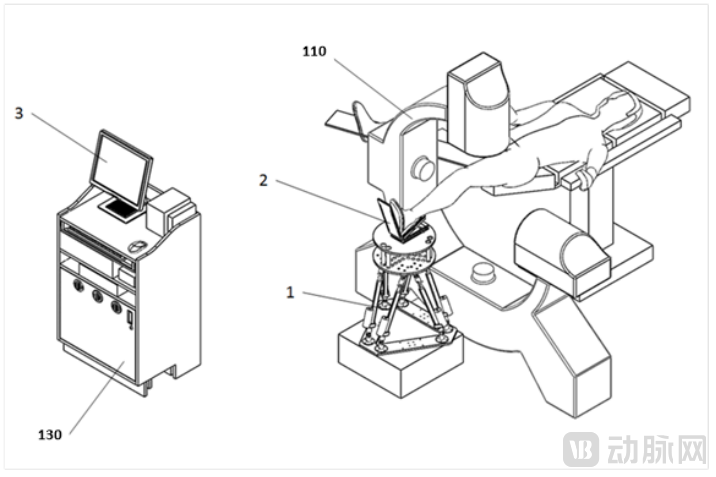 Fracture Reduction Robot System (Image source: Technology Transfer Office, Tsinghua University)
Furthermore, some research teams have focused on overcoming technical integration challenges, achieving the coexistence of CT imaging and needle insertion technologies in surgical robots.
February 21, 2024Shanghai Ruitouch TechnologyThe CT-guided percutaneous lung biopsy surgical robot, the Biopsy Navigation and Positioning System RC120, developed and manufactured by [Company Name] Co., Ltd., has received approval from the National Medical Products Administration (NMPA) for market launch. According to available data, this biopsy system is a global first with fully independent intellectual property rights.“Integrated Technology of CT Imaging and Intelligent Sensing”, not only assists physicians in rapidly planning the puncture path, but also accurately targets the lesion, effectively mitigating puncture risks.
Overall, in recent years, domestically produced surgical robots have continuously undergone technological iterations and expanded their procedural applications. Products in certain segments have achieved parity with, and in some areas even surpassed, their foreign counterparts, accelerating the pace of import substitution.