

SHANMU Biotech Files IPO Prospectus for Its Toilet-Mounted AI-Powered Medical Robot Enabling Fully Automated, Continuous, and Non-Intrusive Monitoring of Over 10 Urinary Metabolites

SHANMU
Developer of Home Medical Robots
Urine, as one of the important metabolic products of the human body, contains uric acid, urinary glucose, creatinine, glucose, urobilinogen, etc.Metabolites can reflect the status of the kidneys, urinary system, and other organs in chronic conditions, serving as critical indicators for diagnosing many diseases. They assist physicians in disease diagnosis, assessment of disease severity, and evaluation of treatment efficacy.
SHANMU (Shenzhen) Biotechnology Co., Ltd. (hereinafter referred to as “SHANMU Bio”) has developed a fully automated digital microfluidic optical sensor, roughly the size of a computer mouse, leveraging cutting-edge technologies such as digital microfluidic chipsets and proprietary AI algorithms. By analyzing metabolic components in user urine samples, the device enables timely monitoring and assessment of individual health status.
When discussing the rationale behind developing an “AI medical robot” for home health management, Lin Hequan, founder of SHANMU, reflected on his many years of studying abroad.
At the time, Lin Hequan, who had just arrived in the UK to begin his undergraduate studies, was scheduling his mandatory enrollment health examination. This appointment required a wait of more than two months. The prolonged waiting period eroded not only his energy and time but also his confidence in the quality and efficiency of medical services.
During his academic pursuits, Lin Hequan also discovered that the General Practitioner (GP) system, which has been in place for decades in Europe and the United States, plays a significant role in the efficient utilization of healthcare resources. As gatekeepers of health, GPs serve as the first point of contact for patients, providing comprehensive medical services to patient families while emphasizing preventive care, thereby reducing the need for repeated hospital visits or readmissions.
Inspired by this, Lin Hequan is exploring whether there is a way to transform the family doctor system into an AI-driven, intelligent, and hardware-based solution, thereby creating a truly futuristic model of healthcare: a fully automated, non-intrusive, and non-invasive medical robot capable of performing early disease screening, diagnosis, and nursing care for household users.
Driven by market demand, Lin Hequan joined forces with his team members, who were then pursuing their PhDs at Imperial College London, to rapidly develop a microfluidic medical robot the size of a computer mouse. This device can be installed on any type of toilet to continuously and unobtrusively monitor more than 10 urinary metabolic biomarkers.
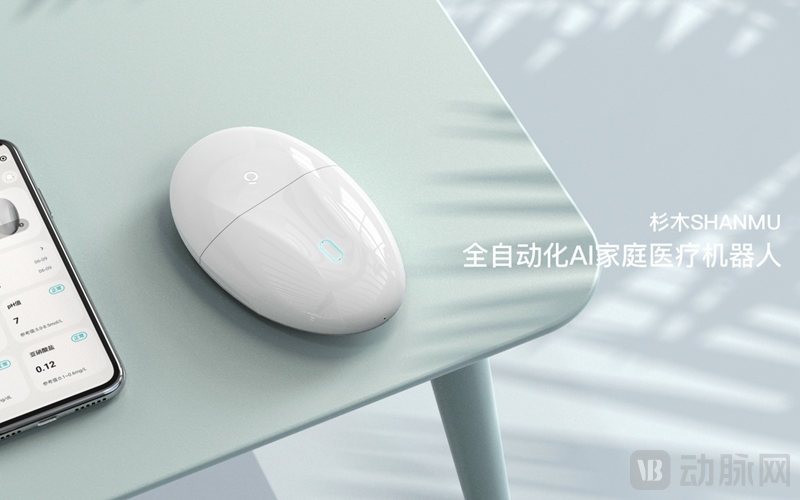
SHANMU Fully Automated Microfluidic Medical Robot
After collecting urinary metabolites, the fully automated microfluidic medical robot integrates urine molecular biomarkers with the user’s dietary habits, congenital conditions, and medical history to construct a personalized health model. By uploading this data to an app or mini-program, the system assists users in precisely managing diabetes, gout, chronic nephritis, and other renal, hepatic, and chronic diseases. It delivers high-quality, multi-dimensional healthcare services via mobile devices, including intelligent and automated disease prediction, diagnosis, medication recommendations, and health management.
SHANMU currently centers on the “AI Home Medical Robot,” from which it has expanded into multiple personalized product lines.Specifically, the inaugural product—the fully automated microfluidic sensor—offers the following key advantages:
First, the self-developed microfluidic chip enables quantitative analysis using only 1 microliter (μL) of urine per test.
At the core of the fully automated microfluidic sensor is SHANMU’s proprietary microfluidic chip set combined with a multispectral system. This sensor achieves precise liquid dispensing of 1 μL ± 5% and flow rate accuracy with a coefficient of variation (CV) ≤ 2% after uniform mixing of urine and reagents, and transmits the test results to mobile devices within 10 minutes.
Furthermore, medical robots can accurately distinguish the identities of different family members through AI algorithmic models or the Bluetooth functionality of mobile devices, intelligently match test results, and provide health status alerts for all family members.Furthermore, each reagent kit supports continuous use for over six months. Upon depletion, users can independently purchase replacement cartridges, truly enabling convenient, routine, and sustained at-home testing, thereby significantly improving user adherence and retention.
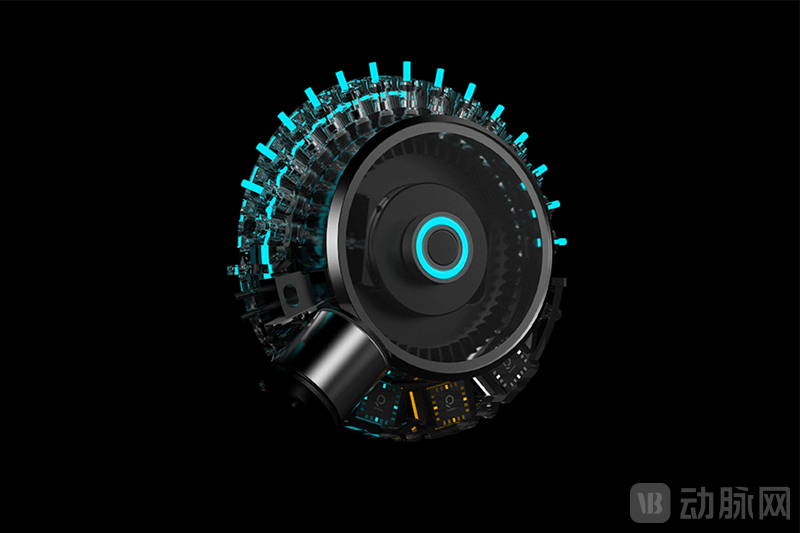
SHANMU Self-Developed Microfluidic Chip Set
The Rise of Artificial General Intelligence (AGI) Signals an Unprecedented Disruptive Revolution in the Field of Medicine.
SHANMU’s vertical AI model combined with microfluidic robotics holds potential in the AGI era that extends beyond the foresight of its technology and business model; it offers users a new perspective: a continuous, seamless, multi-disease-model approach to health management, driven by AI-based diagnosis and early screening. Users may suddenly realize, “In the age of AGI, why must we wait until disease symptoms appear before seeking medical care at hospitals? Why not entrust the health management of all family members to an AI-powered medical robot capable of analyzing and managing complex conditions?”
Following the commercial launch of its first-generation biosensors, SHANMU is collaborating with professor teams from Chinese universities to research and develop a second-generation wearable wireless sweat detection bracelet/ring. This product integrates a multi-analyte sensor array based on electrochemical sensing technology and corresponding microfluidic chipsets, primarily designed for real-time detection and analysis of biomarkers in human sweat. Biomarkers hold significant value for early disease diagnosis, prediction, treatment, and prognosis monitoring. In particular, compared to blood samples, liquid biopsy via sweat offers advantages such as ease of processing and non-invasive sampling.
In addition, SHANMU also provides solutions tailored to various populations, including individuals in a sub-health state, those requiring chronic disease management, and women seeking cyclical health and fertility management.For example, consumer-grade medical product lines for female urinary tract infections and HCG (human chorionic gonadotropin), medical-grade early screening and management series for occult-stage urine glucose and uric acid, medical-grade routine urinalysis periodic management series, as well as scenario-customized embedded module solutions.
According to research by the Zhiyan Qian Industry Research Institute, the market size of China's health management industry was RMB 288.324 billion in 2022 and RMB 154.988 billion in the first half of 2023, maintaining a compound annual growth rate (CAGR) of approximately 10%. The market size continues to expand and accelerate, driven by shifting health management concepts among modern populations and the deepening trend of population aging.
“Through collaborations with companies operating in tech-driven consumer scenarios and by leveraging overseas GP channels, SHANMU has gained strong recognition from both C-end users and B-end channels. The current order value has exceeded tens of millions of RMB,” Lin Hequan told VCBeat.
Lin Hequan continued,“Contemporary young people are just as anxious about health and disease as the elderly. The rate of abnormal findings in medical check-ups among white-collar workers in Shanghai exceeds 95%, and this proportion continues to rise as suboptimal health conditions worsen. As a pioneer brand in global AI-driven home health management, SHANMU’s primary objective for its consumer-facing (C-end) customers is to seamlessly integrate into their daily lives, secure a distinct position within their routines, embed brand and product value in consumers’ minds, and help users independently establish a virtuous cycle of health management.”
As a consumer-oriented, everyday digital healthcare solution, user acquisition cost is a critical factor influencing purchasing decisions and adherence. SHANMU’s fully automated microfluidic sensors are priced at just around RMB 1,000 per unit, with domestic prices ranging from RMB 899 to RMB 1,299 and international pricing under RMB 2,000. In contrast to conventional tests abroad that often cost tens or even hundreds of U.S. dollars, the company will leverage its highly cost-competitive innovative products to enter and further expand its presence in the global health management market.
As an innovative enterprise leading in a new track, SHANMU, founded in 2021, currently holds 47 disclosed patents and approximately 70 undisclosed patents, totaling over 100 patents, 60% of which are invention patents.
Behind these innovations lies the nurturing and incubation by the founding team. Seventy percent of SHANMU’s core team members hold master’s or doctoral degrees from prestigious universities both in China and abroad, including UCLA, Tsinghua University, Fudan University, the University of Manchester, and Georgia Tech. The founder, Lin Hequan, is a post-90s returnee with a master’s degree. He earned his bachelor’s and master’s degrees in Economic Mathematics in the United Kingdom. Lin previously founded a mobile internet company and led a bionic robotics project. His fully automated microfluidic sensor project earned him a spot on the 2022 Shenzhen U30 list (recognizing 30 entrepreneurs under the age of 30 in Shenzhen) and recognition as a high-level talent in Hangzhou, among other honors.
From the perspective of capital support, SHANMU has successively completed multiple rounds of financing amounting to tens of millions of yuan. Its investors include well-known domestic investment institutions such as Qifu Capital and Haofang Venture Capital, as well as Narwal Intelligence. The company has also established preliminary collaborations with leading domestic IoT, smart elderly care, and smart bathroom enterprises, providing them with whole-home smart customization solutions and health and wellness solutions. Through the channels of these IoT partners, its products have entered thousands of stores across hundreds of cities and regions nationwide in China.
At the conclusion of the interview, Lin Hequan stated, “Digital health management and medical care should begin with a non-intrusive approach to users. In the era of Artificial General Intelligence (AGI), fully automated, seamless, and continuous healthcare services tailored for home use will become mainstream products in the future market. The company plans to complete the National Class II Medical Device Certification for its products within 2024, along with launching the second generation of wearable wireless sweat detection bracelets/rings featuring multi-indicator sensor arrays based on electrochemical sensing technology. Additionally, 2024 marks the inaugural year of SHANMU’s global expansion. The company will initially target the more mature health management markets in Europe and North America. Beyond obtaining medical device certifications such as FDA and CE approvals, SHANMU will rapidly penetrate overseas markets and enhance brand visibility through participation in trade shows and physical store exhibitions, engagement in international crowdfunding campaigns, and collaborations with foreign hospitals, thereby improving user awareness of its medical robotics products.”