

China's Rehabilitation Medical Device Sector Exports Surpass $94 Billion, Dominating 90% of U.S. Market
Imported brands account for 90% of the domestic market, a statistic that is common in the medical device sector. However, the situation is precisely the opposite in the field of rehabilitation equipment; for instance, 90% of rehabilitation aids used in the United States are sourced from China.
Rehabilitation equipment is the mainstay of China’s medical device exports. According to data from the China Chamber of Commerce for Import and Export of Medicines and Health Products, China’s export value of health and rehabilitation products reached USD 9.436 billion (exceeding RMB 67 billion) in 2023. Data from Frost & Sullivan shows that the market size of China’s rehabilitation medical device industry was RMB 45.03 billion in 2021, indicating that the export market size of rehabilitation equipment has become comparable to its domestic market size.
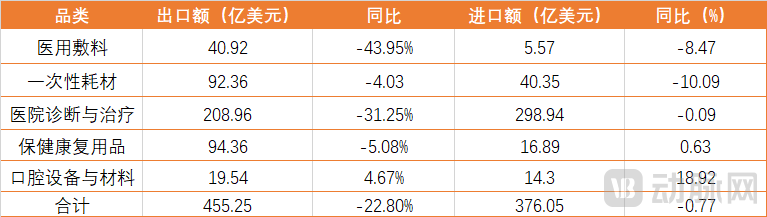
2023 Statistics on China’s Import and Export of Medical Device ProductsData Source: China Chamber of Commerce for Import and Export of Medicines and Health Products
Multiple Chinese companies have already seized this lucrative market. For instance, Kaiyang Medical achieves annual overseas sales of rehabilitation equipment exceeding RMB 200 million; Jumaoyi Medical has become a long-term manufacturing supplier for globally renowned rehabilitation companies such as INVACARE, Drive Medical, and MEDLINE in the United States, relying on its CDMO business for rehabilitation devices; Jinhaoyi Medical, a company specializing in rehabilitation and home-use medical devices, is listed on the Beijing Stock Exchange, with overseas sales accounting for more than 80% of its total revenue.
Currently, global expansion is the focal point of the industry. Over the past three decades, China’s medical device industry has experienced rapid growth, significantly increasing its share of the domestic market. Driven by factors such as the implementation of centralized volume-based procurement and Diagnosis-Related Group (DRG) payment policies, along with fluctuations in the industry cycle, exploring new markets and establishing an overseas presence have become imperative for medical device companies. The nature of Chinese medical device companies’ global expansion is also evolving: while it previously focused primarily on low-value consumables, the export of high-value medical devices has seen accelerated growth in recent years.
How Can Rehabilitation Equipment Manufacturers Achieve Sustained Growth in Overseas Markets? What Insights Can the Global Expansion of Rehabilitation Medical Devices Offer to China’s Medical Device Industry?
Which countries are Chinese rehabilitation devices exported to? According to customs statistics, the United States, Japan, the United Kingdom, and Germany are the primary markets for Chinese rehabilitation device exports.
When selecting overseas markets, market size is the primary consideration for Chinese companies. Meanwhile, the degree of population aging is a key factor influencing the market size of rehabilitation devices.
The global population has entered an aging phase, with the proportion of people aged 65 and older worldwide exceeding 7% in 2022, indicating a stage of mild aging. Europe and North America exhibit higher degrees of aging, with the proportion of the population aged 60 and older reaching 26.3% and 23.7%, respectively. Countries experiencing mild aging are primarily distributed across Asia and South America; those with moderate aging are largely found in North America and other regions; while countries with severe aging are predominantly located in Europe. Japan has become one of the most severely aged nations globally.
Countries and regions with high levels of aging populations and well-developed rehabilitation industries, such as the United States, Japan, and the European Union, are the primary initial destinations for Chinese rehabilitation medical device manufacturers expanding into overseas markets.
Although aging populations are significant across the board, market conditions vary from country to country. How should rehabilitation equipment manufacturers differentiate their global expansion strategies? An industry insider stated, “Countries differ in terms of demand, regulatory frameworks, and competitive landscapes. Entering different markets requires a thorough understanding of entry barriers, demand preferences, and competitive dynamics.”
The United States is the largest market for rehabilitation medical devices globally and also the top destination for China’s exports of such devices. According to customs statistics, the value of rehabilitation medical device exports to the U.S. reached RMB 10 billion in 2023.
The U.S. market is the primary choice for Chinese rehabilitation equipment manufacturers expanding overseas. First, the United States is the world’s largest market for rehabilitation devices, with more than 18,000 sports rehabilitation clinics alone. Second, the U.S. market exerts significant influence on the global stage; securing a foothold there signifies that products have met high-standard recognition, thereby facilitating entry into other international markets.
The barrier to entry for the U.S. market lies in registration qualifications; the FDA imposes stricter requirements on medical devices marketed in the United States, and overall, the FDA approval rate is not high.
Regarding product preferences, the head of overseas markets at Siyi Intelligence, a domestic rehabilitation robotics company, stated: “Unlike in the United States, the domestic market has different demands. When promoting rehabilitation medical devices in China, B-end customers are more concerned with how rehabilitation therapy equipment can free up hands and labor, allowing therapists to conduct more training sessions; whereas in developed countries with advanced rehabilitation industries overseas, customers focus more on how therapists should utilize the equipment, paying attention to technical principles, individual feedback differences, changes in treatment cycles, academic performance, and other aspects.Differing preferences stem from industrial disparities: the ratio of sports rehabilitation therapists in the United States is 62.8 per 100,000 people, whereas in China it is merely 2.65 per 100,000. The supply of rehabilitation service providers is more abundant in the United States, while China faces a significant shortage, leading to divergent market preferences.”
In addition to expanding into the U.S. market, Chinese rehabilitation equipment manufacturers are also focusing primarily on Japan, Germany, the United Kingdom, and Australia as key overseas markets.
From the perspective of industry insiders, the Japanese and German markets are characterized by high entry barriers. Both markets have well-developed rehabilitation industries, making it considerably challenging for Chinese rehabilitation companies to enter. Japan entered the aging society phase earlier than most countries and pioneered the development of its elderly care and rehabilitation industry. The Japanese market for rehabilitation assistive devices is valued at approximately ¥1.76 trillion, with more stringent and detailed requirements for rehabilitation and elderly care products.
An industry insider cited an example: even for simple wheelchair transportation, Japanese clients are highly particular about the fabric of patient transfer slings and every handle and component of the wheelchair. Product design must consider not only the needs of users but also those of caregivers.
The barrier to entry in the German market stems from its highly developed domestic rehabilitation industry. Germany boasts a wide array of rehabilitation modalities and multidisciplinary rehabilitation teams, as well as a robust medical device sector for rehabilitation equipment, making it significantly more challenging for Chinese enterprises to enter the market.
The Russian market witnessed the most significant changes among overseas markets in 2023. According to export data from the China Chamber of Commerce for Import and Export of Medicines and Health Products, the value of China’s medical device exports to Russia reached USD 1.732 billion in 2023, representing a year-on-year increase of 24.01%. Rehabilitation and healthcare devices emerged as a popular export category to Russia, with an export value of USD 140 million in 2023, marking a substantial year-on-year growth of 75.4%. The Russian market relies heavily on imports for high-end medical devices. Amidst the complex geopolitical situation, this has created opportunities for Chinese companies and their products to enter the Russian market.
In addition to mature markets, domestic enterprises should also pay attention to the Southeast Asian market. Although the rehabilitation market in Southeast Asia is still in its early stages, it has strong growth potential and development prospects, and the threshold for domestic enterprises to enter the Southeast Asian market is relatively low.
Expanding Overseas Is Not Smooth Sailing: What Challenges Must Rehabilitation Device Manufacturers Address When Going Global?
An industry insider stated, “The pain points of global expansion are evident in every aspect, including market access qualifications, product portfolios, sales channels, logistics and transportation, and after-sales service.”
The primary challenge lies in regulatory qualifications, as the stringency of requirements for the same product varies across different countries and regions, necessitating distinct certification credentials for market entry in each jurisdiction. As medical device registration regulations become increasingly stringent worldwide, Chinese medical device exports face significant hurdles. In response, domestic enterprises are placing greater emphasis on overseas regulatory registrations and continuously increasing their investments in securing international market access.
Next are the supply chain challenges brought about by logistics and transportation. The complexity of global supply chains has increased. The longer lead times for transportation and logistics also create pressure on inventory and capital.
In terms of sales channels, Chinese companies currently rely primarily on partnerships with overseas distributors, who then sell to downstream customers. Additionally, original equipment manufacturing (OEM) serves as another avenue for international expansion. For instance, Jiangsu Juma Medical, a top-ten exporter of home healthcare and rehabilitation products in China, specializes in the research, development, and production of rehabilitation medical devices such as wheelchairs, four-wheeled walkers, and oxygen concentrators. The company maintains long-term partnerships with U.S.-based firms including Invacare, Drive Medical, and MEDLINE.
Furthermore, cultural and linguistic differences pose a significant challenge. Given the substantial cultural variations across different countries and regions, it is essential to thoroughly understand the cultural characteristics of target markets during global expansion. For instance, Europe comprises a multicultural landscape, requiring enterprises to accommodate diverse cultural nuances.
Medical device application scenarios are complex, and after-sales service presents a significant challenge. Due to the unique product structure and specific usage contexts of rehabilitation therapy equipment, the requirements for after-sales service are even more stringent.
SiYi Intelligence shared the after-sales challenges encountered in its global expansion: “Many of our products have obtained multiple internationally recognized certifications, including FDA approval in the United States and CE marking in the European Union. We have sold our products to more than 80 countries and regions worldwide, entering over 4,000 medical institutions. During our sales on Amazon, we found that under Amazon’s return policy, customers can directly return products upon receipt. However, many such returns are not due to quality issues but rather because users did not receive proper guidance. Geographic barriers prevent us from communicating with users in a timely manner, hindering the establishment of long-term, in-depth relationships with customers.”
“Failure to address after-sales issues also hinders the implementation of our proactive rehabilitation philosophy. We have always emphasized that rehabilitation should be proactive rather than passive. In China, we have designed relevant courses and services based on this proactive rehabilitation concept to enhance therapeutic outcomes. Extending our integrated ‘product + service’ solutions to overseas markets also presents a significant challenge.”
Of course, none of the above issues can be resolved in the short term; breakthroughs require long-term investment and accumulation. Domestic enterprises need to strengthen their internal global expansion frameworks, refine their products and solutions, and then select appropriate overseas expansion models.
There is still significant room for growth for domestic rehabilitation equipment manufacturers expanding into overseas markets. Although the current scale of rehabilitation equipment exports exceeds RMB 60 billion., but overseas exports are dominated by rehabilitation aids, leaving significant room for growth in the export of rehabilitation equipment.
Rehabilitation equipment can be categorized into rehabilitation medical devices, rehabilitation education equipment, and rehabilitation assistive devices, based on their respective fields of application. Among these, rehabilitation medical devices constitute the primary component of rehabilitation equipment; they are medical devices used in rehabilitation medicine for functional assessment, training, and therapy, effectively improving or restoring patient function.
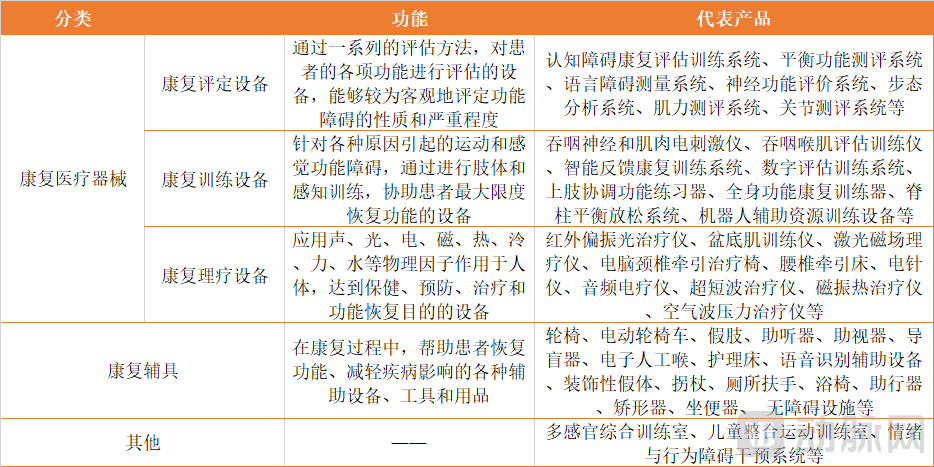
Among these three categories of medical devices, rehabilitation assistive devices are the primary drivers of overseas expansion. The main export products include electric wheelchairs, walkers, hospital beds, crutches, and other assistive devices, which generally have relatively low unit prices. In contrast, rehabilitation medical equipment commands higher unit prices and is often sold as part of comprehensive solutions. The overseas expansion of rehabilitation medical equipment will further increase the overall scale of China’s rehabilitation device exports.
In the face of a vast overseas market, Chinese rehabilitation equipment companies are expanding their global footprint. After years of technological accumulation, many domestic players in this sector now offer comprehensive and diverse product portfolios. Major companies include Xiangyu Medical, Vishee Medical, MaiLande, Pumen Technology, and Longzhijie. VCBeat has observed that these enterprises have recently made international expansion a key strategic priority.
Xiangyu Medical has obtained market access certifications for multiple products abroad and has formulated an accelerated “global expansion strategy.” The company has established a dedicated regulatory affairs department to focus on CE and FDA certifications, with plans to secure approvals for additional products in succession. Vishee Medical has proactively advanced its regulatory strategy, with its body contouring magnetic stimulation and pelvic floor magnetic stimulation products already receiving FDA clearance. Longzhijie’s export revenue exceeded RMB 30 million in 2022. Mailande has been progressively pursuing CE certification as well as regulatory approvals in Thailand and the United Kingdom throughout 2023. Anjielai, a domestic rehabilitation robotics enterprise, has set up an overseas business division in Seattle, USA, responsible for FDA submissions and CE marking in Europe, as well as international market promotion.
Both in overseas and domestic markets, the industrial landscape of the rehabilitation equipment sector remains highly fragmented, with numerous industry participants and a proliferation of small and medium-sized enterprises. In terms of competitive dynamics, the global rehabilitation medical device market exhibits low concentration. Major global players include Medline (US), Enovis (including DJO, US), Invacare (US), BTL (UK), OG Wellness (Japan), and Panasonic Health Care (Japan). Among these, the combined revenue of the two leaders, Enovis and Invacare, is estimated to account for approximately 15% of the industry total.
The fragmented market landscape has also lowered the barriers for domestic companies to enter foreign markets. Moreover, rehabilitation devices possess inherent advantages for international expansion; compared with other medical devices, they carry lower usage risks. It is foreseeable that as leading Chinese companies significantly expand their overseas presence, the global market for Chinese rehabilitation devices will achieve both scale expansion and quality improvement.
It is worth noting that Chinese-made rehabilitation assistive devices have gained widespread recognition in overseas markets, relying on robust manufacturing capabilities and cost-effectiveness. However, for rehabilitation medical devices, overseas markets impose higher requirements for localization. Expanding abroad necessitates building deeper and more enduring connections with local governments, hospitals, therapists, and patients. In addition to cost-effectiveness, rehabilitation medical devices face higher demands for technological leadership and innovation. Consequently, the path for Chinese rehabilitation device manufacturers to expand into overseas markets remains long.
References:
Deep Insights | From “Bringing In” to “Going Global”: Where Lies the Path Forward? A Preliminary Exploration of the Success Strategies for Chinese Medical Device Companies Expanding Overseas – Roland Berger Management Consulting
Nearly 100 Million Yuan in Series A Funding: How Does Mai Deshi Break the Profitability Dilemma of Home Rehabilitation Medical Devices for the Elderly Through “Brand Globalization”? —— AgeClub
CCCMHPIE Exclusive: Pharmaceutical Exports See Slower Decline in 2023 — Pharmaceutical Economic News