

Deep Longevity Files for IPO: Pioneering Multi-Modal Aging Biomarker Platform Backed by AI
On September 2, 2020, Shoukang Group announced that it had entered into a legally binding share purchase agreement with Deep Longevity to fully acquire the company for approximately $3.79 million by issuing around 4.2269 million consideration shares. Upon completion of the transaction, Deep Longevity will become a wholly-owned subsidiary of the company.
After three years, Deep Longevity has become a highly renowned star enterprise in the anti-aging sector. Notably, it is not a foreign company but a Chinese medical enterprise headquartered in Hong Kong.
Looking back to July 15, 2020, Deep Longevity announced its spin-off from its parent company, Insilico Medicine, to become an independent subsidiary, marking the beginning of its rise to prominence.
Concurrently with its spin-off, the company completed its Series A financing round. This round garnered support from numerous globally renowned investment institutions, led by ETP Ventures and the Human Longevity and Performance Impact Venture Fund (HLPIVF), an early-stage venture capital fund focused on the longevity industry. It also attracted some of the most distinguished U.S. biotechnology investors featured on Forbes’ list of the World’s Best Venture Capitalists.
Deep Longevity achieved three major milestones within just one year: spinning out from Insilico Medicine, completing its Series A financing round, and being acquired by Shoukang Group.
Since then, Deep Longevity has been dedicated to developing aging biomarkers using deep learning technologies, with a commitment to enhancing human healthspan through artificial intelligence (AI).Its greatest achievement lies in the development of five major aging clocks for aging detection.Its aging detection method is comprehensive, covering aspects such as blood, DNA, microbiome, and psychological surveys, and it is considered a leading enterprise in the development of deep biomarkers for aging.
Dr. Alex Zhavoronkov, Founder and Chief Longevity Officer of Deep Longevity, is also the Founder and CEO of Insilico Medicine. Under his leadership, Insilico Medicine has raised over $400 million across multiple funding rounds, established R&D centers in six countries or regions, and nominated eight preclinical candidate drugs.
Since 2012, he has published more than 160 peer-reviewed research papers, founded the largest aging research event in the global pharmaceutical industry—the Annual Forum on Aging Research, Drug Discovery, and Artificial Intelligence (held for the ninth time in 2022)—and serves as its co-chair. Notably, Alex Zhavoronkov is also an Adjunct Professor of Artificial Intelligence at the Buck Institute for Research on Aging.
Alex Zhavoronkov pioneered the application of deep learning techniques to predict human biological age using diverse data types, encompassing transfer learning from aging to disease, target identification, and signaling pathway modeling. He has achieved remarkable accomplishments in the fields of Generative Adversarial Networks (GANs) and Reinforcement Learning (RL), with profound expertise in artificial intelligence and neural networks, and is recognized as one of the earliest scholars to adopt AI in the biopharmaceutical and anti-aging sectors.
This has given Deep Longevity an inherent and distinctive identity in the “deep integration of artificial intelligence and anti-aging services,” successfully migrating anti-aging services to cloud networks, with SenoClock serving as the most typical testament.
SenoClock is an AI-powered aging clock platform developed by Deep Longevity. It integrates and centrally manages all aging clocks developed by Deep Longevity. By analyzing standard blood test reports, psychological questionnaires, and epigenetic data, SenoClock predicts an individual’s biological age and potential aging risks. Furthermore, it provides personalized recommendations to improve biological age based on the individual’s aging status.
SenoClock leverages the company’s proprietary technology to generate age prediction reports within minutes. These reports enable users to identify which biomarkers have the greatest impact on their health, determine which organs require focused attention, and understand their optimal achievable biological age. Furthermore, the platform is highly scalable, accommodating varying scales and needs, and can serve anywhere from dozens to tens of thousands of users.
Among the five aging clocks developed by Deep Longevity, the Mind Age Clock is perhaps the most noteworthy.
This is an aging clock focused on psychological states.Compared with the many existing clocks that assess aging from a physiological perspective, Deep Longevity’s approach to predicting and intervening in the degree of aging from a psychological dimension is truly refreshing.
Mind Age Clock is an aging clock developed by Deep Longevity that estimates psychological or lifestyle age based on psychological and lifestyle questionnaires, with a focus on an individual’s perception of time. This perception is a subjective experience that varies from person to person, influenced by factors such as age, cultural background, personality, and life experiences, and it affects an individual’s behavior, emotions, and overall health. Research by Deep Longevity indicates that poor mental health accelerates aging more significantly than smoking, whereas a positive attitude and good mental health are associated with higher work productivity and longevity.
This clock is a trained deep learning model composed of three core components: deep neural networks, self-organizing maps, and clustering algorithms. It analyzes psychological trends associated with aging by exchanging outputs among these components, predicts users’ mental health risks and future mental health status, and determines the optimal course of action based on each user’s background. This facilitates understanding and tracking of the aging process from cognitive and emotional perspectives, enabling timely interventions.
Deep Longevity has developed tool models related to the Mind Age Clock by applying deep learning algorithms to process thousands of psychological profiles obtained from public sources such as MIDUS and NHANES, and delivers specific services through FuturSelf.AI.
FuturSelf is an artificial intelligence model of human psychology developed by Deep Longevity, which utilizes the publicly available longitudinal dataset MIDUS to identify the variables that have the greatest impact on future well-being and psychological age. The company leveraged these data to build a deep neural network capable of predicting future values for the six parameters of the Ryff Scales of Psychological Well-Being. It then employed self-organizing maps to categorize individuals into distinct psychological types and to determine the variables that enhance future well-being for each type.
Currently, FuturSelf has 30,000 users. The company has collected tens of thousands of psychological profiles through the platform and used this data to refine and optimize the Mind Age Clock model.
In terms of specific prediction and intervention methods, the Mind Age Clock combines self-assessment surveys with cognitive tests to measure mental age. User responses can be collected via online platforms, face-to-face interviews, telephone calls/contact centers, or printed forms. Artificial intelligence algorithms analyze the psychological test questionnaires completed by users to assess their current mental health status, compare their mental age with their chronological age, and identify individual needs.
Deep Longevity has also collaborated with licensed psychologists to create a database containing recommendations tailored to each psychological profile, as defined by neural networks. The recommendations provided by the recommendation engine, which include time management training, mindfulness practices, and cognitive behavioral therapy, take into account and respect users’ psychological age and psychological test results. All recommendations are authored by licensed psychologists and reviewed by the development team.
Meanwhile, Deep Longevity’s personalized algorithms can scale to millions of users while actively avoiding stereotypes. For instance, interventions for younger individuals may focus on cultivating coping skills and building resilience, whereas those for older adults may prioritize maintaining cognitive function and supporting healthy aging.
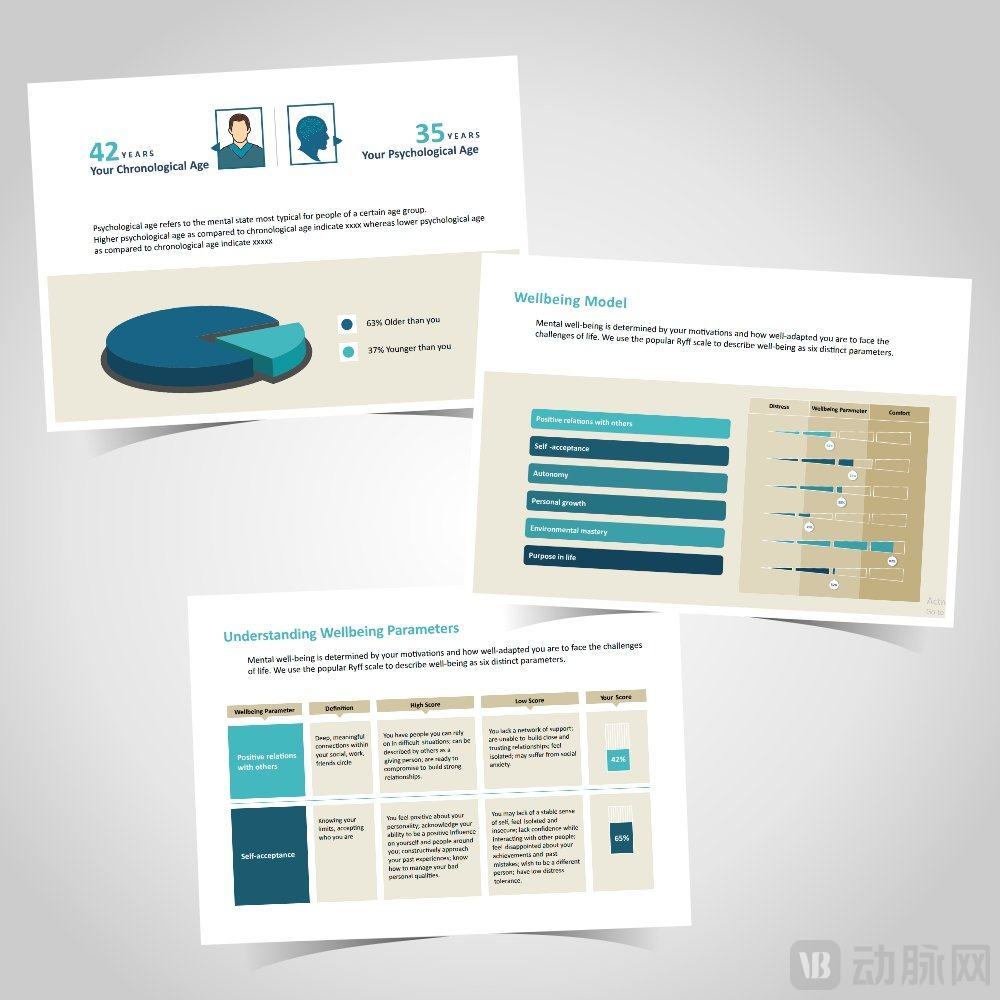
Mind Age Core Health Parameters Report
To help users better adhere to intervention recommendations, Deep Longevity can also provide personalized content based on individual circumstances, such as offering relevant prompts during implementation or reminding users to maintain consistency. Furthermore, Mind Age Clock will conduct repeated assessments to track user progress and adjust intervention plans accordingly. Currently, the application scenarios for Mind Age Clock encompass hospitals, enterprises, insurance companies, and psychological clinics.
In addition to the Mind Age Clock, which focuses on biological mental age, Deep Longevity’s aging clocks also include the Blood Age Clock, the Epigenetic Clock, and the Microbiome Clock. These respectively reflect the relationship between an individual’s blood biochemical parameters, DNA methylation levels, and gut health status with aging.
Blood Age Clock is an aging clock developed to predict biological age using routine clinical blood reports. It works by analyzing 45 blood biomarkers from clinical blood reports, such as complete blood count, minerals, proteins, cholesterol, and glucose, to predict a "blood age" that reflects the user's overall health status, thereby enabling understanding and tracking of the aging process at the cellular level.
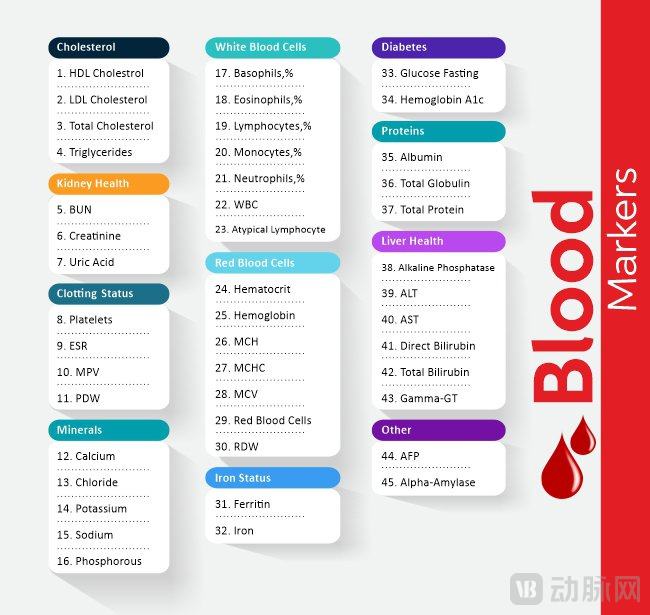
List of Biomarkers Analyzable by the Blood Age Clock
In the blood summary report, Deep Longevity outlines which blood biomarkers are promoting or resisting aging, identifies the user’s current aging status, determines which blood indicators have the greatest impact on the aging process, estimates mortality risk based on current health conditions, identifies potential health threat factors, precisely measures biological age, and provides personalized recommendations. Additionally, this clock can track changes in blood age over time and monitor the effectiveness of interventions.
In numerous peer-reviewed academic studies on aging, the Blood Age Clock has been shown to be a better predictor of mortality than chronological age in Asian, European, and North American populations.
To enhance the accuracy of the Blood Age Clock, Deep Longevity has also developed several digital models to analyze blood test data within the context of aging. These models were trained on hundreds of thousands of historical patient records until they acquired the capability to interpret biomarkers in the context of aging.
Specifically, the Blood Age Clock first generates numerous virtual blood samples that are similar to, yet slightly different from, the original blood sample based on the user’s submitted blood test results. These samples represent potential variations in various biomarkers within the user’s blood. It then employs an algorithm known as “particle swarm optimization” to identify a combination of blood biochemical indicators that maximizes the improvement in biological age. Finally, drawing from a curated database, it recommends evidence-based interventions to help users achieve an optimal biomarker profile, thereby reducing biological age and enhancing overall health.
Deep Longevity’s exploration of blood-based biomarkers extends beyond the Blood Age Clock. Its other aging clock, the Biometrics Age Clock, utilizes 17 blood biomarkers and four biometric parameters to measure biological age. Users need only answer a few health-related questions and upload their blood test reports to receive a personalized biological age report along with tailored recommendations for promoting health and longevity.
Beyond blood, Deep Longevity also targets the microbiome.
Its Microbiome Age Clock, based on gut microbiome composition profiles, measures the health status and diversity of microorganisms living in and on the human body. The Microbiome Age Clock enables broader use of gut microbiome data for age prediction, with a mean absolute error of approximately 5.9 years. On July 7, 2022, Deep Longevity announced that its “Biomarkers of Aging in the Human Microbiome and Microbiome Age Clock” had been granted a patent by the United States Patent and Trademark Office.
As a leading enterprise in the anti-aging sector, Deep Longevity has also capitalized on the burgeoning field of epigenetic clock development.
DeepM Age Clock is an epigenetic aging clock developed by Deep Longevity, with a margin of error of 2.77 years. According to Deep Longevity, the DeepM Age Clock is the most accurate DNA methylation clock to date. This clock can reveal associations with cancer, dementia, obesity, and other age-related diseases.
The Science of Aging Is Becoming the Foundation of Life Insurance.
In-depth customer biometric data, personalized health plans, and highly individualized insurance premiums are converging and intertwining. Meanwhile, with advancements in sensor technology, big data, and other emerging technologies, various physiological changes in the human body can be captured as objective data through wearable devices and other non-invasive methods. This creates new opportunities for implementing continuous underwriting, while also necessitating the analysis and prediction of vast amounts of data.
In this process, the insurance industry faces new challenges: how to leverage various health parameters to create a unified model capable of identifying individual risks and apply it to mainstream underwriting to offer customized plans.
Deep Longevity’s CEO, Deepankar Nayak, pointed out that the tiered underwriting model requires medical tests such as blood tests, urine tests, and electrocardiograms based on different combinations of coverage amounts and age groups, which limits the size of the target customer base. However, aging clocks have the potential to change this predicament.
Deep Longevity offers a variety of aging clocks for health and life insurance companies to assess underwriting risks, facilitating more accurate and personalized underwriting. Citing the company’s most extensively researched blood-based biomarker, the Blood Age Clock, Deepankar Nayak explained that this tool can quantify overall health status into a single numerical value, simplify complex medical examination results, and highlight risks associated with accelerated aging. By predicting users’ physiological age using aging clocks, insurers can offer larger policies to older clients without significantly increasing premiums if their blood age indicates they are biologically younger and thus present lower risk, thereby attracting customers.
By leveraging aging clocks, insurance companies are poised to better understand and assess age-related health risks of their customers, potentially enabling them to tailor insurance policies to more effectively meet client needs. With the aid of aging clocks, insurers can re-evaluate the health status of policyholders at each annual renewal, adjusting premiums or coverage scopes in response to changes in risk profiles. This approach offers more flexible insurance options, catering to the diverse needs of different populations.
Against the backdrop of an increasingly aging population and a significant rise in lifestyle- and behavior-related diseases,Leveraging aging clocks for proactive health management may enable insurance companies to achieve better investment return models.
As a company focused on aging detection, Deep Longevity has attracted significant attention in the anti-aging sector. Beyond benefiting from the reputation of its parent companies, Insilico Medicine and Shoukang Group, its prominence is primarily driven by its outstanding achievements in the field of aging biomarkers.
Compared with other companies in this sector, Deep Longevity has not adopted the “testing + intervention” business model; instead, it focuses on the testing of aging biomarkers., and has developed five major aging clocks for predicting biological age. With multi-dimensional detection covering blood biomarkers, DNA methylation, gut microbiota, and mental health, its comprehensive and holistic approach to aging assessment is rare in the current landscape.
Notably, in the realm of aging assessment, the company has placed particular emphasis on predicting the biological age of the mind.。
In the field of aging biomarker testing, most participating companies focus on age-related changes in physiological dimensions such as the genome, telomeres, proteins, mitochondrial function, and cells, while mental age appears to have received insufficient attention. However, psychological age and mental health are closely linked to longevity. The discrepancy between one’s biological mental age and chronological age can influence emotions, behaviors, health status, and lifespan, and may even increase the risk of developing certain age-related diseases.
Deep Longevity has capitalized on this insight by developing a specialized aging clock, the Mind Age Clock, to measure mental age—a key factor that has enabled it to stand out among anti-aging companies.
Meanwhile, Deep Longevity is also highly favored by its partners. Its collaborators span various industries, including Qatar Insurance Company (QIC-DVP), a leading insurance provider in Qatar and the Middle East and North Africa (MENA) region; Ani Biome, a pioneering BioAgeTech company at the forefront of longevity science; and Garner Industries, a leading industrial company with over 70 years of history.
Bolstered by a powerful parent company, strong investor interest, a steady stream of strategic partners, and an impressive patent portfolio, Deep Longevity is seen as having the potential to become a unicorn in the global anti-aging industry. Can it sustain its competitive edge, break through the pack, and lead the next wave of innovation in anti-aging? Only time will tell.