

China's 'Post-2020' Biotechs Lead Record-Breaking Surge in Innovative Drug Outbound Licensing, Up 260% in Early 2024
Hengrui Pharma
Innovative and High-Quality Pharmaceutical Developer
In 2024, the out-licensing of innovative drugs continued with unmistakable vigor, with recent data indicating that transaction momentum has surpassed that of 2023.
According to data from Meibo Capital, China’s pharmaceutical business development (BD) transactions got off to a strong start in January 2024, with a total of 30 deals; among them, there were 18 license-out transactions, representing a 260% increase compared to the five deals recorded in January 2023.
And in 2023, according to VCBeat New Medicine"2023 China Pharmaceutical Company BD Report"Statistics show that the total value of business development (BD) transactions among Chinese pharmaceutical companies has reached a new high, with license-out deals emerging as the primary focus and resulting in numerous large-scale transactions.
Meanwhile, a cohort of companies has emerged as active players in license-out transactions, securing multiple out-licensing agreements within a year and setting a benchmark for the global expansion of innovative drugs.
Going global has become a mandatory option for innovative drugs.
In early 2024, institutions such as Guosheng Capital, Legend Capital, and CDH VGC all emphasized the importance of global expansion for innovative drugs in interviews with VCBeat: going global is an imperative path, as only by entering international markets can the value of pharmaceuticals be maximized to fill higher-level clinical and commercial gaps; projects lacking significant business development (BD) deals or global expansion potential have no future; in the long run, a large volume of BD transactions for innovative drugs will have a positive impact on China’s domestic innovation ecosystem, and Chinese innovative drugs will gradually enhance their global influence.
According to incomplete statistics from VCBeat, since January 2023, a total of 13 companies have licensed out multiple products (concluding deals for two or more products), emerging as an active cohort in the global expansion of innovative drugs.
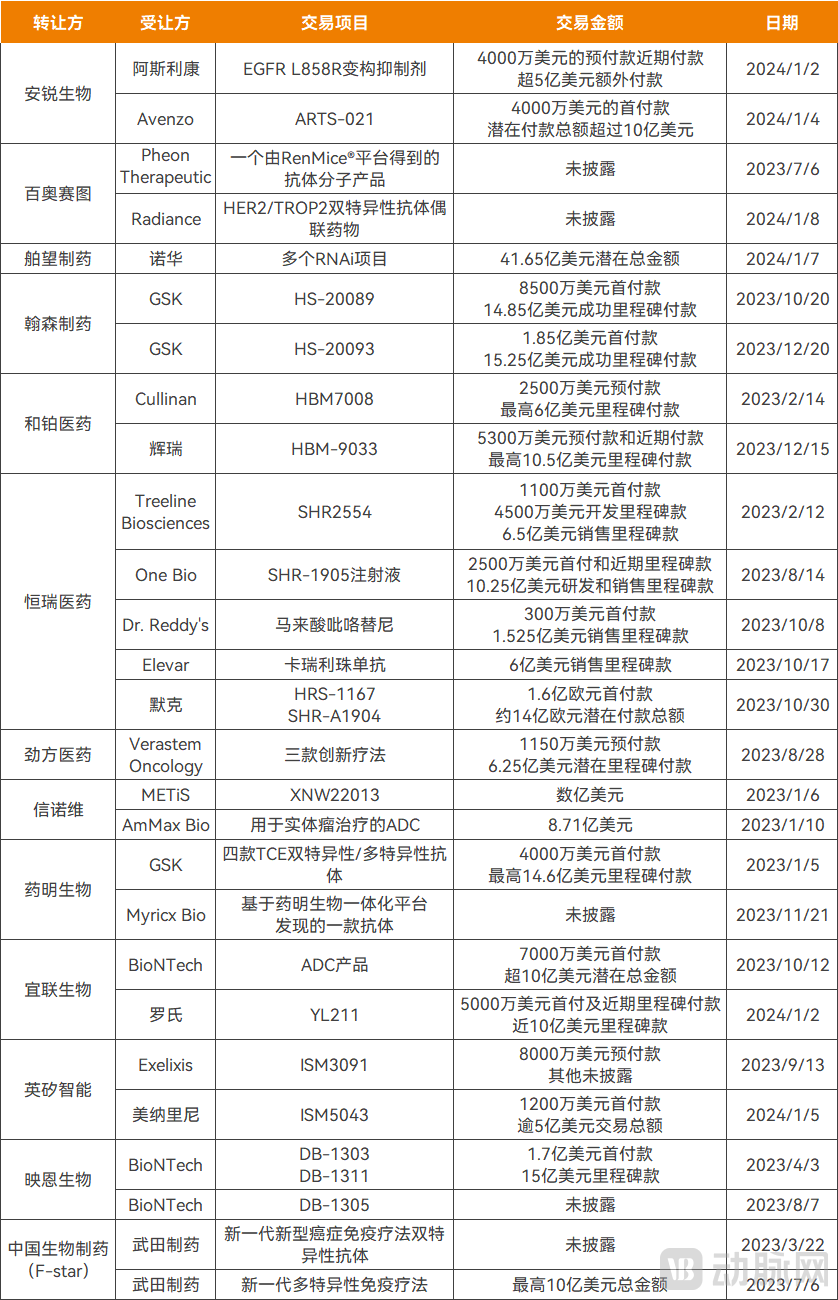
Selected Companies That Have Completed License-Out Deals for Multiple Products in the Past Year. Data sources: VCBeat New Medicine’s “2023 China Pharmaceutical Company BD Report” and publicly available corporate information; chart compiled by VCBeat.
In 2023, Hengrui Pharma hit the accelerator on its business development (BD) activities. From initiating the first out-licensing deal of the year with its innovative EZH2 inhibitor SHR2554 to reaching an agreement with Merck valued at up to €1.4 billion, the company completed five overseas BD licensing deals within the year. In October alone, it secured three consecutive license-out transactions and partnered with a major global multinational corporation for the first time. The total value of Hengrui Pharma’s BD transactions exceeded $4 billion in 2023.
To date, Hengrui Pharma has secured overseas licensing deals for 10 innovative drugs; in addition to its independent international expansion, license-out transactions have become a key pathway for the company’s global outreach.
In 2023, Sinocelltech also completed two license-out deals within a single month, entering into a global exclusive licensing agreement with METiS for its SOS1 inhibitor program, and securing an exclusive agreement with AmMax for the global research, development, and commercialization rights (excluding Greater China) of an innovative antibody-drug conjugate (ADC) for the treatment of solid tumors.
Leveraging its robust product data and strong out-licensing capabilities, Xinnuowei has become one of the companies with the highest number of license-out deals in China’s biopharmaceutical sector.
In January 2024, Insilico Medicine entered into an out-licensing agreement with Menarini, granting Menarini exclusive global rights to develop and commercialize a KAT6 small-molecule inhibitor independently developed by Insilico Medicine. This marked Insilico Medicine’s second international licensing deal within three months. The collaboration follows the September 2023 out-licensing of Insilico Medicine’s USP1 small-molecule inhibitor to Exelixis, a Nasdaq-listed company, for an upfront payment of $80 million, representing another successful external licensing of its internally developed pipeline.
Furthermore, in August 2023, GenFleet Therapeutics entered into a strategic licensing agreement with , covering three anti-cancer drug candidates, including GFH375 (a KRAS G12D inhibitor).
Based on the disclosed figures, the total potential value of transactions involving these 13 companies reached $23.1 billion, accounting for more than half of the total potential value of all license-out deals. This underscores the pivotal role played by active enterprises in the overseas license-out of innovative drugs from China.
Among companies actively generating license-out deals, several post-2020 startups have emerged as prominent players, including Antengene, Yilian Biopharma, Bowang Pharma, and Duality Biologics, each having secured multiple outward licensing agreements with significant industry impact.
On January 2, 2024, Allist Pharmaceuticals and AstraZeneca entered into an exclusive option and global license agreement to develop and commercialize a novel allosteric inhibitor targeting the epidermal growth factor receptor (EGFR) L858R mutation, as a potential new therapy for advanced EGFR-mutated non-small cell lung cancer (NSCLC). Under the terms of the agreement, Allist Pharmaceuticals will receive upfront and near-term payments totaling up to $40 million. Additionally, based on research and development milestones and commercialization milestones achieved by the collaborative project, Allist Pharmaceuticals is entitled to receive more than $500 million in additional payments, as well as tiered royalties on global net sales.
On January 4, two days later, Anrui Biopharma announced that it had entered into a transfer agreement with Avenzo: Avenzo will obtain the global (excluding Greater China) development and commercialization rights to ARTS-021 (Avenzo code: AVZO-021), a potential best-in-class selective cyclin-dependent kinase 2 (CDK2) inhibitor independently developed by Anrui Biopharma, as well as an exclusive option for a preclinical candidate scheduled to submit an Investigational New Drug (IND) application in early 2025. Anrui Biopharma will receive a $40 million upfront payment, additional payments upon the achievement of R&D and commercial milestones, and tiered royalties on sales. The total potential payments for the two projects are expected to exceed $1 billion.
The company, founded in 2020, has consecutively announced two major deals, setting a strong start for Chinese-made innovative drugs going global in 2024.
Bowang Pharma is particularly young among this cohort of companies, having been established in 2021. In January 2024, Bowang Pharma entered into two exclusive licensing and collaboration agreements with Novartis.
Under the first agreement, Bowang Pharma granted Novartis an exclusive global license to develop and commercialize a Phase I clinical-stage asset; this agreement also includes a research collaboration, under which Novartis obtained an option on compounds targeting up to two cardiovascular disease therapeutic targets. Under the second agreement, Bowang Pharma granted Novartis an exclusive license outside Greater China to develop and commercialize a Phase I/IIa clinical-stage asset for the treatment of cardiovascular diseases. The total potential value of both transactions amounts to up to $4.165 billion.
Dr. Shu Dongxu, Chairman and CEO of Bowang Pharmaceuticals, stated that this marks the first major overseas licensing deal in the RNAi field for a Chinese biotechnology company.
Yilian Biopharma, founded in 2020, has also demonstrated active performance over the past year: in 2023, it granted BioNTech exclusive rights to develop, manufacture, and commercialize an ADC product within a specified scope; in early 2024, it granted Roche exclusive global rights to develop, manufacture, and commercialize the YL211 program. The potential total transaction value for each of these two deals reached $1 billion.
DualityBio, founded in 2020, licensed three products to the same company within one year.
In April 2023, DualityBiologics and BioNTech entered into an exclusive license and collaboration agreement for two antibody-drug conjugate (ADC) pipeline candidates, DB-1303 and DB-1311. The collaboration was subsequently expanded; in August 2023, DualityBiologics and BioNTech reached an agreement to collaborate on the development, manufacturing, and commercialization of a third ADC candidate, DB-1305.
In just a few short years since their establishment, these four companies have achieved remarkable success in out-licensing collaborations. The total potential value of their license-out transactions over the past year amounts to approximately $4.7 billion (equivalent to about RMB 33.737 billion). Among other companies that closed license-out deals in the past year, Yousen Jianheng and Kelan Pharma are also “post-2020” startups.
In addition to building internationalized teams and possessing strong R&D capabilities, these emerging players share another critical attribute: they have implemented comprehensive top-level strategic planning since their inception, aiming for “global first-in-class” innovation by gaining insights into the needs of multinational corporations (MNCs) and clarifying project positioning.
For example, Yilian Biopharma has targeted the global market since its inception, with its product pipeline geared toward dual filings in both China and the United States. The company simultaneously advances clinical studies domestically and internationally while establishing complementary partnerships with partners at home and abroad. Prior to initiating its license-out strategy, Yilian Biopharma had already engaged in pipeline collaborations with companies such as Zai Lab, Harbour BioMed, and Henlius.
Furthermore, Anrui Biologics has established R&D laboratories in both Boston, USA, and Guangzhou, China; Bowang Pharmaceuticals has five siRNA drugs in Phase I clinical trials and has obtained clinical trial approvals in multiple regions, including China, the United States, and Australia; DualityBiologics has built several next-generation ADC technology platforms with global intellectual property rights.
Meanwhile, these enterprises have also gained support from numerous renowned international investment institutions, securing ample resources for overseas expansion.
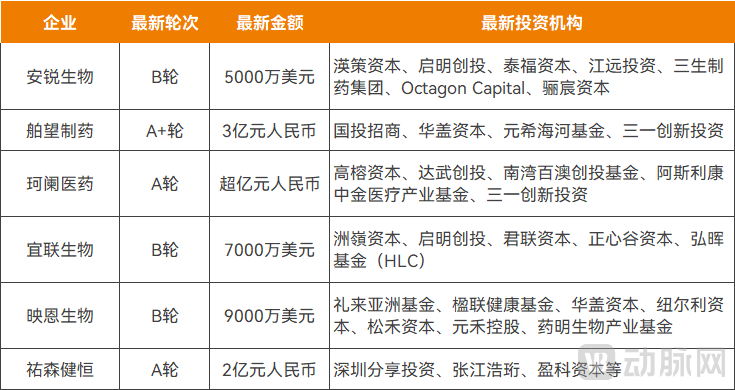
Financing Status of Select “Post-2020” Companies, Source: Artery Orange Database
Overall, companies founded in the 2020s are emerging as a significant force in the wave of license-out deals, driven by their robust innovative vitality.
ADCs have undoubtedly been the hottest topic in license-out deals since 2023.
According to VCBeat New Medicine"2023 China Pharmaceutical Companies BD Report"According to statistics, among the top ten license-out deals by value in 2023, six were related to antibody-drug conjugates (ADCs), and the transaction with the highest value also involved an ADC drug.
According to the announcement released by Baili Tianheng, the $7.1 billion ADC collaboration agreement between the company and BMS, reached on February 8, 2024, has come into effect.
The agreement was reached in December 2023. The collaborative project, BL-B01D1, is a potential first-in-class EGFR/HER3 bispecific antibody-drug conjugate (ADC). The two parties will collaborate to advance the development and commercialization of BL-B01D1 in the United States. Under the terms of the agreement, BMS will pay SystImmune, a wholly-owned subsidiary of Baili Tianheng, an upfront payment of $800 million and near-term contingent payments of up to $500 million. Upon achievement of development, regulatory, and sales milestones, SystImmune will be eligible for additional payments of up to $7.1 billion.
This represents the highest license-out deal value for domestically developed innovative drugs in the past year, setting a new record for the highest upfront payment in China’s overseas licensing of innovative therapies.
Hot sectors imply greater access to funding and resources, as well as increased favor from buyers; however, they also attract more participants, leading to intensified competition.
According to Pharmaceutical Economic News, as of early December 2023, there were a total of 1,166 antibody-drug conjugate (ADC) pipelines developed globally, with 524 under investigation. Among domestic enterprises, not only established pharmaceutical companies such as Hengrui Pharma and Hansoh Pharma have made strategic layouts, but also multiple post-2020 companies mentioned earlier have entered the field. Meanwhile, numerous leading pharmaceutical companies each have multiple pipelines under development.
Among the 13 companies active in license-out transactions, ADC pipelines also play a dominant role. Of these, seven companies are involved in the out-licensing of ADC products. In an increasingly saturated market, product differentiation is particularly critical.
In December 2023, Harbour BioMed and Pfizer entered into an exclusive license agreement for the global clinical development and commercialization of HBM9033, an antibody-drug conjugate (ADC) targeting human mesothelin (MSLN).
HBM9033 (H2L2-ADC) is a representative antibody-drug conjugate (ADC) candidate from Harbour BioMed, capable of specifically targeting human mesothelin (MSLN). HBM9033 features a well-differentiated design: its antibody moiety exhibits weak binding to soluble MSLN but high affinity for membrane-bound MSLN, thereby minimizing the impact of soluble MSLN in circulation. Preclinical data demonstrate that HBM9033 displays superior efficacy and safety profiles in in vivo studies.
In 2023, Hansoh Pharma entered into two collaborations with GSK for the ADC drug candidates HS-20089 and HS-20093.
Among these, HS-20089 is a novel B7-H4-targeting antibody-drug conjugate (ADC) currently undergoing Phase I clinical trials in China for the treatment of gynecological cancers. In addition to targeting the B7-H4 surface antigen, which is overexpressed in ovarian and endometrial cancers and is often associated with poor prognosis, HS-20089 employs clinically validated ADC technology featuring a topoisomerase inhibitor (TOPOi) payload.
In the collaborative project between Biocytogen and Radiance, YH012 is a fully human HER2 x TROP2 bispecific antibody-drug conjugate (bispecific ADC). It exerts its antitumor effects by specifically recognizing tumor cells and inducing drug internalization. The bispecific antibody scaffold is generated from RenLite mice using a common light chain strategy, resulting in a monoclonal antibody-like bispecific format that facilitates purification and drug conjugation. The conjugated payload is vcMMAE, with a drug-to-antibody ratio (DAR) of 4.
It is understood that YH012 has the potential to become a first-in-class product. As bispecific antibody-drug conjugates (bsADCs) combine the advantages of bispecific antibodies and ADCs, they are also regarded by the industry as a major trend in the ADC field.
Based on the performance of various active companies, highlighting differentiation in hot sectors is a key strategy for successfully achieving license-out deals.
Pharmaceutical companies are actively expanding overseas, demonstrating the rapidly growing R&D capabilities of China’s innovative drugs and generating substantial cash flows, both directly and indirectly.
In January 2024, Harbour BioMed issued a positive profit alert, projecting that the company would achieve annual profitability for the first time, with an estimated total profit of approximately USD 18 million for 2023. The turnaround from loss to profit was attributable to multiple factors, including out-licensing collaborations. For instance, licensing and partnership agreements for products such as batoclimab and HBM7008 made significant contributions to revenue in the first half of the year. Additionally, the continued establishment of strategic collaborations with global pharmaceutical companies, such as the partnership with Pfizer for the development and commercialization of HBM9033, was another major factor driving profitability.
To date, Hengrui Pharma has collaborated with companies in the United States, Germany, South Korea, India, and other countries, achieving overseas licensing for 10 innovative drugs, including camrelizumab, pyrotinib, and HRS-1167. In 2023 alone, the potential total value of five transactions reached $4 billion, with the licensing agreement with Merck totaling as much as €1.4 billion.
Sinovant has entered into multiple out-licensing collaborations with renowned companies both domestically and internationally, with total deal values amounting to billions of US dollars. In February 2024, Sinovant completed a Series E financing round of RMB 700 million, primarily intended to advance clinical trials for its multi-pipeline portfolio in China and abroad, enhance its three proprietary technology platforms—targeted therapy, anti-infectives, and PROTACs—and accelerate the operationalization of its manufacturing facilities as well as the development of its commercialization team.
In addition to aligning with the global trend of integrating into the international ecosystem, the overseas expansion of innovative drugs is driven by factors such as domestic policies and the capital winter, making license-out transactions a critical source of funding for many companies.
According to several investors recently interviewed by VCBeat, going global will remain a significant trend in 2024. More companies are expected to secure cash through overseas expansion and reinvest it into drug R&D, thereby driving further corporate development. Transaction values will increase, and deal structures will become more diverse.
However, license-out deals are merely the beginning. The global market remains highly volatile, and factors such as strategic shifts and pipeline adjustments by multinational corporations (MNCs), as well as product development falling short of expectations, can all lead to deal terminations or “returns.” For Chinese innovative drugs, the key to developing high-quality products lies in aligning with global clinical needs and diligently executing every subsequent step in R&D, clinical trials, commercialization, and manufacturing.
References:
Huxiu: A New “Lifesaving Drug” Drives Global Pharma Companies into Fierce Competition
E-Pharm Academy: The Next Big Trend in ADCs: Bispecific Antibody-Drug Conjugates