

Hemos Biotech Files IPO Prospectus: Pioneering Global Recombinant Keratin Innovation with 17 Years of Scientific Research and Ton-Scale Production Capacity
It is no longer surprising that human hair is used as a traditional Chinese medicinal ingredient; however, what has long intrigued people is precisely how it is processed for medicinal use and how it exerts its therapeutic effects.
The Compendium of Materia Medica from the Ming Dynasty records: “Hair is the surplus of blood; therefore, it can treat blood disorders and nourish yin.” The textbook Chinese Materia Medica, published by China Press of Traditional Chinese Medicine, states that “Charred Human Hair” (Xue Yu Tan), prepared by calcining hair into charcoal under sealed conditions, has the effects of astringing to stop bleeding, resolving stasis, and promoting diuresis. It is indicated for hematemesis, hemoptysis, epistaxis, bloody strangury, hematuria, hematochezia, metrorrhagia and metrostaxis, traumatic bleeding, and dysuria.
With advances in modern medicine and biotechnology, researchers have discovered that the primary structural and functional component of “Charred Human Hair” (Xue Yu Tan) is keratin. As scientists delve deeper into its analysis, the pharmacological mechanisms underlying this substance—or more precisely, its keratin basis—are gradually being elucidated, unlocking its significant potential and value.
Keratin is a natural protein composed of various amino acids that can stimulate tissue repair and epithelial cell proliferation, promote the migration of basal keratinocytes, enhance the expression of growth factors, and boost collagen production. There are 54 different types of keratins in the human body, with 17 types found in hair.
2In 2023, the team led by Wang Bochu and Hao Shilei from the College of Bioengineering at Chongqing University globally pioneered the mapping of the regulatory wound-healing functional profiles of 17 human hair keratins. Leveraging DNA recombinant technology, they successfully produced all 17 types of recombinant human hair keratins. The related research findings were published in *Advanced Functional Materials*.
As of the publication of this paper, Dr. Hao Shilei and his supervisor, Professor Wang Bochu, a national-level expert in biomedicine, have been deeply engaged in the field of recombinant keratin based on synthetic biology technologies for 17 years.
Wang Bochun is a Tier-2 Professor and Doctoral Supervisor at the College of Bioengineering, Chongqing University, and ranks among the top 2% of scientists worldwide. He currently serves as Deputy Director of the Key Laboratory of Biorheological Science and Technology (Ministry of Education), Academic Leader of the National Key Discipline in Biomedical Engineering, Executive Director of the Chongqing Society for Biomedical Engineering, and one of the first Academic Leaders in the field of Biomedical Engineering in Chongqing Municipality.
Professor Wang Bochu has successively undertaken five General Programs of the National Natural Science Foundation of China, two National New Drug Innovation Projects, one Shanghai Industry-University-Research Collaboration Project, one Chongqing International Cooperation Project, and five major industry-commissioned projects. He has received six Chongqing Natural Science Awards, published more than 300 academic papers in high-impact journals both domestically and internationally, including over 200 papers indexed by SCI, and holds 12 Chinese invention patents.
Dr. Hao Shilei is currently a doctoral supervisor at the College of Bioengineering, Chongqing University. He is a Young Scholar under the Chongqing Bayu Scholar Program and a Visiting Scholar at the Massachusetts Institute of Technology (MIT) in the United States. He also serves as an Editorial Board Member or Guest Editor for journals including BMC Pharmacology and Toxicology, Current Pharmaceutical Design, and Frontiers in Cellular Neuroscience. Dr. Hao has published more than 40 research papers in top international journals such as PNAS, Chemical Reviews, Advanced Functional Materials, and Nano Letters. His work has been featured by media outlets including MIT News and ScienceDaily.
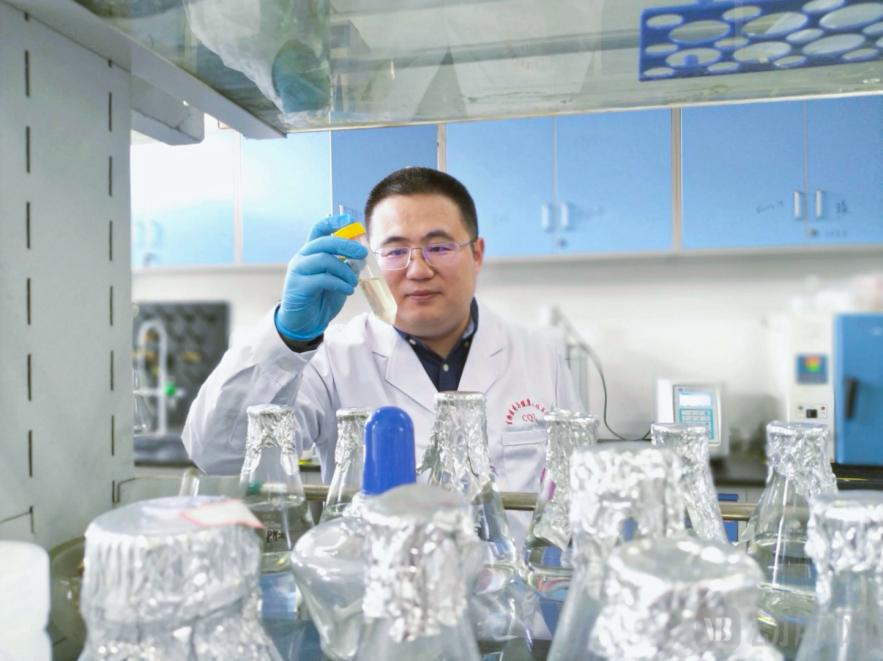
Dr. Hao Shilei is conducting research on recombinant keratin.
Through years of in-depth exploration and research into the traditional “Hair Carbon,” the recombinant keratin technology developed by the scientific research team at Chongqing University not only provides scientific guidance for the personalized or precise utilization of keratin, but also establishes a significant theoretical and experimental foundation for human tissue repair.
To gain deeper insights into recombinant keratin technology and Haimers, VCBeat interviewed Huang Gang, General Manager of Haimers, and Zha Guodong, Deputy General Manager and Technical Director.General Manager Huang Gang graduated from Beijing Normal University. He has held senior executive positions at multiple large enterprises and possesses over twenty years of experience in corporate management. Technical Director Zha Guodong studied under Professor Wang Bochun and has more than ten years of experience in the translation of recombinant protein technologies and the development of medical device products.
Although the functional benefits of keratin have been widely recognized throughout history, pharmacological research and purification processes have remained significant barriers to industry advancement.
Traditional chemical extraction techniques for keratin cause the cleavage of disulfide bonds, converting them into sulfhydryl or sulfonic acid groups, thereby yielding a mixture of soluble keratin fragments. This approach not only disrupts the native structure of keratin but also relies primarily on animal hair or human hair as raw materials, which adversely affects the product’s functionality, quality, safety, and environmental sustainability.
“Haimers’ globally pioneering recombinant keratin technology is based on human keratin gene sequences. By analyzing and comparing 17 different human hair keratin genes, it achieves targeted design and modification of specific sequences. Through a series of processes including DNA recombination, microbial fermentation expression, and downstream purification, it ultimately produces recombinant keratin biomaterials with single, controllable components, high purity, high activity, and high stability,” said Zha Guodong in an interview.
In addition to maintaining technological leadership, the ability to achieve large-scale mass production has become a key indicator for assessing a company’s comprehensive strength in the field of synthetic biology.
In response, Huang Gang stated, “Recombinant keratin materials exhibit excellent biocompatibility and possess biological properties that enable rapid hemostasis, reduce wound infection, and promote tissue repair, demonstrating significant application value across clinical, medical aesthetics, consumer, and other sectors. To allow more people to benefit from this innovative biotechnology, Haimers has established a comprehensive R&D and industrialization platform covering protein biosynthesis, formulation development, pilot-scale scale-up, and process optimization, achieving the world’s first large-scale production of recombinant keratin.”
According to reports, Haimers’ pilot production base for its recombinant keratin technology transfer platform and raw material production has currently achieved an annual output of ton-scale keratin stock solution, with a protein purity exceeding 95%. Meanwhile, to support product research and development and manufacturing more efficiently and stably, and to empower downstream brands, Haimers is also expanding its production capacity and constructing a production line for recombinant keratin freeze-dried powder. The annual output of recombinant keratin freeze-dried powder is expected to reach 2 tons by the end of 2025.
In Traditional Chinese Medicine, "Charred Human Hair" (Xue Yu Tan) is widely used for hemostasis, resolving blood stasis, and promoting tissue regeneration. After years of dedicated research, the scientific team at Haimers has not only elucidated the hemostatic mechanism underlying keratin but also, for the first time globally, mapped the functional profile of human hair keratin in wound healing regulation. Their work has revealed the superior performance of various recombinant keratins in medical applications such as angiogenesis and nerve repair.
“From carbonized human hair to recombinant keratin produced via synthetic biology technologies, featuring single-component controllability, high purity, high activity, and high stability, Haimers has taken a significant step forward in advancing the global recombinant keratin industry. Today, to bring the benefits of scientific innovation to the public, the Haimers team is leveraging the innovative advantages of recombinant keratin in areas such as surgical hemostasis, wound and skin repair, and tissue regeneration to drive the translation of a series of products,” said Huang Gang in an interview.
The recombinant keratin developed and manufactured by Haimers exhibits biological activity and a structural framework similar to that of keratin in human skin. It stimulates the repair of surrounding tissues and the growth of epithelial cells, promotes the migration of basal keratinocytes, enhances the expression of growth factors, and facilitates collagen production, thereby enabling rapid wound and tissue repair.
Grounded in this theoretical framework, Haimers’ research findings can be widely applied across multiple clinical departments, including neurosurgery, neurology, orthopedics, hepatobiliary surgery, and dermatology, to help patients repair compromised skin barriers. This includes the treatment of chronic, hard-to-heal wounds such as diabetic foot ulcers and pressure injuries, which are often challenging to manage and incur high costs.
According to Zha Guodong, the medical repair gel developed by Haimers for the treatment of diabetic foot ulcers, venous ulcers, pressure ulcers, and surgical wounds has completed preclinical studies. Animal experiments have demonstrated that its efficacy in treating chronic wounds and promoting epithelialization is significantly superior to that of current protein-based and growth factor products.
Synthetic biology has blurred the boundary between “natural” and “unnatural,” enabling the targeted design, modification, and even de novo synthesis of living organisms. Consequently, some have likened synthetic biology to Tian Gong Kai Wu (The Exploitation of the Works of Nature). However, society typically maintains a cautious attitude toward emerging technologies, particularly those applied in clinical settings.
We can gain some insight from the “ten years, one billion dollars” rule of pharmaceutical innovation. Haimers’ globally first-of-its-kind recombinant keratin technology also faces similar challenges.
In 2018, Haimers took the lead in submitting an application for attribute identification of recombinant keratin to the National Medical Products Administration. After deliberation by a panel of experts, it was determined that recombinant keratin material is not merely a physical support material but also possesses strong bioactivity.
This consequently imposes higher requirements and greater challenges on the technical development and regulatory registration of recombinant keratin products.
Huang Gang stated, “Recombinant keratin is a novel biomaterial with significant clinical value. As the global leader in the recombinant keratin industry, Haimers has the responsibility and obligation to take the lead in overcoming this ‘major hurdle,’ thereby setting an industry benchmark while benefiting more patients.”
Therefore, in addition to collaborating with research institutes and large hospitals to actively advance the R&D and registration of medical repair gels, nerve repair gels, and hair injection fillers, Haimers has leveraged the advantages of recombinant keratin in promoting cellular repair and growth to innovatively develop a series of high-value-added products, including marketed items such as recombinant keratin soothing gel, facial masks, toothpaste, and oral care solutions.
According to reports, Haimers’ consumer-facing recombinant keratin products have been launched on online platforms such as Taobao, JD.com, and Douyin, as well as in professional beauty salon channels, receiving positive user feedback.
At the conclusion of the interview, Huang Gang stated to VCBeat, “The 21st century is the century of biology, and synthetic biology will play a pivotal role in driving and leading this advancement. To deepen the understanding and application of keratin, Haimers has established in-depth collaborative partnerships with universities and hospitals such as Chongqing University, MIT, West China School of Stomatology of Sichuan University, the First Affiliated Hospital of Army Medical University, the Second Affiliated Hospital of Army Medical University, and the First Affiliated Hospital of Chongqing Medical University. Furthermore, leveraging its team of scientists, Haimers has founded the Haimers Research Institute. In the future, Haimers will remain committed to the research and translational development of recombinant keratin, striving for excellence to make greater contributions to human health and disease treatment at an early date.”