

United Imaging Enters the Hearing Aid Market with Customized Solutions for Tertiary Hospital-Adjacent Stores

United Imaging Microelectronics
Developer and Manufacturer of High-End Analog Signal Chain Chips and Low-Power SoC Products
Recently, the healthcare industry has seen a major development as United Imaging enters the hearing aid market.
The hearing aid project of its subsidiary, Shanghai United Imaging Microelectronics Technology Co., Ltd. (hereinafter referred to as “United Imaging Microelectronics”), has been announced to settle in “United Imaging Town.” It is reported that the project is dedicated to the design, research and development, and production of mid-to-high-end custom hearing aids, and will utilize custom equipment such as high-precision 3D printers for product design and manufacturing.The project is expected to achieve an annual production capacity of over 10,000 units.
It is worth noting that United Imaging Microelectronics has long maintained a hearing aid division, although little information about it has been disclosed to the public. According to its official website, in the medical applications section, the company only presents information on dedicated chips for PET detectors, with no mention of hearing aid chips. “United Imaging Town” is a high-end medical equipment industrial cluster and an integrated industry-city demonstration zone jointly established last year by United Imaging Group and the Administrative Committee of Jiading Industrial Park.
The announcement that United Imaging Microelectronics’ hearing aid project is settling in “United Imaging Town” may signal the United Imaging Group’s imminent push into the hearing aid sector. At a time when the hearing aid industry is attracting significant attention, United Imaging Microelectronics has undoubtedly further intensified market competition.
Annual exports reach 14.3176 million units, serving over 220 million patients, with a market size exceeding RMB 6 billion.
Much like ophthalmology and dentistry, which also belong to the consumer healthcare sector, the hearing care sector boasts fertile ground for rapid growth.
Nevertheless, approximately 95% of the global hearing aid market share remains dominated by the five major hearing groups: Sonova, Demant, GN ReSound, WS Audiology, and Starkey. Unlike the ophthalmology and dentistry sectors, China’s hearing care industry has yet to produce a domestic market leader or experience a comparable market boom.
Over the three years leading up to the first half of 2023, only nine financing deals were completed in the hearing health sector.It was not until the second half of 2023 that the market gradually heated up.Following Boyin Hearing’s announcement in August 2023 that it had completed a Series A financing round of nearly RMB 100 million, Shenglan Medical was officially listed on the National Equities Exchange and Quotations (NEEQ) in November. The momentum from 2023 continued into 2024, with Chinese hearing aid manufacturer “Yinkesi” and hearing aid chipmaker “Muxin Technology” each securing tens of millions of yuan in Series A financing early in the year.
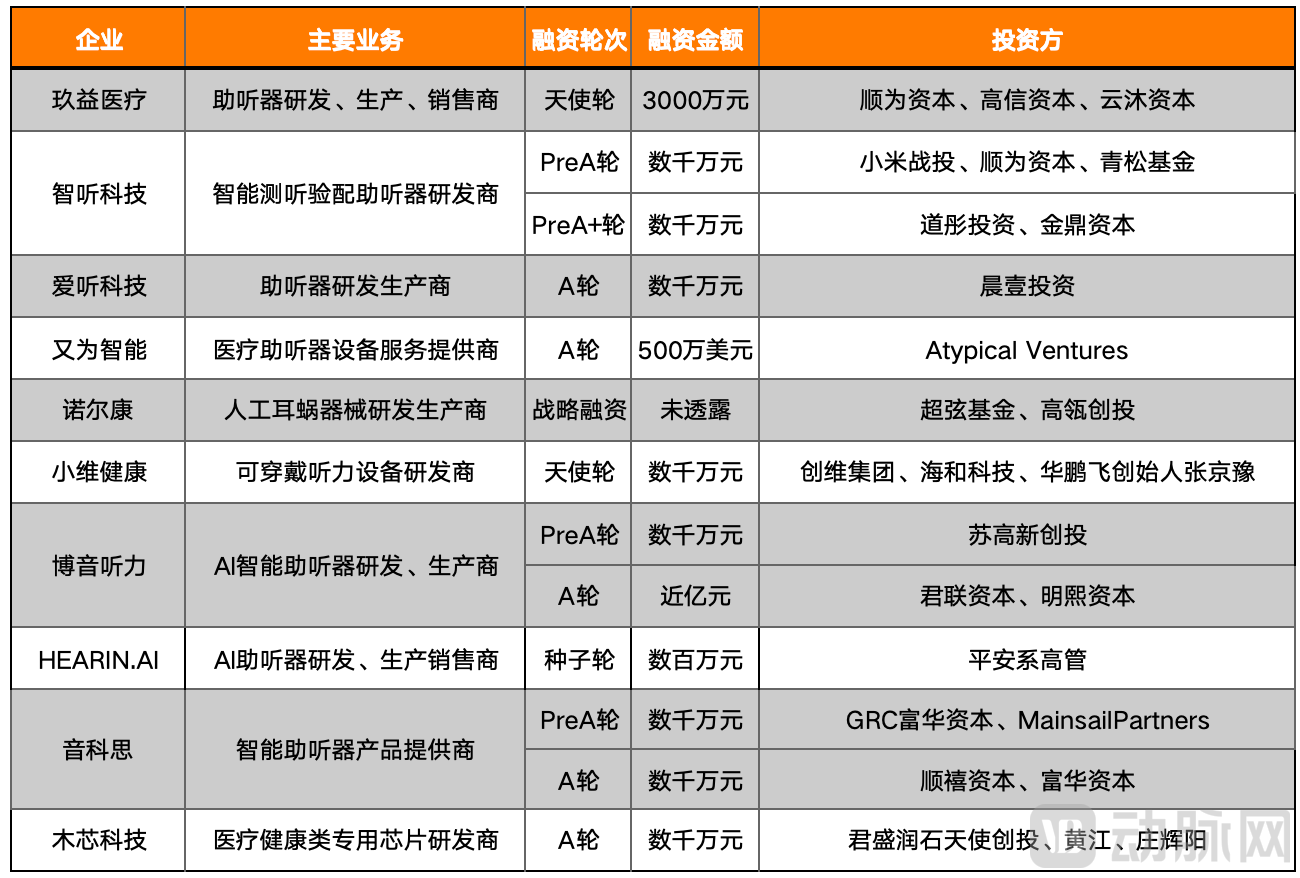
Financing Trends in China’s Hearing Sector Over the Past Three Years (Data Source: VCBeat Orange Database)
Although the hearing healthcare sector is gaining momentum, it still lags far behind the dental and ophthalmology sectors, which have seen hundreds of financing rounds over the past three years. One of the core factors lies inThe Global Top Five Hearing Aid Groups Have Established Extremely High Barriers to Entry in the Premium Hearing Aid Market Through Their Offline Fitting Channels, Premium Product Supply Chains, and Proprietary R&D Systems, to truly break through in this sector and disrupt the market landscape poses significant challenges.
From the perspectives of research and development and manufacturing, chips and algorithms represent a major breakthrough at the core of hearing aid technology.
The chip is arguably the core component of digital hearing aids. It integrates noise reduction, compression, open-fit configuration, wireless technology, frequency lowering, directional technology, feedback suppression, and various algorithms. This tiny chip largely determines the hearing aid’s performance, sound quality, algorithmic capabilities, and even the product’s manufacturing cost.
Although both digital and analog hearing aids employ microphones and speakers as energy transducers, the integration of microchips has endowed digital hearing aids with capabilities unattainable by traditional analog devices, such as a high signal-to-noise ratio, dynamic gain adjustment, and automatic environmental adaptation. Consequently, following the emergence of the world’s first fully digital audio signal processing chip in 1998, the development of hearing aids reached unprecedented heights.
A review of the development trajectories of leading global hearing aid brands reveals that independent research, development, and design of hearing aid chips has become an industry standard.
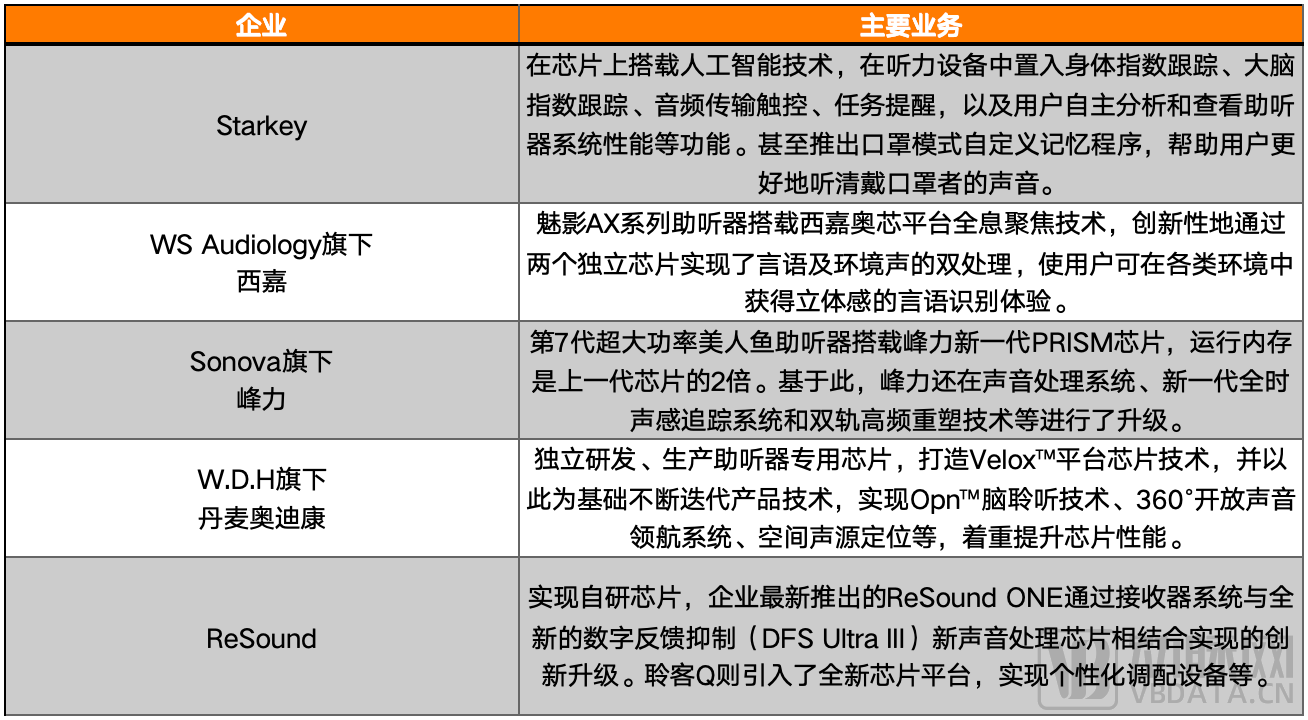
Overseas Business Layout (Partial)
In recent years, the industry has focused on the integration of Bluetooth Low Energy (BLE) functionality and specialized hearing aid chip capabilities; however, power consumption and performance represent only the basic functions of such chips. Combined withTrends such as the over-the-counter (OTC) availability of hearing aids, personalization, multi-functionality, intelligence, health data collection, and the widespread adoption of remote fitting, in the future, hearing aid products will not only see continuous improvements in rigid requirements such as signal processing accuracy and noise reduction, but the application of software in hearing aid fitting and adjustment will also become increasingly prevalent. AndTo meet the above requirements, both chips and algorithms are indispensable.
But due toHistorically, control over key technologies such as hearing aid chips was almost exclusively held by foreign companies.In China, chip technology is a “chokepoint” technology. Hearing aid manufacturers currently rely mainly on U.S.-based suppliers such as ON Semiconductor and IntriCon Corporation for chips. There is not only an insufficient technical reserve among R&D personnel for related chips, but the development of the key industrial chain for hearing aids also lags behind.
Amid the broader trend of shifting from overseas monopolies to domestic substitution, Chinese hearing aid manufacturers urgently need to break through chip technology bottlenecks and enhance their risk resilience.
One of the key factors behind Shanghai United Imaging Microelectronics Technology Co., Ltd.’s push into the hearing health sector may well be its ability to address the pain points in the chip segment of this field.
Shanghai United Imaging Microelectronics Technology Co., Ltd., established in 2019, is primarily engaged in the product research and development, design, manufacturing, marketing, and service innovation of high-end analog signal chain chips and low-power SoCs. Within two and a half years, the company successfully achieved independent design and development of specialized chips for molecular imaging.
This chip combines the advantages of "high computing power and low energy consumption." Compared with the conventional time resolution of 350–550 picoseconds in the industry, the performance of the PET-CT system equipped with this chip has broken through the 200-picosecond technological threshold, achieving an industry-leading time resolution at the 190-picosecond level. This achievement fills the gap in China’s self-developed specialized chips for ultra-high-end medical equipment. The R&D achievements of United Imaging Microelectronics demonstrate its strength in overcoming key technologies in chip development.
It is reported that one of the key reasons for Shanghai United Imaging Microelectronics Technology Co., Ltd.’s rapid breakthroughs lies in its establishment of a vertically integrated innovation system from the ground up, ensuring full-chain autonomy and controllability across “complete systems–core components–underlying components.” Furthermore, United Imaging Group has collaborated with ShanghaiTech University to launch a joint project-based master’s program under the “United Imaging Microelectronics–School of Information” initiative, aiming to address issues such as insufficient technical reserves among chip R&D personnel. By establishing its presence in the Jiading Industrial Park and settling into “United Imaging Town,” United Imaging Microelectronics will further leverage the advantages of the high-performance medical equipment industrial cluster, accelerating the design, R&D, and production of customized mid-to-high-end hearing aid products.
Currently, United Imaging Microelectronics has launched R&D on customized dedicated chips for high-end medical imaging equipment, medical AI chips, and smart wearable medical chips. This strategic layout not only aligns with United Imaging Microelectronics’ longstanding technological strengths and business direction but also conforms to the current development trends in the hearing health sector.It offers a potential solution to the current "chokepoint" technical challenges facing chips in the hearing aid sector.
In addition to Shanghai United Imaging Microelectronics Technology Co., Ltd., other domestic hearing aid manufacturers such asNanjing Tianyue, Haikadi, Aikesound, Xin Hailing, Muxin Technology, Zhitong Technology, etc.,It has also actively invested in research and development, striving to achieve breakthroughs in key technologies. Meanwhile,Internet Giants and Technology Companieshave also been actively entering the hearing health sector. For example,Tencent Tianlai Laboratory and iFLYTEKhave separately launched relevant solutions, focusing on the application of speech recognition and artificial intelligence technologies in the field of hearing aids. Furthermore,Ping An Executives and Xiaomi Corporationthereby making strategic investments in the hearing aid industry, further driving the development of China’s hearing health sector.
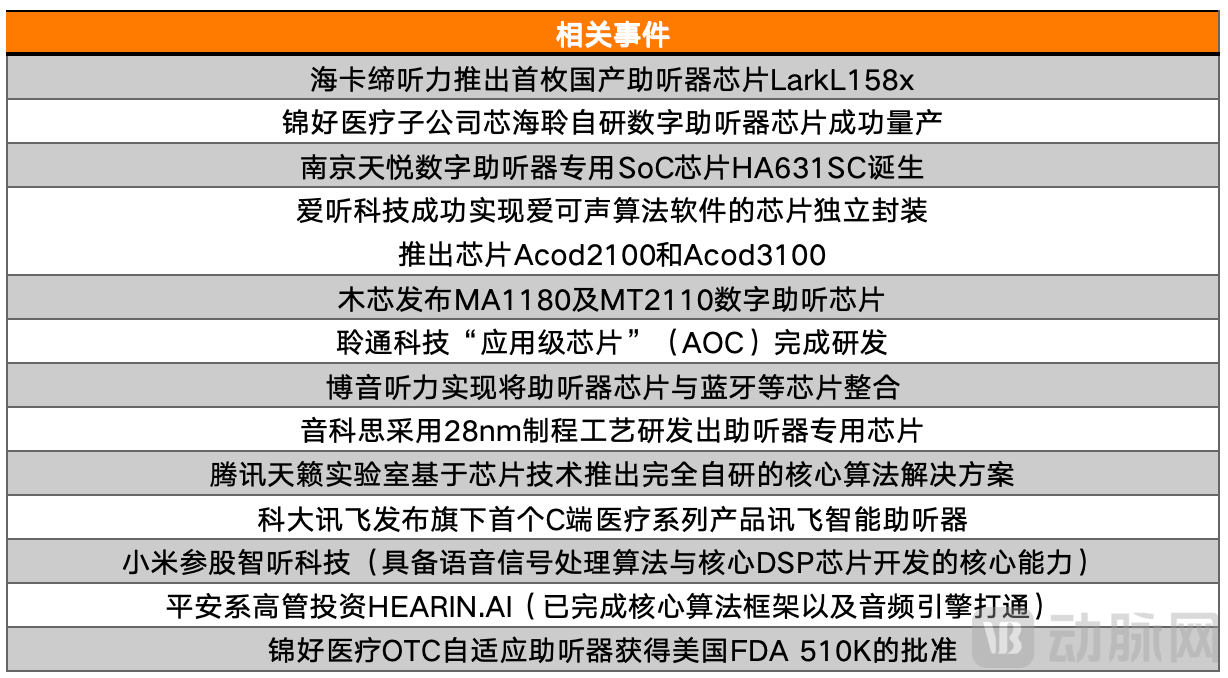
As more domestic manufacturers achieve technological breakthroughs, hearing aid chips will gradually undergo import substitution with domestically produced alternatives, further meeting consumers’ diverse needs and bringing more innovative applications to the hearing aid market.
Behind Every Pain Point Lies a Huge Opportunity.
Despite the hearing industry in China facing challenges such as insufficient R&D capabilities amid international competitive pressures, the large population of individuals with hearing impairment provides a fertile ground for corporate development.
According to the "Current Status and Development Trends of Hearing Health in China," the number of elderly people aged 65 and above with hearing impairment in China has reached 120 million. As the trend of population aging intensifies, the number of deaf individuals will continue to grow. Meanwhile, the penetration rate of hearing aids in China remains relatively low, at only about 5% (according to data from the Centers for Disease Control and Prevention), whereas this figure exceeds 30% in developed countries such as the United States. This further indicates that China's hearing healthcare market possesses substantial room for growth and significant development potential.
In the future, as the domestic hearing health sector gains momentum, major companies will further overcome key technical challenges, such as those related to chips. Driven by these technological breakthroughs, hearing aid products will increasingly become over-the-counter (OTC), intelligent, and personalized. China and other regions will further disrupt the traditional business model of offline hearing aid fitting, cultivating new online sales channels or offline direct-to-consumer channels. This will enable individuals with hearing impairments to access hearing aids more conveniently while alleviating their financial burden. From a market perspective, this shift will help increase the penetration rate of hearing aid usage.
In addition to the expansion of market capacity, the hearing health sector also enjoys policy support.
In 2022, the State Council issued the “14th Five-Year Plan” for National Health., incorporate ear and hearing health initiatives into the Outline of the Healthy China 2030 Planning Program.In late 2023, the Ministry of Industry and Information Technology, the Ministry of Education, and five other departments jointly issued the “Guiding Opinions on Accelerating the High-Quality Development of the Audio-Visual Electronics Industry.”, it is proposed that by 2027, China’s audio-visual electronics industry will significantly enhance its global competitiveness, achieve continuous breakthroughs in key technological innovations, and continuously improve its industrial ecosystem. Several new niche markets worth hundreds of billions of yuan will be cultivated, along with a cohort of specialized, refined, distinctive, and innovative “Little Giant” enterprises and manufacturing single champions. By 2030, the overall strength of China’s audio-visual electronics industry will rank among the world’s leading tiers, with technological innovation reaching internationally advanced levels.
Although the global top five hearing aid groups have established extremely high entry barriers in the high-end hearing aid market, and China’s hearing care sector started relatively late, resulting in a comparatively slow industry progression, the country now possesses a favorable environment for development. Driven by policy support and steadily growing market demand, a technological tipping point on the supply side may be emerging.
As domestic enterprises such as Shanghai United Imaging Microelectronics Technology Co., Ltd. enter the hearing aid sector, the R&D of domestically produced hearing aid chips, algorithms, and complete devices is bound to accelerate. Once successful, this endeavor will significantly improve the lives of many people.