

China's Two Sessions Set the Tone for Major Transformations in the Healthcare Industry
New quality productive forces, disruptive technologies, future industries, AI Plus, the “Invest in China” brand... Over the past two days, buzzwords from the Two Sessions have flooded social media feeds.
During the Two Sessions, the 2024 Government Work Report outlined top-level plans for the healthcare sector’s tasks in the new year, with many items echoing the aforementioned buzzwords.
Overall, six key aspects of the government’s 2024 work tasks directly pertain to healthcare.Accelerate the development of frontier emerging industries such as hydrogen energy, new materials, and innovative drugs, and open up new tracks in quantum technology and life sciences; strengthen the research, development, and application of livelihood technologies in health and elderly care.. InEnhance Healthcare Service Capacity and Strengthen Social Security and ServicesIn its work agenda, the Government Work Report outlines arrangements for multiple key areas, including medical services and healthcare security.
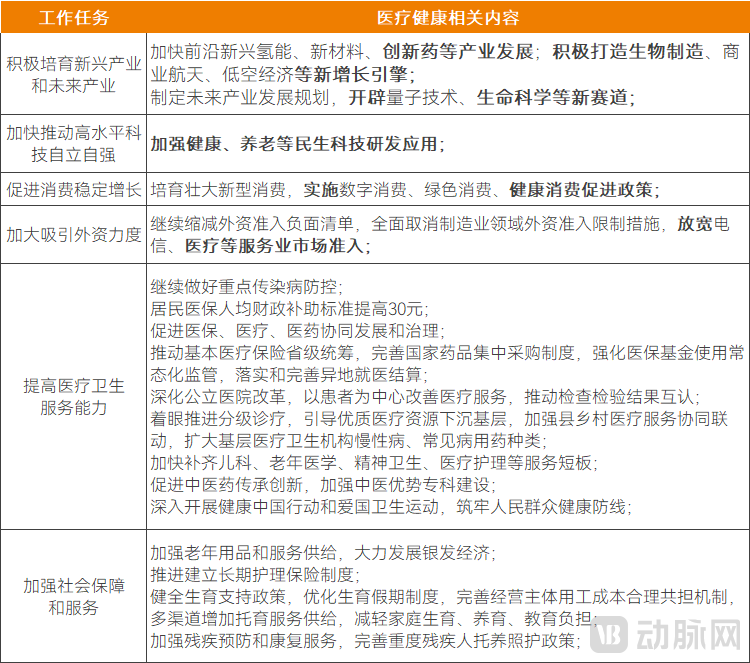
Healthcare-Related Tasks in the 2024 Government Work Report; Source: Chinese Government Website, Chart Compiled by VCBeat
Comparing with the “Government Work Report” from previous Two Sessions, and incorporating the latest developments and policies from departments such as the National Health Commission and the National Healthcare Security Administration, VCBeat has analyzed and provided outlooks on the healthcare-related hot topics of the 2024 National Two Sessions and the associated industry trends.
In the Report, the first major task for the government in 2024 is to “vigorously advance the development of a modern industrial system and accelerate the cultivation of new quality productive forces.”
The task proposes to actively cultivate emerging industries and future industries, including: consolidating and expanding the leading advantages of industries such as intelligent connected new energy vehicles,Accelerate the development of frontier and emerging industries such as hydrogen energy, new materials, and innovative drugs, and actively cultivate new growth engines including biomanufacturing, commercial aerospace, and the low-altitude economy.Formulate a development plan for future industries,Pioneer new frontiers in quantum technology and life sciences, and establish a cohort of pilot zones for future industries.
To provide funding for the cultivation of emerging and future industries, the Government Work Report also encourages the development of venture capital and equity investment, and optimizes the functions of industrial investment funds.
It is understood that “new quality productive forces” represent an advanced form of productivity driven primarily by innovation, breaking away from traditional economic growth models and paths of productivity development. Characterized by high technology, high efficiency, and high quality, they align with the new development philosophy. These forces are spawned by revolutionary technological breakthroughs, innovative allocation of production factors, and deep industrial transformation and upgrading.
Innovative drugs and life sciences have not only been included in the Government Work Report for the first time, but also categorized under “new quality productive forces,” a concept signifying a leap in productivity, underscoring the industry’s strong potential for rapid future growth.
In the past, government work reports primarily used terms such as “biopharmaceuticals” and “new drugs” to describe pharmaceutical innovation. A review of the development trajectory of China’s pharmaceutical industry makes it easy to understand the reasons behind this shift in terminology.
First, since the launch of the review and approval system reform in China, the innovation journey for drugs and medical devices has reached a significant milestone. The harvest season has arrived, with a batch of new drugs launched on the market, rapidly adopted in clinical practice, and even included in the national reimbursement drug list. These innovations have filled clinical gaps or provided more options to meet clinical needs.
Secondly, among the newly approved drugs, there is no shortage of Class 1 new drugs with independent intellectual property rights; among innovative medical devices, there are also products that lead globally in technology and have received the world’s first regulatory approval. China’s pharmaceutical and medical device industries have established a certain level of innovation capability and fostered an environment conducive to innovation.
Finally, in the global market, there is still significant room for innovation and R&D in China’s pharmaceutical and medical device sectors. In particular, deeper breakthroughs must be achieved in mastering upstream “chokehold” technologies and ensuring supply chain security.
From the perspectives of both importance and necessity, innovative drugs deserve to be elevated to the level of national top-level planning. The transition from “new drugs” to “innovative drugs” also reflects that China’s pharmaceutical innovation is undergoing a leap from “availability” to “excellence.”
While innovative drugs focus more on application, life sciences encompass both basic research and translational applications.
In February 2024, the Consortium of Life Science Societies under the China Association for Science and Technology released the “Top Ten Advances in Life Sciences in China for 2023.” The selected projects were characterized by prominent originality and significant social impact. In January 2024, the National Health Commission stated at the National Health Work Conference that, in the new year, it would accelerate the development of a scientific and technological innovation system tailored to the characteristics of the healthcare industry, strengthen key technological breakthroughs, promote the application and dissemination of research achievements, and help open up new tracks for future industries such as life sciences.
Life sciences encompass multiple interdisciplinary fields, leveraging cutting-edge technologies to explore the fundamental origins of life and fundamentally address challenges in disease treatment and health maintenance. Meanwhile, the life sciences sector boasts a broad scope, covering all aspects from basic research and technology transfer to manufacturing, thereby offering immense industrial potential from research to application.
Centralized procurement of drugs and medical devices has been a key initiative driving pharmaceutical and health insurance reforms in recent years. Since the launch of the “4+7” centralized procurement pilot, the National Healthcare Security Administration has carried out nine rounds of national centralized drug procurement and four rounds of national centralized procurement for high-value medical consumables.
During the Two Sessions, the 2024 Government Work Report pointed out that it is necessary to improve the national centralized drug procurement system. At the previous National Healthcare Security Work Conference, the National Healthcare Security Administration also mentioned that it would promote the “expansion and quality improvement” of centralized procurement. New batches of nationally organized centralized procurement for drugs and consumables will be carried out, and proper follow-up arrangements will be made for contracts expiring among selected products in centralized procurement, aiming to achieve a combined total of at least 500 drugs under national and provincial centralized procurement. Efforts will be made to explore new mechanisms for drug price formation and strengthen the disclosure of credit evaluations related to pricing and procurement.
Based on the above plan, centralized procurement of drugs and medical devices is expanding from a focus on “quantity” to one on “quality.” The concept of “quality” encompasses multiple dimensions. To ensure the intrinsic quality of drugs, the National Healthcare Security Administration has organized numerous Grade A tertiary hospitals to conduct real-world studies on centrally procured drugs. Published results have demonstrated that the clinical efficacy and safety of generic drugs selected through centralized procurement are comparable to those of originator drugs.
Since the implementation of centralized volume-based procurement (VBP) for pharmaceuticals and medical devices, multiple winning bidders have been listed on the non-compliance registry due to failures such as inability to fulfill the agreed-upon procurement volumes under the contract, non-compliance with Good Manufacturing Practice (GMP) for pharmaceutical products, or voluntary withdrawal of their winning status after selection. These violations have adversely affected the smooth implementation of VBP and patients’ timely access to medications, thereby undermining the overall quality of the VBP program.
From late 2023 to early 2024, the National Healthcare Security Administration issued multiple documents addressing the supply guarantee of selected drugs, pharmaceutical pricing, and the credit evaluation system for procurement. These documents emphasized the need to promptly organize the signing of procurement agreements, streamline channels for feedback from medical institutions, and actively coordinate responses to sudden surges in drug demand within short periods. They also mandated the implementation of agreed-upon prices in provinces responsible for centralized procurement supply, while requiring reasonable coordination and adherence to agreements in non-supplying provinces. Furthermore, the documents called for expanding the application scope of enterprise credit evaluation results and strengthening information disclosure.
Undeniably, the impact of centralized procurement on enterprises is multifaceted, requiring them to strike a balance among various factors such as volume, profit margins, and market share.The enhancement of centralized procurement initiatives entails higher standards and stricter management for enterprises. However, this also means that high-performing companies with strong comprehensive capabilities—such as product quality, cost control, and production capacity—will be better positioned to thrive in the evolving centralized procurement ecosystem.
Industrial innovation cannot be pursued in isolation. In recent years, foreign pharmaceutical and medical device companies have injected vitality into China’s domestic innovation ecosystem through various means, including establishing R&D centers, building manufacturing facilities, engaging in license-in deals, and pursuing investments and mergers and acquisitions.
The "Government Work Report" mentioned that China will expand high-standard opening-up to promote mutual benefit and win-win outcomes, intensify efforts to attract foreign investment, continue to shorten the negative list for foreign investment access, fully eliminate restrictions on foreign investment in the manufacturing sector, and relax market access for service industries such as telecommunications and healthcare.
As early as August 2023, the State Council issued the “Opinions on Further Optimizing the Foreign Investment Environment and Strengthening Efforts to Attract Foreign Investment,” supporting foreign investors in establishing R&D centers in China, collaborating with domestic enterprises on technological R&D and industrial application, and encouraging foreign-invested enterprises and their R&D centers to undertake major scientific and technological breakthrough projects. Subject to compliance with relevant laws and regulations, efforts will be accelerated to facilitate the implementation and production of foreign investment projects in the biopharmaceutical sector; foreign-invested enterprises are encouraged to conduct clinical trials in China for cell and gene therapy drugs already marketed overseas, in accordance with the law; and the application procedures for drug marketing registration will be optimized for transferring the production of already marketed drugs manufactured overseas to domestic production.
Prior to this, the Special Administrative Measures on Market Access for Foreign Investment (Negative List) (2021 Edition) and the Special Administrative Measures on Market Access for Foreign Investment in Pilot Free Trade Zones (Negative List) (2021 Edition), issued by the National Development and Reform Commission and the Ministry of Commerce, prohibited foreign investment in the development and application of technologies related to human stem cells and genetic diagnosis and treatment, and restricted medical institutions to joint-venture structures.
In contrast, foreign investors have gained broader investment opportunities in China, particularly in cutting-edge fields such as cell and gene therapy. The domestic pharmaceutical industry can leverage foreign capital to enhance its R&D and manufacturing capabilities.With foreign capital entering China and the current surge in Chinese companies “going global,” domestic innovative products are poised to integrate into the global market more rapidly and gain greater influence within the global innovation ecosystem.
Fertility and Elderly Care Issues Garnered Significant Attention During the 2024 Two Sessions.
According to data from the National Bureau of Statistics, in 2023, China had 9.02 million live births, with a birth rate of 6.39‰; 11.10 million deaths, with a death rate of 7.87‰; and a natural population growth rate of -1.48‰. The population aged 60 and above accounted for 21.1% of the total population nationwide.
The birth rate continues to decline, while the aging population issue becomes increasingly prominent, with both trends intertwining.
In 2024, the Report allocated more space to healthcare services related to childbirth and elderly care, including: improving policies to support childbirth, increasing the supply of childcare services through multiple channels, and reducing the financial burden on families for childbirth, child-rearing, and education; accelerating efforts to address shortcomings in pediatric care, geriatrics, mental health, and medical nursing services; strengthening the research, development, and application of technologies for public welfare sectors such as health and elderly care; enhancing the supply of products and services for the elderly, and vigorously developing the silver economy; and promoting the establishment of a long-term care insurance system.
From the planning and developments of relevant departments, the aforementioned content has become a key focus in 2024.
In February 2024, Zhang Ke, the newly appointed Party Secretary of the National Healthcare Security Administration, conducted field research on healthcare security work in Beijing. He visited Beijing Obstetrics and Gynecology Hospital affiliated with Capital Medical University, Peking University People’s Hospital, and Beijing Children’s Hospital affiliated with Capital Medical University to gain a detailed understanding of the inclusion of assisted reproductive technologies in medical insurance coverage, the implementation of nationally negotiated drugs and centrally procured drugs and consumables, as well as the development of healthcare security for children and pediatric medical services.
Zhang Ke pointed out,The National Healthcare Security Administration will continue to guide relevant provinces in further improving the project approval and medical insurance payment management for assisted reproductive technology services, strengthen inter-departmental coordination, promote the integration of basic medical insurance, maternity insurance, and related economic and social policies, and jointly foster long-term balanced population development.Furthermore, it is essential to strengthen medical security for children, steadily improve the level of medication coverage for pediatric patients, reflect the distinctive characteristics of pediatric diagnosis and treatment in medical service pricing and items, and support the expansion of pediatric healthcare service supply.
On March 2, five departments, including the National Healthcare Security Administration, the Ministry of Education, and the National Health Commission, issued a notice to launch a special campaign for children’s enrollment in basic medical insurance. The campaign explicitly aims to ensure that over 80% of newborns are enrolled in the insurance scheme within their birth year by the end of 2024. While maintaining relative stability in policies for children’s insurance coverage, the initiative focuses on optimizing the enrollment process for newborns, simplifying registration procedures, and improving services.
From assisted reproductive technologies and maternity insurance to pediatric healthcare and health protection, policy coverage has continued to expand. Fertility rates are the result of a combination of various social factors. Although healthcare-related policies may not directly and significantly boost fertility intentions on a large scale, providing more accessible, efficient, and high-quality services for pregnancy, childbirth, and child-rearing remains a crucial component of long-term population development efforts.
From an industry perspective, niche sectors such as assisted reproductive technology, pediatric healthcare services, pediatric pharmaceuticals, and medical devices will see increased opportunities amid the aforementioned trends.
In the area of elderly care services, the National Health Commission stated in its key tasks for 2024 that it will continue to improve the quality of medical services, strengthen age-friendly and accessibility-oriented renovations of hospital wards, expand the recruitment scale of professional nursing personnel, continuously enhance medical and nursing care services, and further improve the elderly health service system.
The National Healthcare Security Administration will continue to advance the long-term care insurance program. Notably, relevant occupational standards have recently been established to address the shortage of professional caregivers during the implementation of long-term care insurance.
In February 2024, the General Office of the Ministry of Human Resources and Social Security and the General Office of the National Healthcare Security Administration promulgated the National Occupational Standards for Health Care Attendants (Long-Term Care Attendants). Among these, a Long-Term Care Attendant is a practitioner who applies basic knowledge and skills in daily living assistance and nursing to provide services such as basic daily living care, closely related medical nursing, functional maintenance, and psychological support to individuals eligible for long-term care insurance benefits and other target populations in settings including homes, communities, elderly care institutions, and medical facilities. This occupation was newly established to steadily advance the implementation of long-term care insurance.
According to the National Healthcare Security Administration, long-term care aides must possess the ability to provide basic daily living assistance to individuals with disabilities, helping them live with “decency”; they must have fundamental medical nursing knowledge to promptly identify issues and implement emergency measures, thereby supporting individuals with disabilities in living “safely”; they must uphold strong professional ethics to assist individuals with disabilities in living with “dignity.” Additionally, they are required to understand the basics of long-term care insurance, deliver services in accordance with regulations, and ensure service quality. In essence, long-term care aides are multidisciplinary professionals who integrate expertise and skills in personal care, medical nursing, health management, and long-term care insurance.
Long-term care insurance is a key measure to address the professional nursing and payment challenges faced by the elderly population amid the trend of population aging. The coverage of long-term care insurance will continue to expand, playing an increasingly important role in the healthcare service system for the elderly.Currently, long-term care insurance has facilitated the establishment and development of a number of service providers in pilot regions. In the future, more specialized and standardized institutions are expected to emerge. Meanwhile, intelligent rehabilitative assistive devices that can reduce costs and enhance efficiency for professional caregiving will gain increasing popularity and capture a larger market share.
The Report proposes, under the task of “enhancing healthcare service capacity,” to promote provincial-level pooling of basic medical insurance.
The state has consistently attached great importance to advancing the pooling level of basic medical insurance, and prefecture-level city pooling has been largely implemented across various regions.
Currently, the four direct-administered municipalities of Beijing, Tianjin, Shanghai, and Chongqing, as well as provinces such as Hainan, Fujian, and Ningxia, have advanced provincial-level pooling. Within each province, the systems and policies across various pooling areas have become more standardized and unified, further strengthening the mutual aid capacity and scope of the funds, thereby effectively enhancing the system’s risk resilience.
In 2023, provinces such as Shandong, Sichuan, and Liaoning issued documents to formulate policies for provincial-level pooling of medical insurance. Among them, Sichuan’s provincial-level pooling policy was implemented starting in 2024, adopting a basic medical insurance adjustment fund model characterized by unified provincial budgeting, two-tier (provincial and municipal) fund adjustment, three-tier (provincial, municipal, and county) shared responsibility, and tiered administration.
The “Government Work Report” once again made arrangements for provincial-level pooling of medical insurance, with the pooling progress expected to accelerate.
Provincial-level pooling of basic medical insurance can bring the most direct benefits to insured individuals, namely: convenient use of medical insurance payment and consistent reimbursement policies when seeking medical care across the province. Underpinning this is the enhanced mutual aid capacity of the medical insurance fund. In the past, under the predominantly city-level pooling model, differences in economic development levels, demographic structures, and other factors led to disparities in fund operations across regions. Some areas had substantial fund surpluses, while others faced deficits, with no mechanism for inter-regional fund flows.Following the implementation of provincial-level pooling, health insurance funds can be balanced across a broader scope, thereby enhancing overall operational efficiency.
As the largest payer in China’s healthcare service system, the medical insurance fund serves as the foundation for industry development. Enhanced fund safety and greater risk resilience further solidify this cornerstone of industrial growth.
The “Government Work Report” delivered at this year’s Two Sessions also outlined plans for long-term initiatives such as deepening public hospital reform and advancing the tiered diagnosis and treatment system. Within the strategic frameworks for digital economy innovation, “AI Plus,” and bio-manufacturing, healthcare applications have secured a significant place. Overall, whether viewed from the perspective of improving public welfare services or fostering emerging industries, healthcare-related content occupies a pivotal position in the government’s 2024 work agenda.
These plans represent not only opportunities but also responsibilities and challenges for industry participants across various sectors. Achieving the stated goals will require concerted efforts and close collaboration among all stakeholders.