

72-Year-Old Nankai University Professor Leads Daina Bio to File IPO on Beijing Stock Exchange with Products Deployed in Over 1,300 Hospitals Nationwide
Dynamiker
In Vitro Diagnostic Product Development and Manufacturing for Invasive Fungal Diseases
Since the China Securities Regulatory Commission (CSRC) officially announced a phased tightening of IPOs in August 2023, and the Beijing Stock Exchange (BSE) released its “19 Measures for Deepening Reform” on September 1, numerous enterprises have chosen to “go north” to seek new opportunities. Dynamiker is among them.
In late December 2023, Dynamiker disclosed its prospectus on the Beijing Stock Exchange. Dynamiker is a provider of precision diagnostic services for infectious diseases, specializing in the research, production, and sales of pathogenic microorganism detection products with a focus on the diagnosis of invasive fungal diseases. Its products have been adopted by more than 1,300 medical institutions in China and are exported to countries and regions across Asia, Europe, Africa, South America, and North America.
In November 2020, Dynamiker applied for an initial public offering (IPO) on the STAR Market, but withdrew its application just two months later, citing that “the current valuation fails to reflect the company’s value.” In 2022, Dynamiker made a second attempt to list on the STAR Market, but subsequently shifted its focus to the Beijing Stock Exchange by filing an application for listing on the National Equities Exchange and Quotations (NEEQ).
After a Three-Year Hiatus, Is Dynamiker Ready This Time? VCBeat Seeks to Answer This Question by Interpreting Dynamiker’s Prospectus.
In 2014, Dr. Zhou Zeqi, then 62 years old, underwent a professional transition, shifting from his role as Deputy Director of the Tianjin International Joint Academy of Biomedicine to becoming the founder of Dynamiker.
Zhou Zeqi holds a Ph.D. in Molecular Biology from Ohio University in the United States and completed his postdoctoral fellowship at Harvard Medical School. He previously served as a Senior Scientist at Bayer Diagnostics and Chief Scientist at Wyeth. Currently, he concurrently holds the position of Professor at Nankai University and serves as a doctoral and master’s supervisor at Tianjin University of Science and Technology.
Five core management and technical personnel at Dynamiker are also graduates of Nankai University, possessing extensive experience in theoretical research and product development within the fields of pathogenic microbiology and in vitro diagnostics for biomedical devices. Dynamiker has completed three rounds of financing, with Sanze Capital, Teke Investment, Tianchuang Capital, and Ruixing Investment supporting its growth. In October 2023, Dynamiker was listed on the New Third Board.
Focusing on its product portfolio, Dynamiker offers serological tests for the early diagnosis of invasive fungal diseases, as well as diagnostic products for other pathogenic microorganisms.
Among these, the diagnostic reagent products are categorized into five major series: enzyme kinetics, enzyme-linked immunosorbent assay (ELISA), immunochromatography, chemiluminescence, and fluorescent quantitative PCR. They are primarily applied in the diagnosis of invasive fungal diseases and other infectious diseases, as well as in drug resistance testing. The diagnostic instrument products include fully automatic ELISA analyzers, microplate readers, fully automatic bacterial endotoxin/fungal glucan detectors, dry fluorescent immunoassay analyzers, colloidal gold test strip analyzers, and fully automatic chemiluminescence analyzers.
The prospectus shows,Dynamiker’s Aspergillus Galactomannan IgG Antibody Assay and Candida Mannan IgG Antibody Assay are exclusively registered products in China. As of December 2023, no other diagnostic assays targeting the same biomarkers had been registered and marketed in the Chinese domestic market.
According to the Frost & Sullivan report,In 2022, Dynamiker held approximately a 30% share of the Chinese market for diagnostic reagents for invasive fungal diseases.
As of December 2023, Dynamiker’s products have been adopted by more than 1,300 medical institutions across 34 provincial-level administrative regions in China, including over 960 tertiary hospitals. The company’s products are also exported to countries and regions in Asia, Europe, Africa, South America, and North America, continually meeting the growing diagnostic demands of end-user institutions for invasive fungal diseases as well as certain viral and bacterial infections.
By synthesizing the prospectus data submitted by Dynamiker in 2020 and 2023, we can observe its continuous performance from January 2017 to June 2023, which essentially reconstructs the company’s development trajectory since its inception.

Dynamiker’s Key Financial Data and Indicators for the Past Seven Years (Unit: RMB 100 million)
2014–2018: Pioneering Technical Research to Fill Gaps in the Domestic Market
Before 2019, Dynamiker primarily focuses on the research and development and technological accumulation of in vitro diagnostic products within niche segments. It has established core platforms for raw material preparation, enzyme kinetics, and enzyme-linked immunosorbent assay (ELISA) technologies, and has initially built technical platforms for immunochromatography, chemiluminescence, and fluorescent quantitative PCR. In terms of diagnostic instruments, it began selling microplate readers in 2014 and fully automated ELISA analyzers in 2017.
From 2017 to 2019, Dynamiker’s revenue grew year by year, reaching the hundred-million-yuan mark in 2019. The compound annual growth rate (CAGR) of its operating income reached 62.60%, exceeding the industry average. Its comprehensive gross profit margins for the three years were 89.06%, 90.49%, and 89.65%, respectively, remaining around 90% for three consecutive years—a level comparable to that of Kweichow Moutai. Behind these high gross margins lies Dynamiker’s relative competitive advantage in the field of diagnostic reagents for invasive fungal diseases.
During this phase, Dynamiker’s main business revenue was primarily derived from its G-test and GM-test products. The G-test is an enzyme kinetic chromogenic assay mainly used for the early serological detection of invasive fungal infections. The GM-test is an ELISA-based product primarily used for the detection of invasive aspergillosis, serving as an early diagnostic tool for invasive aspergillosis in neutropenic patients or severely immunocompromised patients (such as those in hematology departments).
Notably, Dynamiker’s G test product was ranked among the global Top 10 in the field of mycology by the Organizing Committee of the European Congress of Clinical Microbiology and Infectious Diseases (ECCMID), and its GM test product was included in the “Catalogue of Innovative Medical Products (2018)” issued by the Ministry of Science and Technology of China.Dynamiker’s Aspergillus Galactomannan IgG Antibody Test Kit and Candida Mannan IgG Antibody Test Kit are exclusively registered products in China., filling the gap in the field of invasive fungal disease antibody testing in China.
2019–2023: Synchronized R&D and industrialization, with product line expanded to cover multiple diseases
After 2019,Dynamiker pursues market expansion and new product development in parallel, with increasingly diversified product technologies,The product’s application scope has gradually expanded from the diagnosis of invasive fungal diseases to include infectious inflammatory markers, other pathogenic microorganisms, antimicrobial resistance testing, and eugenics-related diagnostics.. Affected by the COVID-19 pandemic, Dynamiker has added emergency response services to its business portfolio.
From 2019 to 2022, Dynamiker’s annual operating revenues were RMB 205 million, RMB 234 million, and RMB 295 million, respectively, with total annual revenue exceeding RMB 200 million each year. Complete data for 2023 are not available; however, based on historical quarterly revenue trends, its performance in the first half of the year remained stable compared with previous years.
Focusing on segmented products, as Dynamiker added emergency business related to the COVID-19 pandemic, its segmented product revenue is analyzed by dividing it into regular business and emergency business.
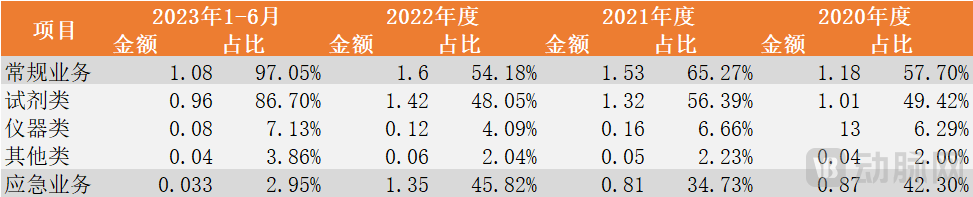 Dynamiker’s Operating Revenue from Core Business and Emergency Business During the Reporting Period (Unit: RMB 100 million; %)
In the conventional business segment, Dynamiker’s revenues from 2020 to the first half of 2023 were RMB 118 million, RMB 153 million, RMB 160 million, and RMB 108 million, respectively, maintaining overall stability. In the first half of 2023, revenue from the conventional business increased by 59.80% year-on-year, primarily due to higher patient visit rates at terminal hospitals and rising product demand. The main revenue contributors were the enzyme kinetics series, enzyme-linked immunosorbent assay (ELISA) series, and immunochromatography series within the reagent portfolio, along with the fully automated ELISA analyzer in the instrument product line.
In the emergency response business segment, Dynamiker’s immunochromatographic assay reagent products accounted for 42.30%, 34.73%, and 45.82% of its total operating revenue from 2020 to 2022, respectively, driving the company’s performance growth. After 2023, as market demand declined accordingly, the proportion of revenue from emergency response businesses dropped significantly to 2.95%.
Strong performance underscores Dynamiker’s strategic successes: First, the company prioritizes R&D innovation, with cumulative R&D expenditures exceeding RMB 77 million over the past three years and a compound annual growth rate (CAGR) of 33.57% in R&D spending during this period. Second, it has implemented a proactive strategy combining external talent acquisition, in-house development, and joint training programs. As of the end of 2023, R&D personnel accounted for 21% of its total workforce, among whom 76% held master’s or doctoral degrees, thereby establishing a highly capable R&D team.
Dynamiker has secured 72 patents domestically and internationally, obtained 70 domestic medical device product registration and filing certificates, and acquired 93 EU CE certifications (including self-declarations), leveraging its accumulated R&D innovation and talent development.
As previously reported by VCBeat, within the first two months of 2024, 17 healthcare companies had terminated their initial public offerings (IPOs). Ninety percent of these failures were attributed to financial constraints, with companies either still operating at a loss or experiencing significant declines or volatility in performance. The in vitro diagnostics (IVD) sector has been particularly hard-hit in its IPO attempts; for instance, no IVD company successfully listed on China’s A-share market throughout the entire year of 2023.
So, how stable is Dynamiker’s business? After excluding its COVID-19-related business data, we examined the company’s revenue from core conventional operations over a seven-year period, which stood at RMB 40 million, RMB 77 million, RMB 105 million, RMB 118 million, RMB 153 million, and RMB 160 million, respectively, with RMB 108 million recorded in the first half of 2023. Overall, the figures show minor fluctuations while maintaining an upward trend.
Certainly, Dynamiker also faces some “anxieties.” For instance, the substantial sales revenue from its series of COVID-19 testing products and testing instruments has dragged down its overall gross profit margin. The gross profit margin declined to 70% or below during 2020–2022. Although it rebounded somewhat in the first half of 2023, it still remains significantly lower than the previous level of nearly 90%.
Next, let us examine the growth potential of the niche market in which Dynamiker operates. According to a Frost & Sullivan report, the market size of diagnostic reagents for invasive fungal diseases in China grew from RMB 240 million in 2018 to RMB 3.03 billion in 2030, with a compound annual growth rate (CAGR) of 23.5%.
Operating in a sufficiently niche market with high technical barriers, Dynamiker has established a leading advantage with a 30% market share. However, the limited market size also constrains its growth; compared to peer companies, Dynamiker still lags behind in terms of revenue and asset scale.
So, how is Dynamiker expanding its market share? As mentioned earlier, since 2019, Dynamiker has pursued innovative R&D alongside incremental product improvements, extending the application of its products from single-disease diagnostics to other areas such as pathogenic microorganism detection, antimicrobial resistance testing, and eugenics-related diagnosis. Furthermore, an analysis of the use of proceeds from this capital raising reveals that Dynamiker is strengthening its competitive position by expanding production capacity and intensifying new product development.
As the pandemic “black swan” fades away, the IVD industry is returning to rationality, with a chorus of pessimistic voices emerging. While some observers may prefer to judge or discuss industry developments through a rigid, either-or binary lens, the reality is undoubtedly far more nuanced and multifaceted.