

Latigo Biotherapeutics Files for IPO to Advance Non-Opioid Pain Therapies Amid Opioid Crisis

Latigo Biotherapeutics
Non-Opioid Analgesic Drug Developer
“A single pill can trigger a tragedy.”
This conclusion may seem alarmist, but understanding the decades-long history of opioid misuse in the United States, the first three “waves” of abuse, and the sweeping fourth wave that has even affected children, may help one grasp the weight of this statement.
Opioids refer to compounds extracted from plants of the Papaveraceae family (scientific name: *Papaver somniferum*), as well as semi-synthetic and synthetic compounds with similar properties, which can interact with opioid receptors in the brain. Non-medical use, long-term use, misuse, and use without medical supervision of opioids can lead to opioid dependence and other health issues. Furthermore, due to their pharmacological effects, opioids can cause respiratory depression, and overdose can result in death.
According to data released by the World Health Organization in August 2023: In 2021, approximately 296 million people worldwide (5.8% of the global population aged 15–64) had used drugs at least once, including approximately 60 million who had used opioids. In 2021, there were approximately 39.5 million people with drug use disorders; while most individuals dependent on opioids used illegally cultivated and manufactured heroin, the proportion of those using prescription opioids was increasing.
The subjective experience of pain is receiving increasing attention, yet existing treatment options remain limited: opioids require higher doses for rapid onset, carry a high risk of addiction, and can lead to severe consequences; traditional acetaminophen is primarily used as a first-line therapy for mild to moderate pain.
The “pain points” of existing analgesics remain unresolved, making an innovative approach to pain management urgently needed.
At the beginning of 2024, an innovative enterprise entered the public eye due to its brief appearance in the capital markets.
On February 14, Latigo Biotherapeutics (“Latigo”), a pharmaceutical R&D company based in California, USA, announced its emergence from stealth mode and the completion of a $135 million (approximately RMB 1 billion) Series A financing round. Investors included 5AM Ventures, Corner Ventures, Foresite Capital, and Westlake Village BioPartners, with Latigo having been incubated by Westlake Village BioPartners.
It is reported that the proceeds from this financing will support the continued development of Latigo’s non-opioid analgesic products, as well as the growth of the company and its platform.
Latigo’s flagship product, LTG-001, is an oral selective NaV1.8 inhibitor designed to treat acute and chronic pain. NaV1.8 inhibitors represent a novel class of analgesics that have emerged in the pharmaceutical industry in recent years. They offer potential advantages such as rapid onset of action, significant efficacy, a safety profile superior to standard of care, and no impact on the central nervous system, positioning them as promising “best-in-class” drug candidates.
Former Amgen Members Form a Startup Team
A close examination of the resumes of Latigo’s founding members and core team reveals an interesting coincidence: the team has a remarkably high “Amgen concentration.” Specifically, the company’s founder, current CEO, and two vice presidents all have prior experience serving as executives at Amgen.
It is also worth noting that Westlake Village BioPartners, which incubated Latigo, has ties to Amgen.
Dr. Sean Harper, a co-founder of Westlake Village BioPartners, joined Amgen’s R&D department in 2002. He steadily advanced through the ranks with accumulating experience and became Executive Vice President of R&D in 2012. During his tenure, he led the approval of new drugs in the fields of cardiovascular disease, oncology, neuroscience, and renal diseases at Amgen. As the company’s global R&D footprint continued to expand, Dr. Harper also became a highly accomplished expert in human genetics.
In 2016, Harper announced his retirement after 16 years at Amgen. Guided by the philosophy of “focusing on unmet medical needs rather than market forecasts—meet those needs, and the rest will follow,” Harper found common ground with Dr. Beth Seidenberg, who had extensive experience in healthcare investment and early-stage project translation. In 2018, they joined forces to formally establish Westlake Village BioPartners, an incubator dedicated to nurturing and developing life sciences companies alongside entrepreneurs poised to deliver transformative therapies for patients.
It is difficult to say whether Dr. Desmond Paddi’s subsequent joining was inspired by this.
Paddi earned a Bachelor of Science in Biology and a Bachelor of Pharmacy from the University of Saskatchewan, a prestigious academic institution in Canada. He subsequently obtained a Doctor of Pharmacy degree from Wayne State University in the United States and completed a clinical pharmacology fellowship at Henry Ford Hospital.
Like Harper, Paddi also worked at Amgen for 20 years before becoming an Operating Partner at Westlake Village BioPartners. During his tenure, he was first promoted to Vice President of the Translational Medicine Group and later served as Vice President of the Pharmacokinetics, Drug Metabolism, and Clinical Pharmacology Group. There, his focus was on leading teams that advanced projects from late-stage research to clinical proof-of-concept.
During his tenure, Padhi advanced a significant number of Amgen’s approved drugs through early clinical development, helping to propel one of the largest early-stage pipelines in Amgen’s history. He holds five patents and has authored 45 publications in top-tier journals, with over 1,600 citations.
Perhaps it was their shared experiences and the successful incubation of early-stage projects in the series that made him particularly resonate with Harper’s philosophy of “addressing unmet needs in healthcare.” After leaving Amgen, Paddi naturally joined the incubator Westlake Village BioPartners.
The exact circumstances surrounding the establishment of Latigo remain unknown, as Westlake Village BioPartners has maintained a secretive stance. However, Harper and Padhi had explicitly expressed their intention in 2019 to found a company specializing in pain management, targeting the non-opioid analgesic sector—a field that, at the time, lacked any significantly advanced drug candidates or licensable technologies.
But another coincidence followed: Amgen made a strategic decision that ultimately indirectly spurred the birth of Latigo.
The pharmaceutical giant announced its withdrawal from the neuroscience sector, resulting in job losses for 172 local employees. In response to this news, Harper and Padhi reached out to their old acquaintances at VCBeat, rapidly established a laboratory, recruited talent, and sought investment.
Their long-standing acquaintances include Dr. Bryan Moyer, who has served at Amgen for over a decade. It is reported that Dr. Moyer led multimodal discovery initiatives to advance therapies for pain and migraine indications based on small molecules, peptides, and antibodies, while also launching an effort to identify novel analgesic targets using genomics, bioinformatics, and genetics approaches.
Holly Carlisle, another familiar face with over 20 years of experience in neuroscience research and a track record of leading cross-functional project teams for multiple discovery-stage initiatives within Amgen’s Neuroscience division, has also joined the group, marking the initial formation of Latigo’s core leadership team. As of February 20, 2024, the company had a total of 26 employees.
26-Employee Company Specializing in Potential Product: Oral NaV1.8 Inhibitor
According to Dr. Nancy Stagliano, CEO of Neuron23 and Chair of the Board of Latigo Biotherapeutics, there had been little innovation in pain management until mid-February, when Latigo completed its initial round of financing. Current treatment options are flawed: opioids carry a significant risk of addiction, while long-term use of nonsteroidal anti-inflammatory drugs (NSAIDs) is limited by poor tolerance.
Therefore, Latigo has selected a NaV1.8 inhibitor as its lead program, with the goal of developing non-opioid therapeutics that address the needs of patients with both acute and chronic pain. This aligns precisely with the company’s founding philosophy.
Latigo’s lead product, LTG-001, is an oral selective NaV1.8 inhibitor that exhibits higher selectivity for NaV1.8 compared to other NaV ion channels. NaV1.8 is a voltage-gated sodium channel that plays a key role in pain signal transmission in the peripheral nervous system and is a genetically validated therapeutic target for pain management.
Currently, Latigo is preparing to develop a new class of drugs through selective inhibition of NaV1.8. Compared with opioids, these agents may provide superior analgesic efficacy while avoiding side effects such as addiction.
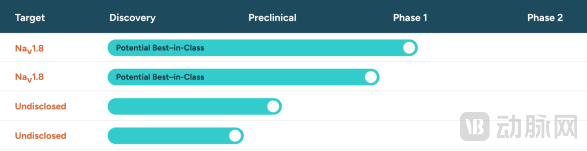
Image from the official website of Latigo Biotherapeutics
Molecular Basis of NaV1.8 Inhibitors
Electrical signals serve as the control basis for a series of physiological processes, including pain signal transmission, while sodium ion channels are the primary factors initiating these electrical signals. The generation and conduction of electrical signals in neurons depend on voltage-gated sodium channels (NaV) located on the cell membrane.
Upon depolarization of the cell membrane, sodium channels are activated and open, inducing an influx of sodium ions that further depolarizes the membrane, thereby generating an action potential. Consequently, inhibiting abnormal sodium channel activity contributes to the treatment and relief of pain.
Voltage-gated sodium channels are multi-subunit transmembrane glycoproteins expressed on the cell membrane, composed of α and β subunits with varying molecular weights. The α subunit serves as the functional unit and consists of four homologous transmembrane domains, each containing six transmembrane hydrophobic α-helices (S1–S6). S1–S4 form the voltage sensor, which regulates the hydrophilicity of the sodium ion channel pore located between S5 and S6, thereby inducing cellular depolarization or hyperpolarization and facilitating transmembrane signal transmission.
The α subunits in the human body can be classified into nine subtypes, named Nav1.1 through Nav1.9. Their abnormal inactivation or activation is associated with various neurological, cardiovascular, and muscular disorders. Among these, the subtypes primarily linked to pain are Nav1.3, Nav1.7, Nav1.8, and Nav1.9.
Among these, NaV1.8 is expressed exclusively in peripheral sensory neurons and serves as a critical ion channel involved in chronic pain, atrial fibrillation, and Budd-Chiari syndrome. Aberrant activation of these channels can lead to analgesia or pathological pain states, thereby providing potential therapeutic targets for non-addictive analgesic mechanisms.
Advantages of NaV1.8 Inhibitors
It should be noted that, since NaV1.8 is primarily distributed in nociceptive neurons, the use of selective NaV1.8 inhibitors is unlikely to cause the adverse reactions commonly associated with non-selective NaV channel inhibitors. More importantly, NaV1.8 is not involved in central nervous system-related activities; therefore, NaV1.8 inhibitors do not carry the risk of addiction similar to that of opioids, nor do they affect motor function.
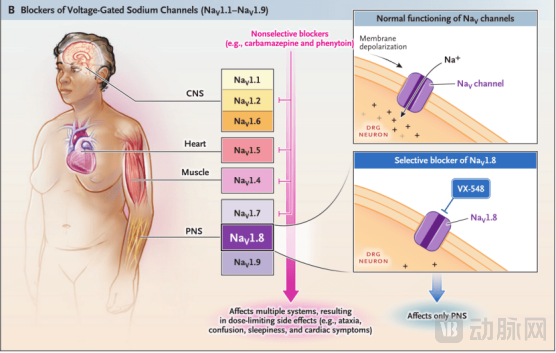
Other Players in the NaV1.8 Inhibitor Landscape
To date, there are few NaV1.8 inhibitors in development globally besides Latigo’s LTG-001. Among them, Vertex Pharmaceuticals’ VX-548 is the most advanced, currently in Phase 3 clinical trials, while the majority of others, like LTG-001, are in Phase 1 clinical trials.
However, Latigo appears undeterred, stating that a critical component of its current drug discovery efforts is ensuring that developed drugs can effectively reach tissues expressing the target. To this end, during development, Latigo minimizes the drug’s biodistribution in the central nervous system as much as possible and incorporates target tissue drug levels into human dose predictions to maximize safety.
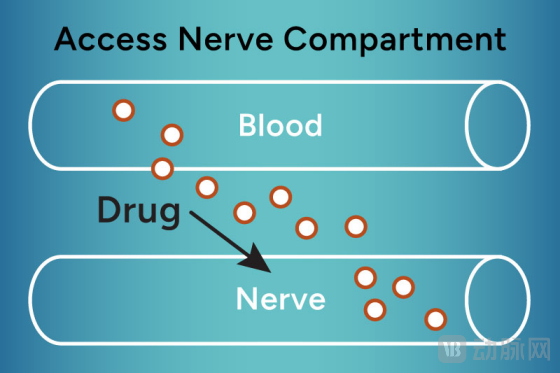
Image from the official website of Latigo