

Songshan Lake Materials Laboratory: $1.4B Invested, $7.5B in Value Created Within Five Years
Dongguan is a tireless city. Hailed as the “World’s Factory,” it is always on the move, constantly breaking new records in manufacturing. Amidst the hustle and bustle, Songshan Lake resembles a veiled maiden—shy yet poised, serene and contemplative, gazing from afar at the city’s glittering lights.
In 2018, Dongguan’s identity as the “World’s Factory” was quietly undergoing a transformation. Led by the Institute of Physics of the Chinese Academy of Sciences, in collaboration with the Guangdong Provincial Department of Science and Technology, the Dongguan Municipal Government, and the Institute of High Energy Physics of the Chinese Academy of Sciences, an institution was established on the shores of Songshan LakeASongshan Lake Materials Laboratory, Focused on the R&D of New Materials and the Commercialization of Scientific and Technological Achievements(hereinafter referred to as: Songshan Lake Laboratory).
Its establishment has not only provided a venue for researchers to exchange ideas and spark innovation, but also paved the way for translating laboratory achievements into market-ready products. From the outset of its top-level design, the commercialization of scientific and technological achievements was positioned as a distinctive strategic pillar, with long-term planning and comprehensive empowerment.In just five years since its establishment, Songshan Lake Laboratory has incubated 25 industrialization project teams and 42 commercialized companies, with a total registered capital reaching RMB 350 million.(Data as of September 2023).
What is the magic behind the “Songshan Lake Model”? Let’s start with the “birth” of the project.
I. R&D Strength: Top-Tier Talent + State-of-the-Art Equipment
Hard scientific research achievements form the foundation for the translation of technological outcomes into practical applications, with the initial step of this transformation still rooted in the research phase. The geographical location of Songshan Lake Laboratory provides it with a prerequisite advantage in attracting talent.
1High-Quality Resources Attract Top Talent
As a key node city within the Guangdong-Hong Kong-Macao Greater Bay Area, Dongguan enjoys unique advantages in attracting talent from all three regions. Due to differences in geography, industry, and institutional frameworks, Guangdong, Hong Kong, and Macao each possess distinct talent pools: Hong Kong focuses more on finance and commerce; Macao has deep-rooted connections with Portuguese-speaking countries; while Guangdong’s strengths lie primarily in manufacturing and the electronic information industry.
In recent years, with the increasing convenience of transportation and policies, exchanges and interactions among the three regions have become more frequent, further fostering a landscape of complementary progress. This has given rise to a new talent network and sparked more diverse scientific research innovations.
Songshan Lake Materials Laboratory seized this opportunity,By establishing an interdisciplinary and cross-industry innovation ecosystem, researchers from three regions have been brought together, yielding numerous cross-disciplinary achievements in materials science and related fields.
Furthermore, backed by the Institute of Physics of the Chinese Academy of Sciences, the Songshan Lake Materials Laboratory also boasts substantial “distinguished expert resources.” To ensure that researchers’ work remains at the forefront of scientific advancements, the laboratory has joined forces withUniversities in China and abroad, the Chinese Academy of Sciences, and the National Natural Science Foundation of Chinaand other institutions, inviting top international scholars for medium- to long-term or short-term visits, such asINL Laboratory, Institute of Space Materials Physics, German Aerospace Center, have all engaged in exchanges and collaborations with Songshan Lake Laboratory.
Over time, these sustained and in-depth scientific seminars have become a distinctive tradition of the Songshan Lake Laboratory, giving rise to a series of renowned international conferences and workshops.
Backed by industry leaders and enriched by the cross-pollination of diverse research perspectives, the young Songshan Lake Materials Laboratory has already yielded abundant fruits.
In 2019, the amorphous materials team led by Academician Wang Weihua developed “high-temperature bulk metallic glass” based on materials genome engineering, which was selected as one of the “Top Ten Scientific Advances in China in 2019.” Subsequently, the light-element team, led by Academician Wang Enge and Professor Liu Kaihui, achieved the controllable preparation of a single-crystal copper foil library featuring the largest dimensions and the most comprehensive set of crystal plane indices, earning recognition as one of the “Major Technological Advances in China in 2020.” By 2022, the precision instrument R&D team delivered its self-developed step profilers, marking a breakthrough from zero to domestic production of such instruments. As of November 2022, the laboratory had published 12 articles in the main journals Nature and Science, demonstrating remarkable development speed.
2Advanced Instruments Empower Cutting-Edge Research
"To do a good job, one must first sharpen one's tools." The sophistication of laboratory facilities largely determines the breadth and depth of basic scientific research.Songshan Lake Laboratory Invests 1 Billion Yuan to Establish a Public Technology Platform to Meet the Needs of the Vast Majority of Materials Scientists
Under the Public Technology Platform, there are sub-platforms for Material Preparation and Characterization, Microfabrication and Devices, Materials Computing and Databases, and the Greater Bay Area Center for Microscopy Science and Technology. The world’s second advanced attosecond laser large-scale scientific facility will also be housed in Phase II of the laboratory. Each platform is equipped with most of the instruments required for various stages, including materials design, preparation, processing, characterization, measurement, and simulation, thereby providing researchers with comprehensive support from multiple dimensions.
Simply put, researchers at the Songshan Lake Laboratory can move in with just their luggage, as the public technology platform meets nearly all their experimental equipment needs.
Only advanced instrumentation can support cutting-edge research projects. By establishing a shared technology platform, Songshan Lake Laboratory has addressed the challenges researchers face in acquiring precision instruments, thereby alleviating the financial burden on project teams and indirectly enhancing their scientific research capabilities.As of September 2023, the Songshan Lake Materials Laboratory, leveraging its public technology platform, has generated more than 720 patents, accounting for 80% of the laboratory’s total number of projects.
II. Commercialization of Achievements: The Innovative Model Factory Provides End-to-End Services
A scientific achievement emerging from the laboratory represents merely the initial step from 0 to 1, while the subsequent 99 steps must still withstand the test of the market. The challenges inherent in translating scientific research into practical applications are well known; by adopting the “Innovative Model Factory” model, the Songshan Lake Materials Laboratory has built a bridge for research teams across the “Valley of Death” in commercialization.
1Team Talent: Diversified Configuration
Like all technology transfer institutions, the Innovative Model Factory is also equipped with a dedicated commercialization team. What sets it apart, however, is that this team features a more diversified composition.
Within the translation team of the innovative model factory, in addition to staff specifically responsible for technology transfer,It is also staffed with engineers, project managers, administrative assistants, and other professionals, forming a complete talent chain for engineering research.Provide full-process support and services for the industrialization R&D of the project.
The addition of engineers to the translational team may be linked to the “specialization” of the Songshan Lake Materials Laboratory. Materials science and engineering have always maintained a complementary relationship: materials science provides the theoretical foundation and technical support for engineering, while engineering applies the theories of materials science to practical applications, thereby driving their advancement. However, knowledge within these disciplines is constantly undergoing “fission,” with research becoming increasingly specialized as it pushes toward the cutting edge. Therefore, when materials scientists design a new material, they rely on engineers to help “materialize” it.
The inclusion of engineers has spared researchers the hassle of independently seeking partners for “materials-engineering integration,” while also saving on the costs associated with adaptation and coordination.
Considering the potential “language gap” between scientific research and management, the industrialization segment also employs project managers who act as “translators” between the two parties. This allows scientist teams to focus on the R&D of industrialization projects without being distracted by trivial matters. Furthermore, nearly one-quarter of the team members in the innovative model factory have PhD or postdoctoral experience, which indirectly helps reduce the information asymmetry that may exist between the team and scientific researchers.
2Funding Support: Coexistence of Strictness and Flexibility
Financial support is also one of the key factors in the commercialization of scientific and technological achievements. Songshan Lake Laboratory has been equally generous in this regard; according to statistics, as of September 2023,The total financial investment in the laboratory reached RMB 1.077 billion, with an average funding of RMB 30 million per project.
From the perspective of the research team, funding for Songshan Lake Laboratory is both strictly regulated and flexibly allocated.
Strict controls are applied to the approval of funding amounts. During the project initiation phase, research teams may submit funding requests based on their needs and prepare a proposal outlining the justification for these financial requirements. Subsequently, a review panel composed of the Industrialization Committee and the Director’s Office Meeting will evaluate the team’s proposal from multiple dimensions, including project innovativeness and market feasibility. Funding is then disbursed on an annual basis following this assessment.
Freedom lies in the use of funding. At the Songshan Lake Laboratory, the team itself serves as the entity responsible for the dedicated use and management of funds, enjoying autonomy over their expenditure.. Therefore, the team may flexibly adjust the use of project funds in accordance with the plan.
There was a case in point: The “Practical Superconducting Thin Film Research Team,” led by Academician Zhao Zhongxian, initially planned to purchase an imported piece of equipment costing over RMB 9 million. After the purchase was blocked, the team had to independently develop a similar device, with R&D costs amounting to only around RMB 4 million. According to regulations, the funds saved by the team did not need to be returned to the laboratory and could be reallocated at the team’s discretion to other projects.
In addition to the flexibility in fund utilization, teams are also granted one or two opportunities to adjust the total amount of their funding applications. As innovation delves deeper, uncertainties multiply, making adjustments to funding needs inevitable. The quantitative limits set by the Songshan Lake Laboratory provide teams with the space to take bold initiatives while requiring them to plan ahead and proceed according to schedule.
3Market-Oriented Assessment: Dual “Diagnosis” Inside and Outside the Hospital
If the strength of the translation team and financial support can help scientific research achievements cross the "valley of death," how far they can go depends on their risk resistance. To this end, Songshan Lake Laboratory has advanced the "diagnosis" work of projects to the translation stage, optimizing project risks through multi-stage and multi-entity approaches.
First, the Songshan Lake Laboratory has designed a quarterly and annual performance appraisal system, under which individuals are treated differently based on their assessment results.On one hand, regular assessments help monitor the progress of researchers and match them with the most suitable services; on the other hand, laboratories can conduct phased quality control and corrective measures to reduce the risk of researchers “going down the wrong path.”
In addition to internal evaluations, the laboratory has specifically engaged capital partners to intervene at an early stage, providing market-oriented guidance for the team’s development.Following their evaluation of the project, capital partners issue a “Diagnostic Report” to assess the project’s market fit from multiple perspectives, including market size and feasibility, and provide corresponding “prescriptions.”
Dual assessments from both the research and market sides have laid a solid foundation for the project’s subsequent translation and eventual market entry, while also enabling researchers to gain a more intuitive understanding of the market.
III. Post-Market Entry: Songshan Lake Laboratory Provides Further Support
For many technology transfer institutions, a project’s entry into the market from the laboratory signifies “successful translation.” At Songshan Lake Laboratory, however, support continues even after commercialization. The laboratory has established an Incubation Center that provides startups with further assistance in areas such as funding, market resources, and market expansion guidance.
First is funding. Songshan Lake Laboratory has innovatively proposed"The Relay Baton Effect", meaning that once a project exits the innovation incubator, it will be immediately backed by capital as its rear-end support.
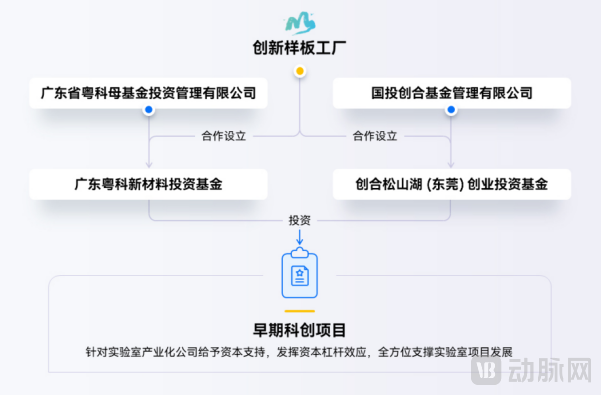 Songshan Lake Materials Laboratory’s “Relay Baton Model” (Image source: Songshan Lake Materials Laboratory official WeChat account)
Even after innovative projects enter the market, they may still face the dilemma of being unable to raise operational funds in the short term, leading to project stagnation.
To improve the “survival rate” of projects, Songshan Lake Laboratory has joined forces with Guangdong Yueke Fund of Funds Investment Management Co., Ltd. to establishGuangdong Yueke New Materials Investment Fund, and SDIC Chuanghe Fund Management Co., Ltd. established ChuangheSongshan Lake (Dongguan) Venture Capital Fund. Invest in innovative projects under the names of two major market-oriented investment funds.
This was also one of the key secrets to the success of the “Songshan Lake Model” shared by Chen Dongmin, Executive Deputy Director of the Laboratory, at the 2023 Songshan Lake Forum on Deep Integration of Industry, Academia, and Research in New Materials: “I believe that the transformation of scientific and technological achievements must create a ‘baton-passing’ effect. Central government funding, local government funding, venture capital, bank loans, IPOs, and other forms of support should sequentially back the entire chain of technology transfer—from laboratory samples and pilot-scale products to mass-produced commercial goods.”
In addition, the Songshan Lake Model maintains strong relationships with many leading brands, such as Aluminum Corporation of China, China Southern Power Grid, and FAW Group. This facilitates the integration of mature and reliable technological products into the supply chains of these top-tier enterprises. Furthermore, the Incubation Center provides continuous support and empowerment across various stages, including subsequent recruitment, corporate governance, and talent development.
Thanks to this,80% of the teams emerging from Songshan Lake Laboratory choose to return to the laboratory with their funding after completing their projects and successfully securing investment, thereby entering a second phase of rolling development.Songshan Lake Laboratory collaborated with it to jointly fund the establishment of a Joint Engineering Center, helping the team attract high-caliber talent, supporting its research on next-generation product processes, and accelerating the startup’s progression from the early stage to the growth and maturity stages.
IV. Epilogue
Five years is neither long nor short. In nature, a sapling can grow into a tree; in the scientific research community, however, scientists may have only just begun to grasp the intricacies of the unknown.
However, over the past five years, Songshan Lake Laboratory has witnessed the growth of more than 50 innovative projects. As of March 2024, the total valuation of projects incubated by Songshan Lake Laboratory had reached RMB 5.2 billion. As we have seen, it has forged a replicable and sustainable pathway for the commercialization of hard-tech scientific achievements.
Academician Wang Enge of the Chinese Academy of Sciences once said:"Whoever masters materials masters the future."Indeed, although fields such as information science and bioengineering play a crucial role in the technological competition of the 21st century, the lag in materials science and engineering will become a bottleneck for the development of other disciplines.
Looking ahead, the Songshan Lake Materials Laboratory will continue to use Dongguan as its starting point, extending its influence across the Guangdong-Hong Kong-Macao Greater Bay Area. It will build bridges to market for more technologies featuring original research and domestic production, continuing to write China’s story in the field of materials science.