

Peking University Li Yulong Team Unveils Next-Generation Serotonin Fluorescent Probes g5-HT3.0 and r5-HT1.0
The brain is one of the most sophisticated organs in the human body. It contains hundreds of millions of neurons, which transmit and process information through complex networked connections, thereby enabling various higher-order functions such as perception, thinking, memory, and emotion.
Exploring the roles and functions of individual neurons is a major focus of contemporary basic research in brain science. Genetically encoded fluorescent molecular probes are essential tools for analyzing cellular excitability and the regulation of synaptic transmission within neural circuits.
On March 5, 2024, the School of Life Sciences at Peking University, the IDG/McGovern Institute for Brain Research, and the PKU-Tsinghua Center for Life SciencesLi Yulong Research TeamAtNature methodsThe journal published“Improved green and red GRAB sensors for monitoring spatiotemporal serotonin release in vivo”Revealing Improved Green and Red 5-HT Fluorescent Probes for Monitoring 5-HT Release in Vivo under Different Conditions
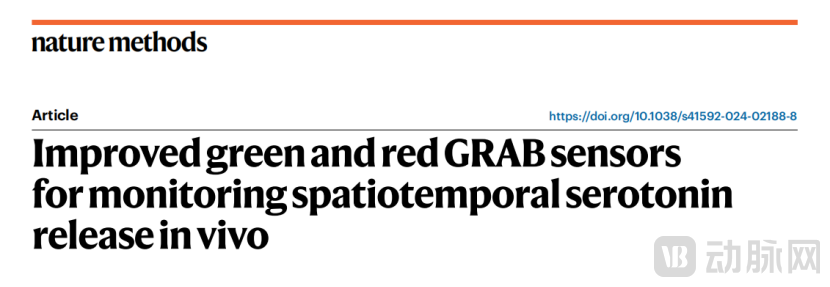 Screenshot of the paper (Image source: Nature Methods)
It is reported that,Next-generation 5-HT probes enable monitoring of 5-HT release in vitro and in vivo with high sensitivity and spatiotemporal resolution.This probe will also provide a powerful tool for research in related fields, facilitating in-depth exploration of the 5-HTergic system.
I. Leading the Field of Neurotransmitter Probes: Three Upgrades to 5-HT Fluorescent Probes
For many years, Dr. Yulong Li’s team has been dedicated to fundamental research on neuronal communication and has developed a variety of novel neurotransmitter sensors. High-efficiency fluorescent probes for neurotransmitters and neuromodulators, such as acetylcholine, dopamine, norepinephrine, and adenosine, have been widely applied in studies of neural circuit function and the mechanisms underlying the release of related signaling molecules.The 5-HT fluorescent probe published in this study represents an upgrade based on previous research.
In 2020, based on the development principles of GRAB probes, Li Yulong’s team developed the first genetically encoded fluorescent probe capable of specifically detecting serotonin, abbreviated asGRAB5-HT. Building on this foundation, the team employed protein engineering techniques to conduct a series of optimized screenings, ultimately yielding a serotonin probe characterized by high specificity, high affinity, sub-second reaction kinetics, and high spatiotemporal resolution. This advancement provides a more efficient detection method for elucidating the mechanisms of serotonin.
In April 2021, the Li Yulong team published another paper on 5-HT probes.The team fused endogenous 5-HT receptors with circularly permutated green fluorescent protein (cpGFP) and, through a series of protein engineering optimizations, developed a novel GPCR-Activation-Based (GRAB) 5-HT fluorescent probe.GRAB5-HT1.0。
The improved GRAB5-HT1.0 exhibits a fluorescence signal response amplitude of nearly 300% to 5-HT in cultured neurons, demonstrating high specificity and affinity for 5-HT molecules, with reaction kinetics reaching the sub-second level.
Building on the invention of this probe, Li Yulong’s team published successive research findings in September 2021 and March 2022, respectively addressing the mechanisms of action and functional roles of serotonin, thereby further advancing serotonin research.
In March 2024, the Li Yulong team iterated the 5-HT probe once again.This update not only optimized the green fluorescent GPCR activation-based 5-HT sensor, but also developed a red fluorescent GRAB5-HT sensor. The new generation of green 5-HT probes is namedg5-HT3.0, while the all-new red probe isr5-HT1.0。
When the two probes are used in combination, they not only exhibit higher specificity but also demonstrate improved sensitivity and spatiotemporal resolution, making them suitable for monitoring the dynamics of 5-HT in vivo. According to the team's experimental results, in addition to recording 5-HT release in the subcortical regions of freely moving mice, the probes enabled the observation of gradient 5-HT release in the dorsal cortex of mice.
Performance of the New ProbeFrom the initial “visibility” to today’s “clarity,” “depth,” and “breadth,”This facilitates researchers in deepening their understanding of the 5-HTergic system.
 Development and Characterization of an Improved Green 5-HT Probe and a Novel Red 5-HT Probe
II. In collaboration with enterprises, multiple neurotransmitter probes have been launched on the market
Professor Li Yulong holds more than ten patents related to neurotransmitter probes, with several of these patents currently undergoing commercialization through industry partnerships or already available on the market.
According toVigene BiosciencesWith authorization from Professor Li Yulong’s team, the company has developed and launched a portfolio of viral products, primarily based on adeno-associated virus (AAV) vectors. These tools enable neuroscience researchers to monitor the dynamic fluctuations of various neurotransmitters in vivo, including acetylcholine (ACh), dopamine (DA), norepinephrine (NE), and serotonin (5-HT).
Meanwhile, the company has also received regulatory approval for more than ten neurotransmitter probes developed or co-developed by Professor Li Yulong’s team, and these products have entered the market.
In addition, according toBrincaseNews: Li Yulong’s team, in collaboration with industry partners, has jointly developed several neurotransmitter probes, including rAAV-hSyn-HAlh, rAAV-hSyn-HAlm, and rAAV-hSyn-HAlmut, which have been applied in studies elucidating the dynamic regulation of histamine in the brain during sleep-wake cycles.
With the rapid development of life sciences, clinical diagnostics, and drug R&D, the Asia-Pacific region has become one of the largest fluorescent probe markets globally, with China’s market share being significant. In the future, thanks to the efforts of many researchers like Professor Li Yulong, more high-quality fluorescent probe products are sure to emerge.