

Mapping the Primate Brain: An Interview with Professor Li Chengyu of Lingang Laboratory on Advancing Neuroscience through Innovative Cell Atlas Research
From microscopic neuronal activity to macroscopic cognitive behaviors, brain science explores one of the most mysterious and complex domains of humanity. In this process, researchers, clinicians, and entrepreneurs play pivotal roles. They are not only dedicated to unraveling the mysteries of the brain but also translating scientific discoveries into practical applications, thereby advancing the progress and development of the field of brain science.
To gain deeper insights into scientific innovation, translation, clinical application, and prospects in the field of brain science, as well as entrepreneurial trends and development bottlenecks within the industry, VCBeat has launched the “Brain Talk Relay” interview series. Through dialogues with researchers, physicians, and entrepreneurs, we aim to present a comprehensive and in-depth view of the world of brain science, enabling more people to understand the latest advances and future trends in this field.
The expert for this edition of “Brain Talk Relay” is fromResearcher Li Chengyu, Lingang Laboratory, he will bring ““Single-Cell Spatial Distribution Atlas of the Macaque Cerebral Cortex”Research Story.
Imagine what the field of chemistry would look like without the periodic table of elements?
Every discipline requires such a “unifying” study. Chemistry underwent a long period of development before it fully grasped the most fundamental and essential laws; neuroscience should follow suit.
The origins of brain science can be traced back to 1906. That year, Camillo Golgi invented the Golgi staining method, and Santiago Ramón y Cajal established the neuron doctrine; the two shared the Nobel Prize in Physiology or Medicine, laying the foundation for the development of brain science.
Over the past century, brain science has gradually expanded, yielding several landmark achievements.However, a clear atlas akin to the “Periodic Table of Elements” has yet to be established for the locations, functions, and other aspects of human brain cells.—First, because research on the human brain is exceedingly complex; second, because such research raises ethical concerns.
In July 2023, Cell published a study jointly released by the Center for Excellence in Brain Science and Intelligence Technology (Institute of Neuroscience), Chinese Academy of Sciences, BGI Research, and other institutions.This study released the world’s first complete atlas of primate brain cells at the time., setting a new milestone for the development of brain science and providing a new foundation for research on brain disorders such as Alzheimer’s disease and Parkinson’s disease.
Li Chengyu, a researcher at the Center for Excellence in Brain Science and Intelligence Technology of the Chinese Academy of Sciences (currently a researcher at Lingang Laboratory), who organized and participated in this studyTell Orange Bureau: “This study is the most comprehensive ‘manual’ to date for primate brain cells.”
I. Tackling a Global Challenge
Li Chengyu still vividly remembers February 6, 2021. On that day, the sunshine in Shenzhen remained warm and gentle, with only occasional gusts of cold wind asserting winter’s dominion. Upon learning that BGI Research had successfully developedStereo-seq Spatiotemporal Omics ChipAfterward, he and Academician Mu-Ming Poo traveled to Shenzhen to evaluate this new technology. At the time, they were conceiving a major scientific research initiative aimed at elucidating“Single-Cell Spatial Distribution Atlas of the Macaque Cerebral Cortex”(hereinafter referred to as the Macaque Brain Cell Atlas).
Three years had passed since Academician Mu-Ming Poo first proposed the plan. During this period, the team advanced multiple research initiatives related to the China Brain Project, such as the “Brain Functional Connectivity Atlas,” while simultaneously searching for suitable tools. The emergence of Stereo-seq has made the goal of mapping the macaque brain cell atlas no longer elusive.
On that day, they andChairman of BGI GroupWang Jian、Dean, BGI ResearchXu XunThe discussions were highly productive, and both parties quickly reached a consensus on the future roadmap for the Brain Atlas Project, swiftly finalizing their collaboration. On the second day of the Lunar New Year, more than 20 researchers from BGI Research visited the Center for Excellence in Brain Science and Intelligence Technology of the Chinese Academy of Sciences (hereinafter referred to as the Institute of Neuroscience) for study and exchange. The following day, they formulated a detailed research plan. At that time, the team’s excitement and apprehension about the imminent launch of the Brain Atlas Project even surpassed their anticipation for the New Year celebrations.
Internationally, research on brain cell atlases has consistently attracted significant attention and is characterized by intense competition, with many research teams having established their strategic presence early on. For instance, the "Brain Initiative" launched by the United States in 2013 aims ultimately to map the most comprehensive human brain cell atlas in the world. After a decade of operation and nearly $1 billion in investment, the project has made rapid progress, with three series of articles published in Nature and Science between 2021 and 2023.
Mapping the human brain cell atlas is highly challenging, so many teams begin by characterizing the brain cell atlases of animals such as mice, fish, and chimpanzees.Mu-Ming Poo and Chengyu Li’s team selected macaques as their model organism. As the model species most closely related to humans in evolutionary terms, macaques present considerable research challenges.But Li Chengyu and his team never considered giving up: “We are all aware that this is a monumental challenge, but if you shy away from challenges, you cannot conduct rigorous scientific research.”
II. Spanning three years, with research data exceeding 300 TB
What Li Chengyu did not expect was that the project encountered difficulties during the experimental phase.
BGI Research provided advanced single-cell resolution sequencing chips for the project and incorporated additional functionalities, such as RNA capture within cells, to meet experimental requirements. With the support of these cutting-edge research tools, reading spatial transcriptomics data should have been a straightforward task; however, incomplete cell readouts unexpectedly occurred.
The brain tissue of a macaque is roughly the size of an adult human fist. To precisely determine the spatial location of every cell, the team had to slice it into sections 10 micrometers thick. However, precisely because the slices were so thin, they tended to curl up, preventing full adherence to the chip and resulting in incomplete cellular data acquisition. Li Chengyu offered a “not entirely apt” analogy: “It’s like thinly sliced lamb for hot pot; if you cut it too thin, it curls up.”
The team subsequently attempted various approaches, experimenting with multiple degrees of dehydration and clearing protocols, and ultimately resolved the issue through the most traditional method—"Cryosection macaque brain tissue, thaw the sections using hand warmth, and mount them onto the chip, ensuring the absence of air bubbles."
Through this repetitive process of sectioning, mounting, and data acquisition, a team of over 100 researchers spent more than a month to complete the cellular statistical analysis of a single macaque brain. Some scientists jokingly remarked, “We’ve all become craftsmen this past month.”
Just as the project was about to move forward to the next phase, the pandemic broke out, bringing all offline work to a halt.
No one knew how long it would take to return to the laboratory. To ensure the research progressed in an orderly manner, the team adoptedOrganized Researchthe method.
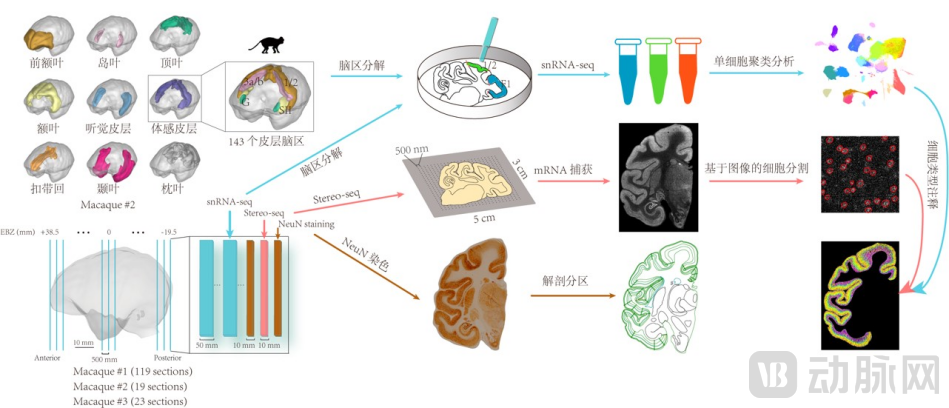
 Overall Experimental Design (Image source: Lingang Laboratory)
The team comprises 106 researchers from various domestic and international research institutions, each with distinct areas of expertise and scientific approaches. For instance, Tencent AI Lab has extensive experience in applying AI to single-cell sequencing, while the Lingang Laboratory possesses deep knowledge in cell classification and gene expression. To maximize efficiency, each team is responsible only for the aspects within its core competency.
Furthermore, to refine experimental progress, each team held daily morning meetings to meticulously assign tasks to every researcher and developed Gantt charts in 20-minute increments. Brief departmental meetings were conducted at noon to assess whether actual operations aligned with the plans. Finally, evening summary meetings were held to consolidate reports on research progress. To foster integration among teams, relevant training programs were implemented during the research period to ensure that every researcher could effectively fulfill their assigned responsibilities.
In just two months, the team completed the analysis of over 6 billion cells in the macaque brain through organized scientific research., and completed the initial submission in November 2021.
Unfortunately, this submission was not accepted.
Following a comprehensive review and reflection, the team identified further potential for data mining. Consequently, they conducted additional experiments, acquiring 161 spatial transcriptomic sections (10 μm in thickness) from the left hemispheres of three macaques using Stereo-seq technology. Simultaneously, they generated single-nucleus transcriptomic data at the million-cell level from the macaque cerebral cortex by combining laser capture microdissection with single-nucleus RNA sequencing. Through integrated analysis of single-cell and spatial transcriptomics, they constructed a three-dimensional single-cell atlas of the entire cerebral cortex in cynomolgus monkeys.This study generated over 300 TB of data and obtained spatial transcriptomic information for more than 42 million cells, representing the largest dataset produced in the field of brain spatial omics research at that time.
Impacted by the pandemic, the research progressed slowly and with many setbacks. Finally, in May 2023, the study was accepted by Cell and officially published online in July. “When we learned that our paper had been accepted, the entire lab erupted in celebration. I believe this represents not only the success of a single project, but also lays a foundation for the development of brain science.” Looking back on those three years of research, Li Chengyu remains deeply moved.
III. The “Periodic Table” of the Neuroscience Community
The Rhesus Macaque Brain Cell Atlas Study: Deciphering the Composition and Spatial Distribution of Cortical Cell Subtypes, Crucial for Elucidating the Organizational Principles of the Primate Brain
First, it was the most comprehensive study at the time on cell types and their molecular characteristics in the primate cerebral cortex, while also mapping the spatial distribution of different cell types.Using this atlas, scientists can clearly identify the cell types present in the macaque cerebral cortex and their spatial distribution.
Second, it lays a solid foundation for humanity to conquer brain diseases.Primate brains contain a vast number of neurons that interconnect to form complex and intricate neural circuits supporting higher-order cognition and behavior; abnormalities in these cells and circuits underlie various brain disorders. By mapping the locations and functions of brain cells, we will be better positioned to accurately identify therapeutic targets for brain diseases, thereby providing precision treatment strategies for conditions currently deemed “untreatable.”
This research is also expected to drive breakthrough advancements in the field of brain science.In future research on neuromorphic intelligence and brain-computer interfaces, this study can help researchers identify target brain regions for precise EEG signal acquisition, thereby enabling more complex bodily activities.
In addition, Li Chengyu believes that this study may serve as the starting point for cross-species research in brain science.In the future, researchers may even explore the brain cell atlases of more model organisms, such as turtles, birds, and mice, to investigate evolutionary changes in the brain and unravel the mysteries of unknown brain regions.
Certainly, the broader value of the macaque brain cell atlas research remains to be validated over time. In the future, the Brain Atlas Team will continue to deepen this research and make further breakthroughs in areas such as elucidating the mechanisms of brain diseases and developing therapeutic targets, understanding the evolution of brain cells and structures, and uncovering the cellular and molecular mechanisms underlying brain function, thereby fostering the growth of more neuroscience applications in China.