

Xingqi Pharma's Breakthrough Ophthalmic Drug Approved, Reshaping the Myopia Control Market

Xingqi Pharmaceutical
Ophthalmic Drug Research, Development, Production, and Sales
A Blockbuster Product in Optometry Receives Approval
On March 11, 2024, Shenyang Xingqi Pharmaceutical’s 0.01% atropine sulfate eye drops received marketing approval. The approved clinical indication is for slowing the progression of myopia in children aged 6 to 12 years with spherical equivalent refraction ranging from -1.00 D to -4.00 D (astigmatism ≤1.50 D and anisometropia ≤1.50 D). Buoyed by this positive development, Xingqi Pharmaceutical’s stock price surged, with intraday gains exceeding 19% on March 12 before closing up 12.88% at 186.8 yuan per share.
Low-concentration atropine sulfate eye drops were previously primarily used in China as hospital-compounded preparations. Xingqi Pharmaceutical’s 0.01% atropine is the first chemically manufactured atropine sulfate eye drop approved for marketing by the National Medical Products Administration (NMPA). No comparable products have yet been approved for indications related to myopia in children. Globally, low-concentration atropine eye drops are already available in markets such as Singapore, Japan, and Taiwan, with an average annual usage cost of RMB 3,000 to 4,000.
Xingqi Pharmaceutical’s low-concentration atropine has become a unique proprietary product following its market launch. The price has not yet been announced; according to forecasts by Debon Securities, the current annual cost of mainstream in-house hospital atropine preparations is approximately RMB 3,600. Under a neutral scenario, Xingqi’s product is expected to reach its sales peak in the third full year after launch (i.e., 2027), hitting RMB 10.18 billion and reshaping the landscape of the ophthalmic drug market.
Myopia prevention and control has been one of the most high-profile sectors in recent years, giving rise to multiple multi-billion-dollar markets for products such as orthokeratology (OK) lenses and defocus spectacles. With the market launch of low-concentration atropine, what changes will occur in the myopia prevention and control market for children and adolescents?
Driven by its high growth potential and advanced technological nature, the ophthalmology sector has emerged in recent years as an undisputed “star sector.” Within this field, myopia prevention and control among children and adolescents represents a key area of focus.
In the field of myopia prevention and control among children and adolescents, supply-side interventions such as low-concentration atropine, orthokeratology lenses, and defocus spectacles are continuously being updated and improved;On the service provider side, optometry institutions are accelerating their expansion into lower-tier markets to enhance service accessibility, thereby driving the robust growth of the myopia prevention and control market. CICC projects that, fueled by strong demand, the market size for myopia prevention and control is expected to reach approximately RMB 210 billion by 2030, representing a ten-year CAGR of about 13.7% (or nearly 25% when excluding conventional spectacle lenses).
Currently, common myopia correction measures for children and adolescents include optical correction (such as standard single-vision spectacles, orthokeratology lenses, and spectacles/contact lenses with special optical designs), pharmacological control (such as low-concentration atropine eye drops), and surgical correction. Each measure has strict indications. Among these, defocus spectacles, orthokeratology lenses, and low-concentration atropine are the three primary therapeutic approaches for myopia prevention and control in children.
China has a large population of children with myopia, resulting in strong demand for myopia prevention and control, which current supply fails to meet.Taking low-concentration atropine as an example, although the mechanism by which it prevents and controls myopia in children and adolescents has not been fully elucidated, the topical administration of low-concentration atropine sulfate eye drops has become one of the primary methods for myopia control in this population.
Previously, there were no commercially available low-concentration atropine sulfate ophthalmic preparations in China. In clinical practice, these formulations were primarily compounded and used in-house by major hospitals across the country. The lack of uniform standards in the compounding process among different institutions has introduced certain uncertainties regarding the safety and efficacy evaluation of their clinical application.
The launch of the first low-concentration atropine sulfate product will unlock a new market worth tens of billions of yuan.According to data on myopia prevalence among children and adolescents in China in 2020, released by the National Health Commission, the overall myopia rate was 52.7%. Specifically, the rate was 14.3% among 6-year-olds, 35.6% among primary school students, 71.1% among junior high school students, and 80.5% among senior high school students, indicating a trend of high prevalence and onset at younger ages. Low-concentration atropine is primarily used for myopia prevention and control in children and adolescents aged 5–16 years, a population comprising nearly 100 million individuals with myopia.
Compared with other myopia control methods for children, the advantages of low-concentration atropine lie in its efficacy being recognized by the National Health Commission, its affordable price, and its high compliance. According to Phase III clinical trial data conducted by Xingqi Pharmaceutical and the Singapore National Eye Centre (SNEC), 406 pediatric subjects aged 6–12 years underwent a one-year medication observation period, followed by a six-month follow-up after discontinuation. Compared with the placebo group, the atropine sulfate eye drops group demonstrated statistically significant differences in primary efficacy endpoints. Furthermore, atropine sulfate eye drops exhibited a favorable safety profile and good patient compliance.
However, a research paper published online in the internationally renowned medical journal JAMA in 2023 by Professor Ren Zhuosheng’s team at The Chinese University of Hong Kong demonstrated that, among children aged 4–9 years without myopia, nighttime use of 0.05% atropine eye drops significantly reduced the incidence of myopia and decreased the percentage of participants experiencing rapid myopia progression over two years, compared with placebo. In contrast, the difference between 0.01% atropine and placebo was not statistically significant.
Although low-concentration atropine has faced some controversy as a myopia treatment, demand remains strong due to the large population of children and adolescents with myopia in China.
Xingqi Eye Hospital, a subsidiary of Xingqi Pharmaceutical, generates annual sales exceeding RMB 200 million from its low-concentration atropine formulations. Many parents also purchase low-concentration atropine through proxy buyers at a premium. According to Nanfang Daily, this so-called “miracle drug” was once sold for RMB 350 per box and experienced exceptionally strong demand.
With Xingqi Pharmaceutical’s 0.01% atropine sulfate launched via the Class 3 chemical drug pathway, the market for low-concentration atropine has been well educated amid robust demand, resulting in high parental awareness. Low-concentration atropine sulfate eye drops are poised to achieve rapid sales volume growth driven by strong product competitiveness.
Industry insiders predict that, following the approval of low-concentration atropine, its sales volume in 2024 is expected to reach RMB 2.5–3 billion, making it a blockbuster product in the consumer healthcare sector with annual sales exceeding RMB 1 billion.
More than 10 companies have entered the low-concentration atropine market. Why has Xingqi Pharmaceutical taken the lead?
In 1989, Liu Jidong (currently Party Secretary and Chairman of Xingqi Pharmaceutical) took over a small pharmaceutical factory on the verge of bankruptcy, when he was serving as its director. On July 5, 2000, Shenyang Xingqi Pharmaceutical Factory underwent structural reform, with Liu Jidong appointed as Chairman. For decades, Xingqi Pharmaceutical has been dedicated to the development of new products in the field of ophthalmology. Atropine eye drops have long been a core focus area for Xingqi Pharmaceutical.
Xingqi Pharmaceutical initiated the low-concentration atropine project as early as 2012 and obtained the registration approval for the medical institution preparation of 0.01% atropine eye drops in January 2019.
In 2016, Liu Jidong secured independent authorization from the Singapore National Eye Centre (SNEC) to access ten years of clinical data on atropine. In Liu’s view, “The significance of collaborating with Singapore lies in gaining access to raw experimental data, which allows us to avoid unnecessary detours and accelerate the R&D process.”
Previously, Xingqi Pharmaceutical primarily sold atropine eye drops through in-house hospital preparations and its internet hospital, generating substantial revenue for the company.. Revenue from atropine formulations is primarily derived from the subsidiary, Xingqi Eye Hospital. According to disclosed data, from January to July 2021, Xingqi Eye Hospital generated RMB 142 million in revenue from atropine eye drop formulations, accounting for over 88.6% of its total revenue.
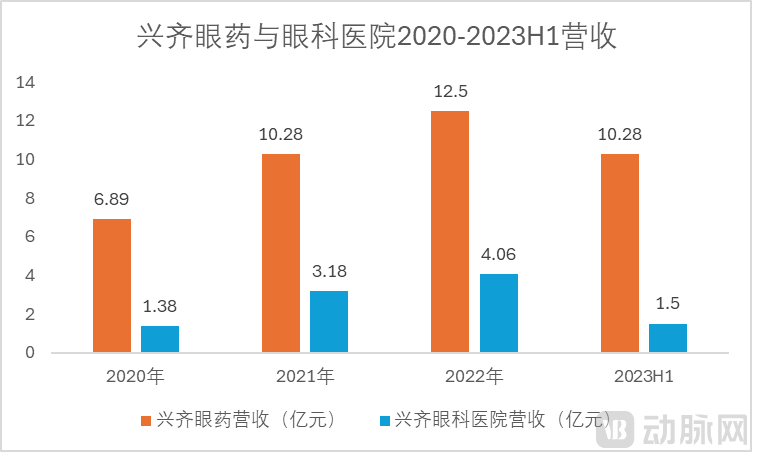
According to data disclosed in Xingqi Pharmaceutical’s annual reports, the operating revenue of Xingqi Eye Hospital amounted to RMB 406 million in 2022 and RMB 150 million in the first half of 2023. Based on the estimate that atropine formulations account for 80% of the eye hospital’s revenue, atropine eye drops have generated at least RMB 200 million in annual revenue for Xingqi Pharmaceutical in recent years.
The decline in hospital revenue was driven by policy changes. In July 2022, new regulations for internet hospitals were introduced, prohibiting the sale of in-house hospital preparations through internet hospital channels. This policy has impacted Xingqi Pharmaceutical’s medical services business from the third quarter of 2022 to the present. Financial report data shows that in the first three quarters of 2023, Xingqi Pharmaceutical recorded revenue of RMB 1.105 billion, a year-on-year increase of 10.02%, while net profit attributable to shareholders stood at RMB 182 million, representing a year-on-year decrease of 10.11%.
With the approval of Xingqi Pharmaceutical’s low-concentration atropine as a chemical drug, in accordance with the provisions of the Administrative Measures for the Registration of Hospital Preparations (Trial), no new approvals will be granted for hospital preparations from other medical institutions, and existing licenses for such preparations will not be renewed upon expiration.
In addition to Xingqi Pharmaceutical being the first to secure approval, several other companies are poised to launch their low-concentration atropine products. According to the official website of the Center for Drug Evaluation (CDE), low-concentration atropine eye drops from numerous enterprises—including Zhaoko Ophthalmology, Hengrui Medicine, Ocumension Therapeutics, Santen Pharmaceutical, Extreme Vision Biology, Healths Technology, Shapuaisi, Qilu Pharmaceutical, Allergan, and Borui Pharmaceutical—have all entered clinical trials. Many of these companies are currently at the Phase III clinical trial stage.
Xingqi Pharmaceutical’s advantages lie, on the one hand, in being the first to obtain marketing approval for its product, thereby enjoying a period of market exclusivity; on the other hand, Xingqi Pharmaceutical received the registration approval for the 0.01% atropine eye drops as a medical institution preparation in January 2019. Its early deployment has helped build brand recognition, facilitating subsequent market promotion of atropine.
The launch of a blockbuster product often cannibalizes the market share of existing products. How will the introduction of low-concentration atropine affect the competitive landscape of the myopia prevention and control market for children and adolescents?
There are limited clinical interventions capable of slowing the progression of myopia in children. Orthokeratology (OK lenses), defocus spectacle lenses, and low-concentration atropine have been validated to some extent as effective measures for delaying myopia progression.
Different products all have certain shortcomings and are not suitable for everyone. What are the characteristics of different myopia prevention and control methods for children and adolescents?
High-concentration atropine eye drops are associated with significant side effects and a rebound effect. Low-concentration atropine eye drops (0.01%–0.05%) have minimal impact on pupil diameter and accommodation, effectively controlling or slowing the progression of myopia in children with fewer side effects. Studies have shown that 0.01% atropine eye drops can effectively delay the progression of myopia in children, with a lower risk of rebound and fewer side effects; however, they should be used under medical supervision. The safety of low-concentration atropine eye drops requires careful monitoring when used in younger children or for long-term treatment.
Orthokeratology (OK) lenses are among the few interventions that have gained clinical recognition and been included in the National Health Commission’s guidelines for myopia prevention and control, where they are acknowledged as an effective method for slowing myopia progression.Orthokeratology (OK) lenses are worn overnight, using the pressure of the eyelids during sleep to flatten the central corneal tissue. Studies have shown that OK lenses can slow axial elongation and play a role in delaying myopia progression; however, they are not suitable for everyone. A comprehensive examination at a professional medical institution is required to determine eligibility. As Class III medical devices, the fitting of OK lenses is a rigorous, scientific medical procedure that must be performed by practitioners with appropriate medical qualifications.
From a pricing perspective, OK lenses currently retail for between RMB 7,000 and RMB 12,000. They need to be replaced every 1 to 1.5 years, and the ongoing costs for care solutions and eye drops are also substantial. Furthermore, their use requires a high level of patient compliance.
Defocus Lenses: Affordable and Easy to Use, Market Sees Explosive GrowthDefocus spectacle lenses work by projecting peripheral images onto or in front of the retina, creating peripheral myopic defocus, thereby preventing excessive axial elongation and slowing myopia progression. Defocus soft contact lenses are a novel type of soft corneal contact lens that also leverage the principle of “peripheral defocus” to delay myopia progression. CooperVision’s defocus soft contact lens product, MiSight, received priority review from China’s National Medical Products Administration (NMPA) and was approved in August 2021.
Myopic defocus spectacle lenses are cost-effective, easy to use, and, as non-medical devices, can be prescribed and fitted at optical retail stores. Consequently, their penetration rate among adolescents with myopia has risen rapidly, surpassing that of orthokeratology (OK) lenses. However, clinical practice has revealed that existing myopic defocus lens designs on the market provide only static and fixed defocus stimulation signals. This limitation may lead to saturation of the therapeutic effect, causing a gradual decline in myopia control efficacy for some patients over prolonged wear. In terms of price, myopic defocus spectacle lenses have an average cost of approximately RMB 3,500 per pair, which is significantly lower than that of OK lenses.
It is worth emphasizing that, under current medical technological conditions, myopia cannot be cured. Existing products on the market all have certain limitations, and the future landscape of the myopia prevention and control market is likely to trend toward the coexistence of multiple product types. Meanwhile, new products offering sustained and effective myopia prevention and control will remain a key focus of industry attention.
References:
A Matter of Children’s Vision! China’s First Eye Drop to Slow Myopia in Children Approved—Previously Banned from Online Sales — China Business News
Expert Consensus on the Preparation of Ophthalmic Formulations of Low-Concentration Atropine Sulfate for Controlling Myopia Progression (2023) — Chinese Journal of Experimental Ophthalmology
Thirty Q&A on Myopia Prevention and Control—Ministry of Education
The “Miracle Drug” with Annual Sales of 280 Million Yuan: Chinese Teenagers Should Be Cautious — Shijie