

Navigating Change and Seizing Opportunities: The Rise of Domestic HMOs in China
Human Milk Oligosaccharides (HMOs) Have Entered a Fast Lane of Development. Recently, the Department of Food Safety Standards, Monitoring and Risk Assessment of the National Health Commission issued another announcement, approving yet another HMO, 2'-Fucosyllactose (2'-FL). This marks the second approval of HMOs in China. In October 2023, two HMO ingredients, 2'-FL (2'-Fucosyllactose) and LNnT (Lacto-N-neotetraose), were officially approved as food nutrient fortifiers, applicable to infant formula, modified milk powder (for children), and special medical purpose infant foods.
The rapid advancement of synthetic biology has provided a new pathway for the industrialization of human milk oligosaccharides (HMOs), overcoming the challenges associated with chemical synthesis, such as high costs and cumbersome production processes, as well as the difficulties in scaling up enzymatic synthesis.The approval of HMOs in China not only holds significant importance for reshaping the industrial chain, but also signals the move toward legalization of synthetic biology products.
Empowering downstream and end-users,
Promoting the Upgrading of Downstream Products and High-Quality Industry Development
For domestic dairy companies, the approval of HMOs marks the beginning of a “major battle” for product upgrading. Public reports indicate that leading Chinese dairy enterprises launched HMOs research programs around the time of approval. Almost simultaneously, multiple domestic dairy brands rolled out advertisements for “HMOs-infant formula,” vying for the title of “the first domestically produced.” This intense competition clearly foreshadows that HMOs will become one of the key ingredients in the future competitive landscape of the infant formula sector.
Image source: 123rf
# What Are HMOs?HMOs (Human Milk Oligosaccharides), also known as human milk oligosaccharides, are naturally occurring oligosaccharides in human breast milk. Composed of 3–14 monosaccharide units, they constitute the third most abundant component in human breast milk solids (after lactose and fat), accounting for more than 10% of the dry matter content.
As early as the 19th century, scientists abroad discovered a link between bacteria in the infant gut and digestive function. In the early 20th century, experiments confirmed differences in the bacterial composition of feces from breastfed and formula-fed infants. Components with carbohydrate characteristics were detected in human milk whey and named “gynolactose” (human milk oligosaccharides), and oligosaccharides were subsequently isolated from these human milk oligosaccharides. Because these oligosaccharides are present in very high concentrations in human breast milk but only in trace amounts in cow’s and goat’s milk, they are termed Human Milk Oligosaccharides (HMOs). Since then, research on the analysis and functions of HMOs has become a hot topic and has advanced rapidly. Extensive experimental evidence abroad has demonstrated that HMOs possess antibacterial, antiviral, immunomodulatory, and gut health-promoting properties, playing a critical role in the growth and health of infants and young children.
Since the beginning of this century, advances in analytical technologies have enabled the identification and isolation of more than 200 individual human milk oligosaccharides (HMOs) from human breast milk. There is substantial variation in the concentrations of different HMO species in breast milk; approximately 25 HMOs account for 90% of the total HMO content, and most of their structures are not found in the milk of other animals. The most abundant and extensively studied individual HMOs include 2′-fucosyllactose (2′-FL), 3′-fucosyllactose (3′-FL), 3′-sialyllactose (3′-SL), 6′-sialyllactose (6′-SL), lacto-N-tetraose (LNT), and lacto-N-neotetraose (LNnT).
Based on the monomers attached to the lactose molecule, HMOs can be classified into three major categories: fucosylated neutral HMOs, sialylated acidic HMOs, and non-fucosylated neutral HMOs. Based on the core structures they contain, HMOs can be divided into Type I and Type II. Among HMOs, Type I is more abundant than Type II, and the Type I core structure LNT is the most abundant core structure in HMOs. Based on sugar unit composition, HMOs can be classified as fucosylated, sialylated, and non-fucosylated types. Based on the presence or absence of acidic groups, HMOs can be divided into neutral HMOs and acidic HMOs, with neutral HMOs accounting for approximately 70% of those in human milk.
Internationally, human milk oligosaccharides (HMOs) have been widely applied in infant formula, dietary supplements, functional foods, and foods for special medical purposes. Since the concentration of each individual HMO varies in breast milk, the approved usage levels for different HMOs differ accordingly based on their respective concentrations in breast milk. According to regulatory approvals in the United States, the European Union, Australia, and New Zealand, 2'-fucosyllactose (2'-FL) has the highest permitted addition level, up to 2.4 g/L. Since Abbott launched the first HMO-containing infant formula in 2015 with an addition level of less than 0.1%, the scientifically determined inclusion levels of HMOs have gradually increased, establishing them as essential nutritional components in infant formula.
A review recently published in Nutrients【1】A summary of 31 clinical trials on HMO supplementation in diverse populations, primarily infants but also including children and adults. All trial results demonstrated that HMO supplements are safe and well-tolerated across different ages and health statuses, regardless of HMO structure or dosage.
Simulating breast milk has always been the core focus of infant formula development, making the addition of human milk oligosaccharides (HMOs) the gold standard for mimicking breast milk in infant formulas. Prior to the approval of HMOs, most domestically produced infant formulas relied on plant-derived fructooligosaccharides (FOS) and lactose-derived galactooligosaccharides (GOS) to “substitute” for the functions of HMOs. The recent formal approval of HMOs not only marks a significant trend in the upgrading and optimization of dairy companies’ formula compositions but also represents a new breakthrough in research on breast milk-like infant formulas. Furthermore, these innovative formula advancements not only drive industry upgrades and high-quality development but also benefit consumers by enabling the market to meet their growing demand for precise nutrition with more advanced products.
Image source: Freepik
According to Milk Powder Intelligence, views for HMO-related keywords on Xiaohongshu (Little Red Book) have surpassed 100 million. If dairy companies can leverage HMOs as a new selling point, they are bound to carve out a differentiated advantage in the fiercely competitive dairy sector. However, it is important to note that registering new HMO formulations with regulatory authorities requires a cycle of at least 6–8 months, with costs—including registration fees, new formulation trials, and reporting—running into the millions. As the wave of implementation for the new national standards for infant formula has yet to subside in the first half of this year, HMO formulations are poised to stir up new waves. It is foreseeable that market concentration will further increase in the future, making it increasingly difficult for small and medium-sized dairy enterprises to sustain their operations.
Chinese HMO Companies Ride the Momentum, Poised to Reshape the Global HMO Landscape
Only a few months separated the two announcements issued by the National Health Commission. According to the announcements, among the companies approved for HMOs, there were two foreign enterprises and two domestic enterprises.
Internationally, since the first approval of human milk oligosaccharides (HMOs) in 2015, regulatory filings for HMOs in Europe and the United States have progressed rapidly. Statistics indicate that there are currently no more than 20 HMO manufacturers worldwide. In addition to independent innovation, many HMO companies are continuing to introduce new products through acquisitions or collaborations. Given the potent functionalities of HMOs, their application scenarios are diverse, offering substantial market potential. The domestic approval of HMOs not only provides Chinese dairy companies with the opportunity to compete on equal footing with international counterparts, thereby further narrowing the gap in technological innovation and product upgrading, but also signifies that Chinese HMO ingredient manufacturers and foreign HMO suppliers now stand on the same competitive stage.
In China, although the industry started slightly later, domestic HMO companies have grown rapidly alongside the rise of synthetic biology, achieving significant scale in both technology and production capacity in recent years. Following regulatory approval of HMOs, Chinese HMO enterprises are not only fully capable of meeting market demand but also poised to compete on equal footing with their European counterparts, offering new solutions to address the critical bottlenecks in precise infant nutrition in China.
Furthermore, studies have shown that factors such as genetics, geography, and environment influence the composition of human milk oligosaccharides (HMOs) in breast milk, leading to variations across different countries and ethnic groups. This provides HMO companies in various nations with a strategic advantage for deepening their localized development.
Currently, some domestic companies have made in-depth investments in the field of HMOs through synthetic biology. With the approval of HMOs in China, a number of Chinese enterprises are poised to enter the international market, reshaping the competitive landscape of the global HMOs industry.
Opening a Legal Pathway for Domestic Synthetic Biology Products,
Green Biomanufacturing Leads the Future
Currently, there are four main methods for the commercial production of human milk oligosaccharides (HMOs): biological extraction, chemical synthesis, enzymatic preparation, and biosynthesis. Since the vast majority of HMOs are unique to human breast milk and involve complex purification processes, HMOs obtained via biological extraction are primarily used for scientific research. Chemical synthesis involves complex reaction processes, expensive substrates, numerous by-products, and environmental concerns; therefore, it is currently mainly employed for small-scale HMOs production for analytical purposes. In enzymatic preparation, the substrates for enzymatic reactions are costly, in vitro enzyme activity and specificity are limited, and yields are relatively low. Consequently, this method is often combined with chemical synthesis to form chemoenzymatic approaches, which are predominantly used for scientific research.
Biosynthesis (i.e., microbial fermentation) leverages the intrinsic metabolic capabilities of microorganisms to convert low-cost sugar feedstocks into human milk oligosaccharide (HMO) components. Compared with other production technologies, biosynthesis offers advantages such as lower production costs and reduced environmental pollution, making it the predominant technology for the industrial-scale production of HMOs. Currently, HMOs approved for use internationally are primarily manufactured via biosynthetic methods. This approach involves engineering cellular factories through metabolic engineering by introducing genes involved in the product biosynthetic pathway and reconstructing their metabolic networks to enable efficient HMO synthesis.
Both 2'-FL and LNnT, approved by the National Health Commission on two separate occasions, are produced via biosynthetic methods. These two HMO ingredients are manufactured using lactose and other raw materials through processes including fermentation, purification, and drying. The announcement permits 2'-FL and LNnT to be used as nutritional fortifiers in formulated milk powder (restricted to children's milk powder), infant formula, follow-on formula for older infants and young children, and infant formula for special medical purposes. Internationally, regulatory bodies such as the U.S. Food and Drug Administration (FDA), the European Commission, and Food Standards Australia New Zealand (FSANZ) have authorized the use of biosynthetically produced 2'-FL and LNnT in food categories including infant formula. It is anticipated that the application scenarios for HMOs in China will continue to expand and diversify in the future.
Leveraging the potent benefits of human milk oligosaccharides (HMOs), their applications extend beyond infant formula to include probiotics, functional foods, and foods for special medical purposes (FSMP). In the era of the "silver economy," elderly nutrition may also emerge as a significant growth driver for HMO adoption. Looking ahead, in addition to becoming a standard ingredient in infant formula, HMO usage is expected to follow four key trends: an increasing number of brands incorporating HMOs, a growing variety of HMO-fortified products, a more comprehensive range of HMO types being added, and higher concentrations of HMOs in formulations.
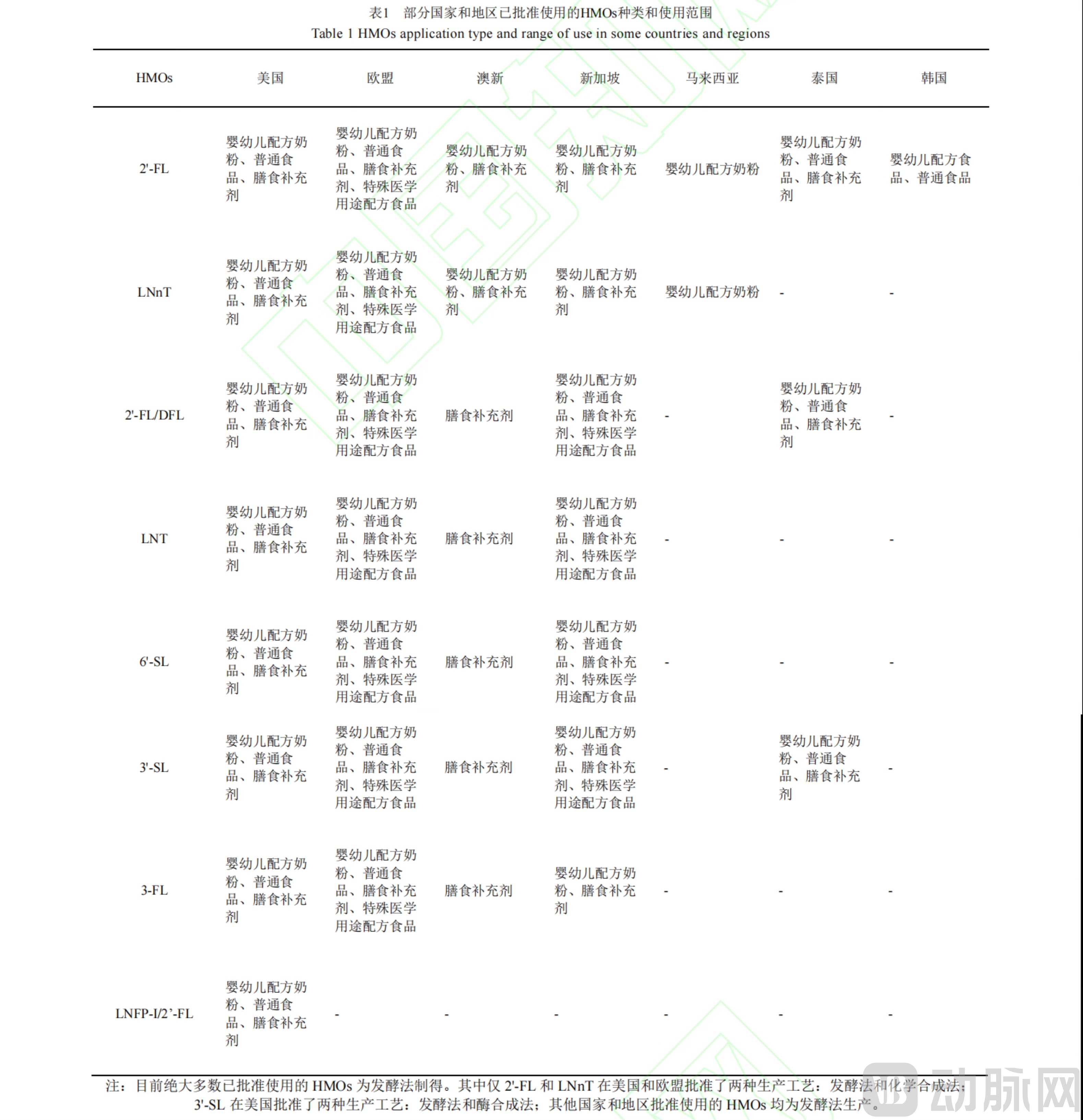 Scientific Consensus on Human Milk Oligosaccharides【2】
As of March 2024, the National Health Commission has accepted a total of 16 applications for 2'-fucosyllactose (2'-FL), 3 applications for sodium 3'-sialyllactate (3'-SL), 2 applications for sodium 6'-sialyllactate (6'-SL), 1 application for lacto-N-neotetraose (LNnT), 1 application for 3-fucosyllactose (3-FL), and 1 application for lacto-N-tetraose (LNT). The specific acceptance details are shown in the table below. Relevant approvals are being actively and orderly conducted. It is believed that more human milk oligosaccharide (HMO) components will soon be scientifically added to and applied in infant formula, thereby making the composition and function of infant formula closer to those of breast milk.
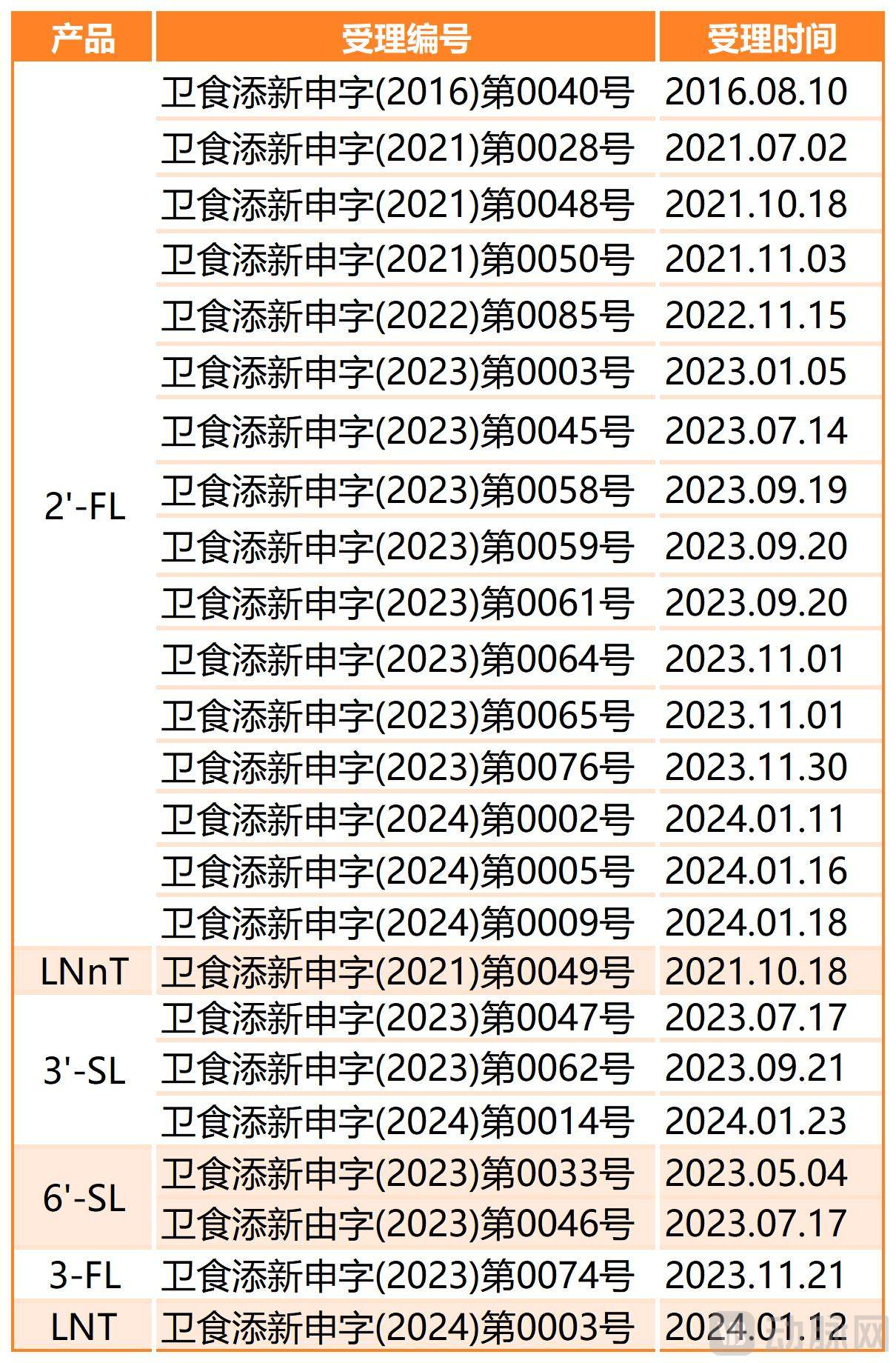
Compiled from information on the official website of the National Health Commission; graphic by VCBeat
With the continuous advancement of synthetic biology technologies, the biosynthesis of an increasing number of products is becoming feasible. According to McKinsey’s forecasts, bio-manufactured products could account for 60% of all chemically manufactured products in the future. Between 2030 and 2040, the annual economic impact of synthetic biology is projected to reach $1.8–$3.6 trillion.
Since 2021, relevant Chinese authorities have been paying increasing attention to the approval of novel food ingredients derived from synthetic biology. The “14th Five-Year Plan for Bioeconomy Development” explicitly calls for vigorous development of synthetic biology technologies to drive iterative upgrades in the food industry. The recent approval of human milk oligosaccharides (HMOs) signals that China’s regulatory review of “three-new foods” (new food raw materials, new food additives, and new food-related products) in the biosynthetic sector has entered a new phase, opening a legal pathway for biosynthetic products. This development undoubtedly serves as a significant boost to biosynthetic enterprises, investors, and companies across the upstream and downstream supply chain.
In the future, it is certain that more high-quality biosynthetic raw materials and products will be continuously approved and brought to market, creating greater value for China’s socioeconomic growth and high-quality development. Leveraging the significant advantages of synthetic biology technologies and biomanufacturing, a promising blueprint has been drawn for the industry’s future development. With continuous technological advancements, the broad application scenarios of synthetic biology products in the food sector and many other industries will undoubtedly drive social progress and bring about more positive transformations.
Conclusion
2023 marked the inaugural year for human milk oligosaccharides (HMOs) in China. The formal approval of HMOs has injected new momentum into industrial upgrading and high-quality development, while also signifying a breakthrough in the legalization of synthetic biology products in China. Henceforth, regulatory approval will no longer hinder the industrialization of synthetic biology products, allowing commercial considerations and technological advancements to proceed on their respective tracks.
In the future, domestic raw material manufacturers should continuously strengthen their capabilities in independent research and development (R&D) and technological iteration. On one hand, HMO companies need to deepen collaboration with research institutes and downstream customers, ensuring that basic scientific research is targeted toward real industrial needs. They should increase R&D investment to support the expansion of HMO applications and policy safeguards. Enterprises across the upstream and downstream supply chain must view the profound significance of technological innovation with a long-term perspective, thereby enhancing supply chain resilience. On the other hand, companies must continually improve production processes and technical standards for HMOs to establish local competitive advantages and actively explore international markets. Only by continuously enhancing hard power in R&D and production, and building an end-to-end value chain, can enterprises achieve steady and sustainable growth amidst this industrial transformation.
References:
1.《Clinical Studies on the Supplementation of Manufactured Human Milk Oligosaccharides: A Systematic Review》
2. Chinese Institute of Food Science and Technology. Scientific Consensus on Human Milk Oligosaccharides (HMOs) [J/OL]. Journal of Chinese Institute of Food Science and Technology. https://kns.cnki.net/kcms2/detail/11.4528.TS.20230627.0936.004.html