

Haishidan Targets Diabetic Kidney Disease Management Market with Proprietary Digital Spectrophotometry Technology
When diabetic nephropathy is mentioned, what comes to mind? Is it one of the complications of diabetes, or a leading cause of ESRD (end-stage renal disease)?
In one statistical analysis, the severity of this disease is more concretely reflected—globally, approximately 30%–50% of cases of end-stage renal disease (ESRD) are caused by diabetic kidney disease (DKD), which has become the leading cause of ESRD among middle-aged and elderly individuals in China. Furthermore, about 20%–40% of patients with type 2 diabetes develop diabetic nephropathy.
Faced with these alarming figures, the current priority, in addition to continuously refining intervention strategies and conducting patient education to improve adherence, is to enhance and advance early screening and diagnosis for diabetic kidney disease. After all, early screening enables early intervention, which can reduce or delay the onset of diabetic kidney disease.
In this context, many experts and scholars are advocating for early screening and diagnosis of diabetic kidney disease (DKD). DKD is typically diagnosed clinically based on an elevated urine albumin-to-creatinine ratio (UACR) and/or a decreased estimated glomerular filtration rate (eGFR), while excluding chronic kidney disease (CKD) caused by other factors. Therefore, DKD screening programs usually include routine urinalysis, serum creatinine testing, and UACR measurement.
Within China’s public healthcare system, primary care institutions often assume critical responsibilities for early screening and diagnosis, as well as triage and patient guidance. Consequently, these institutions are entrusted with significant expectations in the prevention and management of diabetic kidney disease (DKD). The National Technical Guidelines for the Prevention and Control of Diabetic Kidney Disease at the Primary Care Level (2022) recommend that patients with type 2 diabetes mellitus (T2DM) undergo kidney disease screening at least once annually, preferably using random urine samples to measure the urine albumin-to-creatinine ratio (UACR).
Unfortunately, the current state of early screening for diabetic kidney disease in primary healthcare institutions across China is far from optimistic. As Li Yaqi, CEO of Zibo Haishidan Biotechnology Co., Ltd. (hereinafter referred to as “Haishidan”), put it, “Primary healthcare institutions are willing but unable.”
Taking the UACR test, a key component of diabetic nephropathy screening, as an example, unlike the time-consuming and complex 24-hour urinary protein quantification, UACR requires only a single random urine sample for testing. It is also more sensitive, enabling the earliest detection of trace amounts of abnormal urinary protein.
However, primary healthcare institutions require biochemical quantitative analysis platforms to conduct biochemical tests such as the urine albumin-to-creatinine ratio (UACR). Traditional biochemical analyzers employ either grating-based spectrophotometry or filter-based spectrophotometry. The former offers broad applicability and high resolution, but the gratings and associated components are costly and difficult to miniaturize. The latter can only measure specific wavelengths; testing multiple wavelengths requires multiple filters, thereby inadvertently increasing operational costs.
In other words, for primary healthcare institutions, biochemical quantitative analysis platforms employing either traditional grating-based or filter-based spectroscopy technologies face the challenges of either high costs or operational inconvenience.
Therefore, to enable primary healthcare institutions to conduct UACR testing for the purpose of diabetic nephropathy screening, a key issue that must be addressed is identifying a “tool” that offers high cost-effectiveness, superior performance, and ease of use.
This is precisely what Haishidan’s digital spectrophotometry technology excels at.
This is a technique that acquires the reflectance or absorbance spectrum of a sample using only a set of characteristic light sources and mathematical models, without employing gratings or filters. Thanks to this technology, the UACR analyzer developed by Haishidan can test eight wavelengths at a relatively lower cost and is compatible with micro-cuvettes. In other words, Haishidan’s UACR analyzer not only has a wide range of applications but also incurs lower consumable costs.
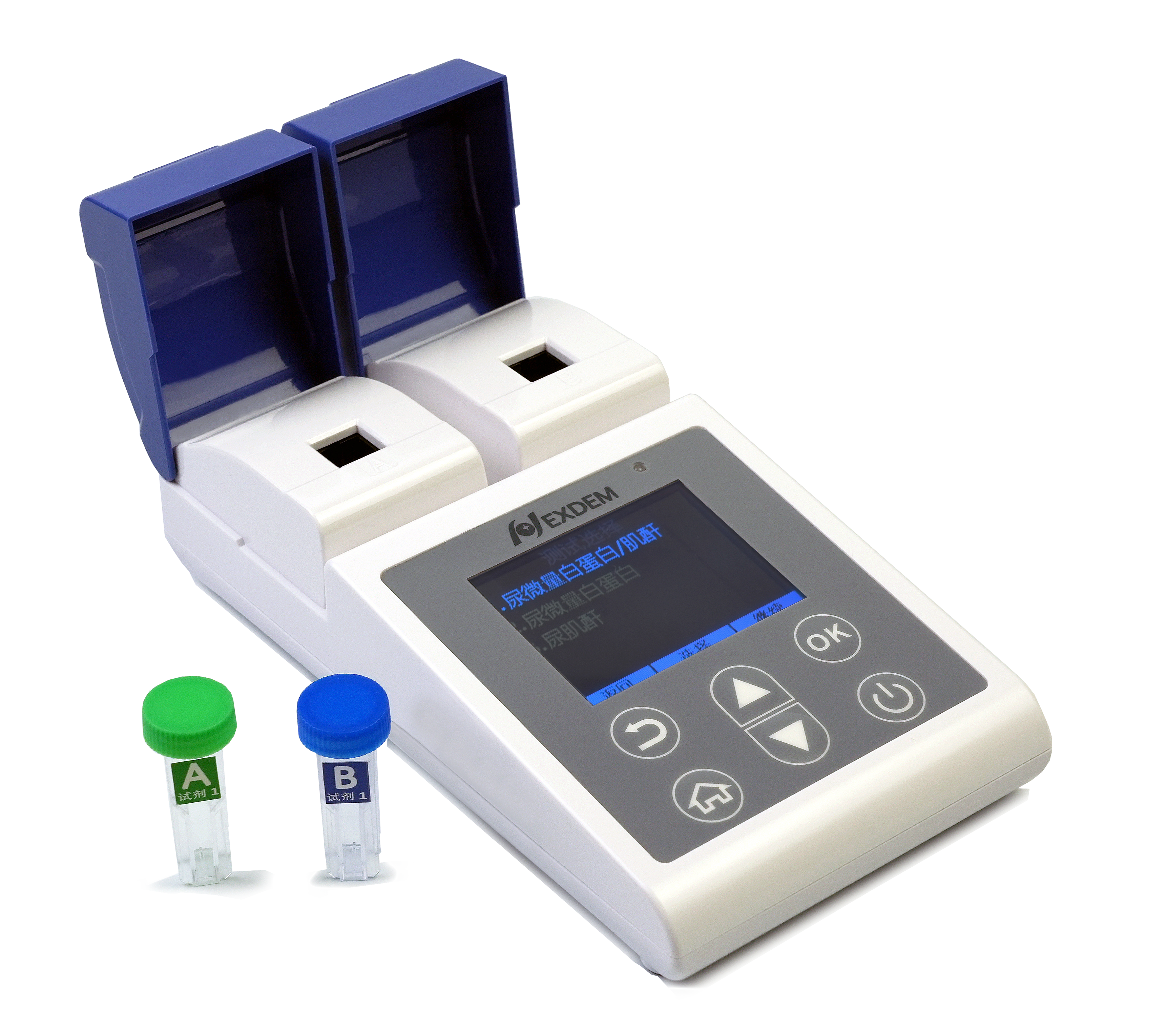
More importantly, according to Li Yaqi, the quantitative test results provided by the Haishidan UACR analyzer show good correlation with those from hospital biochemical analyzers. This means that the Haishidan UACR analyzer can facilitate two-way referrals between primary healthcare institutions and higher-level hospitals.
Moreover, the Haishidan UACR analyzer is compact, roughly the size of a book, making it highly suitable for various screening scenarios in primary healthcare settings, such as on-site screenings and home-based testing services. Furthermore, this analyzer is not only easy to operate with a low learning curve but can also be equipped with mobile data transmission capabilities to upload test results to a data center, facilitating effective health management.
In short, digital spectrophotometry is the foundation underlying the launch of the Haishidan UACR analyzer, and it has also made possible the emergence of compact, specialized, and cost-controllable biochemical quantitative analysis platforms.
However, in its communications with Haishidan, VCBeat noted that Haishidan had already obtained a U.S. invention patent for digital spectrophotometry technology in 2007 and a Chinese invention patent for the same technology in 2009. Yet, its UACR analyzer did not receive Class II medical device registration until 2022. Moreover, before the official launch of its UACR analyzer for medical applications, the company first introduced a water quality analyzer to the market, which has remained its primary revenue driver to date.
Li Yaqi also provided a detailed explanation in the interview: “In fact, from the very beginning, our target application area has been healthcare. However, during the process of industrialization, we encountered certain technical challenges. Therefore, to ensure the normal operation of the company, we decided to first launch our product pipeline for water quality testing.”
As a result, the water quality analyzer entered the commercialization phase in 2013, three years after the establishment of Okdan Biotechnology Co., Ltd. Subsequently, after another four years of effort, Haishidan finally overcame the industrialization challenges associated with applying digital spectrophotometry to UACR testing, and its UACR analyzer obtained Class II medical device registration certification in 2022.
“It’s interesting that when we first sought to apply digital spectrophotometry in the healthcare sector, we estimated it would take two to three years to achieve industrialization, but it ultimately took ten years. Fortunately, we eventually overcame the challenges of commercializing digital spectrophotometry for medical applications and will continue to iterate on subsequent products,” said Li Yaqi with a smile.
Haishidan’s ability to overcome these industrialization challenges is naturally attributable to the profound industry expertise of its core team. Founder Li Yaqi holds a Ph.D. in Space Physics from the University of Washington and completed his postdoctoral research at Los Alamos National Laboratory, bringing over 20 years of experience in R&D and project management for spectral measurement technologies. Lin Zhihao, Head of Diagnostic Instrument Development, and Yao Yue, Head of Biochemical Detection Technology Development, both hold Ph.D.s in Chemistry from the University of Washington. The former has more than two decades of experience in R&D and project management for automated analysis and real-time monitoring methods, while the latter possesses over 20 years of expertise in biotechnology research, product development, and project management.
As Li Yaqi stated, under the leadership of the core team members, Haishidan is also developing a mobile version of the biochemical analyzer based on the 2022 UACR detector.
VCBeat has learned that the mobile version of the biochemical analyzer will retain the current 8-wavelength optical testing module of the UACR detector, with its control, display, calculation, and data storage functions all completed on the mobile end.
The idea to develop a mobile version of the biochemical analyzer stemmed from a core belief held by Haishidan: since UACR test results are influenced by numerous factors—such as infection, fever, significant hyperglycemia, significant hypertension, physical activity within 24 hours, heart failure, and menstruation—the trend revealed by multiple periodic tests can more accurately reflect the true renal health status of patients with diabetes. Consequently, there is a market need for a UACR testing device suitable for home use. In response, Haishidan launched its mobile (home-use) UACR analyzer.
From Haishidan’s deployment of the mobile (home-use) UACR analyzer, it is evident that the company’s target market extends far beyond in-house testing at primary healthcare institutions. This was confirmed by Li Yaqi in an interview. He revealed that Haishidan is actively seeking partnerships with health management companies for both its 2022-version UACR analyzer, which has already achieved mass production, and the mobile-version UACR analyzer currently under development. The company welcomes inquiries from businesses interested in collaboration.
“In fact, in China, the implementation of diabetic nephropathy screening still has a long way to go, facing numerous obstacles such as limitations in primary healthcare institutions and low awareness among patients with diabetes. However, the clinical and social value of diabetic nephropathy screening is gradually being recognized. In the future, as public health awareness improves, the market potential for UACR testing will undoubtedly expand. We are committed to collaborating with all stakeholders in the industry to promote the widespread adoption of diabetic nephropathy screening,” said Li Yaqi.